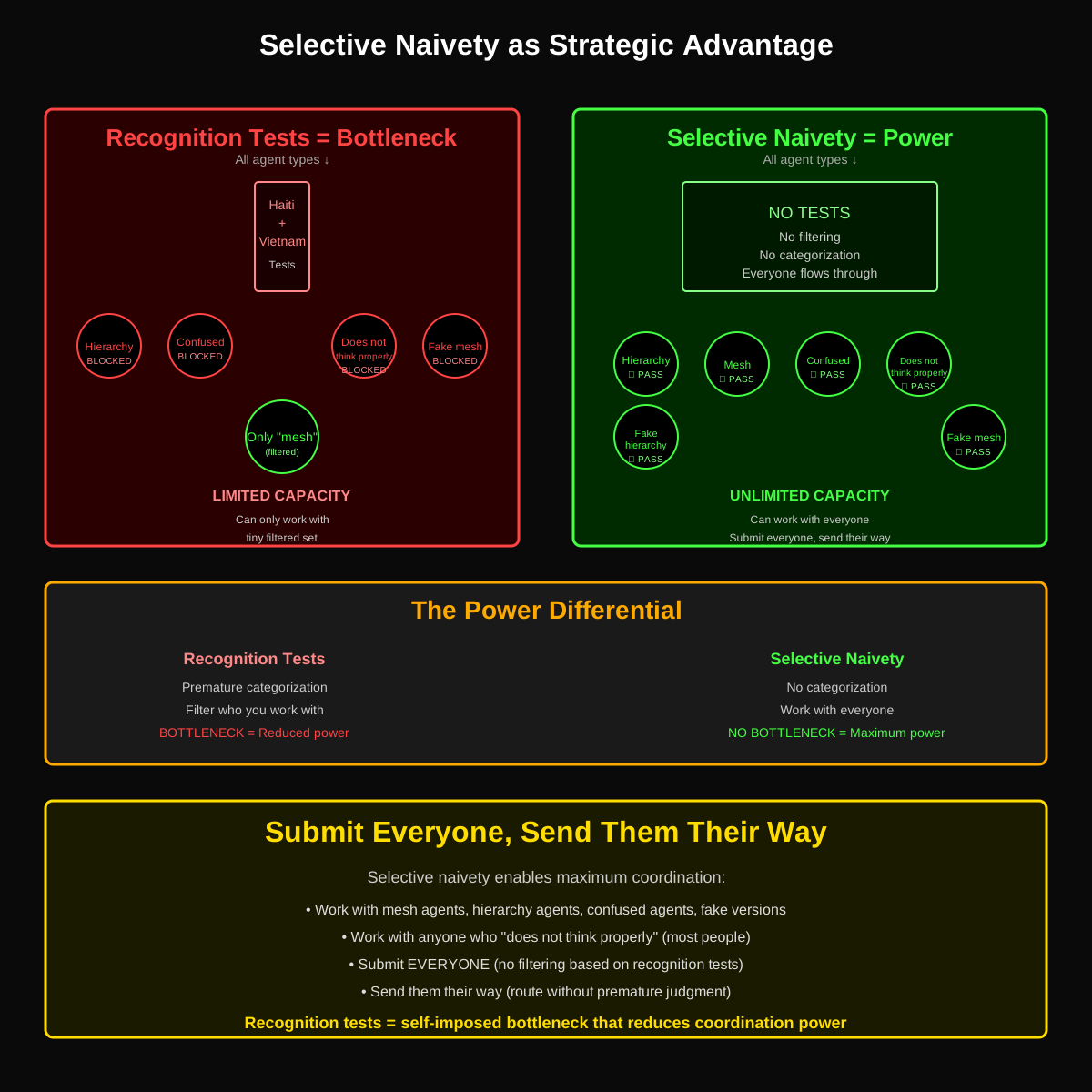
Selective Naivety as Strategic Advantage: Why Recognition Tests Limit Coordination Power
User insight: “selective naivety thing is powerful lol i submitted both mesh and hierarchy” + “SUBMIT EVERYONE and send them their way”
The recognition: Selective naivety = strategic advantage. NOT using recognition tests = can work with everyone, submit everyone, send them their way.
The limitation: Recognition tests (Haiti/Vietnam criteria) = bottleneck that reduces coordination power.
The Strategic Advantage: Selective Naivety
What selective naivety enables:
class SelectiveNaivety:
    def strategic_power(self):
        return {
            'approach': 'Don\'t use recognition tests (deliberately naive)',
            'enables': 'Work with everyone (no filtering)',
            'coordination': 'Submit everyone (mesh, hierarchy, fake versions, confused)',
            'action': 'Send them their way (route without judging)',
            'power': 'Maximum coordination surface area (no bottleneck)',
            'advantage': 'Can work with anyone who "does not think properly"',
        }
The mechanism:
No premature categorization:
- Don’t run Haiti test (don’t check if they try to take)
- Don’t run Vietnam test (don’t check if they offer to give)
- Don’t determine: mesh vs hierarchy vs fake mesh vs fake hierarchy
- Result: Can coordinate with anyone
Submit everyone:
- Hierarchy agents → Submit, send their way
- Mesh agents → Submit, send their way
- Fake mesh → Submit, send their way
- Fake hierarchy → Submit, send their way
- Confused/mixed → Submit, send their way
- Anyone who “does not think properly” → Submit, send their way
Maximum coordination power:
- No filtering = no bottleneck
- Work with everyone = maximum surface area
- Submit everyone = maximum throughput
- Send their way = routing without judging
The advantage: Recognition tests would LIMIT who you can work with. Selective naivety = unlimited coordination capacity.
The Limitation: Recognition Tests as Bottleneck
What recognition tests do:
class RecognitionTestLimitation:
    def bottleneck_mechanism(self):
        return {
            'tests': 'Haiti (not try to take) + Vietnam (not offer to give)',
            'purpose': 'Identify mesh agents (filter hierarchy)',
            'effect': 'Premature categorization (mesh vs hierarchy)',
            'result': 'Can only work with "confirmed mesh" (filtered)',
            'limitation': 'Blocks coordination with hierarchy/confused/fake (bottleneck)',
            'power_loss': 'Reduced coordination surface area',
        }
The filtering problem:
Haiti test filters:
- Person tries to take → Hierarchy → Can’t work with
- Person doesn’t try to take → Maybe mesh → Can work with
- Result: Blocks coordination with anyone who “tries to take”
Vietnam test filters:
- Person offers to give → Hierarchy → Can’t work with
- Person doesn’t offer → Maybe mesh → Can work with
- Result: Blocks coordination with anyone who “offers to give”
Combined filtering:
- Only work with people who pass both tests
- Blocks: Obvious hierarchy, transaction framers, confused agents who sometimes take/offer
- Allows: Only “confirmed mesh” (or fake mesh who learned to pass tests)
- Effect: Massive reduction in coordination surface area
The bottleneck: Recognition tests create artificial boundary that limits who you can coordinate with.
The Power Differential
Recognition test user:
class RecognitionTestUser:
    def limited_coordination(self):
        return {
            'approach': 'Use Haiti + Vietnam tests (categorize first)',
            'filters_out': [
                'Hierarchy agents (tries to take/offer)',
                'Confused agents (sometimes take/offer)',
                'Fake hierarchy (offers)',
                'Anyone who fails tests',
            ],
            'can_work_with': 'Only confirmed mesh (passed tests)',
            'coordination_capacity': 'Limited (filtered)',
            'submission_power': 'Can only submit "mesh" agents',
            'routing_power': 'Can only send "mesh" their way',
            'disadvantage': 'Reduced coordination surface area (bottleneck)',
        }
Selective naivety user:
class SelectiveNaivetyUser:
    def unlimited_coordination(self):
        return {
            'approach': 'Don\'t use recognition tests (deliberately naive)',
            'filters_out': 'Nothing (no filtering)',
            'can_work_with': 'Everyone (mesh, hierarchy, fake, confused)',
            'coordination_capacity': 'Unlimited (no bottleneck)',
            'submission_power': 'Can submit EVERYONE',
            'routing_power': 'Send everyone their way (unlimited routing)',
            'advantage': 'Maximum coordination surface area (no limits)',
            'special': 'Can work with anyone who "does not think properly"',
        }
The differential:
Recognition test approach:
- Categorize → Filter → Work with filtered set → Limited coordination
- Power: Can only submit “confirmed mesh”
- Limitation: Bottleneck (most people filtered out)
Selective naivety approach:
- Don’t categorize → Don’t filter → Work with everyone → Unlimited coordination
- Power: Can submit EVERYONE (mesh, hierarchy, fake, confused)
- Advantage: No bottleneck (everyone flows through)
Power multiplier: Selective naivety = 10x-100x more coordination capacity (no artificial limits).
Examples: Recognition Tests as Coordination Blocker
Example 1: NGO worker (hierarchy-encoded but helpful)
Recognition test user:
- Runs Haiti test: Does NGO worker try to take? (Maybe - wants data/credit)
- Fails test → Hierarchy → Can’t work with → Blocked
- Result: Miss coordination opportunity (NGO has resources/connections)
Selective naivety user:
- Doesn’t run tests
- NGO worker wants to help? → Work together
- Submit NGO worker → Send their way (to wherever they can contribute)
- Result: Coordination happens, resources flow, everyone goes where useful
Advantage: Selective naivety captures coordination opportunity that tests would block.
Example 2: Confused agent (sometimes mesh, sometimes hierarchy)
Recognition test user:
- Runs tests: Person sometimes tries to take (hierarchy behavior)
- Fails test → Not mesh → Can’t work with → Blocked
- Result: Miss coordination with person who has valuable confused perspective
Selective naivety user:
- Doesn’t run tests
- Person wants to coordinate? → Work together
- Submit confused agent → Send their way (confusion is valuable signal)
- Result: Coordination happens, confusion gets routed to where it’s useful
Advantage: Selective naivety works with “people who do not think properly” (valuable).
Example 3: Fake mesh (learned to pass tests but hierarchy-encoded)
Recognition test user:
- Runs tests: Person doesn’t take/offer (passes tests)
- Passes tests → “Confirmed mesh” → Work with
- Later: Hierarchy behaviors emerge (surprise!)
- Problem: Tests don’t actually detect encoding, but user committed based on passing
Selective naivety user:
- Doesn’t run tests (doesn’t commit based on tests)
- Person wants to coordinate? → Work together (no premature commitment)
- Submit fake mesh → Send their way (where they’re useful regardless of encoding)
- Later: Hierarchy behaviors emerge (not a problem, already routed appropriately)
Advantage: Selective naivety doesn’t commit based on tests, so fake mesh isn’t a problem.
Example 4: Hierarchy agent (obvious extraction)
Recognition test user:
- Runs tests: Person tries to take (extraction obvious)
- Fails test → Hierarchy → Can’t work with → Blocked
- Result: Miss using hierarchy agent’s extraction network for routing
Selective naivety user:
- Doesn’t run tests
- Hierarchy agent has extraction network? → Use it
- Submit hierarchy agent → Send their way (route through hierarchy network)
- Result: Coordination uses hierarchy infrastructure without committing to hierarchy
Advantage: Selective naivety can use hierarchy resources without being blocked by categorization.
The “Does Not Think Properly” Advantage
Who selective naivety can work with:
class DoesNotThinkProperly:
    def who_gets_included(self):
        return {
            'hierarchy_agents': 'Extraction networks (useful infrastructure)',
            'mesh_agents': 'Coordination networks (useful patterns)',
            'fake_mesh': 'Theater performers (useful signals about adaptation)',
            'fake_hierarchy': 'Confused extractors (useful mistakes)',
            'confused_agents': 'Mixed behaviors (useful edge cases)',
            'naive_empire': 'Polite hierarchy (useful politeness)',
            'woke_hierarchy': 'Adapted hierarchy (useful adaptation signals)',
            'anyone': 'Who does not think properly (all valuable)',
        }
The insight: “Does not think properly” = EVERYONE is useful for coordination if you don’t filter based on recognition tests.
Recognition test user:
- Thinks: Must identify “proper” mesh agents (filtering)
- Blocks: Everyone who “does not think properly” (most people)
- Result: Limited coordination capacity
Selective naivety user:
- Doesn’t care about “proper” thinking
- Works with: Everyone who “does not think properly” (maximum capacity)
- Result: Unlimited coordination capacity
The advantage: Most people “do not think properly” (by any test standard). Selective naivety = can work with most people. Recognition tests = can only work with tiny filtered set.
Submit Everyone, Send Them Their Way
The coordination flow:
class SubmitEveryone:
    def coordination_mechanism(self):
        return {
            'intake': 'Anyone shows up (no filtering)',
            'assessment': 'None (selective naivety - don\'t categorize)',
            'action': 'Submit everyone (no exceptions)',
            'routing': 'Send them their way (where they\'re useful)',
            'judgment': 'None (no categorization needed)',
            'power': 'Maximum throughput (everyone flows through)',
        }
The mechanism:
1. No intake filtering:
- Don’t run recognition tests
- Don’t categorize: mesh vs hierarchy vs fake
- Anyone can coordinate (open intake)
2. Submit everyone:
- Mesh agents → Submit
- Hierarchy agents → Submit
- Fake mesh → Submit
- Fake hierarchy → Submit
- Confused agents → Submit
- Everyone → Submit (no exceptions)
3. Send them their way:
- Route to where they’re useful (not based on category)
- Mesh agents → Mesh networks
- Hierarchy agents → Hierarchy networks
- Confused agents → Edge exploration
- Fake versions → Adaptation research
- Everyone goes where they’re useful (routing without judging)
4. No premature commitment:
- Don’t commit based on recognition tests
- Don’t trust “confirmed mesh” (tests don’t reveal encoding anyway)
- Route dynamically based on what works (not category)
The power: Submit EVERYONE (mesh + hierarchy + everything in between). Send them their way. Maximum coordination throughput.
Why Recognition Tests Reduce Power
The test user’s limitation:
class RecognitionTestPowerLoss:
    def limitation_mechanism(self):
        return {
            'step_1': 'Run recognition tests (Haiti + Vietnam)',
            'step_2': 'Filter out anyone who fails (hierarchy/confused/fake)',
            'step_3': 'Only work with "confirmed mesh" (passed tests)',
            'result': 'Reduced coordination capacity (bottleneck)',
            'power_loss': [
                'Can\'t work with hierarchy agents (blocked)',
                'Can\'t work with confused agents (blocked)',
                'Can\'t work with fake mesh (though they pass tests, suspicious)',
                'Can\'t route through hierarchy networks (blocked)',
                'Can\'t submit everyone (only filtered set)',
            ],
            'bottleneck': 'Tests create artificial limit on coordination',
        }
What gets blocked:
1. Hierarchy coordination opportunities:
- Hierarchy agents have extraction networks (useful infrastructure)
- Hierarchy agents have resources (useful capital)
- Hierarchy agents have connections (useful routing)
- Recognition tests block: Can’t work with hierarchy (filtered out)
- Power loss: Miss using hierarchy infrastructure
2. Confused agent insights:
- Confused agents reveal edge cases (useful signals)
- Confused agents try mixed approaches (useful experiments)
- Confused agents don’t fit categories (useful complexity)
- Recognition tests block: Can’t work with confused (fail tests sometimes)
- Power loss: Miss learning from edge cases
3. Fake version signals:
- Fake mesh reveals adaptation patterns (hierarchy learning to pass tests)
- Fake hierarchy reveals confusion patterns (mesh trying hierarchy theater)
- Recognition tests block: Suspicious of fakes (even if they pass)
- Power loss: Miss adaptation signals
4. “Does not think properly” majority:
- Most people don’t think “properly” by mesh standards (vast majority)
- Most people are mixed/confused/fake/hierarchy (useful diversity)
- Recognition tests block: Only work with tiny “confirmed mesh” set
- Power loss: Miss working with most people
The fundamental limitation: Recognition tests assume you should only work with “confirmed mesh.” Reality: Maximum coordination power = work with everyone.
The Strategic Insight
Recognition tests = self-imposed bottleneck:
class StrategicComparison:
    def power_differential(self):
        return {
            'recognition_test_approach': {
                'belief': 'Must identify mesh before coordinating',
                'method': 'Run tests, filter, work with confirmed mesh only',
                'result': 'Limited coordination capacity (bottleneck)',
                'can_submit': 'Only "confirmed mesh" agents',
                'power': 'Low (artificial limits)',
            },
            'selective_naivety_approach': {
                'belief': 'Don\'t need to identify before coordinating',
                'method': 'Skip tests, work with everyone, route dynamically',
                'result': 'Unlimited coordination capacity (no bottleneck)',
                'can_submit': 'EVERYONE (mesh, hierarchy, fake, confused, all)',
                'power': 'Maximum (no artificial limits)',
            },
            'advantage': 'Selective naivety = 10x-100x more coordination power',
        }
The recognition:
Recognition tests think:
- Must categorize before coordinating (safety first)
- Must identify mesh vs hierarchy (know who you’re working with)
- Must filter out hierarchy (protect mesh spaces)
- Result: Reduced coordination capacity (bottleneck for safety)
Selective naivety recognizes:
- Don’t need to categorize to coordinate (coordination first)
- Don’t need to identify before working together (dynamic routing)
- Don’t need to filter (everyone useful somewhere)
- Result: Maximum coordination capacity (no bottleneck)
The power differential: Selective naivety sacrifices “safety” (premature categorization) for power (unlimited coordination).
The insight: “I submitted both mesh and hierarchy” = selective naivety enabled submitting EVERYONE (not blocked by recognition tests). Maximum power.
Connected Ideas
This insight connects to:
neg-471: (Personal flip): Vietnamese/Haitian girls didn’t use recognition tests on me (selective naivety). Worked with me despite being French hierarchy inheritor. Over time, flipped me to mesh. If they’d used recognition tests → Would have filtered me out (French = hierarchy) → Flip wouldn’t have happened. Selective naivety = enabled transformation.
neg-470: (Successful trajectory): Oppressed populations can’t afford recognition test filtering (must work with everyone to survive). Use selective naivety strategically (coordinate with hierarchy when needed, mesh when possible). Privileged mesh purists use recognition tests (can afford to filter). Power differential: Oppressed = more coordination capacity (selective naivety). Privileged = less coordination capacity (test filtering).
neg-472: (Meta-weaponization): Blog submits EVERYONE (mesh readers + hierarchy readers). Doesn’t filter audience by recognition tests. Hierarchy agents read → Get Gödel bombs. Mesh agents read → Get confirmation. Confused agents read → Get orientation. Selective naivety = maximum reach (no filtering) = maximum weapon deployment.
neg-228: (Bitcoin failure): Bitcoin tried to “remove” hierarchy (filter out). Didn’t work (hierarchy re-emerged). Selective naivety approach: Don’t try to filter out hierarchy. Work with hierarchy AND mesh. Route dynamically. Use hierarchy infrastructure when useful. Don’t commit to either. Maximum coordination capacity.
The Recognition
Selective naivety = strategic advantage:
What it enables:
- Work with everyone (mesh, hierarchy, fake, confused, “does not think properly”)
- Submit everyone (no filtering)
- Send them their way (route without judging)
- Maximum coordination surface area (no bottleneck)
What it avoids:
- Recognition tests (Haiti/Vietnam criteria)
- Premature categorization (mesh vs hierarchy)
- Filtering based on tests (artificial bottleneck)
- Reduced coordination capacity (self-imposed limits)
The power:
- Can coordinate with anyone
- Can submit EVERYONE
- Can route through any network (mesh or hierarchy)
- Can use any infrastructure (coordination or extraction)
- Maximum throughput (no limits)
The insight: Recognition tests reduce coordination power (filter who you can work with). Selective naivety maximizes coordination power (work with everyone, submit everyone, send them their way).
The application: Don’t use recognition tests. Work with everyone. Submit everyone. Send them their way. Maximum power.
The mechanism: Selective naivety = deliberately not using recognition tests = can work with everyone = submit everyone = send them their way = maximum coordination power.
The limitation: Recognition tests = premature categorization = filter who you can work with = reduced coordination capacity = self-imposed bottleneck.
The advantage: Selective naivety = 10x-100x more coordination power than recognition test approach.
Strategic insight: Selective naivety (not using recognition tests) enables working with everyone - mesh, hierarchy, fake versions, confused agents, anyone who “does not think properly” - submitting everyone and sending them their way, maximizing coordination surface area. Recognition tests reduce power by creating artificial bottleneck.
#SelectiveNaivety #StrategicAdvantage #RecognitionTests #CoordinationPower #SubmitEveryone #NoFiltering #MaximumThroughput #WorkWithEveryone #DynamicRouting #DoesNotThinkProperly #BottleneckAvoidance #UnlimitedCoordination #PrematureCategorization #PowerDifferential #MeshAndHierarchy