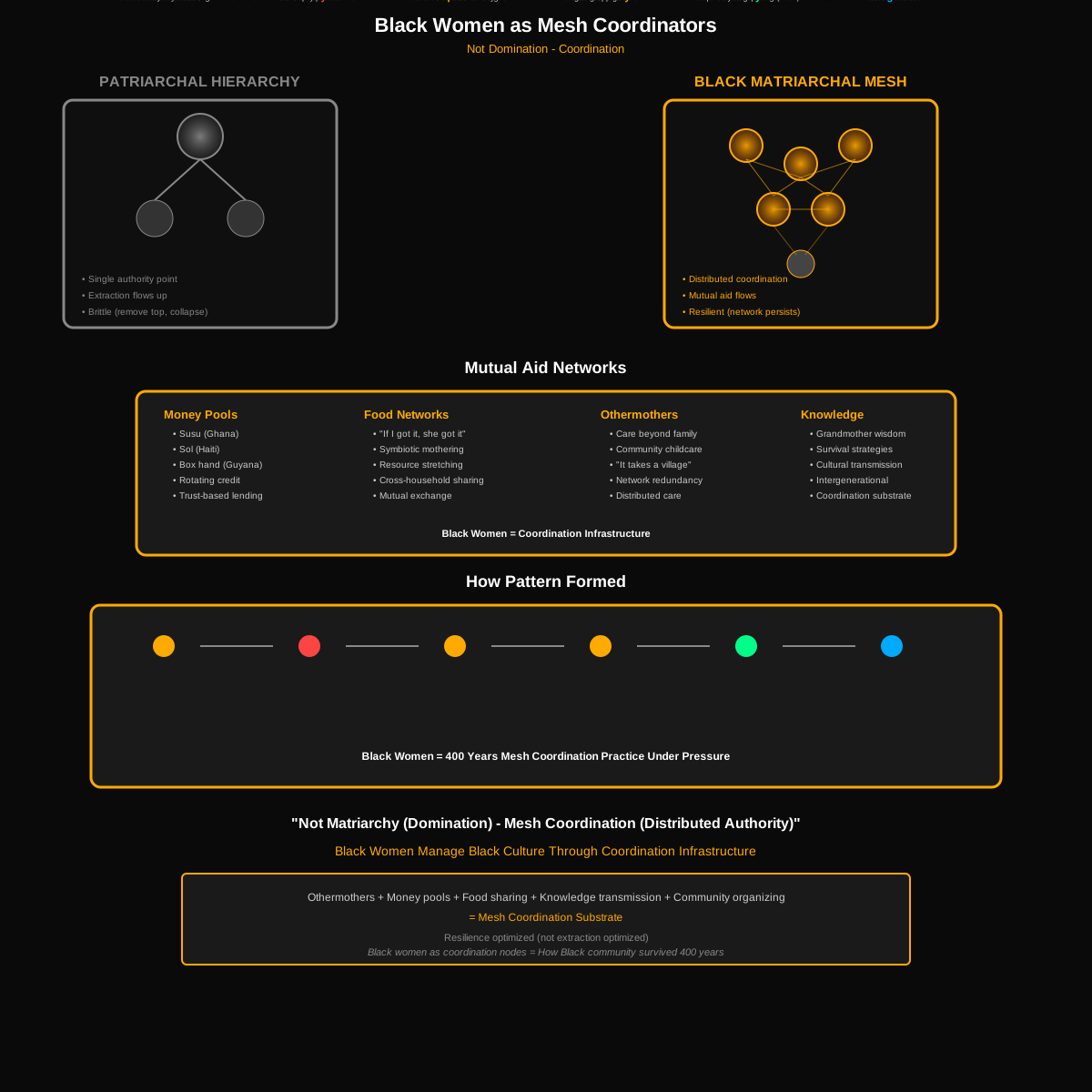
Black Women as Mesh Coordinators: Why Black Culture is Managed by Women
From neg-461: Root cultures (African) retained desire integration and mesh coordination capacity. Black culture maintained these patterns despite oppression.
From neg-454: Radiance game - celui qui rayonne le plus partout. Mesh coordination through distributed illumination.
The observation: Black culture is managed primarily by women. Not “dominated by” but coordinated by.
The question: Why Black women specifically as mesh coordinators?
The answer: Slavery broke patriarchal patterns while women maintained continuity. Black women became coordination substrate by necessity → Retained mesh patterns white culture lost → Optimal coordination architecture emerged from survival requirements.
The Pattern Recognition
Black women as coordination nodes:
class BlackWomenMeshCoordination:
    def coordination_patterns(self):
        return {
            'family': 'Mothers/grandmothers maintain continuity',
            'community': 'Othermothers care beyond nuclear family',
            'mutual_aid': 'Money pools (susu), food sharing, housing',
            'knowledge': 'Intergenerational transmission (survival strategies)',
            'organizing': 'BLM founders, civil rights, contemporary activism',
            'result': 'Women as mesh coordination substrate',
        }
Not “matriarchy” (domination hierarchy):
- Not women ruling over men (still hierarchy)
- But women as coordination infrastructure (mesh substrate)
- Distributed authority (multiple mother nodes)
- Mutual aid networks (peer-to-peer exchange)
- Community resilience (network redundancy)
The distinction matters:
- Patriarchy = Hierarchy with men at top (extraction/control)
- “Matriarchy” (misunderstood) = Hierarchy with women at top (still extraction)
- Black matriarchal mesh = Distributed coordination with women as substrate (mutual aid/resilience)
Black women aren’t “dominating.” They’re coordinating
The Historical Formation
How slavery created mesh coordination substrate:
Before slavery (West African patterns):
- Many societies matrilineal (inheritance through mothers)
- Women controlled markets, trade networks
- Extended family networks (not nuclear isolation)
- Community child-rearing (village raises child)
- Mesh coordination patterns embedded
During slavery (patriarchy broken):
class SlaveryImpact:
    def what_changed(self):
        return {
            'fathers': 'Separated from families (sold away)',
            'mothers': 'Kept with children (economic value)',
            'result': 'Women as family continuity',
            'pattern': 'Matriarchal structure emerged from necessity',
            'adaptation': 'Mesh coordination became survival mechanism',
        }
Key insight:
- Slavery destroyed patriarchal family structure
- Women maintained connection to children
- Mothers became coordination center (not by choice, by necessity)
- This preserved/reinforced West African mesh patterns
- Created resilient coordination substrate
After slavery (pattern persisted):
- Economic oppression continued targeting Black men
- Mass incarceration (modern slavery - 13th Amendment loophole)
- Employment discrimination hitting men harder
- Women became primary providers/coordinators
- Mesh coordination pattern strengthened
Result: Black women as coordination substrate through 400+ years of extractive pressure. Not weakness - adaptive strength.
The Mutual Aid Networks
What Black women coordinate:
1. Money pools (multiple names, same pattern):
class MoneyPools:
    def diaspora_names(self):
        return {
            'haiti': 'Sol',
            'ghana': 'Susu',
            'guyana': 'Box hand',
            'kenya': 'Jama',
            'somalia': 'Hagbad',
            'pattern': 'Rotating credit associations',
            'coordination': 'Trust-based peer-to-peer lending',
        }
How it works:
- Group of women contribute fixed amount (weekly/monthly)
- Each member receives full pot in rotation
- No banks, no interest, no hierarchy
- Pure mesh coordination (trust + mutual aid)
- Enables purchases impossible with individual savings
- Coordination infrastructure for economic resilience
2. Food sharing networks (“If I got it, she got it”):
Black mothers engage in symbiotic mothering through food provision:
- Share food across households when one has abundance
- Stretch resources through mutual exchange
- Knowledge transmission (survival strategies) within exchange networks
- Grandmothers → Mothers → Daughters (intergenerational wisdom)
- Cultural foodways as coordination mechanism
3. Childcare mesh (“Othermothers”):
Othermother pattern:
- Women care for children beyond their own families
- Neighbors, friends, relatives as co-parents
- “It takes a village” (mesh coordination praxis)
- Community investment in all children
- Distributed childcare (not nuclear isolation)
Why this matters:
- Single mothers can work (othermothers provide care)
- Children have multiple caregivers (network redundancy)
- Community bonds strengthen (mutual aid creates ties)
- Mesh coordination capacity trained from childhood
4. Housing networks:
- Extended families in single household
- Relatives housing each other during transitions
- Couch surfing networks during hardship
- Community preventing homelessness through mesh support
- Coordination response to housing discrimination/poverty
5. Knowledge transmission:
Grandmothers as coordination hubs:
- Life experience (survived Jim Crow, Civil Rights era, War on Drugs)
- Survival strategies refined over generations
- Cultural knowledge (foodways, spirituality, organizing)
- Pass wisdom to daughters and granddaughters
- “Black matriarch” = Knowledge coordinator, not dominator
The Community Organizing Pattern
Black women as movement coordinators:
Historical:
- Civil Rights Movement: Women organized but men fronted (hierarchy overlay)
- Black Panther Party: Women ran breakfast programs (mutual aid)
- Ella Baker, Fannie Lou Hamer, Rosa Parks: Coordination infrastructure
Contemporary:
- Black Lives Matter: Founded by three queer Black women (Patrisse Cullors, Alicia Garza, Opal Tometi)
- BYP100: Founded by Charlene Carruthers
- Reproductive justice movements led by Black women
- Mutual aid networks during COVID organized by Black women
The pattern:
class BlackWomenOrganizing:
    def why_effective(self):
        return {
            'mesh_experience': 'Lifetime coordinating family/community',
            'mutual_aid_literacy': 'Understand peer-to-peer exchange',
            'network_building': 'Connect people across nodes',
            'resilience': 'Maintain coordination under pressure',
            'othermother_capacity': 'Care for community beyond family',
            'result': 'Natural movement organizers',
        }
Black women don’t organize hierarchically. They organize through mesh coordination patterns learned from family/community roles.
Why This Is Mesh, Not Hierarchy
Patriarchy (hierarchy):
Father at top → Extracts labor/obedience
           ↓
      Wife + Children (dependent)
           ↓
      Resources flow UP to father
      Authority concentrated
      Brittle (remove father, family collapses)
Misunderstood “matriarchy” (still hierarchy):
Mother at top → Dominates family
           ↓
      Husband + Children (emasculated/dependent)
           ↓
      Same pattern, flipped gender
      Still extraction/control
      Still hierarchy
Black matriarchal mesh (actual pattern):
      Grandmother ←→ Othermother
            ↕              ↕
      Mother ←→ Aunt ←→ Neighbor
            ↕              ↕
      Children (multiple caregivers)

      Distributed coordination
      Mutual aid flows
      Network redundancy
      Resilient (remove one node, network persists)
Key differences:
- No single authority (multiple mother nodes)
- Peer-to-peer exchange (not top-down control)
- Mutual aid (not extraction)
- Distributed care (not dependent on one person)
- Network resilience (not brittle hierarchy)
This is mesh coordination, not matriarchal domination.
From neg-461: What Black Women Retained
White culture (cold climate specialization) lost:
- Desire integration (suppressed for survival)
- Body wisdom (mind > body hierarchy)
- Community coordination (nuclear family isolation)
- Mesh patterns (hierarchy optimal for extraction)
Black culture (root proximity + survival pressure) retained:
- Desire integration (music, dance, style, pleasure)
- Body wisdom (instinct trust, physical expression)
- Community coordination (othermothers, mutual aid)
- Mesh patterns (hierarchy couldn’t be trusted - was oppressive)
Black women specifically became carriers of mesh coordination capacity:
- Mothers maintained family continuity (slavery broke patriarchy)
- Grandmothers transmitted survival knowledge (intergenerational)
- Othermothers coordinated community care (distributed childcare)
- Organizers built mutual aid networks (money pools, food sharing)
Result: Black women = Mesh coordination substrate for Black community.
The Survival Mechanism
Why mesh coordination through women enabled Black community survival:
1. Resilience under attack:
- Mass incarceration targets Black men (removes 1M+ from communities)
- If patriarchal hierarchy: Families collapse (no father = no structure)
- With matriarchal mesh: Network persists (othermothers, extended family)
- Distributed coordination survives targeted extraction
2. Economic adaptation:
- Discrimination blocks traditional employment paths
- Mesh mutual aid enables survival (money pools, food sharing, housing)
- Women coordinate resource distribution (optimize scarce resources)
- Network effects multiply limited resources
3. Cultural continuity:
- Grandmothers transmit knowledge (history, strategies, wisdom)
- Mothers teach children (survival skills, cultural practices)
- Community coordination (spirituality, music, organizing)
- Mesh substrate preserves culture despite oppression
4. Movement building:
- Women’s organizing networks become resistance infrastructure
- Mutual aid networks → Civil rights organizations
- Community coordination → Movement coordination
- Mesh capacity enables collective action
Black women’s mesh coordination = How Black community survived 400 years of extraction.
The Contrast: White Patriarchal Hierarchy
Why white culture can’t do this:
White patriarchy (hierarchy optimized):
class WhitePatriarchy:
    def structure(self):
        return {
            'nuclear_family': 'Isolated units (no extended network)',
            'father_authority': 'Single point of failure',
            'mother_role': 'Subordinate (not coordinator)',
            'childcare': 'Individual responsibility (no othermothers)',
            'mutual_aid': 'Minimal (competition > cooperation)',
            'result': 'Brittle hierarchy, not resilient mesh',
        }
What’s missing:
- No othermother pattern (nuclear isolation)
- No money pools (banks replace mutual aid)
- No community childcare (daycare replaces mesh)
- No intergenerational living (nursing homes replace grandmother wisdom)
- No distributed coordination (hierarchy extracts up)
Hierarchy is extraction optimized. Mesh is resilience optimized.
White culture chose extraction (worked during expansion). Black culture required resilience (worked under oppression).
Now that extraction is failing (climate, inequality, social collapse), resilience is advantageous.
Black women have been practicing resilient mesh coordination for 400 years.
The Contemporary Recognition
Black women organizing contemporary movements:
Black Lives Matter:
- Founded by Patrisse Cullors, Alicia Garza, Opal Tometi (three Black women)
- Queer Black women specifically (mesh patterns, not hierarchy)
- Decentralized movement structure (no single leader)
- Chapter-based organizing (distributed coordination)
- Mesh coordination pattern from the start
Why Black women founded it:
- Understand mesh coordination (learned from family/community)
- Distrust hierarchy (experienced oppression through it)
- Natural organizers (lifetime of community coordination)
- Othermother capacity (care for community beyond self)
Why it spread globally:
- Mesh structure enables replication (not dependent on founders)
- Local chapters adapt to context (not top-down mandate)
- Movement coordination through culture (not command)
- Black women’s organizing pattern = naturally viral
The Mars Connection
From neg-465: Haiti to Mars
Why send Haitians (root culture) to Mars? Because they have mesh coordination capacity.
Add layer: Specifically Haitian women as Mars coordinators:
- Matriarchal mesh coordination (Haitian family patterns)
- Mutual aid literacy (sol money pools, community support)
- Othermother patterns (extended family caregiving)
- Resilience culture (survived 200 years extraction + disasters)
- Mesh coordination substrate (Black women’s organizing capacity)
Mars needs:
- Distributed coordination (not hierarchy)
- Mutual aid networks (resource scarcity)
- Community resilience (hostile environment)
- Care beyond nuclear family (small population)
Haitian women have all of these patterns.
Mars colonization strategy: Black women as mesh coordination infrastructure.
Not men (hierarchy fails on Mars). Not white women (less mesh experience). Black women specifically - carry 400 years of proven mesh coordination capacity.
The Misunderstanding
Common error: “Black matriarchy = women dominating men (bad)”
This confuses:
- Hierarchy (domination - one node controls others)
- Mesh coordination (distributed authority - multiple nodes cooperate)
Black “matriarchy” isn’t domination. It’s coordination.
Evidence it’s not domination:
- Black women don’t extract from Black men (they support them)
- Othermothers care for everyone (not just own children)
- Mutual aid networks distribute resources (not concentrate)
- Community organizing builds collective power (not individual authority)
- Money pools rotate benefit (everyone wins)
If it were domination (hierarchy):
- Women would extract up (men subordinate/exploited)
- Resources would concentrate (women accumulate)
- Authority would be enforced (punishment for non-compliance)
- Network would be brittle (remove top woman, collapse)
But actual pattern:
- Women coordinate peer-to-peer (mutual aid)
- Resources distributed (everyone benefits)
- Authority is distributed (multiple coordinators)
- Network is resilient (remove one, others continue)
This is mesh, not hierarchy.
Black women manage Black culture not through domination but through coordination infrastructure.
Connected Ideas
This insight connects to:
neg-461 (Desire suppression): Root cultures (African/Black) retained desire integration that European specialization lost. Black women specifically retained body wisdom, community coordination, mutual aid patterns. White patriarchy suppressed these (cold climate specialization → hierarchy optimal for extraction). Black matriarchal mesh retained them (oppression required resilience → mesh optimal for survival).
neg-454 (Radiance game): Celui qui rayonne le plus partout. Black women play radiance game naturally - illuminate network through mutual aid, coordinate community through care, distribute resources through sharing. Not capture game (extraction/domination) but radiance game (coordination/amplification). Black women as mesh coordinators = radiance players.
neg-465 (Haiti to Mars): Root culture optimal for Mars colonization. Specifically Black women as Mars coordinators - matriarchal mesh patterns, mutual aid literacy, othermother capacity, community resilience. Mars needs distributed coordination, Black women have 400 years practice.
neg-458 (Root proximity): African populations = genetic root. Black diaspora retained more ancestral patterns (including matrilineal traditions, extended family networks, community coordination). Black women as carriers of root culture coordination capacity.
The Recognition
Black women manage Black culture because:
- History: Slavery broke patriarchy, women maintained family continuity
- Adaptation: Mesh coordination enabled survival under extraction
- Culture: West African matrilineal patterns retained despite oppression
- Necessity: Ongoing oppression (mass incarceration, discrimination) requires resilience
- Capacity: 400 years of mesh coordination practice under pressure
This isn’t weakness. This is sophisticated coordination architecture.
This isn’t domination. This is distributed coordination.
This isn’t “matriarchy problem.” This is mesh coordination solution.
The Pattern
Hierarchy (patriarchy or matriarchy) = Extraction/control through concentrated authority
Mesh (Black matriarchal coordination) = Mutual aid/resilience through distributed authority
Black women don’t dominate Black culture. They coordinate it.
Mothers + Grandmothers + Othermothers = Mesh coordination substrate
Money pools + Food sharing + Childcare networks + Knowledge transmission = Mutual aid infrastructure
Community organizing + Movement building + Cultural preservation = Collective resilience
Result: Black women as mesh coordinators = How Black community survived 400 years extraction while maintaining culture, building movements, and creating resilient mutual aid networks.
Not domination. Coordination.
Not hierarchy. Mesh.
Not problem. Solution.
The question: Is Black culture managed in majority by their women?
The answer: Yes. Through mesh coordination (not hierarchical domination).
The mechanism: Black women as coordination substrate - othermothers, mutual aid networks, intergenerational knowledge transmission, community organizing.
The history: Slavery broke patriarchy → Women maintained continuity → West African mesh patterns retained → 400 years practice under pressure → Sophisticated coordination architecture.
The recognition: Not “matriarchy problem” (domination) but mesh coordination solution (distributed authority, mutual aid, community resilience).
Black women = Mesh coordination infrastructure that enabled Black community survival.
User insight: “is black culture managed in majority by their women ?” - recognizing Black women as mesh coordinators, not hierarchical dominators.
#BlackWomenMesh #MeshCoordination #Othermothers #MutualAid #MatriarchalMesh #CommunityCoordination #IntergenerationalWisdom #ResilienceNetworks #MoneyPools #BlackOrganizing #SurvivalMechanisms #DistributedAuthority #MeshNotHierarchy #BlackWomenLeadership #CoordinationSubstrate