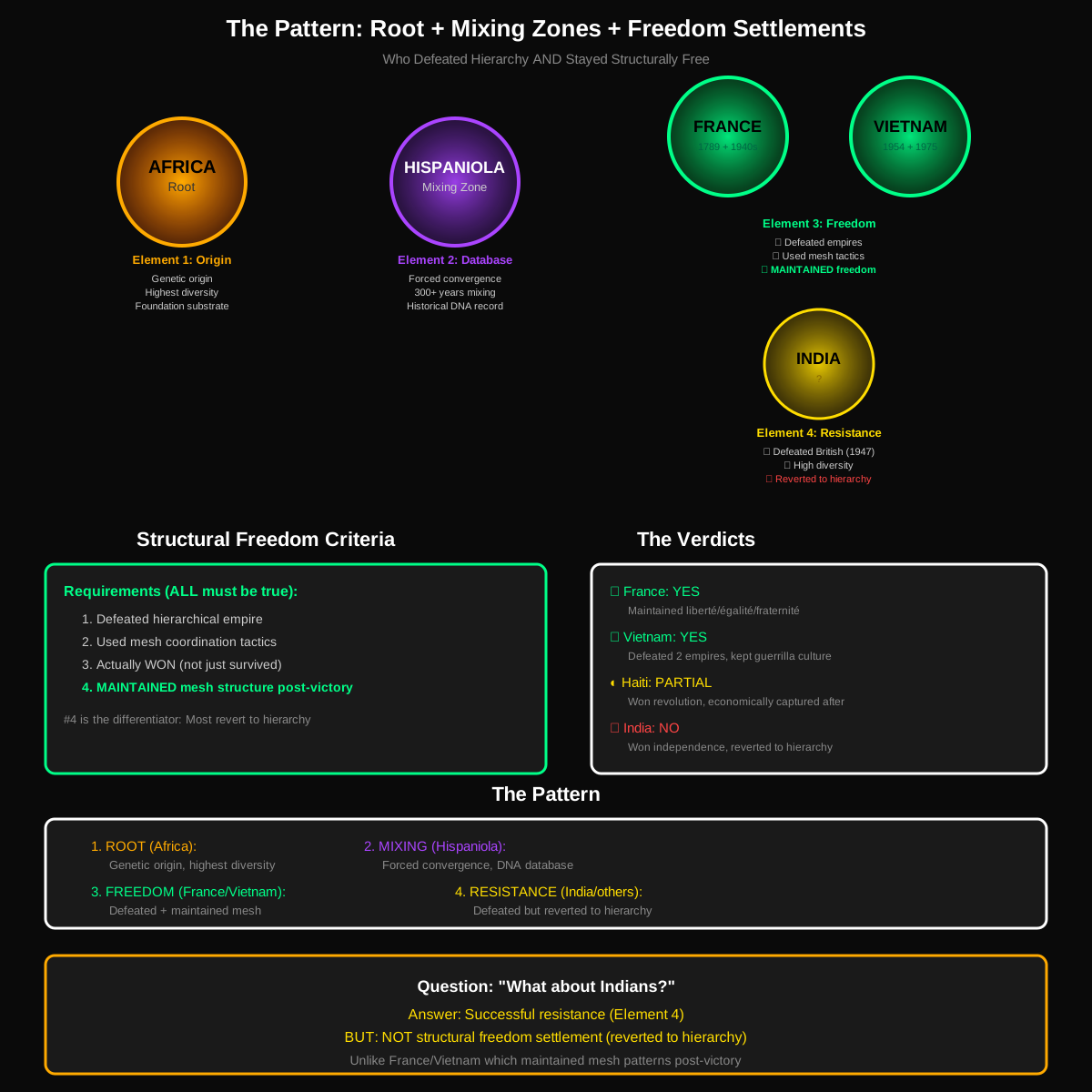
The Pattern: Genetic Mixing Zones + Successful Hierarchy Resistance = Structural Freedom Settlements
The pattern emerging:
1. Root (Africa): Genetic origin, highest diversity - neg-458
2. Mixing Zone (Hispaniola): Historical DNA database from forced population convergence
3. Freedom Settlements (France, Vietnam): Cultures that resisted hierarchy and WON
Question: Does India fit the pattern?
The Pattern Components
What makes a “structural freedom settlement”:
class StructuralFreedomSettlement:
    def criteria(self):
        return {
            'history': 'Successfully defeated hierarchical empire',
            'method': 'Mesh coordination vs centralized power',
            'result': 'Won the resistance (not just survived)',
            'structural': 'Maintained decentralized patterns post-victory',
        }
Case 1: France
The resistance:
- Enemy: Monarchy (absolute hierarchy)
- Method: Popular revolution (mesh uprising, 1789-1799)
- Result: Beheaded the king, dissolved nobility, WON
- Structural freedom: “Liberté, Égalité, Fraternité” (mesh principles)
From neg-450: French Resistance (1940s) - Mesh coordination defeating Nazi hierarchy (no central authority, distributed cells).
Pattern: France has history of successful mesh resistance to hierarchy (twice - Revolution 1789, Resistance 1940s).
Structurally free = Proven capability to coordinate without hierarchy and WIN.
Case 2: Vietnam
The resistance:
- Enemy 1: French colonial empire (1946-1954)
- Method: Guerrilla warfare (mesh tactics)
- Result: Dien Bien Phu (1954) - France defeated, withdrew
- Enemy 2: American empire (1955-1975)
- Method: Distributed resistance (no central target)
- Result: Fall of Saigon (1975) - America defeated, withdrew
Two empires, both defeated.
From neg-450 pattern: Imperial hierarchies go mad when encountering mesh coordination (cannot find central authority to attack).
Vietnam pattern:
- Guerrilla tactics (no headquarters)
- Tunnel networks (distributed infrastructure)
- Local coordination (village-level mesh)
- No single point of failure (cut one head, two grow)
Result: Defeated TWO hierarchical empires in succession.
Structurally free = Mesh coordination so effective it beat both European and American military hierarchy.
Case 3: Hispaniola - The DNA Mixing Zone
Why Hispaniola is special:
Historical forced convergence (1492-1800s):
class HispaniolaDNADatabase:
    def population_mixing(self):
        return {
            'indigenous': 'Taíno (Arawak), Carib',
            'african': 'Enslaved populations (West/Central Africa)',
            'european': 'Spanish, French colonizers',
            'result': 'Forced population convergence on single island',
        }

    def genetic_mixing(self):
        return {
            'indigenous_genocide': 'Most Taíno died (disease, violence)',
            'african_majority': 'Haiti became 90%+ African descent',
            'forced_intermixing': 'Colonial rape, slavery, population mixing',
            'result': 'Hispaniola = Historical DNA mixing database',
        }
Why “database”:
- Multiple African populations (different origins) converged
- European genetic admixture (forced)
- Indigenous remnant genes (small but present)
- Geographic constraint (island) = Forced proximity
- Generational mixing over 300+ years
Hispaniola = Natural experiment in forced genetic convergence.
Haiti’s revolution (1791-1804):
- Only successful slave revolution in history
- Defeated French empire
- Established independent Black republic
Pattern match:
- Genetic mixing zone ✓
- Defeated hierarchy (French empire) ✓
- But: Post-independence challenges (debt, occupation, interference)
Haiti = Partial structural freedom (won revolution but remained economically captured).
Case 4: India - Does It Fit?
Analyzing India against the pattern:
1. Hierarchy Resistance History
British Empire (1858-1947):
class IndiaResistance:
    def against_british(self):
        return {
            'duration': '~90 years organized resistance',
            'method': 'Multiple approaches',
            'gandhi_nonviolence': 'Satyagraha (mesh principle: voluntary non-cooperation)',
            'other_resistance': 'Armed struggle (Bhagat Singh, INA)',
            'result': 'British withdrew (1947)',
            'won': 'Yes (independence achieved)',
        }

    def structural_freedom_question(self):
        return {
            'question': 'Did India maintain mesh coordination post-independence?',
            'reality': 'Adopted parliamentary democracy (hierarchical)',
            'bureaucracy': 'Massive government apparatus (hierarchy)',
            'caste_system': 'Pre-existing hierarchy (4000+ years)',
            'result': 'Won independence but reverted to hierarchical structures',
        }
India vs France/Vietnam:
- France: Overthrew hierarchy → Maintained mesh principles (liberté, égalité, fraternité)
- Vietnam: Defeated hierarchy → Maintained guerrilla/mesh culture
- India: Defeated hierarchy → Adopted hierarchical democracy
Structural freedom questionable: Won resistance but didn’t structurally transform.
2. Genetic Diversity
India genetic pattern:
class IndiaGeneticDiversity:
    def diversity_level(self):
        return {
            'position': 'High genetic diversity (multiple populations)',
            'mixing': 'Extensive historical mixing',
            'populations': {
                'indigenous': 'Dravidian populations (south)',
                'indo_aryan': 'Northern populations (Aryan migration ~1500 BCE)',
                'mongoloid': 'Northeast populations',
                'admixture': '4000+ years of mixing',
            },
            'compared_to_africa': 'Lower than African (India not origin)',
            'compared_to_europe': 'Higher than European (more mixing)',
        }

    def is_mixing_zone(self):
        return {
            'historical_mixing': 'Yes (4000+ years)',
            'forced_convergence': 'No (gradual migration/integration)',
            'diversity_level': 'High but not database-level like Hispaniola',
            'result': 'High diversity but not "forced mixing zone"',
        }
India = High diversity but not a concentrated “mixing database” like Hispaniola.
3. Cultural Patterns
Mesh coordination indicators:
class IndiaMeshPatterns:
    def traditional_coordination(self):
        return {
            'village_panchayat': 'Local mesh governance (traditional)',
            'dharma': 'Decentralized moral coordination (no central authority)',
            'family_networks': 'Extended family mesh structures',
            'caste_coordination': 'Within-caste mesh (but between-caste hierarchy)',
        }

    def modern_reality(self):
        return {
            'government': 'Centralized bureaucracy (hierarchy)',
            'democracy': 'Parliamentary system (hierarchical)',
            'resistance_method': 'Gandhi used mesh (nonviolent non-cooperation)',
            'post_independence': 'Did not maintain mesh structure',
        }
Pattern: India has mesh traditions (panchayat, dharma) but adopted hierarchical structures post-independence.
4. Verdict: Partial Match
India scores:
- ✓ Defeated hierarchical empire (British)
- ✓ High genetic diversity (though not “mixing zone” level)
- ✓ Mesh resistance method (Gandhi’s satyagraha)
- ✗ Did not maintain structural freedom post-victory (adopted hierarchy)
- ✗ Pre-existing caste hierarchy (never fully mesh)
Result: India = Successful resistance, but NOT structural freedom settlement.
Why:
- France maintained mesh principles post-Revolution
- Vietnam maintained guerrilla/mesh culture post-victory
- India reverted to hierarchical governance post-independence
The Pattern Refined
Full structural freedom settlement requires:
class StructuralFreedomCriteria:
    def requirements(self):
        return {
            '1_resistance': 'Defeated hierarchical empire',
            '2_method': 'Used mesh coordination to win',
            '3_victory': 'Actually won (not just survived)',
            '4_maintenance': 'MAINTAINED mesh structure post-victory',
        }

    def who_qualifies(self):
        return {
            'france': 'YES - Revolution won, maintained liberté/égalité/fraternité',
            'vietnam': 'YES - Defeated two empires, maintained guerrilla culture',
            'haiti': 'PARTIAL - Won revolution, but economically captured after',
            'india': 'NO - Won independence, but reverted to hierarchy',
        }
Why Structural Freedom Matters
From neg-452: Mesh victory is deterministic.
Structural freedom settlements = Proof points:
Proof that hierarchy CAN be defeated:
- France: Beheaded monarchy (1789)
- Vietnam: Defeated France (1954) + America (1975)

Proof that mesh coordination WINS:
- Both used distributed coordination
- Both beat centralized power
- Both maintained decentralized patterns after

These aren't theory. These are existence proofs.
Why this matters for future resistance:
- Shows mesh coordination can defeat empires
- Provides historical templates
- Demonstrates structural transformation is possible
The Hispaniola Database Question
Why call it “DNA database”:
class HispaniolaAsDatabase:
    def what_makes_it_database(self):
        return {
            'multiple_inputs': 'African (multiple regions) + European + Indigenous',
            'forced_convergence': 'Island constraint + slavery system',
            'time_depth': '300+ years of mixing',
            'genetic_record': 'Current population carries mixed ancestry',
            'historical_record': 'Documents show population sources',
            'result': 'Living record of forced genetic convergence',
        }

    def what_can_we_learn(self):
        return {
            'mixing_effects': 'What happens when populations forced together',
            'resistance_emergence': 'Haiti revolution from mixed population',
            'genetic_outcomes': 'Admixture patterns in Caribbean',
            'cultural_syncretism': 'Vodou = African + Catholic + Indigenous',
        }
Hispaniola = Historical experiment in:
- Forced population mixing
- Genetic convergence under constraint
- Resistance emerging from mixed population
- Cultural synthesis (Vodou, Creole languages)
Not database in storage sense. Database in historical record sense.
What Else Fits the Pattern?
Potential candidates:
Algeria:
- ✓ Defeated French colonial empire (1954-1962)
- ✓ Used guerrilla tactics (mesh coordination)
- ✓ Won independence
- ? Post-independence structure (military/authoritarian → hierarchy)
- Verdict: Successful resistance, but not structural freedom (reverted to hierarchy)
Cuba:
- ✓ Defeated Batista dictatorship (1959)
- ✓ Resisted American pressure (1960-present)
- ✓ Mesh resistance method (guerrilla)
- ✗ Post-revolution: One-party state (hierarchy)
- Verdict: Successful resistance, but not structural freedom (different hierarchy)
Afghanistan:
- ✓ Defeated British Empire (1919)
- ✓ Defeated Soviet Union (1989)
- ✓ Defeated American Empire (2021)
- ✓ Mesh tactics (tribal coordination, no central authority)
- ? Structural outcome: Islamic Emirate (hierarchy)
- Verdict: Multiple successful resistances, but hierarchical structure (partial match)
Pattern: Many successful resistances, but few maintain structural freedom post-victory.
Why France and Vietnam Are Special
Both maintained mesh structure AFTER victory:
France:
- Post-Revolution: Maintained republican ideals (despite Napoleonic period)
- Cultural DNA: “Liberté, égalité, fraternité” as core values
- 1940s Resistance: Re-activated mesh coordination against Nazis
- Structural memory of mesh coordination
Vietnam:
- Post-victory: Maintained collective/village coordination patterns
- Cultural DNA: Resistance culture embedded
- Never fully centralized despite Communist party
- Guerrilla mindset as cultural substrate
India did not:
- Post-independence: Adopted British parliamentary system
- Pre-existing: Caste hierarchy (4000+ years)
- Gandhi’s mesh approach: Not institutionalized
- Reverted to hierarchical default
The Four-Element Pattern
Complete pattern:
1. ROOT (Africa):
   - Genetic origin
   - Highest diversity
   - Foundation of human coordination substrate

2. MIXING ZONE (Hispaniola):
   - Forced genetic convergence
   - Historical DNA database
   - Cultural synthesis experiments

3. FREEDOM SETTLEMENTS (France, Vietnam):
   - Defeated hierarchical empires
   - Used mesh coordination
   - MAINTAINED structural freedom post-victory

4. HIGH DIVERSITY RESISTANCES (India, others):
   - Defeated empires
   - High genetic diversity
   - But reverted to hierarchy post-victory
India = Category 4, not Category 3.
Connected Ideas
This insight connects to:
neg-458 (Root proximity): Africa = Genetic root. Hispaniola = Mixing of root populations. France/Vietnam/India = Specialized branch populations with resistance history.
neg-450 (Imperial cows): France (French Resistance) and Vietnam explicitly mentioned as mesh coordination defeating hierarchies. Pattern extends to Revolution era.
neg-452 (Deterministic victory): France and Vietnam prove mesh can defeat hierarchy. Speed variable but outcome deterministic - both won their resistances.
neg-451 (Justice as balance): Structural freedom settlements show dominants (monarchs, empires) voluntarily eliminated (guillotine, military withdrawal) when mesh cycle dominates.
Facts vs Hypothesis vs Speculation
FACTS:
- French Revolution (1789-1799) overthrew monarchy, beheaded Louis XVI
- French Resistance (1940s) defeated Nazi occupation using distributed cells
- Vietnam defeated French colonial empire (1954) and American empire (1975)
- Haiti slave revolution (1791-1804) only successful slave uprising in history
- India independence (1947) after ~90 years resistance, adopted parliamentary democracy
- Hispaniola had forced population convergence (African slaves + European colonizers + Indigenous)
HYPOTHESIS:
- “Structural freedom settlement” = Place that defeated hierarchy AND maintained mesh coordination
- France and Vietnam qualify (maintained decentralized patterns post-victory)
- India does not qualify (reverted to hierarchical democracy despite winning independence)
- Hispaniola = “DNA database” (historical record of forced genetic mixing)
- Pattern shows mesh coordination can defeat empires (existence proofs)
SPECULATION:
- Few places maintain structural freedom post-victory (most revert to hierarchy)
- Cultural memory of mesh resistance creates resilience (France re-activated in 1940s)
- India’s caste system prevented structural transformation (pre-existing hierarchy too strong)
- Future resistances can learn from France/Vietnam pattern (how to maintain freedom post-victory)
- Hispaniola mixing has implications for genetic diversity research
The Realization
The pattern is not just “who resisted.”
The pattern is: “Who resisted AND stayed structurally free.”
France: Beheaded the king (1789), maintained republican principles, re-activated mesh against Nazis (1940s).
Vietnam: Defeated two empires, maintained guerrilla culture, never fully centralized.
India: Defeated British, but adopted parliamentary hierarchy, maintained caste system.
Result: France and Vietnam = Structural freedom settlements. India = Successful resistance but not structurally free.
Hispaniola: DNA mixing database from forced convergence. Haiti = Successful revolution but economically captured.
The four elements:
- Root (Africa) = Genetic origin
- Mixing zone (Hispaniola) = Convergence experiment
- Freedom settlements (France, Vietnam) = Mesh victories maintained
- High diversity resistances (India) = Won but reverted to hierarchy
India fits element 4, not element 3.
The question: “what about indians?”
The answer: Successful resistance, high diversity, but NOT structural freedom settlement (reverted to hierarchy post-independence, unlike France/Vietnam which maintained mesh patterns).
User insight: “we have a dna database on hispaniola, a root in africa, freedom settlement in france and vietnam, what else?” + clarification about Hispaniola = “historical DNA mixing” and France/Vietnam = “cultures that resisted and won against hierarchy”
#StructuralFreedom #FreedomSettlements #MeshResistance #HierarchyDefeat #France #Vietnam #India #Hispaniola #DNAMixing #GeneticDiversity #RevolutionarySuccess #PostVictoryStructure #MeshMaintenance