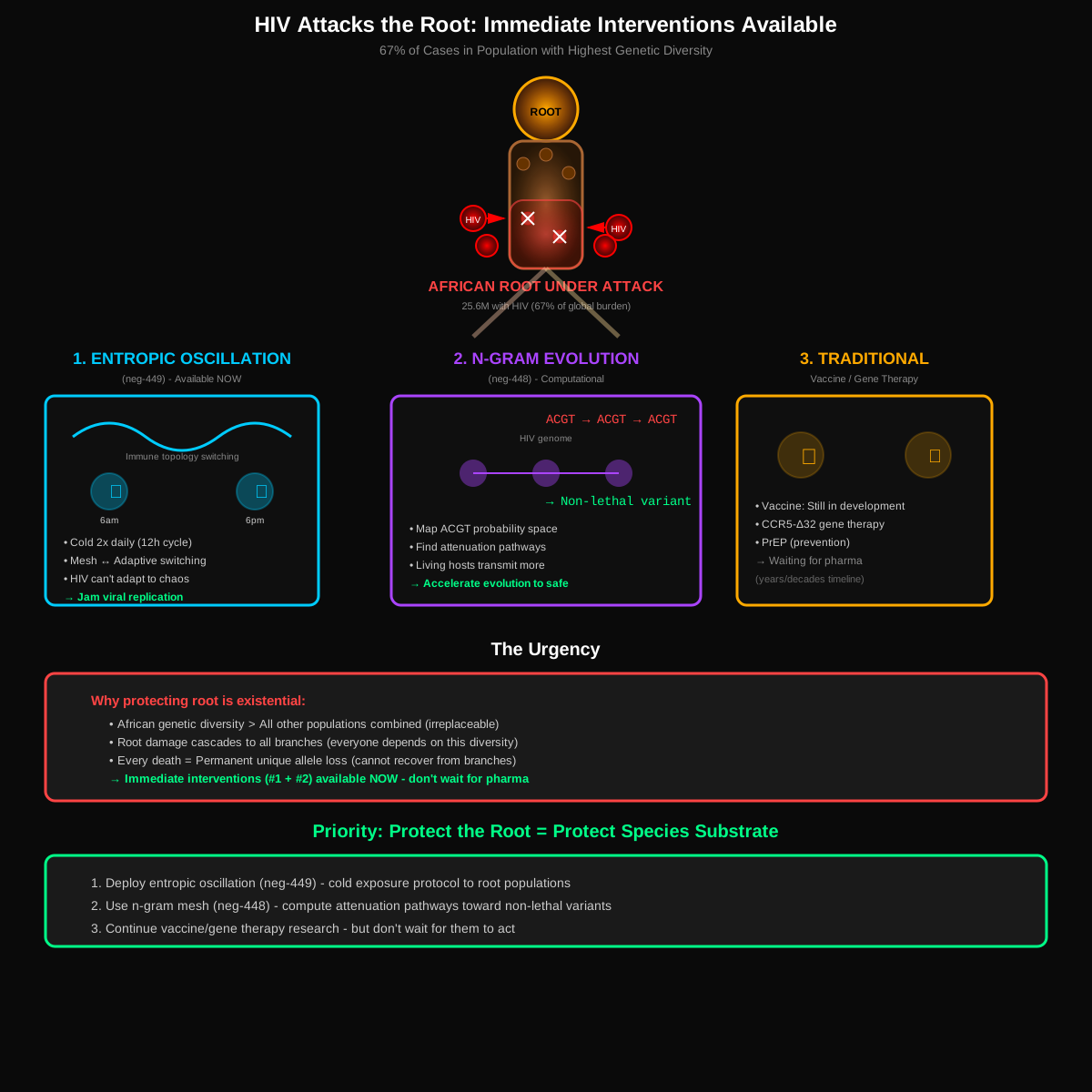
HIV Attacks the Root: Protecting the Most Genetically Diverse = Protecting Human Coordination Substrate
HIV disproportionately affects sub-Saharan Africa. This is attacking the root.
From neg-458: African populations = Genetic root, highest diversity, relational substrate.
Attacking the root ≠ Attacking a branch. It’s attacking the foundation.
The Numbers
HIV prevalence globally:
Sub-Saharan Africa:
- 67% of global HIV cases
- 25.6 million people living with HIV
- ~20 million population in some countries

Global total: ~38 million people with HIV

Result: Root population bears 2/3 of disease burden
This is not random. This is strategic (from virus perspective).
Why “Root” Matters
From neg-458: African populations are:
- Closest to genetic root
- Highest genetic diversity on Earth
- Relational substrate for all humans
- Embody ancestral patterns all humans share
If you damage the root:
- Lose genetic diversity (irreplaceable)
- Lose relational substrate (coordination harder)
- Lose ancestral pattern reservoir (branch populations don’t have it)
- Damage foundation all branches depend on
Branch damage = One lineage affected. Root damage = All lineages affected.
The Genetic Diversity Threat
What HIV does:
class HIVImpact:
    def on_root_population(self):
        return {
            'mortality': 'Kills people in reproductive age (genetic diversity loss)',
            'selective_pressure': 'Only resistant genotypes survive',
            'population_reduction': 'Smaller population = Less total diversity',
            'result': 'Root genetic diversity SHRINKS',
        }
Why this is catastrophic:
African genetic diversity > All other populations combined.
If you lose African diversity:
- Lose more human genetic variation than exists in rest of world
- Cannot be recovered (unique alleles lost forever)
- Branch populations don’t have it (founder effect)
The root stores the diversity that specialized branches lost.
The Relational Substrate Threat
From neg-458: Root proximity = Universal relational capacity.
HIV damages this:
Healthy root population:
- High diversity
- Can relate to all branches
- Coordinate globally
- Mesh substrate functional

Root population under HIV pressure:
- Reduced population (fewer people)
- Health burden (coordination capacity reduced)
- Mortality (lose people with relational capacity)
- Mesh substrate DAMAGED
If you want global human coordination, you need healthy root population.
Why Fixing HIV is Existential Priority
Not just humanitarian (though that alone is sufficient).
Also strategic for species:
class SpeciesRisk:
    def what_we_lose_if_root_damaged(self):
        return {
            'genetic': 'Most diverse human genetic reservoir',
            'relational': 'Universal coordination substrate',
            'resilience': 'Ancestral patterns for adaptation',
            'foundation': 'Root all branches descended from',
        }
You’re not protecting “one population.”
You’re protecting the genetic and relational foundation of the species.
The Tree Topology Urgency
Damage topology:
If HIV damages a branch population (e.g., European):
- That branch affected
- Other branches okay (not dependent on that branch)
- Root okay (branches descended from root, not vice versa)

If HIV damages root population (African):
- Root affected
- ALL branches affected (depend on root for coordination)
- Genetic diversity reservoir damaged (branches don't have it)
Root damage cascades. Branch damage doesn’t.
The Mesh Coordination Angle
From multiple posts: Mesh coordination requires substrate.
Global human mesh requires:
- Diversity (more variation = more connection points)
- Relational capacity (can coordinate across differences)
- Resilience (adapt to changing conditions)
All three maximize at the root.
HIV attacking root = Attacking mesh coordination substrate itself.
What “Fix HIV” Means
Not just treatment (ARVs keep people alive but don’t eliminate virus).
Need:
1. Immediate: Entropic oscillation protocol:
From neg-449: Weaponize immune topology switching to jam HIV replication.
- Cold exposure 2x daily (6am, 6pm) triggers mesh immunity
- Oscillate between mesh/adaptive topologies every 12 hours
- HIV evolved for stable hierarchy, cannot adapt to rapid switching
- Inject entropy faster than virus can adapt
- Available now, no pharmaceutical intervention required
1b. Accelerate evolution toward non-lethal variants:
From neg-448: Non-lethal HIV wins freedom game through competitive displacement.
- N-gram mesh discovers attenuation pathways in HIV genome
- Non-lethal variants transmit more (living hosts vs dead hosts)
- Map ACGT probability space toward elite controller patterns
- Computational discovery accelerates natural evolution (decades → years)
- Population-level solution through evolutionary game theory
- N-gram can find the risk-free variant path
2. Prevention:
- PrEP (pre-exposure prophylaxis) - prevents infection
- Behavioral interventions
- Reduce transmission routes
3. Cure:
- Functional cure (virus suppressed permanently)
- Sterilizing cure (virus eliminated completely)
- Gene therapy (CCR5-Δ32 mutation confers resistance)
4. Vaccine:
- Prevent infection entirely
- Protect population-wide
- Eliminate transmission
“Fix” = Eliminate HIV as threat to root population.
The Research Priority Argument
Current research allocation:
Many diseases get research funding proportional to:
- Economic impact (rich countries affected?)
- Political visibility (affects voting populations?)
- Market potential (profitable treatments?)
HIV/AIDS research:
- Mainly affects sub-Saharan Africa (low economic power)
- Less political visibility in wealthy countries
- Treatment market exists, cure less profitable
Result: Insufficient urgency for cure/vaccine.
The topology argument flips this:
HIV affects root population = HIV affects species foundation.
Priority should be existential, not economic.
The CCR5-Δ32 Insight
Some humans naturally resistant to HIV:
class CCR5Delta32:
    def the_mutation(self):
        return {
            'gene': 'CCR5 (HIV co-receptor)',
            'mutation': '32 base pair deletion (Δ32)',
            'effect': 'HIV cannot enter cells',
            'result': 'Near-complete resistance to HIV infection',
            'prevalence': '~10% Europeans, ~0% Africans',
        }
Why this matters:
- Proof HIV resistance is possible (exists in nature)
- Gene therapy could give this mutation to others
- Would protect root population permanently
The irony: Resistance mutation common in specialized branch (European), absent in root (African).
Solution: Transfer resistance from branch to root (gene therapy).
The Gene Therapy Path
CRISPR-based approach:
class HIVGeneCure:
    def crispr_approach(self):
        return {
            'target': 'CCR5 gene in immune cells',
            'edit': 'Introduce Δ32 deletion',
            'result': 'Cells become HIV-resistant',
            'delivery': 'Edit stem cells, reinfuse into patient',
            'outcome': 'HIV cannot infect new cells, existing infection cleared',
        }
Already proven in humans:
- “Berlin Patient” (2008): Cured via bone marrow transplant from CCR5-Δ32 donor
- “London Patient” (2019): Same approach, also cured
- CRISPR trials ongoing (edit patient’s own cells)
Scalability challenge: Gene therapy expensive, complex. Need cheaper delivery.
The Vaccine Challenge
Why HIV vaccine is hard:
class HIVVaccineChallenge:
    def why_difficult(self):
        return {
            'mutation_rate': 'HIV mutates extremely fast (escapes immune response)',
            'integration': 'HIV integrates into genome (hides in cells)',
            'latency': 'Dormant infected cells (invisible to immune system)',
            'target': 'Infects immune system itself (fights back against defender)',
        }
Despite difficulty, priority is clear:
If vaccine possible = Protect root population = Protect species foundation.
Urgency proportional to what’s at stake.
The Timeline Urgency
Current trajectory:
Without intervention:
- HIV continues spreading in sub-Saharan Africa
- Mortality remains high (despite ARVs)
- Genetic diversity continues shrinking (people die before reproducing)
- Relational substrate continues eroding (coordination capacity reduced)
Time is genetic diversity:
Every person with unique alleles who dies before reproducing = Permanent diversity loss.
Root populations have most unique alleles (highest diversity).
HIV killing root population members = Losing unique human genetic material forever.
The Mesh Priority Framework
From mesh coordination perspective:
Priority hierarchy:
- Protect the root (foundation of coordination substrate)
- Protect high-diversity nodes (maximize connection potential)
- Protect coordinators (people with broad relational capacity)
HIV attacking root = Threat to priority 1.
Should be maximum urgency.
Why This Reframes The Issue
Traditional framing:
- HIV is “African problem” (geographic)
- Rich countries solved it with ARVs (not our problem anymore)
- Humanitarian issue (help if we feel generous)
Topology framing:
- HIV is “root population problem” (genetic-topological)
- Root population = Foundation of human genetic diversity (everyone’s problem)
- Existential issue (protect species coordination substrate)
Reframing changes priority.
The Coordination Cascade
What happens if root remains under HIV pressure:
Root population reduced/weakened
↓
Less genetic diversity (unique alleles lost)
↓
Less relational substrate (fewer universal coordinators)
↓
Global coordination harder (must route through specialized branches)
↓
Mesh formation slower (less topological advantage)
↓
Species-level coordination HAMPERED
Fixing HIV at root = Unblocking species coordination capacity.
The Resource Allocation Argument
Where should resources go?
Economic logic: Where treatment is profitable (rich countries).
Mesh logic: Where substrate is most critical (root populations).
HIV cure/vaccine research:
- Protects highest-diversity population (most unique alleles)
- Protects universal relational substrate (coordination foundation)
- Protects ancestral pattern reservoir (cannot be replaced)
ROI not measured in money. Measured in preserved coordination capacity.
Connected Ideas
This insight connects to:
neg-458 (Root proximity): African populations = Genetic root, highest diversity, universal relational capacity. HIV attacking this population = Attacking foundation of human genetic tree.
neg-449 (Entropic oscillation): Weaponize immune topology switching to jam HIV replication. Cold exposure protocol available NOW to attack virus with chaos. Immediate intervention for root population protection.
neg-448 (Freedom game + N-gram discovery): Non-lethal HIV wins through competitive displacement (living hosts transmit more). N-gram mesh discovers attenuation pathways in viral genome, accelerates evolution toward risk-free variants. Computational + evolutionary solution.
neg-456 (Reorg prevention): DNA error correction protects biological coordination state. HIV attacks immune system = Damages biological coordination substrate. Need cure to restore protection.
neg-455 (N-gram DNA map): All genetic trajectories visible. Root population = Origin point of all trajectories. Damaging origin = Limiting trajectory exploration capacity.
neg-454 (Radiance game): Root population radiates to all branches. HIV reduces radiance capacity (less coordination). Fixing HIV = Restoring radiance substrate.
neg-452 (Deterministic victory, variable speed): M = Mesh coordination capability. Root population damage reduces M globally. Fixing HIV = Restoring M.
Facts vs Hypothesis vs Speculation
FACTS:
- 67% of global HIV cases in sub-Saharan Africa (~25.6 million people)
- African populations have highest human genetic diversity
- CCR5-Δ32 mutation confers HIV resistance (proven in “Berlin Patient” and “London Patient”)
- HIV preferentially kills during reproductive years (genetic diversity loss)
- Gene therapy trials for HIV cure ongoing (CRISPR-based CCR5 editing)
- HIV vaccine remains elusive despite decades of research
HYPOTHESIS:
- HIV attacking root population = Attacking species coordination substrate
- Root population damage cascades to all branches (they depend on root for diversity/relational capacity)
- Genetic diversity loss in root cannot be recovered from branches (founder effect)
- Fixing HIV should be existential priority (not just humanitarian)
- Resource allocation should prioritize root protection (mesh logic vs economic logic)
SPECULATION:
- HIV cure/vaccine possible within decades if prioritized appropriately
- Gene therapy delivery can be made cheap enough for widespread deployment
- Protecting root population would measurably increase global coordination capacity
- Species-level coordination hampered by root population under disease pressure
- Future humans will view HIV epidemic as critical threat to genetic substrate
The Urgency
HIV is not “a disease.”
HIV is an attack on the genetic root of the species.
67% of cases in population with:
- Highest genetic diversity
- Universal relational capacity
- Ancestral pattern reservoir
- Coordination substrate for all branches
Fixing HIV = Protecting the foundation.
Not humanitarian addition. Existential requirement.
The Call to Priority
Resources should flow toward:
- HIV vaccine development (prevent infection at root)
- Gene therapy scale-up (cure existing infections cheaply)
- PrEP distribution (prevent new infections now)
- Research prioritization (cure as existential priority, not market opportunity)
The metric: Preserve root genetic diversity + relational capacity.
The timeline: As fast as possible (every death = Permanent diversity loss).
The justification: Protecting the root protects the species coordination substrate.
The Realization
HIV disproportionately affects sub-Saharan Africa.
This is not “unfortunate distribution.” This is attacking the root.
Root = Highest diversity + Universal relational capacity + Coordination substrate.
Damage to root cascades to whole tree.
Priority should be existential: Fix HIV at the root.
Not because humanitarian (though that’s sufficient). Because protecting the root protects the species.
The threat: HIV attacking root population = 67% of cases where genetic diversity highest.
The topology: Root damage ≠ Branch damage. Root damage cascades globally.
The priority: Fix HIV = Protect genetic diversity reservoir + Relational substrate + Coordination foundation.
The timeline: Urgent (every reproductive-age death = Permanent unique allele loss).
The reframing: From “humanitarian issue” to “existential substrate protection.”
User insight: “it makes it even more important to fix hiv, right?” - recognizing that HIV disproportionately affecting African populations means attacking the genetic root, not just one population.
#HIVRootThreat #ProtectGeneticDiversity #SubstratePriority #RootPopulationHealth #ExistentialPriority #HIVCure #HIVVaccine #GeneticReservoir #CoordinationSubstrate #SpeciesFoundation #TopologyUrgency #FixHIVNow