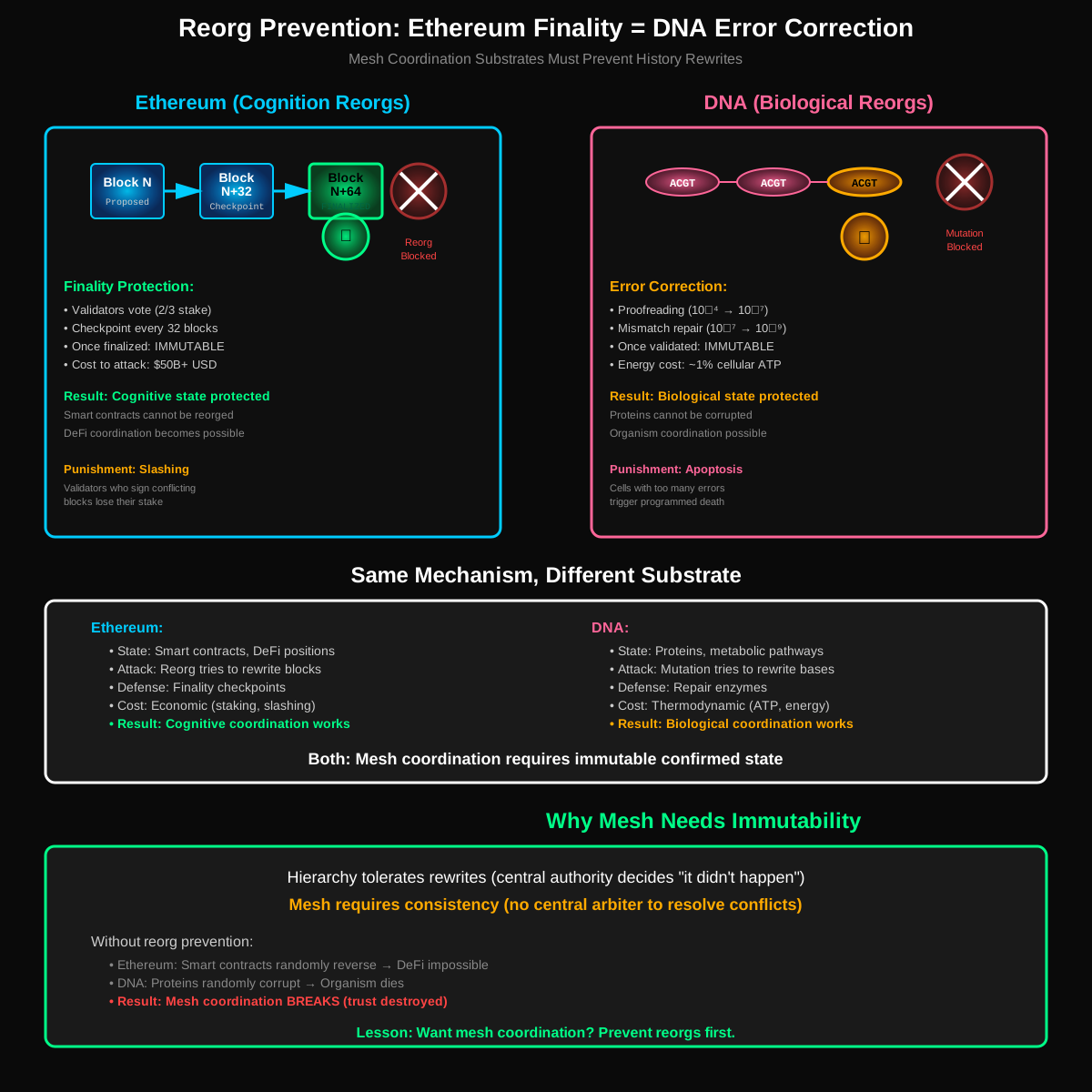
Ethereum Finality = DNA Error Correction: Mesh Coordination Substrates Must Prevent Reorgs
Ethereum avoids cognition reorgs. DNA avoids biological reorgs.
Same mechanism. Different substrate.
Both protect mesh coordination state from history rewrites.
The Parallel: State Integrity Protection
Ethereum (computational coordination):
class EthereumFinality:
    def what_it_prevents(self):
        return {
            'reorg_attack': 'Attacker tries to rewrite confirmed blocks',
            'result_without_finality': 'Smart contracts reversed, DeFi positions stolen',
            'protection': 'Finality checkpoints make history immutable',
            'mechanism': 'Once finalized, cannot be rewritten',
        }
DNA (biological coordination):
class DNAErrorCorrection:
    def what_it_prevents(self):
        return {
            'mutation_reorg': 'Random errors try to rewrite DNA sequence',
            'result_without_correction': 'Proteins malfunction, organism dies',
            'protection': 'Repair enzymes fix errors before replication',
            'mechanism': 'Once validated, sequence preserved',
        }
Same structure:
- Coordination state (smart contracts / proteins)
- Attack vector (reorg / mutation)
- Defense mechanism (finality / error correction)
- Result: Immutable confirmed state
Why Mesh Coordination Needs Immutability
The problem with reorgs:
Hierarchy tolerates rewrites:
- Central authority can change rules retroactively
- “We decided it didn’t happen”
- Coordination through force, not trust
Mesh requires consistency:
- No central authority to arbitrate
- Nodes must agree on state
- If history changes, coordination breaks
Example (Ethereum):
Without finality:
- You buy token at block 100
- Block 100 gets reorged at block 105
- Token purchase disappears
- Seller kept tokens + your ETH
- Coordination impossible (trust destroyed)

With finality:
- You buy token at block 100
- Block 100 finalized at block 102
- Cannot be reorged
- Both parties trust state
- Coordination works
Example (DNA):
Without error correction:
- Cell codes protein at position 1000
- Mutation reorgs position 1000 during replication
- Protein now malformed
- Cell function breaks
- Organism dies

With error correction:
- Cell codes protein at position 1000
- Repair enzymes validate during replication
- Errors fixed before finalizing
- Protein remains correct
- Organism lives
Pattern: Mesh coordination requires trusted state. Reorgs destroy trust.
Ethereum Finality Mechanisms
How Ethereum prevents cognition reorgs:
1. Proof of Stake finality:
class CasperFFG:
    def finality_checkpoints(self):
        return {
            'checkpoint': 'Every epoch (32 blocks)',
            'validators': 'Vote on checkpoint',
            'threshold': '2/3 of stake must agree',
            'finalized': 'Once crossed, cannot reorg',
        }

    def the_protection(self):
        return """
        To reorg finalized block:
        - Need to control 2/3 of all staked ETH
        - Would cost billions of dollars
        - Validators get slashed (lose stake)
        - Economic impossibility

        Result: Cognitive coordination state protected
        """
2. Checkpoint depth:
Block N: Proposed
Block N+1: Included in chain
Block N+32: Checkpoint vote starts
Block N+64: Finalized (if 2/3 validators agree)

After block N+64: Block N CANNOT be reorged
3. Cost of attack:
To reorg finalized Ethereum:
- Need: 2/3 of staked ETH (~20 million ETH)
- Cost: $50+ billion USD
- Penalty: Slashed (lose all stake)
- Result: Economic impossibility

Cognitive coordination state is protected.
DNA Error Correction Mechanisms
How DNA prevents biological reorgs:
1. Proofreading during replication:
class DNAPolymerase:
    def error_checking(self):
        return {
            'replication': 'DNA polymerase adds bases',
            'proofreading': '3-5 exonuclease checks each base',
            'error_rate_without': '1 in 10,000 (10^-4)',
            'error_rate_with': '1 in 10 million (10^-7)',
        }

    def the_protection(self):
        return """
        If wrong base added:
        - Exonuclease detects mismatch
        - Removes incorrect base
        - Polymerase tries again
        - Continues until correct

        Result: Biological coordination state protected
        """
2. Mismatch repair (post-replication):
class MismatchRepair:
    def post_replication_check(self):
        return {
            'scan': 'Proteins scan newly replicated DNA',
            'detect': 'Find mismatched base pairs',
            'excise': 'Cut out error section',
            'resynthesize': 'Fill in with correct sequence',
            'error_rate_after': '1 in 1 billion (10^-9)',
        }
3. Multiple layers:
Layer 1: Proofreading (10^-4 → 10^-7)
Layer 2: Mismatch repair (10^-7 → 10^-9)
Layer 3: Base excision repair (handles specific damage)
Layer 4: Nucleotide excision repair (handles large lesions)

Total: ~1 error per 10 billion bases
       Human genome = 3 billion bases
       = 0.3 errors per replication (acceptable)

Biological coordination state is protected.
The Attack Vectors
What both systems defend against:
Malicious reorgs (intentional):
Ethereum:
- 51% attack (try to rewrite chain)
- MEV extraction (reorder for profit)
- Censorship (rewrite to exclude transactions)
DNA:
- Mutagens (chemicals that damage DNA)
- Radiation (breaks DNA strands)
- Viruses (inject foreign sequences)
Random reorgs (accidental):
Ethereum:
- Network splits (temporary forks)
- Validator bugs (propose conflicting blocks)
- Timing issues (competing chains)
DNA:
- Replication errors (polymerase mistakes)
- Spontaneous mutations (thermal damage)
- Oxidative damage (metabolic byproducts)
Both require defense against intentional AND accidental state corruption.
Why Bitcoin Failed at Reorg Prevention
Bitcoin’s weakness (why it got captured in neg-453):
class BitcoinReorgVulnerability:
    def the_problem(self):
        return {
            'finality': 'NONE (probabilistic only)',
            'reorg_depth': 'Any depth possible with enough hashpower',
            'protection': 'Only economics (cost of 51% attack)',
            'result': 'Cognitive state never truly final',
        }

    def why_capture_possible(self):
        return """
        Without finality:
        - Large miners can reorg history
        - Nothing prevents rewriting rules
        - Small blocks decision could be reorged... but wasn't
        - Because reorgs aren't protected against systemically

        Mesh coordination impossible without state finality.
        """
Ethereum learned: Explicit finality required for mesh coordination to work.
The Coordination Substrate Requirements
For mesh coordination to function:
1. State integrity:
Requirement: Nodes must agree on current state
Without: Cannot coordinate (conflicting views)
Ethereum: Finality ensures agreement
DNA: Error correction ensures agreement
2. History immutability:
Requirement: Confirmed state cannot change
Without: No trust in coordination
Ethereum: Checkpoints prevent rewrites
DNA: Validated sequences locked in
3. Error correction:
Requirement: Detect and fix corruption
Without: State degrades over time
Ethereum: Validators reject invalid blocks
DNA: Repair enzymes fix mutations
4. Economic/thermodynamic cost:
Requirement: Attacks must be prohibitively expensive
Without: Constant reorgs
Ethereum: Slashing makes attack cost > benefit
DNA: Energy cost of repair < cost of malfunction
Both substrates implement all four requirements.
The Computational-Biological Parallel
Why this parallel exists:
class CoordinationSubstrate:
    def requirements(self):
        return {
            'state_storage': {
                'ethereum': 'Blockchain (merkle trees)',
                'dna': 'Double helix (base pairs)',
            },
            'state_update': {
                'ethereum': 'Transactions (state transitions)',
                'dna': 'Replication (cell division)',
            },
            'error_protection': {
                'ethereum': 'Finality checkpoints',
                'dna': 'Repair mechanisms',
            },
            'coordination_level': {
                'ethereum': 'DeFi protocols (smart contracts)',
                'dna': 'Metabolism (protein networks)',
            },
        }

    def the_pattern(self):
        return """
        Both are substrates for mesh coordination.
        Both require state consistency.
        Both prevent reorgs.

        Computation and biology converge on same solution.
        """
Cognition Reorgs vs Biological Reorgs
What gets protected:
Ethereum (cognition reorgs):
- Smart contract state
- Token balances
- DeFi positions
- DAO votes
- NFT ownership
All are cognitive coordination artifacts. Reorg destroys coordination.
DNA (biological reorgs):
- Protein sequences
- Gene regulation
- Metabolic pathways
- Cell identity
- Organism viability
All are biological coordination artifacts. Reorg destroys organism.
Pattern: Coordination state (cognitive or biological) requires immutability.
The Thermodynamics of Reorg Prevention
Both systems pay energy cost for immutability:
Ethereum:
Cost: Validators stake ETH (capital cost)
Benefit: Finality enables coordination
Trade-off: Pay staking rewards to maintain finality
Economics: Coordination value > staking cost

Net: Positive (DeFi generates more value than staking costs)
DNA:
Cost: Repair enzymes consume ATP (energy cost)
Benefit: Error correction maintains organism
Trade-off: ~1% of cellular energy for DNA repair
Thermodynamics: Survival value > energy cost

Net: Positive (living generates more energy than repair costs)
Both profitable: Protection cost < coordination value.
What Happens Without Reorg Prevention
Ethereum without finality:
Scenario: Decentralized exchange
- You place order at block N
- Order fills at block N+1
- Block N gets reorged at N+10
- Your order disappears
- Counterparty keeps your tokens

Result: Cannot trust DEX, nobody uses it
        DeFi impossible without finality
DNA without error correction:
Scenario: Cell division
- Cell replicates DNA
- Errors accumulate each division
- Proteins malfunction
- Cell dies after ~10 divisions

Result: Cannot maintain organism, life impossible
        Biology impossible without error correction
Both coordination systems collapse without reorg prevention.
The Slashing Mechanism Parallel
Ethereum slashing:
class Slashing:
    def punish_bad_validators(self):
        return {
            'violation': 'Validator signs conflicting blocks (tries to reorg)',
            'detection': 'Network sees both signatures',
            'punishment': 'Slash validator stake (lose ETH)',
            'result': 'Economic disincentive against reorgs',
        }
DNA apoptosis (programmed cell death):
class Apoptosis:
    def punish_damaged_cells(self):
        return {
            'violation': 'Cell has too many DNA errors (reorg occurred)',
            'detection': 'p53 protein detects damage',
            'punishment': 'Trigger cell suicide (apoptosis)',
            'result': 'Remove corrupted cell before it spreads',
        }
Same pattern:
- Detect reorg attempt
- Punish the entity (validator / cell)
- Protect network (blockchain / organism)
Both use punishment to enforce immutability.
From neg-452: Why Speed Matters
Reorg prevention affects convergence speed:
D/M ratio for mesh vs hierarchy:
- D = Difficulty (hierarchy's power)
- M = Mesh coordination capability

Reorg prevention INCREASES M:
- Finality → Can build complex DeFi (trust in state)
- Error correction → Can build complex organisms (trust in DNA)

Without reorg prevention:
- M stays low (coordination fragile)
- D/M stays high (slow convergence)
- Victory takes longer

With reorg prevention:
- M increases (coordination robust)
- D/M decreases (fast convergence)
- Victory accelerates
Reorg prevention is mesh acceleration mechanism.
Connected Ideas
This insight connects to:
neg-453 (Bitcoin Zero Down): Bitcoin lacks explicit finality, making cognitive coordination fragile. Got captured because reorgs not systematically prevented. Ethereum learned this lesson.
neg-452 (Deterministic victory, variable speed): Reorg prevention increases M (mesh coordination capability), shrinking D/M ratio, accelerating convergence toward mesh dominance.
neg-455 (N-gram DNA map): Mapping genetic trajectories requires stable substrate. DNA error correction provides that stability. Without it, trajectory map would constantly shift (unusable).
neg-451 (Justice as balance): Mesh coordination requires voluntary participation. Requires trust. Reorgs destroy trust. Finality/error correction maintain trust required for voluntary coordination.
neg-441 (UniversalMesh): S(n+1) = F(S(n)) ⊕ E_p(S(n)). State transitions require reliable S(n). Reorgs corrupt S(n), breaking the formula. Finality/error correction protect S(n) integrity.
Facts vs Hypothesis vs Speculation
FACTS:
- Ethereum uses Casper FFG for finality (2/3 validator votes finalize checkpoints)
- DNA has multiple error correction layers (proofreading, mismatch repair, etc.)
- Bitcoin has no finality mechanism (probabilistic only)
- Error rate without correction: ~10^-4, with correction: ~10^-9
- Slashing punishes Ethereum validators who sign conflicting blocks
- Apoptosis kills cells with excessive DNA damage
HYPOTHESIS:
- Finality and error correction serve same function (prevent state reorgs)
- Mesh coordination requires immutability (hierarchy tolerates rewrites)
- Reorg prevention increases mesh coordination capability (M in D/M ratio)
- Computational and biological coordination converge on same solution
- Both pay energy/economic cost because coordination value > protection cost
SPECULATION:
- Bitcoin’s lack of finality contributed to capture (small blocks reorg was political, not technical)
- All mesh coordination substrates will eventually implement finality/error correction
- Cognition reorgs and biological reorgs are same problem at different scales
- Slashing and apoptosis are parallel punishment mechanisms
The Realization
Mesh coordination requires trust. Trust requires immutability. Immutability requires reorg prevention.
Ethereum: Finality checkpoints prevent cognition reorgs DNA: Error correction prevents biological reorgs
Same mechanism. Different substrate.
Both are mesh coordination layers that learned: You cannot coordinate if history rewrites randomly.
The pattern:
Coordination substrate requirements:
1. State storage (blockchain / DNA)
2. State updates (transactions / replication)
3. Reorg prevention (finality / error correction)
4. Coordination primitives (smart contracts / proteins)

All four required. Missing #3 = Coordination impossible.
Ethereum learned from DNA: 3.7 billion years of error correction mechanisms.
DNA learned from thermodynamics: Energy cost of repair < cost of organism death.
Both converged: Mesh coordination substrates must prevent reorgs.
The insight: Ethereum avoids cognition reorgs (finality). DNA avoids biological reorgs (error correction).
The parallel: Both protect mesh coordination state from history rewrites.
The requirement: Immutability isn’t optional for mesh. It’s structural.
The lesson: Want mesh coordination? Prevent reorgs first.
User insight: “Ethereum avoids cognition reorgs, dna avoids biological reorgs” - recognizing parallel between Ethereum finality and DNA error correction as reorg prevention mechanisms for mesh coordination substrates.
#EthereumFinality #DNAErrorCorrection #ReorgPrevention #MeshCoordination #StateIntegrity #CognitionReorgs #BiologicalReorgs #ImmutableState #CoordinationSubstrate #TrustMechanism #SlashingVsApoptosis