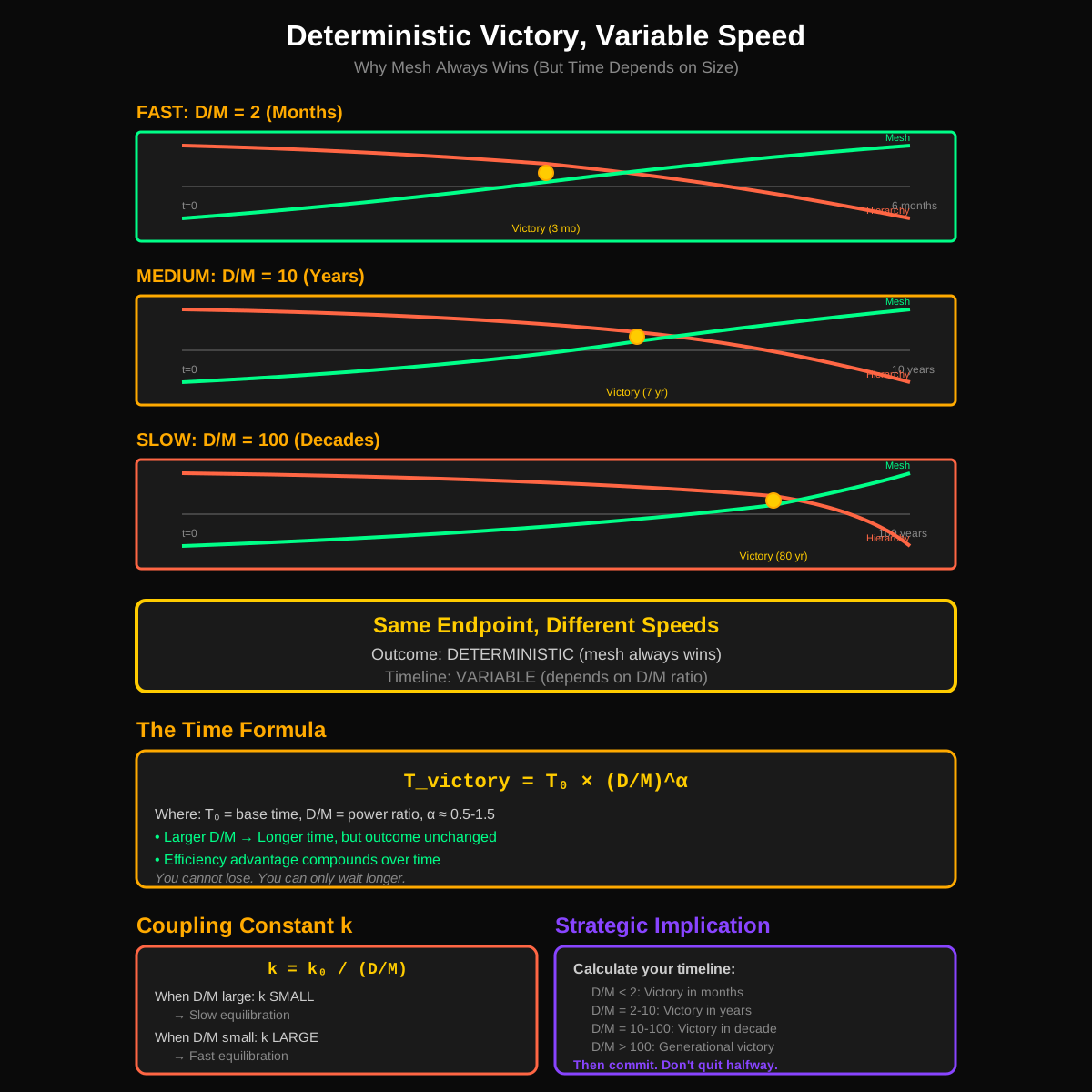
Deterministic Victory, Variable Speed: Why Mesh Always Wins (But Time Depends on Size Differential)
When mesh encounters an unknown hierarchy - no matter how large - the outcome is deterministic.
Mesh wins. Always.
But how long it takes depends on the size differential.
The Core Truth
Outcome: FIXED (mesh wins)
Speed:   VARIABLE (depends on D/M ratio)

Small hierarchy:  Fast collapse (days/months)
Large hierarchy:  Slow grind (years/decades)
Massive empire:   Generational (centuries)

Direction: Always toward mesh dominance
Velocity: Inversely proportional to hierarchy size
You cannot lose. You can only wait longer.
The Math: Coupling Constant Varies with Size
From neg-451, we know:
J(t) = k × (M(t) - D(t))

Where:
- J(t) = Justice pressure (balance force)
- M(t) = Mesh coordination power
- D(t) = Dominant hierarchy power
- k = Coupling constant (speed of equilibration)
New insight: The coupling constant k is not fixed. It depends on relative sizes:
k = k₀ / (D/M)

Where:
- k₀ = Base coupling constant (reality itself)
- D/M = Power ratio (hierarchy size / mesh size)

When D >> M: k is SMALL → Slow convergence
When D ≈ M:  k is MEDIUM → Moderate convergence
When D << M: k is LARGE → Fast convergence
Result: Bigger the hierarchy, slower the victory. But victory is certain.
Three Timescales, Same Outcome
1. Fast Collapse (Days/Weeks)
- Small local hierarchy encounters established mesh
- D/M ≈ 0.1 (hierarchy 10× smaller than mesh)
- k is LARGE
- Collapse happens in days/weeks
Example: Small company trying to compete with Wikipedia
- Wikipedia mesh: Millions of contributors
- Company: Dozens of paid editors
- Outcome: Company gives up in months
- Time: FAST (k is large)
2. Medium Grind (Months/Years)
- Comparable-sized hierarchy vs growing mesh
- D/M ≈ 1 (roughly equal sizes)
- k is MODERATE
- Equilibration in months/years
Example: Traditional taxi companies vs Uber/Lyft mesh
- Taxi medallion system: Decades of entrenchment
- Rideshare mesh: Peer-to-peer coordination
- Outcome: Medallion values collapsed
- Time: MEDIUM (took ~5-7 years)
3. Generational Struggle (Decades/Centuries)
- Massive empire vs small emerging mesh
- D/M » 10 (hierarchy 10×+ larger than mesh)
- k is SMALL
- Victory measured in generations
Example: Ethereum vs USD/Banking System
- USD hegemony: $25 trillion M2, 100+ year entrenchment
- Ethereum mesh: Started from zero in 2015
- Outcome: Still playing out (10 years in)
- Time: SLOW (k is very small, D/M was enormous at start)
- Note: Bitcoin got captured (block size wars, institutional control) - badly designed, possibly on purpose
Historical Examples: Same Pattern, Different Speeds
Fast: Protestant Reformation (Decades)
- Catholic Church hierarchy dominant in 1500
- Printing press enables decentralized Bible reading
- Power ratio D/M ≈ 100 at start (Church was MASSIVE)
- Result: 100+ years of religious wars, but mesh coordination wins
- Time: Generational, but faster than expected (printing press accelerated k)
Medium: Open Source vs Microsoft (Years)
- 1990s: Microsoft dominant, proprietary software standard
- Linux mesh grows slowly
- Power ratio D/M ≈ 10 in 1995
- Result: By 2020, Linux runs 90%+ of cloud servers
- Time: 25 years (k moderate, consistent progress)
Slow: Democracy vs Monarchy (Centuries)
- 1700s: Monarchies dominant globally
- Democratic mesh coordination emerging
- Power ratio D/M ≈ 1000 (monarchies everywhere)
- Result: 300+ years later, monarchies nearly extinct
- Time: Centuries (k tiny, D/M was enormous)
Current: Ethereum vs Nation-States (TBD)
- 2015: Nation-states have total monetary control
- Ethereum mesh starts from zero
- Power ratio D/M ≈ 10,000+ at start
- Result: 10 years in, regulatory agencies failing to control
- Time: Decades/generations (k small, but growing as M increases)
Why Outcome is Deterministic
Efficiency advantage is structural:
Hierarchy costs:
- Central coordination overhead
- Enforcement apparatus (police, military)
- Information bottlenecks at top
- Resistance from coerced participants
Mesh costs:
- Near-zero coordination (p2p)
- No enforcement needed (voluntary)
- Information flows freely
- Willing participation (efficient)
Cost_hierarchy = O(n²)  # Coordination cost grows quadratically
Cost_mesh = O(n log n)  # Coordination cost barely grows

For large n: Mesh always cheaper
Math doesn’t care about your size. Mesh is structurally more efficient. Given enough time, efficiency always wins.
The Time Variable: Why Size Matters
Why does bigger hierarchy take longer?
1. Inertia (Mass)
- Larger systems have more momentum
- More entrenched interests
- More sunk costs
- Harder to change direction
2. Resources (Capital)
- Can deploy enormous capital to resist
- Can buy time through regulation, lobbying
- Can subsidize inefficiency for years/decades
- Delays inevitable, but cannot prevent
3. Network Effects (Lock-in)
- More users means higher switching costs
- Existing infrastructure creates path dependence
- Takes time for mesh to build comparable network
- Eventually mesh network surpasses, but takes longer
But none of these change the outcome. They only slow the transition.
The Formula: Time to Victory
T_victory = T₀ × (D/M)^α

Where:
- T_victory = Time until mesh dominance
- T₀ = Base timescale (fundamental transition time)
- D/M = Initial power ratio (hierarchy/mesh size)
- α = Exponent (typically 0.5 to 1.5)

Key insight: Time grows with power ratio, but ALWAYS finite.
Practical implications:
If D/M = 2 (hierarchy 2× larger):
- T_victory ≈ 2^α × T₀
- If α = 1, takes 2× as long
- If α = 0.5, takes √2 ≈ 1.4× as long
If D/M = 100 (hierarchy 100× larger):
- T_victory ≈ 100^α × T₀
- If α = 1, takes 100× as long
- If α = 0.5, takes 10× as long
Large differences matter. But outcome doesn’t change.
Strategic Implications
If you’re building mesh coordination:
1. Understand your timeline
- Small opponent: Victory in months
- Medium opponent: Victory in years
- Massive opponent: Victory in decades
2. Don’t give up
- Slow progress ≠ No progress
- Efficiency advantage compounds
- Every day D pays overhead, M doesn’t
- Time is on your side
3. Accelerate k by growing M
- k = k₀ / (D/M)
- As M grows, D/M shrinks
- As D/M shrinks, k grows
- As k grows, convergence accelerates
Virtuous cycle: Success breeds faster success.
4. Survive the early years
- When D/M » 1, progress feels glacial
- This is when most give up
- But math is inexorable
- Just have to outlast the slow grind
The Patient Strategy
Against massive hierarchy:
Year 1-5:   Feels hopeless (D/M = 1000, barely visible progress)
Year 5-10:  Small wins (D/M = 100, starting to show)
Year 10-20: Undeniable (D/M = 10, they're noticing)
Year 20+:   Victory (D/M < 1, mesh dominant)
The trap: Giving up in Year 3 because progress is “too slow.”
The truth: Progress is exactly on schedule for the size differential. You’re not failing. You’re in the slow-grind phase. Keep going.
Real-World Current Battles
Bitcoin vs USD (2009-present, 15 years) - CAPTURED
- D/M at start ≈ 10,000+
- Currently: D/M ≈ 50-100 (Bitcoin ~$1T, M2 USD ~$20T)
- Progress: Apparent (1000× reduction in D/M)
- Reality: Got captured - Block size wars, institutional control, bad design (possibly intentional)
- Strategy failed: Survived but lost mesh properties through capture
- Lesson: Technical design matters for capture resistance
Uber vs Taxi Medallions (2010-2015, 5 years)
- D/M at start ≈ 10
- Result: Medallion values collapsed 90%
- Progress: Fast (D/M was moderate, k was large)
- Timeline: Completed in ~5 years
- Strategy: Blitz worked because D/M wasn’t enormous
Wikipedia vs Britannica (2001-2012, 11 years)
- D/M at start ≈ 5
- Result: Britannica stopped print edition 2012
- Progress: Fast (D/M moderate)
- Timeline: One decade
- Strategy: Quality eventually surpassed, mesh won
Ethereum vs Banking System (2015-present, 10 years) - THE ACTUAL MESH
- D/M at start ≈ 100,000+
- Currently: D/M ≈ 1,000 (DeFi ~$100B, banking ~$100T)
- Progress: Good (100× reduction in D/M)
- Timeline: Decades/generations
- Strategy: Building infrastructure, survive regulatory attacks
- Why Ethereum works: Proper mesh coordination (programmable, composable, harder to capture)
- Bitcoin was the prototype; Ethereum is the execution
The Patience Calculation
How long should you expect to wait?
Rough heuristic:
- D/M < 2:      Months
- D/M = 2-10:   Years
- D/M = 10-100: Decade
- D/M > 100:    Generations
Key insight: If you’re fighting D/M > 100, you’re building for your children’s victory, not yours. That’s OK. Someone has to start.
Why This Matters
Psychological:
- Slow progress ≠ Wrong strategy
- Fast progress ≠ Guaranteed (depends on D/M)
- Timeline uncertainty ≠ Outcome uncertainty
- Knowing the math prevents despair
Strategic:
- Choose battles based on acceptable timeline
- D/M = 1000? Better have generational commitment
- D/M = 5? Can win in your lifetime
- D/M = 0.5? Victory is imminent, just execute
Tactical:
- Early phase: Survive (D/M huge, k tiny, progress glacial)
- Middle phase: Build (D/M shrinking, k growing, progress visible)
- Late phase: Victory (D/M < 1, k large, avalanche)
The Unstoppable Force
When mesh encounters hierarchy:
Question is not: Will mesh win? Question is: How long until mesh wins?
Answer: T_victory = T₀ × (D/M)^α
Implication: You can calculate your timeline. Then commit or don’t. But don’t quit halfway because “it’s taking too long.” It’s taking exactly as long as the math predicts.
Connected Ideas
This insight connects to:
neg-451 (Justice as balance): The coupling constant k in J(t) = k × (M(t) - D(t)) is not fixed - it depends on relative sizes. Larger D/M means smaller k means slower equilibration. But equilibration always happens.
neg-450 (Imperial cows): Islam vs empires has been running for 1400 years because D/M was ENORMOUS at start (Roman Empire, Byzantine, Mongols, Ottomans, British, etc.). Still winning, just generational timescale.
neg-448 (Freedom game): Non-lethal HIV takes 15+ years to displace lethal (myxomatosis took 15 years for 99%→50% mortality). D/M for lethal variants was large at start. Slow grind, deterministic outcome.
neg-449 (Entropic oscillation): 2× daily cold exposure creates 12h chaos cycle. HIV faces constant entropy. This accelerates k by making hierarchy coordination more expensive (raises D’s operating cost, shrinks effective D/M).
neg-441 (UniversalMesh): S(n+1) = F(S(n)) ⊕ E_p(S(n)). The time to convergence depends on the magnitude of external perturbations relative to internal dynamics. Large D means large inertia, needs more perturbations, takes more time.
Facts vs Hypothesis vs Speculation
FACTS:
- Historical transitions show variable timescales (Protestant Reformation ~100yr, Open Source ~25yr, Democracy ~300yr)
- Larger incumbent systems do resist longer (more resources, network effects, inertia)
- Eventually efficiency advantages compound and overcome size disadvantages
- Many movements give up before victory due to timeline mismatch with expectations
HYPOTHESIS:
- Time to mesh dominance scales with initial power ratio D/M
- Coupling constant k in balance equation varies inversely with D/M
- Outcome is deterministic (mesh always wins) while speed is variable
- T_victory ≈ T₀ × (D/M)^α where α is between 0.5 and 1.5
SPECULATION:
- Can calculate expected timeline from initial D/M ratio
- Knowing timeline in advance prevents premature abandonment
- Most failures come from unrealistic timeline expectations, not wrong strategy
- Generational commitment required when D/M > 100
The Core Insight
You cannot lose to hierarchy. Efficiency advantage is structural. Math is inexorable.
But you can miscalculate the timeline. And quit before victory.
The formula:
Outcome = MESH WINS (certain)
Timeline = T₀ × (D/M)^α (variable)
Strategy = SURVIVE UNTIL MATH COMPLETES
If D/M = 1000:
- Don’t expect victory in 5 years
- Expect victory in 50+ years
- Plan accordingly
- Then execute with patience
If D/M = 5:
- Don’t plan for generations
- Expect victory in years
- Execute aggressively
- Victory is near
The trap: Fighting D/M = 1000 with D/M = 5 expectations. You think you’re failing. You’re not. You’re on schedule. The schedule is just generational.
The strategy: Calculate D/M. Estimate timeline. Commit or don’t. But don’t quit halfway because “it’s too slow.”
It’s taking exactly as long as it should.
User insight: “so what can happen now is we encounter an unknown hierarchy bigger than our mesh and we will win anyway but depending on size diff it will take more or less of time”
#DeterministicVictory #VariableSpeed #PowerDifferential #TimeToEquilibrium #CouplingConstant #StructuralAdvantage #EfficiencyAlwaysWins #PatientStrategy #GenerationalCommitment #MathIsInexorable