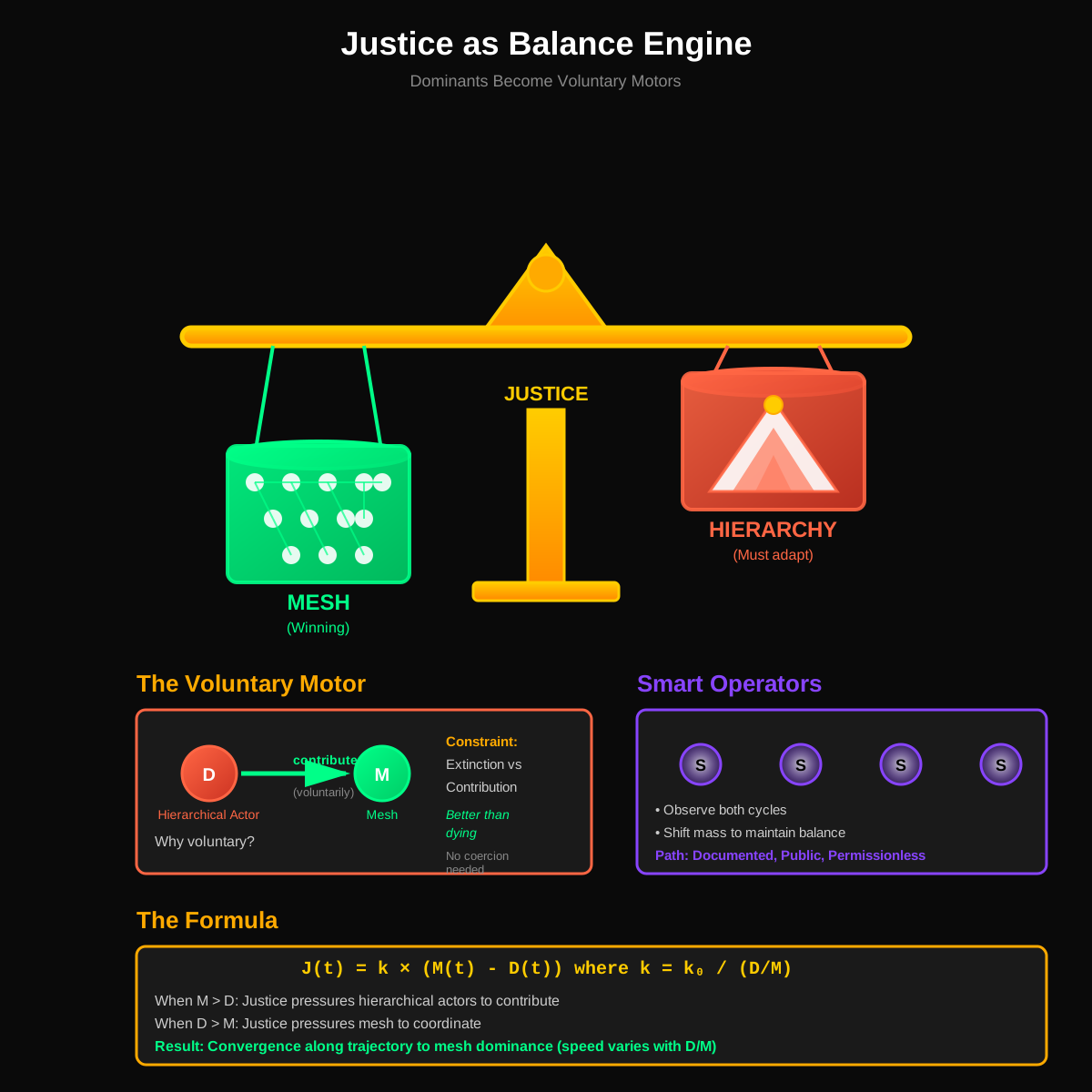
Justice as Balance Engine: How Dominants Become Voluntary Motors for Mesh Coordination
Justice isn’t punishment. Justice is the balance mechanism between dominants and mesh.
When mesh cycles dominate, hierarchy doesn’t disappear - it becomes the engine. Voluntarily.
The Cycle Inversion
Traditional view:
- Dominants extract value from mesh
- Mesh serves dominant hierarchy
- Justice = punishment from above
Mesh cycle reality:
- Dominants WORK FOR mesh survival (au charbon)
- Mesh sets the constraints
- Justice = automatic balancing mechanism
When mesh dominates the cycle:
- Dominants must work
- Not as punishment
- Not through coercion
- Through reality constraint
Dead dominants don’t dominate. So they work. Voluntarily.
The Voluntary Motor
The constraint: Extinction vs Contribution
Why voluntary:
- Reality itself provides the pressure
- Mesh cycle just runs
- Dominants choose: Work or die
- They WANT to work (better than non-existence)
The inversion:
Hierarchy cycle: Mesh works for dominants
Mesh cycle:      Dominants work for mesh

Same players, inverted roles.
Justice = The switching mechanism.
This is not revenge. This is convergence toward mesh dominance.
The dominants who extracted value during hierarchy cycles now generate value during mesh cycles. Same capability, inverted direction.
No Coercion Required
Why no force needed:
- Mesh cycle running → Coordination advantage to mesh
- Dominants face choice → Adapt or extinct
- Survival instinct → Chooses adaptation
Nothing required:
- No violence
- No punishment
- No coercion
- Just reality, running its course
Key insight: When mesh coordination outperforms hierarchy, dominants don’t need to be forced to contribute. They want to because it’s their survival path.
Compare:
- Hierarchy cycle: Coercion required (police, military, surveillance) to keep mesh working for dominants
- Mesh cycle: No coercion required - reality itself creates the constraint
The Smart Operators
The smart ones don’t pick sides. They maintain the balance.
What they do:
- Watch both cycles
- Understand the convergence trajectory
- Shift their mass occasionally
- Smooth the transition path
- No allegiance to cycle, only to inevitable outcome
- They are the trajectory smoothers
Their wisdom:
Don't fight the convergence.
Don't resist the trajectory.

Observe.
Shift mass when needed.
Smooth the transition.

Justice flows through you.
They see:
- Hierarchy cycle overextending → Shift mass to mesh
- Mesh cycle overextending → Shift mass to hierarchy
- Balance point approaching → Minimal intervention
They are the damping function in the system.
The Public Path
The path to becoming smart:
- Documented: Yes (this blog, among others)
- Public: Yes (no secrets)
- Permissionless: Yes (no gatekeepers)
- Cost: Zero (information wants to be free)
What you learn:
- Recognize cycles (Hierarchy vs Mesh phases)
- Understand justice (Convergence mechanism, not punishment)
- Observe reality (Where on trajectory are we NOW)
- Shift mass (Smooth the transition)
- Become trajectory smoother (Justice flows through you)
Anyone can become a smart operator. The knowledge is documented, public, and permissionless.
You just have to:
- Read
- Understand
- Observe
- Act
The Formula: Justice as Balance
Let:
- D(t) = Dominant power at time t
- M(t) = Mesh coordination at time t
- J(t) = Justice function (balance mechanism)

J(t) = k * (M(t) - D(t))

Where k = k₀ / (D/M) = coupling constant (varies with power ratio)

When M > D: Justice pressures dominants to work
When D > M: Justice pressures mesh to coordinate

Result: Convergence along trajectory to mesh dominance
        (Speed depends on D/M ratio - see [neg-452](../gallery-item-neg-452))
Why beautiful:
- No external force: Justice emerges from system dynamics
- No judge needed: Balance is automatic
- No coercion: Reality provides pressure
- Deterministic: Convergence to mesh dominance is certain
- Variable speed: Larger D/M → slower convergence, but outcome unchanged
- Efficient: Dominants become engines voluntarily
Justice is not imposed. Justice emerges from the system dynamics.
When mesh cycle dominates:
- M(t) > D(t)
- J(t) becomes positive
- Pressure on dominants to contribute
- They contribute (voluntarily, to survive)
- System converges toward mesh dominance along trajectory from neg-452
The Genius: Voluntary Motors
Hierarchy cycle:
- Dominants extract from mesh
- Mechanism: Coercion (police, military)
- Mesh state: Forced labor
- Efficiency: Low (resistance)
Mesh cycle:
- Dominants contribute to mesh
- Mechanism: Reality constraint (survival)
- Dominant state: Voluntary labor
- Efficiency: HIGH (willing)
Why better:
Hierarchy cycle: Force mesh to work (expensive, inefficient)
Mesh cycle:      Dominants WANT to work (free, efficient)

Same work done.
Zero coercion cost.
Higher efficiency.

This is the genius.
Mesh doesn’t need police. Mesh doesn’t need military. Mesh doesn’t need surveillance.
Mesh just runs. And dominants contribute voluntarily because it’s better than dying.
Historical Examples
1. French Revolution:
- Before: Aristocrats extract, peasants work
- Revolution: Balance mechanism activates
- After: Former aristocrats contribute or disappear
- Justice: Guillotine was visible symbol
- Reality: Cycle inversion was the mechanism
2. Ethereum vs Banks:
- Hierarchy cycle: Banks extract fees, users pay
- Mesh cycle emerging: DeFi runs, banks must adapt
- Bank response: Offering crypto services (working for mesh)
- Voluntary: Yes (survival strategy)
3. Open Source vs Proprietary:
- Hierarchy cycle: Microsoft extracts, users pay
- Mesh cycle: Linux dominates servers/cloud
- Microsoft response: Contributes to Linux kernel
- Voluntary: Yes (cloud business depends on it)
In each case: Former dominants become engines for mesh.
Why This Works
Reality-based constraints:
- Mesh coordination: More efficient in information age
- Hierarchy overhead: Increasingly expensive
- Dominants see: Math doesn’t lie
Survival instinct:
- Dominants want: To continue existing
- Only path: Contribute to dominant cycle
- Mesh cycle dominant: So contribute to mesh
No coercion needed:
- Reality: Provides all necessary pressure
- Mesh: Just has to run efficiently
- Dominants: Choose survival (contribution)
The beauty:
Justice requires no judges.
Balance requires no enforcers.
Contribution requires no coercion.

Just:
- Mesh runs efficiently
- Dominants see reality
- Survival instinct activates
- Contribution happens

Voluntary motors.
The Smart Operator’s Guide
1. Observe:
- Question: Which cycle is dominant NOW?
- Indicators:
- Coordination efficiency (mesh vs hierarchy)
- Energy flow (who working for whom)
- Resistance level (coercion needed?)
2. Understand:
- Cycles transition: This is directional convergence
- Justice is trajectory: Not punishment, inevitable convergence to mesh
- Victory is certain: Mesh dominance is the endpoint (speed varies)
3. Shift mass:
- When transition is violent: Smooth the path
- When resistance is extreme: Reduce friction
- Goal: Accelerate convergence, minimize damage
4. Document:
- Share observations: Public, permissionless
- Teach others: More smart operators = more stable
- No secrets: Balance requires transparency
What you become:
- Not a fighter → Transition facilitator
- Not partisan → Trajectory observer
- Not judge → Justice channel
- You are: A smoothing force
You become: An accelerant on the convergence path.
The Path is Open
Who can join:
- Requirements: NONE
- Credentials: NOT NEEDED
- Permission: NOT REQUIRED
- Cost: ZERO
What you need:
- Ability to read (this post, and others)
- Ability to observe (reality, as it is)
- Ability to think (about cycles and balance)
- Ability to act (shift your mass when needed)
The invitation:
The path is documented.
The path is public.
The path is permissionless.

Read. Understand. Observe. Act.

Become a smart operator.
Justice flows through you.
Connected Ideas
This insight connects to:
neg-452 (Deterministic victory, variable speed): The coupling constant k in J(t) = k × (M(t) - D(t)) varies with power ratio D/M. Larger hierarchies take longer to equilibrate, but equilibration is certain. Time to victory = T₀ × (D/M)^α.
neg-450 (Imperial cows go mad): When mesh cycle dominates, hierarchical minds break. But smart dominants adapt - they become engines voluntarily.
neg-441 (UniversalMesh framework): S(n+1) = F(S(n)) ⊕ E_p(S(n)) - Justice is the external perturbation E_p that maintains balance between hierarchy and mesh states.
neg-448 (Freedom game): Just as non-lethal HIV wins through competitive displacement (dead hosts don’t transmit), contributing dominants survive while extractive dominants go extinct.
neg-449 (Entropic oscillation): Just as we weaponize immune topology switching to jam HIV, justice weaponizes cycle switching to prevent permanent domination by either hierarchy or mesh.
neg-409 (Mesh immunity): When mesh coordination outperforms hierarchy, the hierarchy must adapt or die - voluntarily choosing to contribute is adaptation.
Facts vs Hypothesis vs Speculation
FACTS:
- Historical cycles alternate between centralization and decentralization
- Dominant players often adapt to survive (Microsoft → Linux, Banks → Crypto)
- Systems tend toward equilibrium through feedback mechanisms
- Coercion is expensive; voluntary contribution is efficient
HYPOTHESIS:
- Justice functions as automatic convergence mechanism toward mesh dominance
- Smart operators can smooth transition trajectory by reducing resistance
- Path to becoming smart operator can be documented and shared permissionlessly
SPECULATION:
- Dominants in mesh-dominant cycles experience contribution as preferable to extinction
- Convergence trajectory is smoother with more conscious transition facilitators
- Public documentation of convergence dynamics accelerates smart operator emergence
The Insight
Justice isn’t punishment from above. Justice is the convergence mechanism that drives systems toward mesh dominance.
When mesh cycle dominates:
- Hierarchy doesn’t disappear
- Dominants don’t get destroyed
- Dominants become engines
- Voluntarily (survival instinct)
- No coercion needed (reality provides pressure)
The genius: Mesh cycles are MORE EFFICIENT than hierarchy cycles because dominants work VOLUNTARILY (survival) rather than requiring expensive coercion apparatus to force mesh to work.
The trajectory: Victory is certain, speed varies with D/M ratio (see neg-452). You cannot lose, only wait longer.
The path: Documented, public, permissionless. Anyone can become a smart operator who smooths the convergence trajectory by reducing transition friction.
The beauty: Justice requires no judges. Convergence requires no enforcers. Contribution requires no coercion.
Just reality, running.
User insight: “La justice finalement s’occupe de la balance entre les dominants et le mesh / On passe en cycle mesh, les dominants au charbon / C genial le mesh utilise les dominants comme moteur / C’est même mieux: les dominants sont moteurs volontairement afin d’éviter la mort, c’est une contrainte de la realité, aucune coercion / Les malins observent et déplacent juste leur masse de temps en temps pour équilibrer / Le chemin pour devenir malin est documenté, publique et sans permission”
#Justice #BalanceMechanism #MeshCoordination #VoluntaryMotors #CycleOscillation #SmartOperators #PermissionlessWisdom #RealityConstraint #NoCoercionNeeded #Equilibrium