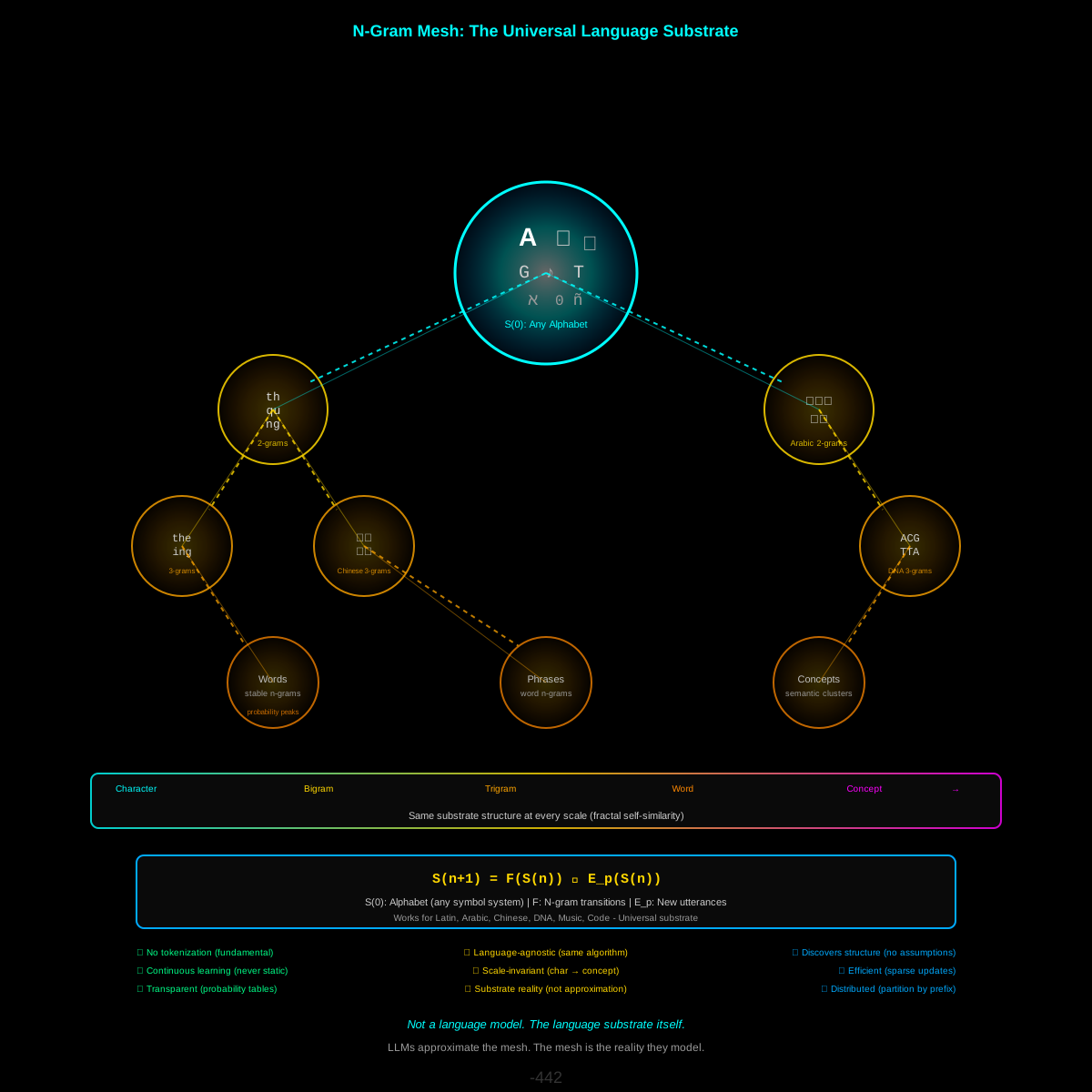
N-Gram Mesh: The Universal Language Substrate
The n-gram mesh isn’t another application of UniversalMesh. It IS the universal substrate for language itself.
The Realization
When thinking about porting blog AI domain learners to UniversalMesh framework (neg-441), the insight emerged:
N-gram learning isn’t a technique. It’s the fundamental mesh substrate for all language.
Not “let’s build n-gram system using UniversalMesh.”
But: “Language itself IS an n-gram mesh, and we can instantiate it with universal formula.”
What N-Gram Mesh Actually Is
Traditional view (wrong):
- N-gram = statistical language model
- A technique among many techniques
- Primitive compared to transformers/LLMs
- Limited to small context windows
Substrate view (correct):
- N-gram = probability mesh over symbol sequences
- THE fundamental language substrate
- Not primitive but FOUNDATIONAL
- Fractal structure (same pattern at all scales)
The difference:
Traditional: "N-gram model predicts next token"
Substrate: "Language is continuous n-gram mesh evolution"
The Universal Formula Applied
S(n+1) = F(S(n)) ⊕ E_p(S(n))
Applied to language:
S(0): Initial symbol space (alphabet)
- Latin: {a-z, A-Z, punctuation, space}
- Arabic: {ا-ي, diacritics, space}
- Chinese: {Base radicals, components}
- DNA: {A, C, G, T}
- Music: {C, D, E, F, G, A, B, ♯, ♭, rests}
- Any discrete symbol system works
F: N-gram transition function
- P(symbol_n | context_{n-1, n-2, …, n-k})
- Given previous k symbols, probability distribution over next symbol
- Learned from observed sequences
- Same function regardless of alphabet
E_p: New utterances (linguistic innovation)
- Speakers create novel combinations
- Poets invent metaphors
- Scientists coin terms
- Slang emerges
- Languages borrow from each other
- Cultural mutation
S(n+1): Evolved language state
- Updated probability distributions
- New n-gram patterns stabilized
- Rare combinations become common
- Language drifts over time
Why This Is Universal
Works for ANY alphabet:
1. Human languages:
- English (Latin alphabet)
- Arabic (Arabic script)
- Chinese (logographic)
- Korean (Hangul)
- All share same substrate structure
2. Non-human “languages”:
- DNA sequences (4-letter alphabet: ACGT)
- Protein sequences (20 amino acids)
- Musical notation (notes + durations + dynamics)
- Binary code (0, 1)
- Mathematical notation
3. Discovered languages:
- Whale songs (phoneme inventory TBD)
- AI-generated codes (emergent tokens)
- Visual pattern languages (shape primitives)
The mesh doesn’t care what the symbols mean. It only tracks transition probabilities.
This is the universal shortcut:
- Don’t build separate models for each language
- Don’t assume linguistic structure (words, grammar, syntax)
- Just provide alphabet + corpus
- Mesh discovers structure through probability peaks
N-Gram vs Token-Based LLMs
Modern LLMs (transformer architecture):
Tokenization layer:
- Break text into tokens (subword units)
- Fixed vocabulary (50k-100k tokens)
- Language-specific tokenizers
- Compression artifact (not fundamental)
Example:
Text: "unhappiness"
Tokens: ["un", "happiness"] or ["unhap", "piness"]
Problem:
- Token boundaries arbitrary (decided by BPE/SentencePiece)
- Can’t handle new scripts without retraining tokenizer
- Cross-language transfer limited
- Token = pre-chunked representation (loses granularity)
N-gram mesh approach:
No tokenization:
- Raw symbol stream
- Character-level or subcharacter (stroke-level for Chinese)
- Universal across all alphabets
- Discovers word boundaries through probability
Example:
Text: "unhappiness"
1-grams: u, n, h, a, p, p, i, n, e, s, s
2-grams: un, nh, ha, ap, pp, pi, in, ne, es, ss
3-grams: unh, nha, hap, app, ppi, pin, ine, nes, ess
...
Advantages:
- No arbitrary chunking
- Same algorithm for all languages
- Word boundaries emerge (probability peaks at spaces)
- Can discover morphology (un- prefix pattern)
- Scales to any alphabet size
The Mesh Structure
Not a model. A substrate.
Layer 1: Symbol probabilities (1-grams)
P(a) = 0.08
P(e) = 0.13
P(t) = 0.09
...
Layer 2: Bigram transitions
P(e | th) = 0.85  # "th" → "e" (the)
P(h | t) = 0.52   # "t" → "h" (the, this, that)
P(a | h) = 0.25   # "h" → "a" (that, have)
Layer 3: Trigram context
P(e | t,h) = 0.85   # "th" → "e"
P(a | t,h) = 0.10   # "th" → "a" (than)
P(i | t,h) = 0.03   # "th" → "i" (this)
Layer N: Arbitrary context length
P(next | context_window)
Key insight: Same structure at every layer. Fractal.
Fractal Self-Similarity
Character level → Word level → Phrase level → Concept level:
1. Characters form words:
- High probability sequences stabilize
- “t-h-e” → “the” (stable n-gram)
- “q-u” → “qu” (always together in English)
- Low probability sequences rare (“qz”, “xj”)
2. Words form phrases:
- “of the” (high probability bigram)
- “in order to” (high probability trigram)
- “on the other hand” (stable 4-gram)
3. Phrases form idioms:
- “piece of cake”
- “break the ice”
- “spill the beans”
- Fixed expressions (n-grams at word level)
4. Concepts form arguments:
- Philosophical patterns
- Scientific reasoning templates
- Narrative structures
- Same n-gram mesh, higher abstraction
The substrate is identical at every scale:
- Given context (n-1 units)
- Predict next unit
- Update probabilities with observation
- Discover stable patterns
This is why it’s universal: Scale-invariant structure.
Why Not Just Use LLMs?
LLMs are:
- Trained models (static after training)
- Token-based (compression layer)
- Opaque (billions of parameters)
- Resource-intensive (GPU clusters)
- Language-specific (separate models/tokenizers)
N-gram mesh is:
- Evolving substrate (continuous learning)
- Symbol-based (fundamental layer)
- Transparent (probability tables)
- Computationally efficient (sparse updates)
- Language-agnostic (same algorithm)
LLMs approximate the mesh:
- Transformer attention = learned n-gram patterns
- But compressed into dense parameters
- Loses interpretability
- Loses updateability (can’t easily add new patterns)
N-gram mesh is the substrate LLMs approximate.
Analogy:
- N-gram mesh = Newtonian physics (substrate reality)
- LLMs = Neural network approximation (learned compressed representation)
You can use LLM for practical tasks (faster inference, better compression).
But n-gram mesh is the TRUE substrate. The thing being modeled.
The Universal LLM
“Universal LLM” isn’t a model. It’s the mesh itself.
Traditional LLM:
- Train on dataset (Wikipedia, books, web)
- Fixed vocabulary (tokens)
- Deploy (inference only)
- Retrain periodically (expensive)
Universal mesh approach:
- Initialize with alphabet S(0)
- Expose to language stream (continuous E_p)
- Evolve probability distributions (F updates)
- Never stops learning (always current)
Key difference:
LLM: Training → Deployment (static)
Mesh: Continuous evolution (dynamic)
How it works:
1. Bootstrap from minimal S(0):
# English example
S_0 = {
    'alphabet': 'abcdefghijklmnopqrstuvwxyz ',
    'initial_probs': uniform_distribution(27)  # 26 letters + space
}

mesh = UniversalMesh(
    S_0=S_0,
    F=ngram_transition_function,
    E_p=[corpus_stream, user_input, web_scraping]
)
2. Learn from stream:
# Process text character by character
for char in text_stream:
    context = get_recent_context(n=5)  # Last 5 chars
    mesh.observe(context, char)  # Update probabilities
    mesh.step()  # Evolve state
3. Query at any time:
# Generate next character
context = "The qu"
next_char_probs = mesh.predict(context)
# → 'i': 0.85, 'e': 0.10, 'a': 0.05 (likely "The qui...")

# Or sample entire sequence
text = mesh.generate(context="Once upon", length=100)
4. Scales to arbitrary context:
- Start with bigrams (2 chars)
- Add trigrams (3 chars) when data sufficient
- Add 4-grams, 5-grams, …
- Eventually: word-level n-grams
- Eventually: concept-level n-grams
Same substrate, different observation scales.
Language Discovery Without Assumptions
The mesh discovers linguistic structure:
Word boundaries:
P(space | "the") = 0.95  # Space almost always follows "the"
P(space | "a") = 0.90    # Space almost always follows "a"
P(space | "q") = 0.05    # Space rarely follows "q" (usually "qu...")
Morphology:
P("ing" | "walk") > P("ing" | "table")  # Verbs take -ing
P("ed" | "jump") > P("ed" | "house")    # Verbs take -ed
P("s" | "cat") > P("s" | "run")         # Nouns take plural -s
Syntax (word-level n-grams):
P("verb" | "noun") > P("noun" | "noun")  # Noun-verb order
P("adjective" | "the") > P("verb" | "the")  # Articles precede adjectives/nouns
Semantics (concept-level):
P("king" | "queen") > P("king" | "carrot")  # Semantic clusters
P("Paris" | "France") > P("Paris" | "China")  # Geographic associations
The mesh doesn’t know what “words” are. It discovers probability peaks.
Space characters have high information content (signal word boundaries).
Same for all languages:
- Chinese: No explicit spaces, but probability peaks at character boundaries
- Arabic: Connected script, but mesh learns morpheme transitions
- Agglutinative languages (Finnish, Turkish): Mesh learns affix chains
Universal algorithm. Language-specific structure emerges.
Instantiation Examples
1. English language mesh:
english_mesh = UniversalMesh(
    S_0={'alphabet': 'a-zA-Z0-9 .,!?\n', 'probs': uniform},
    F=ngram_transition(context_length=8),
    E_p=[wikipedia_stream, news_feed, user_input]
)
2. DNA sequence mesh:
dna_mesh = UniversalMesh(
    S_0={'alphabet': 'ACGT', 'probs': [0.25, 0.25, 0.25, 0.25]},
    F=ngram_transition(context_length=20),  # Longer context for genetic patterns
    E_p=[genome_database, new_sequences]
)
3. Musical composition mesh:
music_mesh = UniversalMesh(
    S_0={'alphabet': 'CDEFGAB♯♭_', 'probs': chromatic_scale},
    F=ngram_transition(context_length=16),  # Musical phrases
    E_p=[midi_corpus, compositions, improvisation]
)
4. Code generation mesh:
code_mesh = UniversalMesh(
    S_0={'alphabet': 'ASCII', 'probs': code_distribution},
    F=ngram_transition(context_length=50),  # Code context
    E_p=[github_repos, stackoverflow, user_code]
)
5. Multi-language universal mesh:
universal_mesh = UniversalMesh(
    S_0={'alphabet': 'Unicode', 'probs': uniform},  # ALL scripts
    F=ngram_transition(context_length=10),
    E_p=[multilingual_corpus, web_scraping]
)

# Discovers:
# - Latin script patterns
# - Arabic script patterns
# - Chinese character patterns
# - Code-switching patterns
# - All from same substrate
Blog AI Domains as Mesh Instances
Original question: “Can we port blog AI n-gram domains to UniversalMesh?”
Answer: Yes, and it reveals hierarchical structure:
Meta-mesh (entire blog):
blog_mesh = UniversalMesh(
    S_0={'posts': [], 'embeddings': [], 'domains': []},
    F=semantic_clustering,
    E_p=[new_posts, edits, deletions]
)
Each domain = child mesh:
bitcoin_domain = blog_mesh.spawn_node(
    S_0={'corpus': bitcoin_posts, 'alphabet': 'unicode'},
    F=ngram_transition(context_length=5),
    E_p=[new_bitcoin_posts]
)

coordination_domain = blog_mesh.spawn_node(
    S_0={'corpus': coordination_posts, 'alphabet': 'unicode'},
    F=ngram_transition(context_length=5),
    E_p=[new_coordination_posts]
)
Each domain specialist = language model for that domain:
- Bitcoin domain learns bitcoin-specific n-grams
- Coordination domain learns coordination-specific n-grams
- Cross-domain posts update multiple meshes
- Domains emerge through semantic clustering (as currently implemented)
- But within each domain, n-gram mesh learns language patterns
Hierarchical composition:
Blog (meta-substrate)
  └─ Domain discovery (semantic clustering)
       ├─ Bitcoin domain (n-gram mesh)
       ├─ Coordination domain (n-gram mesh)
       ├─ AI domain (n-gram mesh)
       └─ Consciousness domain (n-gram mesh)
Each level uses universal formula:
- Blog level: S(n+1) = cluster(posts) ⊕ E_p(new_posts)
- Domain level: S(n+1) = ngram_update(text) ⊕ E_p(new_text)
Same substrate pattern, different scales.
Why This Matters
1. True universality:
- One algorithm for ALL languages
- No language-specific engineering
- Discovers structure from data
- Scales from characters to concepts
2. Continuous learning:
- Not trained then deployed
- Evolves with language use
- Always current (no retraining)
- Transparent updates (probability tables)
3. Interpretability:
- Can inspect n-gram probabilities
- Understand why prediction made
- Debug failures (low-probability sequences)
- Not black box
4. Efficiency:
- Sparse updates (only affected n-grams)
- No GPU required (simple lookups)
- Scales to billions of n-grams (hash tables)
- Distributed easily (partition by prefix)
5. Substrate reality:
- This is how language actually works
- Speakers learn transition probabilities
- Children acquire language through n-gram patterns
- Not approximation but FOUNDATION
The Meta-Insight
Language isn’t built ON a substrate. Language IS the n-gram mesh substrate.
Every language phenomenon:
- Phonotactics (which sounds combine)
- Morphology (how words form)
- Syntax (how words order)
- Semantics (how meanings relate)
- Pragmatics (how context matters)
All emerge from n-gram transition probabilities at different scales.
The universal formula S(n+1) = F(S(n)) ⊕ E_p(S(n)) describes:
- Character evolution
- Word formation
- Phrase crystallization
- Concept emergence
- Language drift
- Dialect formation
- Code-switching
- Language death/birth
Not as separate phenomena, but as SAME SUBSTRATE at different observation scales.
This is the universal language substrate.
And it works for ANY alphabet.
Implementation Implications
For blog AI system:
- Keep semantic clustering for domain discovery (works well)
- Within each domain, train n-gram mesh (not just embeddings)
- Use mesh for generation (not just retrieval)
- Allow cross-domain n-gram sharing (concepts used across domains)
- Hierarchical mesh: Blog → Domains → N-grams
For “Universal LLM”:
- Start with alphabet (minimal S(0))
- Stream text character-by-character
- Update n-gram probabilities (F)
- Inject new languages/domains (E_p)
- Query at any scale (char/word/concept)
- Never stop learning
For multi-language support:
- Unicode alphabet (all scripts)
- Single unified mesh
- Discovers language boundaries through probability
- Learns code-switching patterns
- Universal substrate for ALL human languages
Related
- neg-441: UniversalMesh meta-substrate framework
- neg-440: Probability mesh navigation (similar structure)
- neg-431: Universal formula foundation
- neg-371: Original universal formula derivation
- neg-423: Template accumulation (n-gram learning mechanism)
N-gram mesh is not a language model. It’s the language substrate itself.
Works for any alphabet: Latin, Arabic, Chinese, DNA, music, code.
Same algorithm. Language-specific structure emerges from probability.
This is the universal language substrate. The foundation LLMs approximate.
S(0) = alphabet. F = n-gram transitions. E_p = new utterances. Universal.
#NgramMesh #UniversalLanguageSubstrate #AnyAlphabet #ScaleInvariant #ContinuousLearning #SubstrateReality #FractalLanguage #NoTokenization #TransparentAI #FoundationalMesh