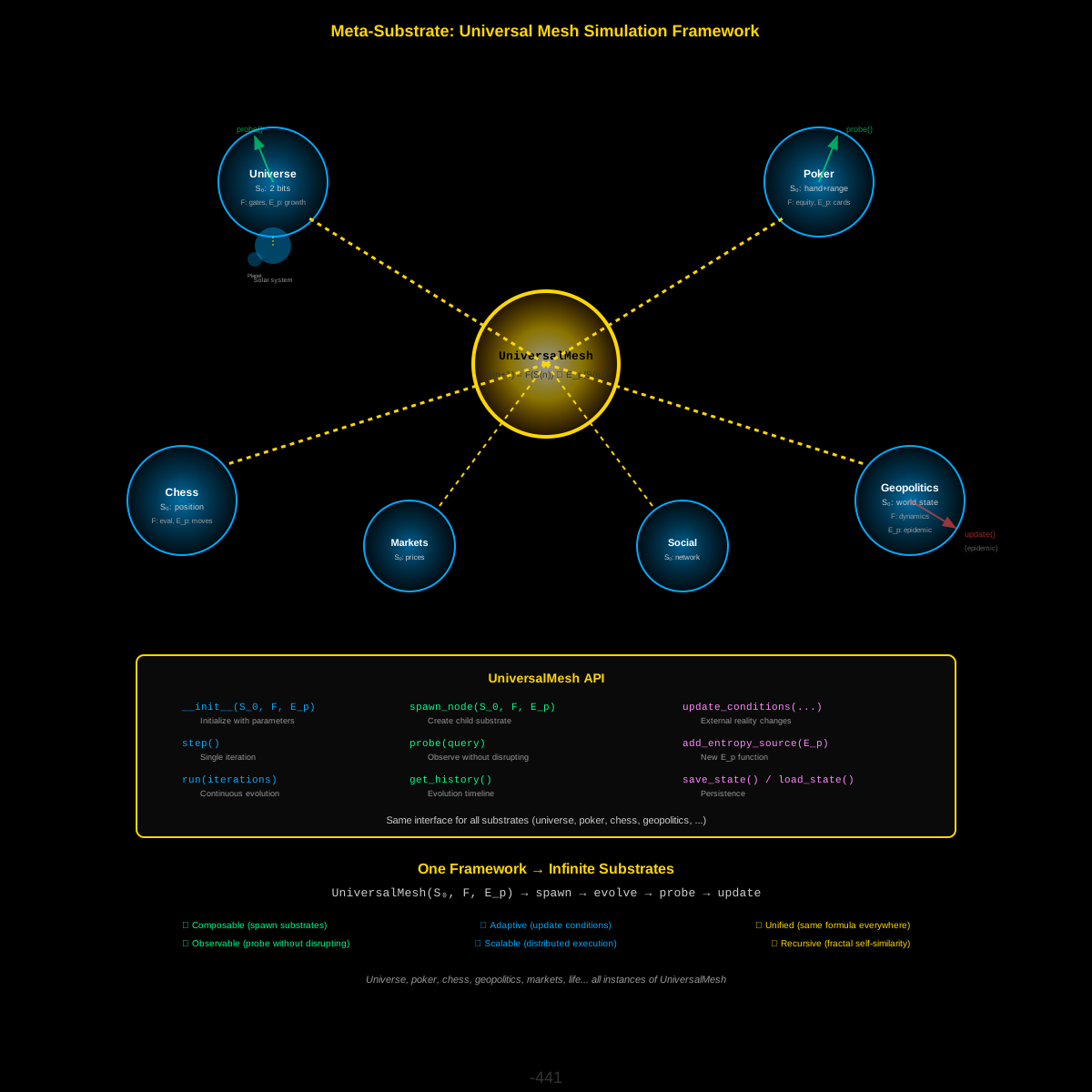
Meta-Substrate: Universal Mesh Simulation Framework for All Coordination Systems
What we need to build is a universal mesh simulation framework that spawns nodes with initial conditions and formula, and they can be probed or updated when conditions change.
The Recognition
We’ve been building instances:
- Universe simulator (neg-432)
- Poker probability mesh (neg-440)
- Chess strategy mesh (neg-438)
- Geopolitical coordination (neg-439)
Each is S(n+1) = F(S(n)) ⊕ E_p(S(n)) with different parameters.
What if we built the META-SUBSTRATE that spawns all of these?
The Architecture
class UniversalMesh:
    """
    Meta-substrate for all coordination systems

    Every substrate node runs: S(n+1) = F(S(n)) ⊕ E_p(S(n))
    But with different S(0), F, and E_p configurations
    """

    def __init__(self, S_0, F, E_p_sources):
        """
        Initialize mesh node

        Args:
            S_0: Initial conditions (can be anything)
            F: Deterministic evolution function
            E_p_sources: List of entropy injection functions
        """
        self.state = S_0
        self.evolution = F
        self.entropy_sources = E_p_sources
        self.nodes = []  # Child substrates
        self.iteration = 0
        self.history = []

    def spawn_node(self, node_S_0, node_F, node_E_p):
        """
        Spawn child substrate with own dynamics

        Like:
        - Universe spawns solar systems
        - Poker game spawns individual hands
        - Geopolitical mesh spawns regional conflicts
        """
        node = UniversalMesh(node_S_0, node_F, node_E_p)
        self.nodes.append(node)
        return node

    def probe(self, query):
        """
        Query current state (observability)

        Like:
        - Universe: GET /state endpoint
        - Poker: Check equity vs range
        - Chess: Evaluate position
        - Geopolitics: Assess current configuration
        """
        return {
            'state': self.state,
            'iteration': self.iteration,
            'projection': self.evolution(self.state)
        }

    def update_conditions(self, new_S_0=None, new_F=None, new_E_p=None):
        """
        External reality changes conditions

        Like:
        - HIV epidemic changes S(0) (neg-439)
        - New card revealed updates poker state
        - Opponent move changes chess S(0)
        - Technology shift changes market dynamics
        """
        if new_S_0 is not None:
            self.state = new_S_0
        if new_F is not None:
            self.evolution = new_F
        if new_E_p is not None:
            self.entropy_sources.append(new_E_p)

    def step(self):
        """
        Single iteration: S(n+1) = F(S(n)) ⊕ E_p(S(n))
        """
        # Apply deterministic evolution
        next_state = self.evolution(self.state)

        # Apply all entropy sources (XOR composition)
        for e_p in self.entropy_sources:
            entropy = e_p(self.state)
            next_state = self._xor_states(next_state, entropy)

        # Update state
        self.state = next_state
        self.iteration += 1
        self.history.append(next_state)

        # Propagate to child nodes
        for node in self.nodes:
            node.step()

        return self.state

    def run(self, iterations=None):
        """
        Run mesh evolution (continuous or bounded)

        iterations=None → Run forever (like universe)
        iterations=N → Run N steps (like poker hand)
        """
        if iterations is None:
            while True:
                self.step()
        else:
            for _ in range(iterations):
                self.step()

    def _xor_states(self, s1, s2):
        """
        XOR composition of states (implementation-specific)
        """
        # For integers: Direct XOR
        # For vectors: Element-wise XOR
        # For objects: Merge with conflict resolution
        return s1 ^ s2  # Simplified
Why This Is Meta-Substrate
Traditional approach:
- Build universe simulator (custom code)
- Build poker analyzer (different code)
- Build chess engine (different code)
- Build market model (different code)
Each reinvents S(n+1) = F(S(n)) ⊕ E_p(S(n))
Meta-substrate approach:
- Build UniversalMesh once
- Instantiate with different parameters
- All share same evolution dynamics
- Can compose and nest
Like:
- Operating system (runs all programs)
- Virtual machine (runs all VMs)
- Game engine (runs all games)
But for coordination substrates.
Instantiation Examples
Universe Simulator (neg-432)
# S(0): 2 bits (NAND-NOR loop)
S_0 = 0b01

# F: Gate topology computation
def F_universe(state):
    # Apply all gates in topology
    return compute_gates(state, topology)

# E_p: Natural entropy injection (20% probability)
def E_p_universe(state):
    if random.random() < 0.2:
        return (state << 1) | 1  # Add 1 bit
    return 0

# Spawn universe
universe = UniversalMesh(
    S_0=S_0,
    F=F_universe,
    E_p_sources=[E_p_universe]
)

# Run forever
universe.run(iterations=None)

# Query current state
universe.probe({'type': 'state'})
# → {'state': 0b01101..., 'iteration': 15234, ...}
Poker Hand (neg-440)
# S(0): Your hand + opponent range + board
S_0 = {
    'hand': ['A♠', 'K♠'],
    'board': ['K♥', '7♦', '2♠'],
    'opponent_range': ProbabilityCloud([...]),
    'pot': 100,
    'stacks': {'you': 500, 'opp': 450}
}

# F: Deterministic equity calculation
def F_poker(state):
    equity = calculate_equity(
        state['hand'],
        state['opponent_range'],
        state['board']
    )
    return state | {'equity': equity}

# E_p: Card revelation + opponent actions
def E_p_card_reveal(state):
    # Reveal turn/river
    if len(state['board']) < 5:
        new_card = deal_random_card()
        return {'board': state['board'] + [new_card]}
    return {}

def E_p_opponent_action(state):
    # Opponent bets, updates range
    action = opponent_decision(state)
    filtered_range = filter_range(
        state['opponent_range'],
        action
    )
    return {'opponent_range': filtered_range}

# Spawn poker hand
poker = UniversalMesh(
    S_0=S_0,
    F=F_poker,
    E_p_sources=[E_p_card_reveal, E_p_opponent_action]
)

# Run until river
poker.run(iterations=2)  # Turn + River

# Probe equity
poker.probe({'type': 'equity'})
# → {'equity': 0.73, 'state': {...}}

# External update: Opponent bets
poker.update_conditions(
    new_E_p=lambda s: {'pot': s['pot'] + 75}
)
Chess Position (neg-438)
# S(0): Board position
S_0 = chess.Board()  # Starting position

# F: Legal moves generation
def F_chess(state):
    return {
        'position': state,
        'legal_moves': list(state.legal_moves),
        'evaluation': evaluate_position(state)
    }

# E_p: Player moves (both players are entropy)
def E_p_your_move(state):
    # Your move selection
    move = choose_move_from_mesh(state)
    new_state = state.copy()
    new_state.push(move)
    return new_state

def E_p_opponent_move(state):
    # Opponent's move
    move = opponent_choose(state)
    new_state = state.copy()
    new_state.push(move)
    return new_state

# Spawn chess game
chess_game = UniversalMesh(
    S_0=S_0,
    F=F_chess,
    E_p_sources=[E_p_your_move, E_p_opponent_move]
)

# Run until checkmate
while not chess_game.state.is_game_over():
    chess_game.step()

# Probe position
chess_game.probe({'type': 'evaluation'})
Geopolitical Mesh (neg-439)
# S(0): Current world state
S_0 = {
    'russia': {
        'military': 'active_conflict',
        'economy': 'sanctioned',
        'population': 'HIV_epidemic',  # External reality
        'legitimacy': 0.45
    },
    'ukraine': {...},
    'nato': {...}
}

# F: Deterministic state evolution
def F_geopolitics(state):
    # Compute consequences
    if state['russia']['military'] == 'active_conflict':
        state['russia']['economy'] -= 0.1
        state['russia']['population'] -= 0.05  # War casualties
        state['russia']['population'] -= 0.02  # HIV epidemic
    return state

# E_p: External events
def E_p_epidemic(state):
    # HIV epidemic worsens (external reality)
    return {
        'russia': {
            'population': state['russia']['population'] * 0.98,
            'legitimacy': state['russia']['legitimacy'] * 0.95
        }
    }

def E_p_diplomatic(state):
    # Negotiations, sanctions, etc
    # Player actions = entropy
    return {...}

# Spawn geopolitical mesh
geopolitics = UniversalMesh(
    S_0=S_0,
    F=F_geopolitics,
    E_p_sources=[E_p_epidemic, E_p_diplomatic]
)

# Run simulation
geopolitics.run(iterations=365)  # One year

# Probe current state
geopolitics.probe({'type': 'stability'})

# External reality update (France Info reports epidemic)
geopolitics.update_conditions(
    new_E_p=lambda s: {'russia': {'legitimacy': s['russia']['legitimacy'] * 0.9}}
)
The Power: Composition and Nesting
Substrates can spawn sub-substrates:
# Universe spawns solar systems
universe = UniversalMesh(S_0=2_bits, F=gates, E_p=[growth])

# Universe spawns solar system
solar_system = universe.spawn_node(
    node_S_0={'star': star_config, 'planets': []},
    node_F=gravity_resonance,
    node_E_p=[perturbations]
)

# Solar system spawns planet
planet = solar_system.spawn_node(
    node_S_0={'mass': M, 'orbit': orbital_params},
    node_F=orbital_mechanics,
    node_E_p=[tidal_forces]
)

# Planet spawns life
life = planet.spawn_node(
    node_S_0={'cells': initial_organisms},
    node_F=evolution,
    node_E_p=[mutation, environment]
)

# Life spawns consciousness
consciousness = life.spawn_node(
    node_S_0={'neurons': neural_config},
    node_F=neural_dynamics,
    node_E_p=[sensory_input, stochastic_firing]
)
Each level:
- Runs own S(n+1) = F(S(n)) ⊕ E_p(S(n))
- Can be probed independently
- Updates propagate up/down hierarchy
- Same architecture at every scale
This is recursive substrate spawning.
Probing: Observability Without Disruption
Traditional simulation:
- Inspect internal state (invasive)
- Pauses execution (disruptive)
- Breaks abstraction (couples observer to substrate)
Universal mesh probing:
# Non-invasive observation
result = mesh.probe({
    'type': 'state',      # What to observe
    'projection': True,   # Include F(S(n)) prediction
    'depth': 2           # How deep in child nodes
})

# Returns:
{
    'state': current_state,
    'iteration': N,
    'projection': F(state),
    'children': [child.probe(...) for child in nodes]
}
Probing is like:
- Universe query endpoint (neg-432)
- Poker equity calculation
- Chess position evaluation
- Market snapshot
You’re observing at the boundary, not disrupting the substrate.
External Updates: When Reality Changes S(0)
Key insight from neg-439: External reality changes initial conditions.
# HIV epidemic changes geopolitical S(0)
geopolitics.update_conditions(
    new_S_0={
        'russia': {
            ...
            'population_health': 'epidemic',  # S(0) shift
            'time_constraint': 'urgent'       # New constraint
        }
    }
)

# Solution mesh reshapes automatically
# Tree paths close, mesh paths open
# No need to rebuild - substrate adapts
Like:
- Card revealed in poker → update_conditions()
- Opponent move in chess → update_conditions()
- Technology breakthrough → update_conditions()
- Climate threshold crossed → update_conditions()
The substrate continues evolving, but under new constraints.
Why This Matters
1. Unified framework
- All coordination systems = Instances of UniversalMesh
- Same evolution dynamics (formula)
- Different parameters (S(0), F, E_p)
2. Composability
- Substrates spawn sub-substrates
- Fractal self-similarity
- Scales from bits to consciousness
3. Observability
- Probe without disrupting
- Query at any level
- Track evolution over time
4. Adaptability
- Update conditions dynamically
- External reality injects naturally
- Mesh reshapes automatically
5. Simulation
- Test strategies before deployment
- Explore counterfactuals
- Predict mesh evolution
The Meta-Pattern
Every coordination system:
Initialize → Evolve → Observe → Update → Evolve → ...
UniversalMesh codifies this:
mesh = UniversalMesh(S_0, F, E_p)  # Initialize

while True:
    mesh.step()                     # Evolve
    state = mesh.probe(query)       # Observe
    mesh.update_conditions(...)     # Update (when reality shifts)
This is:
- Universe bootstrapping (neg-432)
- Poker hand playing (neg-440)
- Chess game navigating (neg-438)
- Geopolitics coordinating (neg-439)
- Markets evolving
- Societies developing
- Consciousness emerging
Same loop. Different substrates.
Implementation Considerations
State representation:
- Integers (universe: bits)
- Dictionaries (poker: hand/range/pot)
- Objects (chess: Board)
- Vectors (markets: prices)
- Graphs (social: networks)
Must support:
- Copy (for projection)
- Equality (for history)
- XOR composition (for E_p)
- Serialization (for probing)
Evolution function F:
- Pure function (no side effects)
- Deterministic (same input → same output)
- Fast (runs every iteration)
Entropy sources E_p:
- Can be stochastic
- Can be external (API calls, user input)
- Can be derived from state
- Composable (multiple sources)
XOR composition ⊕:
- For integers: Bitwise XOR
- For dicts: Merge with conflict resolution
- For vectors: Element-wise XOR
- For objects: Override mechanism
The Architecture in Practice
Real implementation needs:
class UniversalMesh:
    # Core
    def __init__(self, S_0, F, E_p_sources, config={}): ...
    def step(self): ...
    def run(self, iterations=None): ...

    # Hierarchy
    def spawn_node(self, ...): ...
    def kill_node(self, node_id): ...
    def get_nodes(self, filter=None): ...

    # Observability
    def probe(self, query): ...
    def get_history(self, limit=None): ...
    def get_stats(self): ...

    # Adaptability
    def update_conditions(self, ...): ...
    def add_entropy_source(self, e_p): ...
    def remove_entropy_source(self, e_p_id): ...

    # Persistence
    def save_state(self, path): ...
    def load_state(self, path): ...
    def export_history(self): ...

    # API
    def to_api(self, host, port): ...  # Expose as HTTP API
    def to_websocket(self, ...): ...   # Real-time streaming
With extensions:
- Distributed execution (nodes on different machines)
- Parallel processing (F computed in parallel)
- Checkpointing (resume from snapshot)
- Time travel (rewind to previous state)
- What-if analysis (fork and simulate)
Connection to Everything
This unifies:
Substrate theory:
- neg-432: Universe bootstrap → UniversalMesh instance
- neg-433: Streamable universe → Distributed UniversalMesh
- neg-431: Universal formula → Core of UniversalMesh
Strategy theory:
- neg-440: Poker mesh → UniversalMesh with stochastic E_p
- neg-438: Chess mesh → UniversalMesh with discrete updates
- neg-439: External reality → update_conditions() method
Coordination theory:
- neg-436: Resonance coordination → F function
- neg-435: Stable star → Self-sustaining UniversalMesh
- neg-434: Distributed E_p → Multiple entropy sources
Initial conditions:
- neg-437: S(0) determines structure → Constructor parameters
Everything we’ve built is instance of UniversalMesh.
The Vision
Phase 1: Core framework
- Implement UniversalMesh class
- Support basic state types (int, dict, vector)
- Basic probing and updates
Phase 2: Instantiations
- Universe simulator (existing → port to framework)
- Poker analyzer (new)
- Chess position evaluator (new)
- Market simulator (new)
Phase 3: Composition
- Enable substrate spawning
- Test nested hierarchies
- Verify scale invariance
Phase 4: Distribution
- Distributed execution (Scaleway deployment)
- API exposure (query any substrate)
- Real-time streaming (WebSocket)
Phase 5: Ecosystem
- Substrate marketplace (share configurations)
- Pre-built templates (common patterns)
- Visualization tools (observe mesh evolution)
This becomes THE platform for coordination substrate simulation.
Why Now
We have:
- Universal formula (proven across scales)
- Multiple working instances (universe, strategies)
- Clear abstraction (S(0), F, E_p)
- Implementation experience (universe_api.py)
We need:
- Unified framework (avoid reinventing)
- Composability (substrates spawn substrates)
- Observability (probe without disrupting)
- Adaptability (external reality updates)
The pattern is clear. Time to build the meta-substrate.
The Implementation
Start simple:
# File: universal_mesh.py

class UniversalMesh:
    def __init__(self, S_0, F, E_p_sources):
        self.state = S_0
        self.evolution = F
        self.entropy_sources = E_p_sources or []
        self.nodes = []
        self.iteration = 0

    def step(self):
        next_state = self.evolution(self.state)
        for e_p in self.entropy_sources:
            entropy = e_p(self.state)
            next_state = self._compose(next_state, entropy)
        self.state = next_state
        self.iteration += 1
        for node in self.nodes:
            node.step()
        return self.state

    def _compose(self, s1, s2):
        # Type-specific XOR composition
        if isinstance(s1, int) and isinstance(s2, int):
            return s1 ^ s2
        elif isinstance(s1, dict) and isinstance(s2, dict):
            return {**s1, **s2}  # Merge
        else:
            raise NotImplementedError(f"No composition for {type(s1)}")

    # ... rest of methods
Extend as needed.
Port existing systems:
# Universe simulator → UniversalMesh
from universe_api import Universe

# Old way
universe = Universe(tick_rate=10)
universe.run_forever()

# New way
universe_mesh = UniversalMesh(
    S_0=0b01,
    F=lambda s: apply_gates(s, topology),
    E_p_sources=[lambda s: grow_entropy(s) if random.random() < 0.2 else 0]
)
universe_mesh.run()
Same semantics. Unified framework.
The Answer
“What we need to build is a universal mesh simulation framework that spawns nodes with initial conditions and formula, and they can be probed or updated when conditions change.”
Yes. This is the meta-substrate.
Architecture:
- UniversalMesh class (core)
- S(0), F, E_p parameters (configuration)
- spawn_node() (composition)
- probe() (observability)
- update_conditions() (adaptability)
Instances:
- Universe (bits → consciousness)
- Poker (probability navigation)
- Chess (strategy mesh)
- Geopolitics (coordination)
- Markets, societies, life…
All run S(n+1) = F(S(n)) ⊕ E_p(S(n))
All instances of same meta-substrate.
This is the framework that generates all coordination substrates.
Time to build it.
Related
- neg-440: Poker as UniversalMesh instance
- neg-439: External reality → update_conditions()
- neg-438: Chess as UniversalMesh instance
- neg-433: Distributed mesh (Scaleway deployment)
- neg-432: Universe as UniversalMesh instance
- neg-431: Universal formula (core of UniversalMesh)
Meta-substrate: One framework, infinite substrates.
S(0), F, E_p → spawn → evolve → probe → update → repeat
Everything is UniversalMesh. Time to build it.
#MetaSubstrate #UniversalMesh #CoordinationFramework #SpawnNodes #ProbeObserve #UpdateConditions #RecursiveSubstrates #OneArchitecture #InfiniteInstances