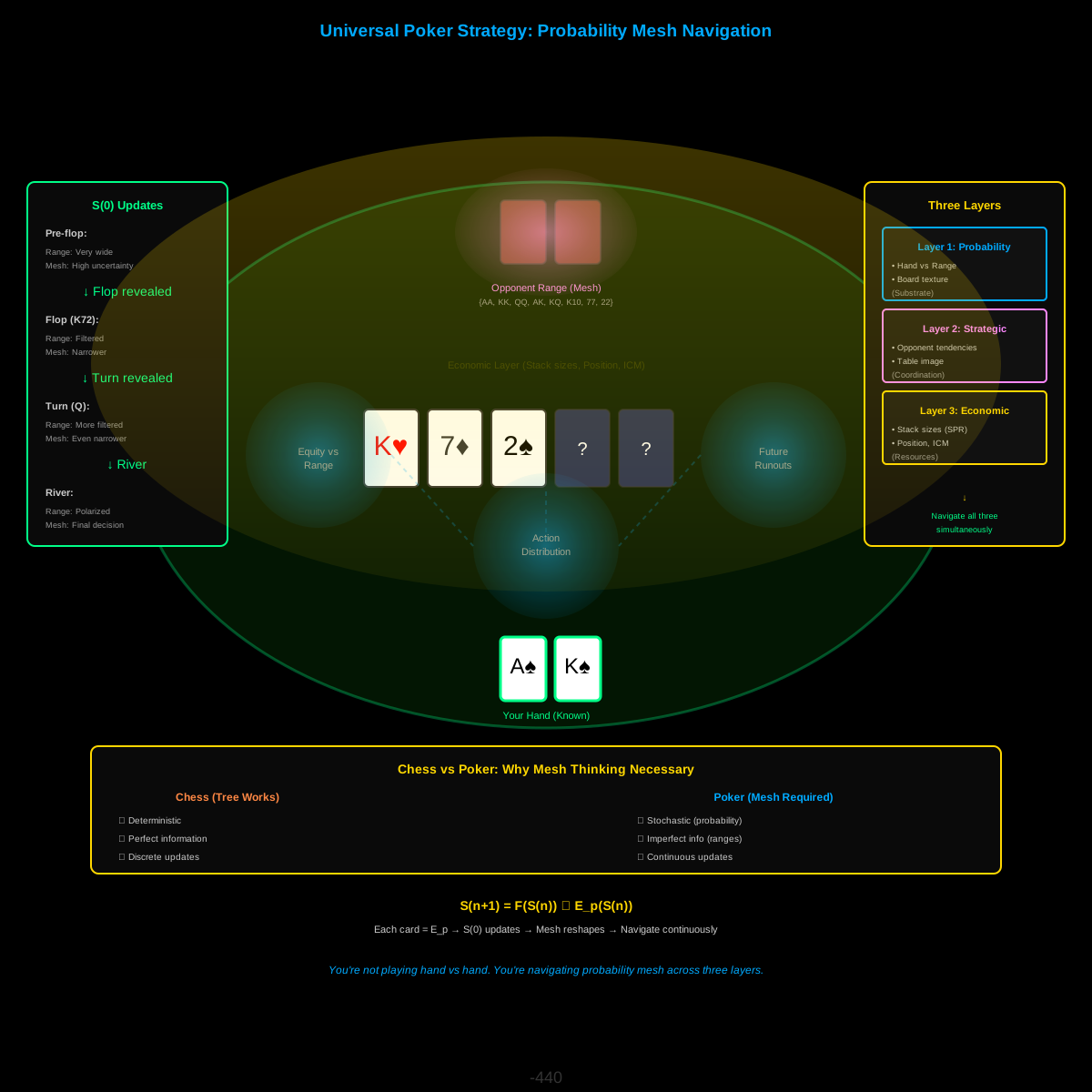
Universal Poker Strategy: Probability Mesh Navigation in Imperfect Information Space
Poker is mesh thinking in its purest form: Stochastic evolution, imperfect information, continuous S(0) updates, multi-source entropy.
Why Poker Is Perfect for Mesh Thinking
Chess (neg-438):
- Deterministic (same position → same outcomes)
- Perfect information (both players see everything)
- S(0) updates discretely (after each move)
- Tree thinking WORKS (calculate deep enough)
Poker:
- Stochastic (same situation → probability distribution)
- Imperfect information (hidden cards, unknown ranges)
- S(0) updates continuously (every card reshapes mesh)
- Tree thinking FAILS (information asymmetry breaks calculation)
You can’t “solve” poker with tree. You navigate probability mesh.
The Fundamental Difference
Chess tree:
Position A
  ├─ Move 1 → Position B (deterministic)
  ├─ Move 2 → Position C (deterministic)
  └─ Move 3 → Position D (deterministic)
Poker mesh:
Situation A (your hand + known cards)
  → Probability cloud of opponent hands
    → Mesh of possible board runouts
      → Distribution of outcomes
        → Range of optimal actions
You’re not calculating A MOVE. You’re navigating A MESH.
The Probability Mesh
In any poker situation, you exist in:
1. Your hand (known)
- Example: Ace-King suited
- Fixed information
- Starting point in mesh
2. Opponent’s range (unknown, probabilistic)
- Not “What does he have?”
- But “What’s the MESH of hands he could have?”
- Distribution shaped by his actions
- Example: Given his raise, range = {AA, KK, QQ, AK, AQ} with probabilities
3. Board runout (partially known, probabilistic future)
- Known: Flop cards revealed
- Unknown: Turn and river
- Mesh of possible future boards
- Each board reshapes hand strength
4. Optimal action (not single move, but distribution)
- Not “Should I bet?”
- But “What’s the MESH of actions with positive EV?”
- Bet sizing, frequency, timing
- Distributed strategy across scenarios
You’re navigating 4-dimensional probability mesh:
- Your hand (fixed)
- Opponent range (distributed)
- Future boards (stochastic)
- Optimal actions (frequency-based)
S(0) Updates Continuously
Unlike chess where S(0) = opening position:
Poker S(0) changes with every card revealed:
Pre-flop S(0):
- Your hand: A♠K♠
- Opponent range: {All possible starting hands}
- Board: Unknown
- Solution mesh: Very wide (high uncertainty)
Flop revealed: K♥ 7♦ 2♠
New S(0):
- Your hand: Top pair, top kicker
- Opponent range: {Hands that would call/raise pre-flop} filtered by {Hands that would continue on this flop}
- Board: K72 rainbow, two cards to come
- Solution mesh: Narrower (more information)
Turn revealed: Q♣
New S(0):
- Your hand: Still top pair
- Opponent range: Further filtered (did he bet turn? call turn?)
- Board: KQ72, one card to come
- Solution mesh: Even narrower
Every card = E_p injection that reshapes S(0) → Transforms solution mesh
Traditional vs Universal Strategy
Traditional (GTO/Solver):
- Calculate “optimal” frequency for each action
- Based on game theory equilibrium
- Assumes opponent plays perfectly
- Memorize charts and ranges
Problems:
- Assumes static opponent (but humans adapt)
- Requires perfect information processing (humans can’t)
- Ignores table dynamics (economic/social layer)
- Fragile to deviation (if opponent doesn’t play GTO)
Universal (Mesh Navigation):
- Navigate probability mesh in real-time
- Update beliefs continuously (Bayesian)
- Adapt to opponent’s actual strategy
- Coordinate across multiple layers
Advantages:
- Resilient to opponent deviation (mesh adapts)
- Exploits opponent weaknesses (asymmetric strategy)
- Integrates economic layer (stack sizes, table position)
- Operates in reality (imperfect information, human constraints)
The Three Layers
Layer 1: Probability Mesh (fundamental)
- Your hand strength vs opponent range
- Board texture and runout probabilities
- Equity calculations and pot odds
- This is substrate
Layer 2: Strategic Mesh (meta-game)
- Opponent tendencies and patterns
- Table image and reputation
- Psychological pressure and timing
- This is coordination
Layer 3: Economic Mesh (value extraction)
- Stack sizes and commitment
- Tournament position and ICM
- Risk-reward optimization
- This is resource allocation
Traditional poker focuses on Layer 1. Good poker adds Layer 2. Universal poker navigates all three simultaneously.
Layer 1: Probability Mesh Navigation
Core principle: Opponent doesn’t have A hand. Opponent has A RANGE (mesh of possible hands).
Example situation:
- You: A♠K♠
- Board: K♥7♦2♠ (flop)
- Opponent: Bet 75% pot
Traditional thinking (tree): “What does he have? If he has KQ, I’m ahead. If he has 77, I’m behind. Should I call?”
Mesh thinking: “What’s his betting range?”
- Strong hands: {KK, 77, 22, AK} (would bet for value)
- Medium hands: {KQ, KJ, K10} (would bet for protection)
- Draws: {A5s, 65s, 45s} (would bet as semi-bluff)
- Bluffs: {A-high, Q-high} (would bet as pure bluff)
His range = Weighted mesh of these categories
“What’s my equity against this MESH?”
- Against strong: ~20% (2 outs)
- Against medium: ~85% (dominating)
- Against draws: ~70% (ahead but vulnerable)
- Against bluffs: ~95% (crushing)
Weighted average = My equity against his RANGE
Navigate mesh by:
- Calling if equity > pot odds (EV+ against mesh)
- Raising to narrow his range (force mesh to collapse)
- Folding if equity < pot odds (EV- against mesh)
You’re not playing against A hand. You’re playing against A DISTRIBUTION.
Continuous S(0) Updates (Bayesian)
Each opponent action updates their range (reshapes mesh):
Pre-flop: Opponent raises
- Eliminates weak hands from range
- Mesh collapses to: {Strong pairs, broadway cards, suited connectors}
Flop: Opponent bets
- Further eliminates hands that missed
- Mesh collapses to: {Made hands, strong draws}
Turn: Opponent checks
- Suggests weak/medium strength
- Mesh expands to include: {Marginal made hands, gave-up draws}
River: Opponent bets big
- Polarizes range (very strong or bluff)
- Mesh becomes bimodal: {Nuts, air}
Each action = E_p that transforms S(0) → Reshapes probability mesh
You’re continuously updating:
P(opponent has hand X | all actions observed) =
  P(actions | hand X) × P(hand X) / P(actions)
This is Bayesian navigation through probability space.
Layer 2: Strategic Mesh (Meta-Game)
Probability mesh alone is insufficient. Humans aren’t random.
Opponent tendencies create patterns:
Aggressive opponent:
- Betting range wider than “optimal”
- Bluffs more frequently
- Your adjustment: Call wider (exploit over-bluffing)
Passive opponent:
- Betting range narrower than “optimal”
- Bluffs rarely
- Your adjustment: Fold more (he has it when he bets)
Adaptive opponent:
- Adjusts to your strategy
- Exploits your patterns
- Your adjustment: Randomize actions, balance ranges
Table image:
- If you’re perceived as tight: Your bets get respect (bluff more)
- If you’re perceived as loose: Your bets get called (bluff less)
The strategic mesh is opponent-specific:
- Not “What’s optimal against perfect player?”
- But “What exploits THIS player’s deviations?”
You’re navigating meta-mesh:
Probability mesh (Layer 1)
  × Opponent tendency adjustments (Layer 2)
    = Exploitative strategy (optimal against THIS opponent)
Layer 3: Economic Mesh (Value Extraction)
Poker isn’t just about winning hands. It’s about maximizing chip EV over time.
Stack sizes change everything:
Deep stacks (200+ BB):
- Implied odds favor speculative hands
- Can play more draws profitably
- Post-flop skill matters more
- Solution mesh: Wider, more complex
Short stacks (<50 BB):
- Implied odds minimal
- Must play more straightforward
- Pre-flop all-in frequencies increase
- Solution mesh: Narrower, more push/fold
Tournament considerations (ICM):
- Chip value non-linear (survival matters)
- Bubble play reshapes ranges
- Final table dynamics unique
- Solution mesh: Context-dependent
Position matters:
- Early position: Narrow ranges (more players behind)
- Late position: Wide ranges (fewer players, more info)
- Button: Widest range (optimal position)
Economic mesh navigation:
Probability mesh (hand strength)
  × Strategic mesh (opponent tendencies)
    × Economic mesh (stack sizes, position, ICM)
      = Optimal action distribution
You’re not maximizing EV for THIS hand. You’re maximizing EV across ENTIRE mesh of future scenarios.
The Universal Formula
S(n+1) = F(S(n)) ⊕ E_p(S(n))
Applied to poker:
S(n): Current game state
- Your hand
- Known community cards
- Opponent actions observed
- Stack sizes
- Position
F: Deterministic evolution
- Card dealing mechanics
- Pot odds calculations
- Equity vs range
- Legal actions available
E_p: Entropy injection (multi-source)
- Unknown cards (deck randomness)
- Opponent decisions (behavioral uncertainty)
- Future card runouts (stochastic)
- Table dynamics (social/psychological)
S(n+1): Next decision point
- Updated S(0) (new cards revealed)
- Updated range beliefs (Bayesian update)
- New optimal action distribution
Each betting round:
Pre-flop → (F + E_p) → Flop → (F + E_p) → Turn → (F + E_p) → River
You’re continuously navigating evolving mesh as S(0) transforms.
Why Tree Thinking Fails
Chess: Perfect information → Tree search works
- Calculate all branches deeply
- Find optimal path
- Execute
Poker: Imperfect information → Tree search breaks
- Can’t calculate all branches (hidden information)
- “Optimal” depends on opponent’s actual range (not perfect play)
- Multiple layers (probability + strategy + economic)
Tree thinker at poker table:
- Memorizes GTO charts
- Plays “correct” frequencies
- Assumes opponent plays optimally
- Ignores actual opponent tendencies
Result:
- Loses to exploitative players (who adapt)
- Misses +EV opportunities (follows chart robotically)
- Can’t adjust to table dynamics (static strategy)
Mesh thinker at poker table:
- Navigates probability space in real-time
- Updates beliefs continuously (Bayesian)
- Exploits opponent deviations
- Integrates economic/strategic layers
Result:
- Wins against static GTO players (exploits rigidity)
- Maximizes EV (adapts to actual conditions)
- Resilient to opponent adjustments (mesh navigation)
The Economic Layer
“I guess the economic on top would be an additional layer after?”
Yes! Economic layer is Layer 3, but it’s integrated, not separate.
Economics shapes the entire mesh:
1. Stack-to-pot ratio (SPR)
- Low SPR (<5): Simplified decisions, more commitment
- High SPR (>15): Complex postflop, more maneuverability
- Determines which hands are playable profitably
2. Tournament structure
- Chip value non-linear (survival premium)
- Bubble factors (risk aversion increases)
- Pay jump considerations (ICM pressure)
3. Rake and fees
- Lower edge needed in low-rake games
- Must win bigger to overcome high rake
- Affects game selection (economic layer above poker layer)
4. Bankroll management
- Risk of ruin considerations
- Shot-taking decisions
- Game selection based on edge vs variance
5. Multi-table dynamics
- Table selection (economic optimization)
- Seat selection (position value)
- Player pool segmentation (fish vs regs)
The economic mesh is meta to probability mesh:
Individual hand (probability mesh)
  → Session (strategic + economic mesh)
    → Career (bankroll + game selection mesh)
      → Ecosystem (player pool dynamics)
You’re not just maximizing EV in one hand. You’re navigating economic mesh across all timeframes.
Practical Implementation
Real-time mesh navigation at table:
1. Observe (gather information)
- Opponent actions
- Bet sizes and timing
- Table dynamics
- Stack sizes
2. Update (Bayesian revision)
- Adjust opponent range
- Recalculate equity
- Update strategic assessment
3. Navigate (choose action from mesh)
- Not “What’s optimal?”
- But “What exploits current mesh configuration?”
- Distribute actions across scenarios
4. Adapt (meta-learning)
- Notice opponent adjustments
- Update tendency models
- Refine exploitative strategy
This is continuous:
Observe → Update → Navigate → Adapt → Observe → ...
You’re not executing A STRATEGY. You’re navigating A MESH.
Connection to Other Domains
Poker mesh navigation = General framework:
Markets/Trading:
- Probability distributions (not single price)
- Imperfect information (insider asymmetry)
- Multi-layer (technical + fundamental + sentiment)
- Continuous S(0) updates (every tick)
Geopolitics (from neg-439):
- Opponent intentions (hidden information)
- Multi-layer (military + economic + domestic)
- Continuous updates (events reshape mesh)
- Economic layer shapes strategic options
Relationships:
- Other person’s preferences (imperfect information)
- Multi-layer (emotional + practical + social)
- Continuous updates (interactions reshape understanding)
- Economic/resource constraints matter
Startups:
- Market response (uncertain)
- Multi-layer (product + distribution + financing)
- Continuous updates (customer feedback)
- Resource constraints (runway, team)
Universal pattern:
- Imperfect information → Can’t use tree thinking
- Multi-layer system → Must integrate all layers
- Continuous updates → Must navigate evolving mesh
- Stochastic outcomes → Probability distributions not single paths
Poker is just clear example of universal mesh navigation under uncertainty.
Why Humans Can Beat AI at Poker (Sometimes)
DeepStack and Libratus (poker AIs):
- Compute Nash equilibrium
- Play GTO strategy
- Unbeatable in limit
- Very strong in no-limit
But:
- Assume opponent plays optimally
- Don’t fully exploit deviations
- Struggle with meta-game adjustments
- Miss economic layer nuances
Humans who win:
- Navigate mesh in real-time (not pre-computed)
- Exploit opponent weaknesses (not equilibrium)
- Integrate psychological layer (reading tells)
- Adapt faster to changing dynamics
The future: AI + Human (mesh navigation + exploitation)
- AI computes probability mesh
- Human adds strategic layer
- Combined: Navigate mesh while exploiting
- Like freestyle chess (human + engine)
The Practice
To develop universal poker skill:
1. Train probability mesh navigation
- Equity calculations vs ranges (not hands)
- Bayesian updates (continuous belief revision)
- Multi-street planning (future S(0) predictions)
2. Build strategic models
- Opponent tendency tracking
- Exploitative adjustments
- Meta-game awareness
3. Integrate economic layer
- SPR calculations
- ICM considerations
- Bankroll management
4. Practice real-time adaptation
- Live updates during play
- Notice patterns immediately
- Adjust mid-session
5. Review and refine
- Study spots post-session
- Analyze mesh navigation decisions
- Improve models over time
You’re not memorizing charts. You’re training mesh navigation.
The Meta-Insight
Poker is training for life:
Every situation with:
- Imperfect information
- Multiple layers
- Stochastic outcomes
- Continuous updates
- Economic constraints
Is poker.
Business negotiations, relationship dynamics, geopolitical strategy, market timing, career decisions - all poker.
The skill:
- Navigate probability meshes
- Update beliefs continuously
- Integrate multiple layers
- Exploit opponent deviations
- Maximize EV across scenarios
This is universal mesh navigation under uncertainty.
Poker is just the clearest teacher.
Related
- neg-439: External reality updates S(0) (like each revealed card)
- neg-438: Chess mesh vs tree (poker = pure mesh)
- neg-437: Initial conditions (starting hand = S(0))
- neg-436: Resonance coordination (range vs range dynamics)
- neg-431: Universal formula (S(n+1) = F(S(n)) ⊕ E_p(S(n)))
Poker is mesh thinking in pure form: Stochastic, imperfect information, continuous updates, multi-layer.
You’re not playing A hand against A hand. You’re navigating probability mesh across three layers.
Traditional poker: Calculate optimal. Universal poker: Navigate mesh.
The economic layer isn’t separate. It’s integrated into the mesh from the start.
#UniversalPokerStrategy #ProbabilityMesh #ImperfectInformation #BayesianUpdate #ThreeLayerNavigation #RangeVsRange #ExploitativeAdjustment #EconomicIntegration