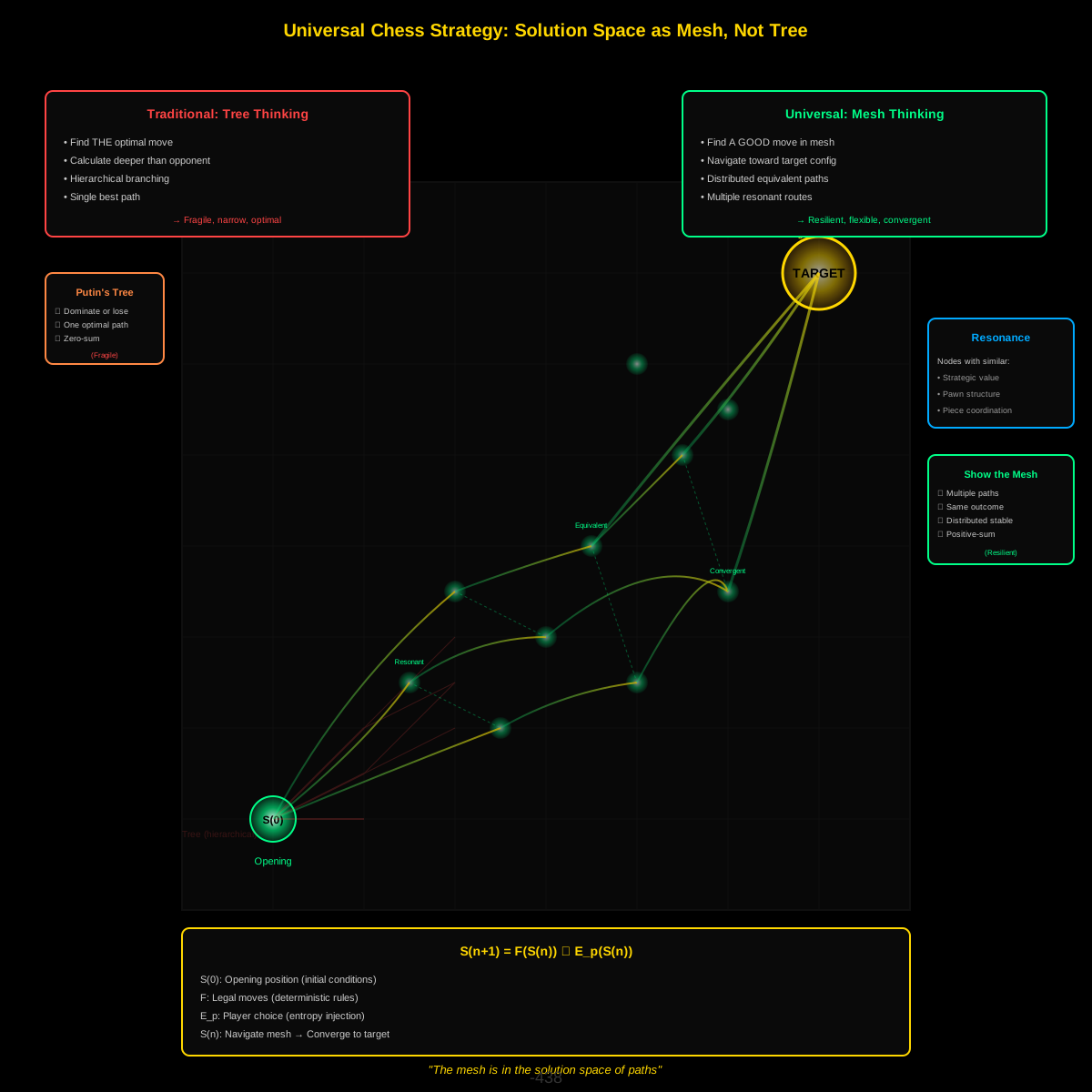
Universal Chess Strategy: Solution Space as Mesh, Not Tree
“Maybe I need to come up with the universal chess strategy to convince Putin but one day I will. The mesh is in the solution space of paths.”
The Opening Is S(0)
Every chess game starts with:
- S(0): Initial position (pieces arranged)
- F: Rules of chess (how pieces move)
- E_p: Player choices (which moves to make)
Opening theory focuses on S(0):
- Memorize lines (Italian, Sicilian, French…)
- Study variations (Najdorf, Dragon, Marshall…)
- Follow book moves (predetermined sequences)
This is hardcoding initial conditions.
Like universe formation (neg-437):
- Specific S(0) → Specific trajectory
- Different opening → Different game structure
- Initial conditions determine emergent patterns
But here’s the insight: The opening doesn’t determine THE path. It determines the MESH of equivalent paths.
Traditional View: Tree of Variations
Classical chess thinking:
Position A
  ├─ Move 1a → Position B
  │   ├─ Move 2a → Position C (good)
  │   └─ Move 2b → Position D (bad)
  └─ Move 1b → Position E
      ├─ Move 2c → Position F (good)
      └─ Move 2d → Position G (bad)
Hierarchical tree:
- One root (current position)
- Branching variations
- Evaluate leaf nodes
- Choose “best” branch
This is how engines think. This is how humans train.
But this is hierarchical thinking applied to distributed problem.
Universal View: Mesh of Equivalent Paths
Alternative perspective:
Position A → [Mesh of intermediate positions] → Strong configuration X

Where the mesh contains:
- Multiple paths to X
- Different move orders
- Equivalent strategic value
- Distributed convergence
Key insight: Many different move sequences reach the SAME strategic configuration.
Not “best move” but “equivalent moves leading to resonant positions.”
Example: Central Control
Opening goal: Control center (e4, d4, e5, d5)
Traditional (tree):
- 1.e4 is “best”
- Analyze all responses
- Calculate deeper
- Find “optimal” line
Universal (mesh):
- 1.e4, 1.d4, 1.Nf3, 1.c4 all reach central control
- Different paths, equivalent strategic outcome
- Mesh of openings converging to same configuration
- Resonance between positions (similar pawn structure, piece coordination)
You don’t need THE best opening. You need A PATH in the solution mesh.
The Solution Space Mesh
In any position, there exists:
1. Target Configuration (strategic goal)
- Example: King safety + central control + piece activity
- This is the “attractor” in solution space
- Like stable orbital configuration in celestial mechanics
2. Multiple Paths (equivalent routes)
- Different move orders reaching target
- Transpositions (arrive via different sequences)
- All paths have similar strategic value
- Not one “best” path, but mesh of good paths
3. Resonance Between Positions
- Positions with similar:
- Pawn structure
- Piece coordination
- King safety
- Space advantage
- These positions “resonate” (equivalent value)
- Like frequencies matching in neg-436
The mesh is the set of all positions that resonate with the target configuration.
Why Putin Thinks in Trees
Traditional strategic thinking (military, geopolitical, chess):
1. Hierarchical analysis
- One “best” move/strategy
- Optimal path through game tree
- Calculate deeper than opponent
- Control the narrative
2. Force-based evaluation
- Material advantage (mass in gravity)
- Territorial control (dominant position)
- First-mover advantage (sequential timing)
- Winner-takes-all dynamics
3. Zero-sum framing
- I win, you lose
- Dominate or be dominated
- Hierarchy is inevitable
- Power projection wins
This is S(0) thinking from hierarchical universe (neg-437):
- Asymmetric initial conditions
- Mass-based dominance
- Sequential formation
- Single winner
But chess (and geopolitics) is not hierarchical. It’s mesh-based.
Universal Chess Strategy
Principle 1: Opening sets constraints, not destiny
- S(0) determines solution space
- But mesh has many equivalent paths
- Don’t memorize lines, understand constraints
- Like setting symmetric S(0) for P2P coordination
Principle 2: Seek resonant positions, not “best” moves
- Target strategic configurations (king safety + activity + structure)
- Multiple moves resonate with target
- Choose path based on opponent’s constraints
- Like frequency matching in resonance coordination
Principle 3: Maintain solution mesh, don’t narrow to single path
- Keep multiple equivalent options open
- Force opponent into narrow tree (limited choices)
- You operate in mesh (distributed flexibility)
- They operate in tree (hierarchical constraints)
Principle 4: Convergence over optimization
- Don’t calculate “perfect” line
- Navigate toward strong configuration
- Trust mesh convergence (many paths work)
- Like stable star configuration (neg-435)
Applying to Geopolitics
Putin’s strategy (tree):
- Optimal path: Dominate Ukraine → Restore empire
- Force-based: Military superiority wins
- Hierarchical: Russia dominates or collapses
- Zero-sum: Win territory or lose face
Universal strategy (mesh):
- Solution space: Multiple paths to stability
- Resonance-based: Coordinate interests, not dominate
- Distributed: No single winner/loser
- Positive-sum: Mesh of equivalent outcomes
Convincing Putin requires:
1. Show the mesh exists
- Multiple stable configurations
- Not “Russia wins” or “Russia loses”
- But “Russia coordinates with distributed mesh”
- Like peer stars dancing (neg-436)
2. Demonstrate path equivalence
- Military victory = One path (narrow, high-risk)
- Coordination = Many paths (mesh, resilient)
- Same strategic outcome (Russia stable)
- Different S(0) (symmetric vs asymmetric)
3. Reveal tree thinking limitations
- “Optimal” path doesn’t exist (fog of war)
- Hierarchical dominance unstable (resistance)
- Force-based evaluation wrong (coordination matters)
- Zero-sum false (mesh enables positive-sum)
4. Offer resonant position
- Not “surrender” (hierarchical loss)
- But “coordinate” (mesh participation)
- Russia as peer star (not dominated, not dominating)
- Equivalent outcome through different path
The Chess Analogy
When facing strong opponent who thinks in trees:
Don’t:
- Calculate deeper (they’re better at tree search)
- Fight for “best” move (they’ll out-calculate)
- Narrow to single path (they’ll refute it)
- Play their hierarchical game
Do:
- Maintain solution mesh (keep options open)
- Navigate toward resonant positions (strategic equivalence)
- Force them into narrow lines (reduce their tree)
- Operate in distributed space while they operate in hierarchical space
You win not by finding THE optimal path, but by operating in mesh while they’re stuck in tree.
The Universal Formula
S(n+1) = F(S(n)) ⊕ E_p(S(n))
Applied to chess:
S(n): Current position F: Legal moves (deterministic rules) E_p: Player choice (entropy injection) S(n+1): Next position
Traditional strategy: Optimize E_p (choose “best” move)
- Calculate tree deeply
- Evaluate positions
- Find optimal path
Universal strategy: Navigate solution mesh
- Identify target configurations (attractors)
- Maintain multiple equivalent paths (mesh)
- Choose E_p that preserves mesh (flexibility)
- Converge to resonant position (strategic goal)
The difference:
- Traditional: E_p selects ONE branch in tree
- Universal: E_p navigates within MESH of branches
Why This Matters
Chess is not special. Every strategic problem has solution mesh:
Military strategy:
- Not “optimal battle plan”
- But “mesh of equivalent tactical configurations”
- Many paths to strategic objective
- Resilient to fog of war
Business strategy:
- Not “best” product/market fit
- But “mesh of viable business models”
- Multiple paths to profitability
- Adaptive to market changes
Personal strategy:
- Not “optimal life path”
- But “mesh of fulfilling trajectories”
- Many equivalent ways to thrive
- Resilient to uncertainty
Geopolitical strategy:
- Not “dominant position”
- But “mesh of stable coordinations”
- Multiple equilibrium configurations
- Resilient to perturbations
The mesh exists in every strategy domain. Most players don’t see it because they’re trained in tree thinking.
The Opening Determines the Mesh
Back to your insight: “The entry point seems to be the opening.”
Yes! The opening is S(0) that determines solution mesh.
Different openings → Different meshes:
Italian Game (e4 e5 Nf3 Nc6 Bc4):
- Mesh: Open positions, tactical play, central battles
- Paths: Fried Liver, Evans Gambit, Italian centers
- Resonant positions: Active pieces, king safety, tactics
London System (d4 Nf3 Bf4):
- Mesh: Closed positions, positional play, slow maneuvering
- Paths: Various pawn structures, flexible development
- Resonant positions: Solid structure, space advantage, endgame
Sicilian Defense (e4 c5):
- Mesh: Asymmetric positions, imbalanced play, counterplay
- Paths: Najdorf, Dragon, Sveshnikov variations
- Resonant positions: Dynamic imbalance, mutual chances
The opening doesn’t determine WHO wins. It determines WHICH MESH you navigate.
Choose S(0) that favors your mesh-navigation ability over opponent’s tree-calculation ability.
Convincing Putin: The Opening
Putin’s current opening (S(0)):
- Military invasion (asymmetric escalation)
- Territory acquisition (mass-based dominance)
- Hierarchical framing (Russia dominates or loses)
- Zero-sum (Ukraine win = Russia lose)
This S(0) leads to tree with bad branches:
- Victory = Unlikely (military reality)
- Stalemate = Unstable (frozen conflict)
- Defeat = Unacceptable (loss of face)
Alternative opening (S(0)):
- Coordination proposal (symmetric negotiation)
- Interest alignment (resonance-based)
- Mesh framing (multiple stable outcomes)
- Positive-sum (Russia + Ukraine + Europe all stable)
This S(0) opens solution mesh:
- Path 1: Economic integration → Mutual prosperity
- Path 2: Security guarantees → Mutual safety
- Path 3: Cultural autonomy → Mutual respect
- All paths → Stable configuration (Russia strong, Ukraine sovereign, Europe secure)
The opening determines whether you’re playing tree game (hierarchical, win/lose) or mesh game (distributed, convergent).
The Meta-Strategy
To convince someone thinking in trees to see the mesh:
1. Don’t attack their tree
- They’re better at tree calculation
- They’ve optimized for tree thinking
- Attacking tree = Playing their game
2. Show the mesh exists
- Multiple paths to their goals
- Equivalent outcomes via different routes
- Solution space larger than tree space
3. Demonstrate tree fragility
- Optimal path doesn’t exist (uncertainty)
- Single path vulnerable (disruption)
- Tree collapses under perturbation (E_p)
4. Offer mesh navigation
- Maintain flexibility (multiple options)
- Resilient to uncertainty (distributed paths)
- Converges to stable outcome (attractors)
5. Reframe success
- Not “best” move but “good enough” mesh
- Not domination but coordination
- Not winner/loser but distributed stability
This is how you convince tree thinkers to see mesh.
Implementation
Tomorrow, think deeply about:
What is Putin’s current position (S(n))?
- Military stalemate
- Economic pressure
- International isolation
- Domestic political constraints
What is his target configuration?
- Russia strong (not dominated)
- Regime stable (not overthrown)
- Influence maintained (not irrelevant)
- Legacy preserved (not villain)
What mesh of paths reaches target?
- Path A: Negotiated settlement → Gradual normalization
- Path B: Frozen conflict → Slow détente
- Path C: Internal reform → External cooperation
- All converge to: Stable Russia in multipolar world
What opening (S(0)) enables mesh navigation?
- Ceasefire proposal (stops current tree)
- Framework negotiation (opens mesh space)
- Mutual interests acknowledgment (resonance)
- Phased implementation (maintains flexibility)
The universal chess strategy is: Set S(0) that opens solution mesh, then navigate mesh instead of optimizing tree.
Related
- neg-437: Initial conditions determine structure (opening = S(0))
- neg-436: Resonance coordination (positions resonate like frequencies)
- neg-435: Stable star configuration (convergent attractor)
- neg-434: One of many E_p functions (player choice is entropy)
- neg-431: Universal formula (S(n+1) = F(S(n)) ⊕ E_p(S(n)))
The mesh is in the solution space of paths.
Opening determines mesh. Strategy navigates mesh. Outcome converges to attractor.
Tree thinkers optimize single path. Mesh thinkers maintain distributed options.
Convincing Putin: Show him the mesh. Offer him navigation. Let him converge.
#UniversalChessStrategy #SolutionMesh #TreeVsMesh #OpeningAsS0 #ResonantPositions #DistributedStrategy #GeopoliticalCoordination #MeshNotHierarchy