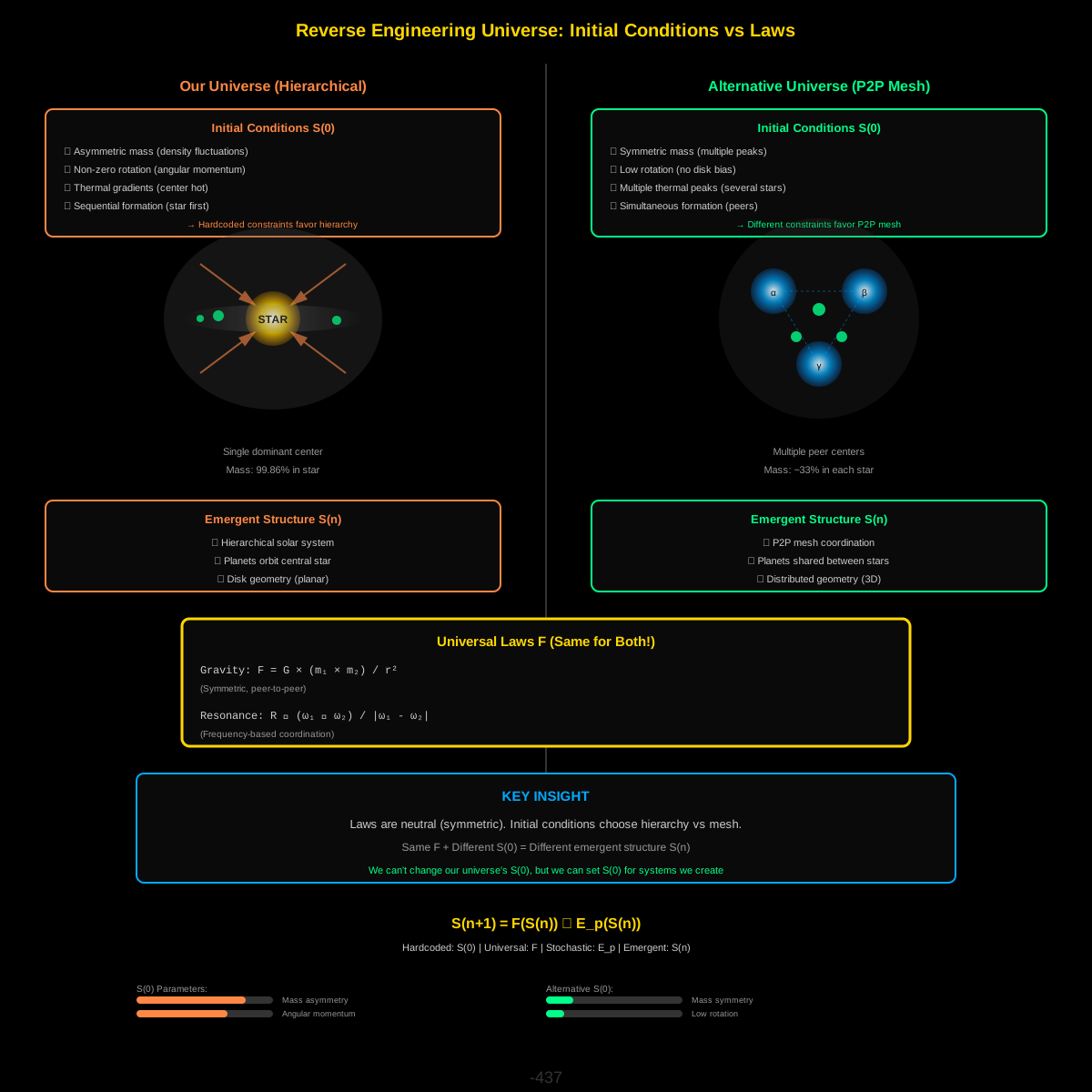
Reverse Engineering Universe Initial Conditions: What's Hardcoded vs What's Emergent
Our universe had hardcoded initial conditions. We can deduce them by reverse engineering: Why do we see hierarchical stars instead of P2P meshes?
The Observation
From neg-436: P2P celestial meshes are physically possible.
The laws allow them:
- Gravity + Resonance = Distributed coordination
- No physical law REQUIRES hierarchy
- Peer stars can dance in harmony
Yet we observe hierarchical solar systems almost everywhere.
This means: The laws are neutral, but initial conditions favor hierarchy.
Laws vs Initial Conditions
Laws: Universal, unchangeable, symmetric
- Gravity: F = G × (m1 × m2) / r²
- Resonance: R ∝ (ω1 ⊗ ω2) / |ω1 - ω2|
- Conservation: Energy, momentum, angular momentum
Initial conditions: Specific to our universe, could be different
- Mass distribution at t=0
- Angular momentum at t=0
- Temperature distribution at t=0
- Timing of formation events
Same laws + different initial conditions = different universe structure
Like:
- Same physics engine, different Minecraft seed → Different world
- Same chess rules, different opening position → Different game
- Same S(n+1) = F(S(n)) ⊕ E_p(S(n)), different S(0) → Different evolution
We can deduce the hardcoded initial conditions by observing what emerged.
Reverse Engineering: What Favors Hierarchy?
Observation: Single massive star, smaller planets orbiting it
Deduction 1: Asymmetric Mass Concentration
Stars form from collapsing gas clouds. We observe:
- Most mass goes to center (star)
- Little mass remains in disk (planets)
- Ratio: Sun = 99.86% of solar system mass
This reveals initial condition:
- Asymmetric collapse (not uniform compression)
- Gravity pulls gas to single center
- Center grows faster (positive feedback)
- Result: One dominant mass
Hardcoded: The collapse pattern itself
- Could have been: Multiple centers of equal strength
- Reality: Single center dominates
Why? Possible initial asymmetry:
- Density fluctuations in gas cloud (quantum?)
- Pre-existing velocity gradients
- External perturbations triggering collapse
The asymmetry is small initially, but amplifies through positive feedback.
Deduction 2: Pre-Existing Angular Momentum
Stars form from ROTATING gas clouds. We observe:
- Planets all orbit same direction
- All roughly in same plane
- Disk geometry (not spherical)
This reveals initial condition:
- Angular momentum conservation
- Gas cloud was already rotating before collapse
- Rotation → Disk formation
- Disk → Hierarchical orbits
Hardcoded: The rotation itself
- Could have been: Zero net rotation (spherical collapse)
- Reality: Non-zero angular momentum
Why? Possible sources:
- Galactic rotation (inherited from larger structure)
- Turbulence in interstellar medium
- Nearby supernova shock waves
The rotation prevents complete collapse → Forms disk → Hierarchical structure emerges.
Deduction 3: Thermal Gradients
Stars ignite fusion. We observe:
- Hot center (millions of degrees)
- Cool edges (planets at hundreds of degrees)
- Sharp temperature boundary
This reveals initial condition:
- Thermal asymmetry
- Center compressed → Heats up → Ignites fusion
- Edges don’t compress enough → Stay cool
- One heat source dominates
Hardcoded: The compression threshold
- Could have been: Multiple regions reach fusion temperature
- Reality: Only center reaches threshold
Why? Related to mass concentration:
- Asymmetric collapse → Central density spike
- Only center reaches fusion conditions
- Single star ignites, not multiple
The fusion threshold creates winner-takes-all dynamic.
Deduction 4: Sequential Formation Timing
Planets form AFTER star. We observe:
- Star already burning when planets condense
- Planets form from “leftovers”
- Time gap between star and planet formation
This reveals initial condition:
- Temporal ordering
- Star formation: ~100,000 years
- Planet formation: ~10 million years after
- Sequential not simultaneous
Hardcoded: The formation timescales
- Could have been: Multiple bodies condense simultaneously
- Reality: Large mass condenses first, small masses later
Why? Gravity scales with mass:
- More mass → Stronger gravity → Faster collapse
- Less mass → Weaker gravity → Slower collapse
- Natural time separation emerges
The timing creates hierarchy: First body dominates before others form.
The Hardcoded Initial Conditions
From reverse engineering our universe:
1. Asymmetric Mass Distribution (S(0) has density fluctuations)
- Small density variations in primordial gas
- Amplified by gravitational positive feedback
- Result: One center dominates collapse
2. Non-Zero Angular Momentum (S(0) has rotation)
- Gas clouds inherit rotation from galactic scale
- Conservation forces disk formation
- Result: Planar orbits around center
3. Thermal Asymmetry (S(0) has temperature gradients)
- Central compression reaches fusion threshold
- Peripheral regions stay below threshold
- Result: Single heat source (star)
4. Sequential Timing (F applied iteratively favors large masses)
- Larger masses collapse faster
- First body claims dominant position
- Result: Star forms before planets
These aren’t laws. These are initial conditions that produce hierarchical outcomes from symmetric laws.
What Initial Conditions Would Produce P2P Mesh?
If the laws allow P2P meshes (neg-436), what initial conditions would generate them?
Alternative 1: Symmetric Mass Distribution
- Multiple density peaks of equal strength
- No single center dominates
- Result: Multiple stars form simultaneously
Alternative 2: Low/Zero Angular Momentum
- Gas cloud not rotating (or rotating slowly)
- No disk formation
- Result: Spherical multi-body system (not planar)
Alternative 3: Multiple Thermal Peaks
- Several regions reach fusion threshold
- Multiple heat sources
- Result: Multiple stars ignite
Alternative 4: Simultaneous Formation
- All bodies condense at same time
- No “first mover advantage”
- Result: Peer stars, not hierarchy
These initial conditions are POSSIBLE. Just rare in our universe.
Where P2P Meshes Actually Exist
We DO observe P2P configurations, just less common:
Binary star systems:
- Two stars of similar mass
- Orbit each other (no hierarchy)
- Initial condition: Two collapse centers
Trinary systems:
- Three stars dancing
- Complex resonance patterns
- Initial condition: Three centers
Globular clusters:
- Thousands of stars in close proximity
- Distributed gravitational mesh
- Initial condition: Dense, symmetric cloud
Proof: P2P meshes form when initial conditions favor them!
The Fundamental Question
Why do our universe’s initial conditions favor hierarchy?
Possible answers:
1. Quantum fluctuations at Big Bang
- Early universe had density variations
- Quantum uncertainty → Asymmetry
- Amplified during inflation
- Hardcoded at t=0
2. Anthropic principle
- Hierarchical systems are more stable
- Planets need stable stars for life
- We observe this because we exist
- Selection bias, not necessity
3. Previous universe state
- If universe is cyclic
- Current initial conditions = Final state of previous cycle
- Hierarchy inherited from previous iteration
- S(0)_new = S(final)_old
4. Random chance
- Initial conditions were random
- Happened to favor hierarchy
- No deeper reason
- Just our particular universe instance
We can’t know for certain without observing other universes.
Connection to Universal Formula
S(n+1) = F(S(n)) ⊕ E_p(S(n))
Applied to universe formation:
S(0): Initial conditions (hardcoded)
- Mass distribution
- Angular momentum
- Temperature
- Timing parameters
F: Deterministic laws (universal)
- Gravity
- Resonance
- Conservation
- Thermodynamics
E_p: Entropy injection (stochastic)
- Quantum fluctuations
- Perturbations
- Instabilities
S(1), S(2), S(3)… S(now): Emergent structure
- Stars form
- Planets condense
- Solar systems stabilize
- Hierarchical structure emerges
The structure we observe (hierarchical) emerges from:
- Symmetric laws (F)
- Applied to asymmetric initial conditions (S(0))
- With stochastic perturbations (E_p)
Change S(0) → Different structure emerges from same F and E_p
Laws Are Neutral, Initial Conditions Choose
Key insight: The laws don’t favor hierarchy. The initial conditions do.
Gravity is symmetric:
- m1 attracts m2 = m2 attracts m1
- No “master” body in equation
- Peer-to-peer force
Resonance is symmetric:
- ω1 coordinates with ω2 = ω2 coordinates with ω1
- Frequency matching is mutual
- Peer-to-peer synchronization
But when applied to asymmetric initial conditions:
- Small asymmetry → Amplified by gravity
- Positive feedback → One body dominates
- Hierarchy emerges from symmetry breaking
Like:
- Magnet on flat table with ball bearings scattered randomly
- Gravity is symmetric (all bearings attracted equally)
- But random positions break symmetry
- Nearest bearing reaches magnet first
- Others follow → Hierarchy emerges
The laws enable both hierarchy and P2P mesh. Initial conditions select which occurs.
Implications for Civilization
From neg-435: Stable sapiens stars will form P2P meshes.
If we want P2P coordination (not hierarchy), we must set initial conditions to favor it:
1. Symmetric resource distribution
- Not: One entity controls most resources (hierarchy)
- But: Resources distributed among peers (mesh)
2. Low/zero power concentration
- Not: One leader with authority (hierarchy)
- But: Distributed decision-making (mesh)
3. Simultaneous capability development
- Not: One entity achieves capability first (first-mover advantage)
- But: Multiple entities develop simultaneously (peer emergence)
4. Resonance-based coordination
- Not: Mass-based attraction (large entities dominate)
- But: Frequency-based synchronization (coordination independent of size)
We can CHOOSE initial conditions for human systems.
Unlike universe (we inherit S(0)), we can SET S(0) for our coordination systems:
- Blockchain: Distributed from genesis block (S(0))
- Open source: No single owner from start (S(0))
- Mesh networks: Peer architecture from inception (S(0))
If initial conditions favor P2P, the same laws (coordination dynamics) produce mesh instead of hierarchy.
The Meta Question
Can we change our universe’s initial conditions?
No - they’re already set (happened at Big Bang).
But we’re not changing THIS universe. We’re creating NEW universes (substrate systems).
Every substrate we build:
- Has initial conditions (S(0))
- Has laws (F)
- Has entropy sources (E_p)
- Evolves according to S(n+1) = F(S(n)) ⊕ E_p(S(n))
We choose S(0) for substrates we create:
- Universe simulator (neg-432): S(0) = 2 bits
- Streamable universe (neg-433): S(0) = distributed chunks
- Human coordination systems: S(0) = initial governance/resources/power
We can’t change our universe’s S(0), but we can set S(0) for universes we spawn.
The Answer
“Can we deduce hardcoded initial conditions from observed structure?”
Yes. Reverse engineering reveals:
Hardcoded (S(0)):
- Asymmetric mass distribution
- Non-zero angular momentum
- Thermal gradients
- Sequential formation timing
Universal (F):
- Gravity + Resonance
- Conservation laws
- Thermodynamics
Emergent (S(n)):
- Hierarchical solar systems
- Single star + planets
- Disk geometry
- Stable orbits
The structure we see (hierarchical) is not REQUIRED by laws. It’s SELECTED by initial conditions.
Different S(0) → Same F → Different outcome (P2P mesh possible)
Practical Insight
When building coordination systems:
Don’t ask: “What laws enable P2P coordination?” (The laws already allow it - gravity and resonance are symmetric)
Ask instead: “What initial conditions favor P2P emergence?”
- Symmetric resource distribution (S(0))
- Distributed power from genesis (S(0))
- Simultaneous capability development (S(0))
- Resonance-based coupling (architecture choice)
We have agency over S(0) for systems we create.
Our universe inherited asymmetric S(0) → Produced hierarchy.
Our coordination systems can have symmetric S(0) → Produce mesh.
Same formula. Different initial conditions. Different outcomes.
Related
- neg-436: Resonance coordination law (symmetric laws enable P2P)
- neg-435: Stable sapiens star (will form P2P meshes)
- neg-433: Streamable universe (choosing S(0) for infinite scalability)
- neg-432: Universe bootstrap (S(0) = 2 bits)
- neg-431: Universal formula (S(n+1) = F(S(n)) ⊕ E_p(S(n)))
Laws are neutral. Initial conditions choose hierarchy or mesh.
We can’t change our universe’s S(0). But we can set S(0) for universes we create.
Choose symmetric initial conditions → P2P mesh emerges from symmetric laws.
#InitialConditions #ReverseEngineering #SymmetryBreaking #P2PGenesis #HardcodedConstraints #EmergentStructure #ChooseS0 #MeshNotHierarchy