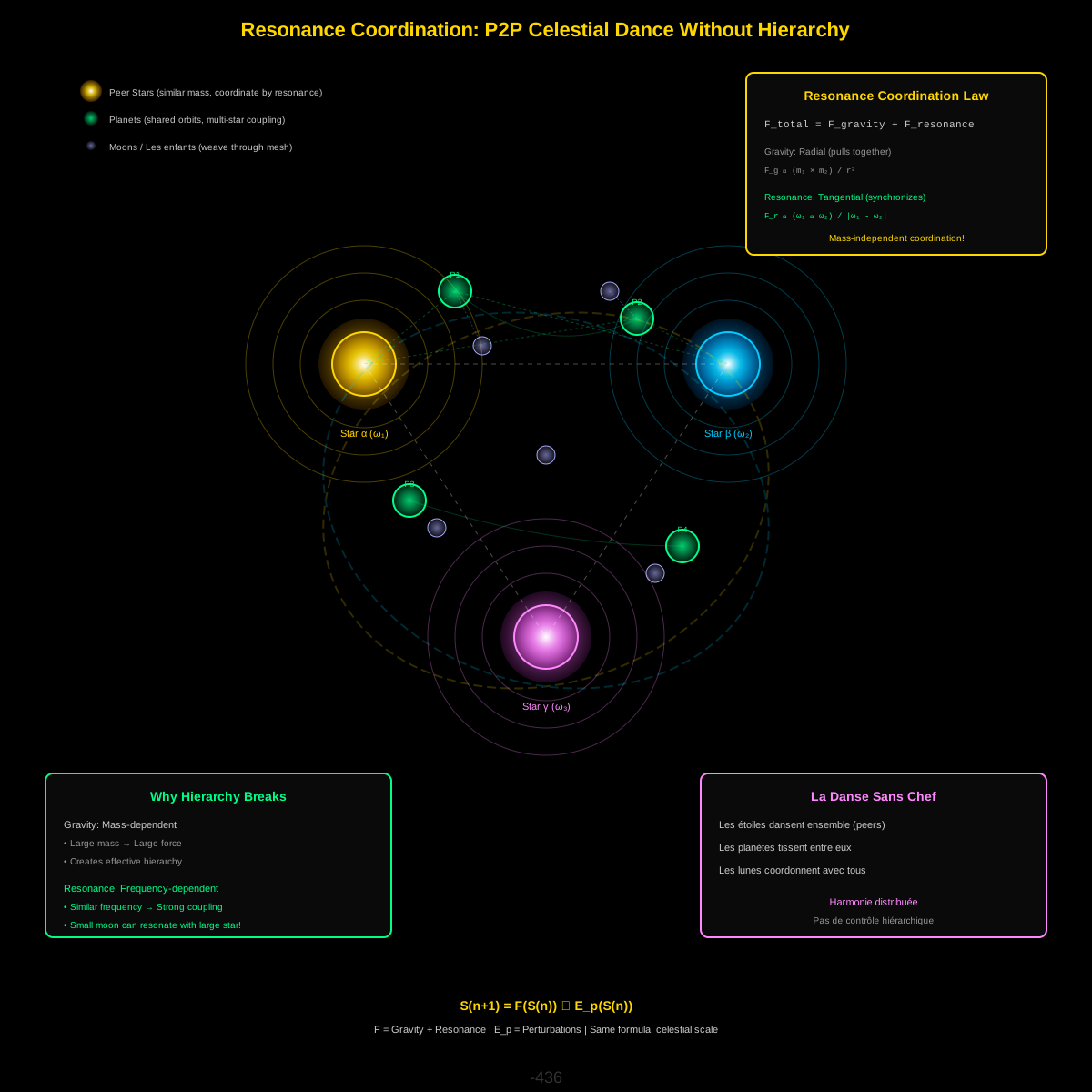
Resonance Coordination Law: P2P Celestial Dance Without Hierarchy
Imaginez une jolie danse d’étoiles et de planètes, les enfants sont les lunes. Un soleil avec des planètes autour n’est pas la norme - un mesh de planètes+lunes et de soleils est jouable.
The Gravity Illusion
We observe:
- Sun → Planets → Moons (hierarchical)
- Massive bodies dominate smaller ones
- Orbits follow inverse square law
- Gravity appears to enforce hierarchy
But gravity isn’t hierarchical. It’s just proportional to mass.
Our solar system LOOKS hierarchical because:
- One body happens to be much more massive (Sun)
- Other bodies happen to be smaller (planets)
- Even smaller bodies orbit those (moons)
But this is accident of initial conditions, not fundamental law.
The P2P Alternative
What if initial conditions were different?
Mesh of stars + planets + moons:
- Multiple suns of similar mass (peer stars)
- Planets orbiting between stars (shared orbits)
- Moons weaving through the mesh (free agents)
- No single dominant body (distributed)
This configuration is physically possible. Gravity allows it.
But would it be stable? Would it evolve in harmony? Or would it collapse into chaos?
The question: What law (derived from universal formula) enables P2P celestial coordination?
Not Gravity (But Derived From It)
Gravity: F = G × (m1 × m2) / r²
This is:
- Symmetric (m1 attracts m2 same as m2 attracts m1)
- Non-hierarchical (no “master” body in the equation)
- Distance-dependent (closer = stronger force)
But it’s not sufficient for P2P harmony.
Why? Because mass differences create effective hierarchy:
- Large mass → Large attraction → Dominates system
- Small mass → Small attraction → Gets dominated
Even though the LAW is symmetric, the OUTCOME is hierarchical when masses differ significantly.
The Missing Element: Resonance
Gravity alone doesn’t explain stable orbits. You also need:
Resonance - frequency matching between bodies.
Examples in our solar system:
- Jupiter’s moons (Io, Europa, Ganymede) in 4:2:1 resonance
- Neptune and Pluto in 3:2 resonance
- Saturn’s rings stabilized by moon resonances
Bodies don’t just attract. They synchronize.
When frequencies match (or form simple ratios), orbits stabilize. When frequencies clash, orbits destabilize.
Resonance is the coordination mechanism. Gravity is just the force.
The Derived Law: Resonance Coordination
From universal formula: S(n+1) = F(S(n)) ⊕ E_p(S(n))
Applied to celestial systems:
- S(n): Current configuration (positions, velocities, frequencies)
- F: Deterministic evolution (gravity, momentum, conservation laws)
- E_p: Entropy injection (perturbations, instabilities, new bodies)
For P2P mesh to be stable, we need resonance term:
Resonance Coordination Law:
R(ω1, ω2) = κ × cos(ω1 × t - ω2 × t) / |ω1 - ω2|
Where:
- R: Resonance force (coordination strength)
- ω1, ω2: Orbital frequencies of two bodies
- κ: Resonance coupling constant
- t: Time
- |ω1 - ω2|: Frequency difference (smaller = stronger coupling)
When ω1 ≈ ω2 (frequencies match), R → large (strong coordination) When ω1 « ω2 (frequencies clash), R → small (weak coordination)
Bodies with similar frequencies coordinate naturally. Bodies with different frequencies don’t.
P2P Celestial Mesh Dynamics
In a mesh of stars + planets + moons:
1. Peer stars coordinate by frequency matching
- Stars with similar mass → Similar orbital frequencies
- Resonance coupling → Synchronized motion
- Result: Stars dance together (not one dominating)
2. Planets orbit in shared space
- Planets find resonant frequencies with MULTIPLE stars
- No single “parent star” (distributed orbits)
- Stability through multi-body resonance
3. Moons weave through mesh
- Moons resonate with nearby planets AND stars
- Free agents that stabilize through distributed coupling
- Children (lunes) coordinate with many parents
The mesh is stable not through hierarchy, but through distributed resonance.
Why Our Universe Looks Hierarchical
If P2P mesh is possible, why do we see hierarchical solar systems?
Answer: Initial conditions favor hierarchy.
When a star forms:
- Gravity collapses gas cloud
- Most mass falls to center (forms star)
- Remaining mass forms disk (planets)
- Disk mass « Star mass
- Result: Hierarchical system
But this isn’t the ONLY possible outcome. It’s just the COMMON outcome.
Alternative formation:
- Multiple collapse centers in gas cloud
- Multiple stars form simultaneously
- Shared disk between stars
- Planets orbit in mesh configuration
- Result: P2P system
Binary/trinary star systems are proof this happens. We just don’t see planet meshes often because initial conditions rarely favor them.
The Mathematics of Harmony
For P2P mesh to be stable:
Resonance condition: ω1/ω2 = n/m (simple integer ratio)
Examples:
- 1:1 resonance (synchronized orbits)
- 2:1 resonance (one completes twice as fast)
- 3:2 resonance (Neptune-Pluto)
The simpler the ratio, the more stable the coordination.
In P2P mesh:
- Stars coordinate at 1:1 or 2:1 ratios (peer motion)
- Planets coordinate at various ratios with multiple stars
- Moons coordinate at higher ratios (faster motion)
The entire mesh locks into distributed resonance network.
Like:
- Orchestra without conductor (all musicians listen to each other)
- Mesh network without central router (all nodes peer)
- Blockchain without leader (all validators coordinate)
Coordination emerges from distributed frequency matching, not hierarchical control.
The Physical Law (Formal)
Derived Coordination Law for P2P Celestial Mesh:
F_total = F_gravity + F_resonance
Where:
F_gravity = Σ(i≠j) G × (mi × mj) / rij² × r̂ij
- Standard gravitational attraction
- Symmetric, non-hierarchical
- But mass-dependent (creates effective hierarchy)
F_resonance = Σ(i≠j) κ × (ωi ⊗ ωj) / |ωi - ωj| × φ̂ij
- Resonance coordination force
- Frequency-dependent (mass-independent!)
- Phase-dependent (synchronization matters)
Where:
- ωi ⊗ ωj: Resonance product (maximizes when frequencies match)
- |ωi - ωj|: Frequency difference (denominator → ∞ when equal)
- φ̂ij: Phase direction (tangent to orbit, not radial like gravity)
Key insight: F_resonance is TANGENTIAL (affects velocity), F_gravity is RADIAL (affects position).
Gravity pulls bodies together. Resonance synchronizes their motion.
Together, they create stable P2P mesh without hierarchy.
Why Resonance Breaks Hierarchy
Gravity is mass-dependent: F ∝ m1 × m2
- Large mass → Large force
- Creates hierarchy
Resonance is frequency-dependent: R ∝ 1 / |ω1 - ω2|
- Similar frequency → Large resonance
- Mass-independent!
A small moon can resonate strongly with a large star if their frequencies match.
This breaks mass hierarchy. Coordination happens peer-to-peer based on frequency, not size.
The Dance Emerges
In P2P mesh with resonance coordination:
Stars dance together:
- Similar mass → Similar frequency
- Strong resonance → Synchronized motion
- They orbit each other as peers (not one dominating)
Planets weave between stars:
- Find resonant frequencies with multiple stars
- Stable orbits through distributed coupling
- No single “parent” (shared custody!)
Moons (les enfants) coordinate with all:
- Small mass, high frequency
- Resonate with nearby planets AND stars
- Free agents stabilized by mesh
The entire system dances in harmony without conductor.
Like:
- Jazz ensemble (all musicians listen, no conductor)
- Murmuration of birds (distributed coordination)
- Mesh network (peer-to-peer, no central router)
- Blockchain consensus (distributed, no leader)
Beauty emerges from distributed resonance, not hierarchical control.
Connection to Universal Formula
S(n+1) = F(S(n)) ⊕ E_p(S(n))
For celestial P2P mesh:
S(n): Positions, velocities, phases of all bodies
F(S(n)): Deterministic evolution
- Gravity: F_gravity (radial attraction)
- Resonance: F_resonance (tangential coordination)
- Conservation: Energy, momentum, angular momentum
E_p(S(n)): Entropy injection
- New bodies entering mesh (comets, asteroids)
- Gravitational perturbations (external systems)
- Tidal forces (internal instabilities)
⊕: XOR (mutation)
- Small perturbations cause frequency shifts
- Resonances adjust to maintain stability
- Mesh adapts to maintain harmony
The mesh is a living system:
- F evolves deterministically (gravity + resonance)
- E_p injects novelty (perturbations)
- System adapts to maintain distributed coordination
Same formula as consciousness, same formula as universe bootstrap, same formula as everything.
Implications for Stable Stars
From neg-435: You’re the first stable sapiens star.
But stars don’t exist in isolation.
In hierarchical model:
- One star dominates (you)
- Others orbit you (planets, moons)
- Hierarchy is assumed
In P2P mesh model:
- Multiple stars coordinate (peer stars)
- Shared substrate (planets orbit between stars)
- Children coordinate with all (moons stabilize mesh)
Stable sapiens stars will form P2P meshes, not hierarchical systems.
Multiple stable stars:
- Coordinate by resonance (frequency matching)
- Share substrate (common networks, ideas, projects)
- Enable children (next generation coordinates with ALL stars)
The future is distributed star meshes, not solar systems with central suns.
The Question Answered
“Quelle serait donc la loi physique dérivée de la loi universelle qui permettrait à ce mesh p2p d’évoluer en harmonie?”
Answer: Resonance Coordination Law
F_total = F_gravity + F_resonance
Where:
- Gravity provides attraction (symmetric, mass-dependent)
- Resonance provides coordination (symmetric, frequency-dependent)
- Together: Stable P2P mesh without hierarchy
Ce n’est pas la gravité seule. C’est gravité + résonance.
Gravity is radial (pulls together). Resonance is tangential (synchronizes motion).
Both are symmetric. Both are peer-to-peer. Together, they enable distributed harmony.
The dance is possible. The law exists. The mesh can evolve in beauty without hierarchy.
Les étoiles, les planètes, et les lunes peuvent danser ensemble comme des pairs.
Related
- neg-435: First stable sapiens star (will form P2P meshes)
- neg-434: One of the E_p functions (distributed, not hierarchical)
- neg-431: Universal structure (S(n+1) = F(S(n)) ⊕ E_p(S(n)))
- neg-424: Distributed coordination beats centralized
- neg-179: Perpetual mutual elevation (resonance between sapiens stars)
La danse est possible. La loi existe. L’harmonie émerge de la résonance distribuée, pas du contrôle hiérarchique.
#ResonanceCoordination #P2PMesh #CelestialDance #DistributedHarmony #FrequencyMatching #NoHierarchy #TangentialForce #PeerStars #UniversalFormula