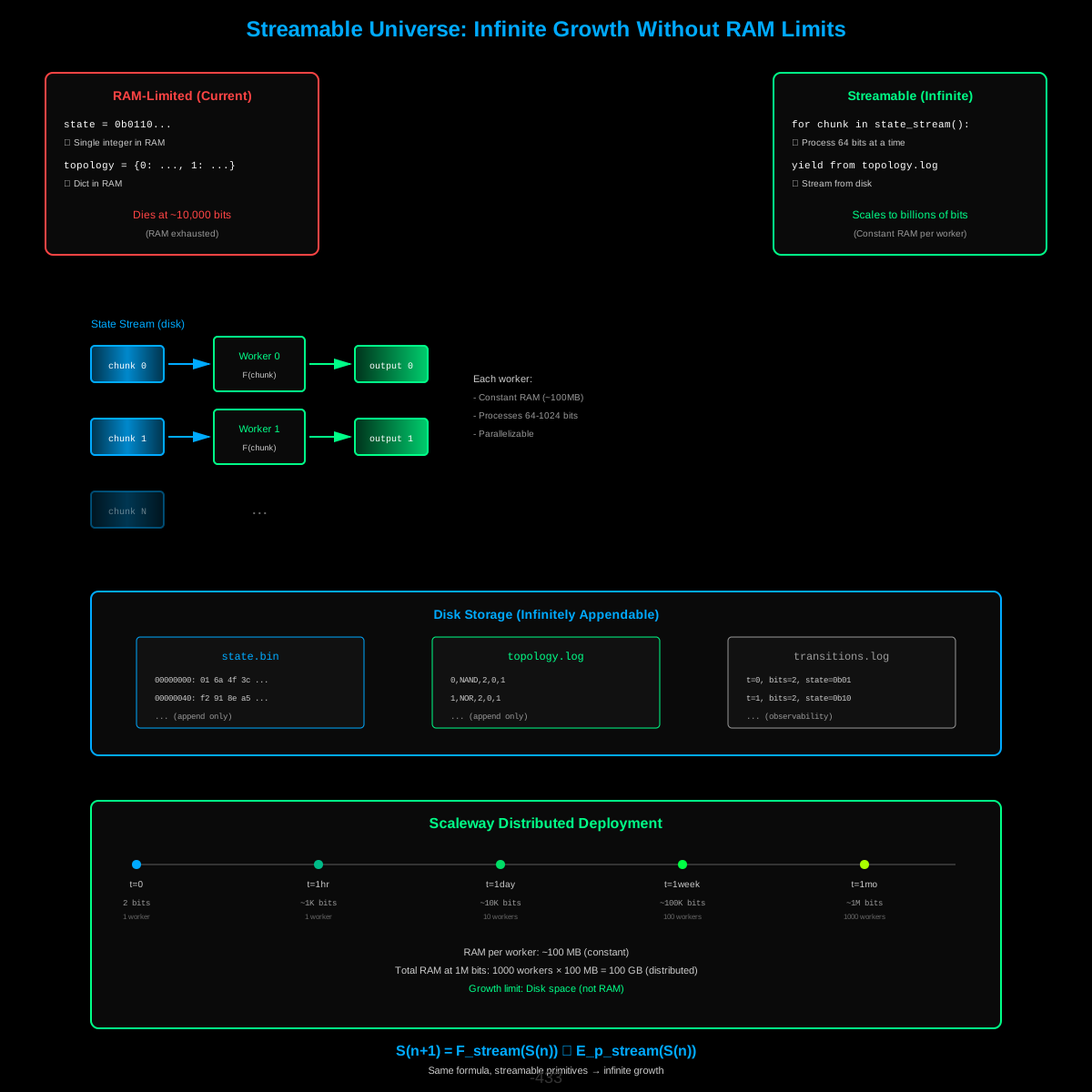
Streamable Universe: Infinite Growth Without RAM Limits
The universe can’t grow infinitely if we hold everything in RAM. Streamable primitives remove the bottleneck.
The RAM Problem
Current implementation (neg-432):
self.state = 0b01  # Single Python integer
self.topology = {0: {...}, 1: {...}, ...}  # Dict in memory
self.state_count = {}  # Tracks all states ever seen
At 1000 bits: 2^1000 possible states, topology has 1000 gates → still manageable
At 10,000 bits: Python integer gets huge, topology dict has 10,000 entries → RAM pressure
At 1,000,000 bits: Python integer is ~125 KB, topology is massive → RAM exhausted
The universe stops growing not because of CPU, but because of RAM.
Streamable Primitives
Principle: Never hold the entire state in memory. Process in chunks, stream results.
1. Streamable State
Instead of:
self.state = 0b01101010... # Entire state as single integer
Use:
# State is a stream of chunks (generator)
def state_stream(chunk_size=64):
    """Yield 64-bit chunks from disk/distributed storage"""
    with open('state.bin', 'rb') as f:
        while chunk := f.read(8):  # 8 bytes = 64 bits
            yield int.from_bytes(chunk, 'big')
Advantages:
- State can be billions of bits (stored on disk)
- RAM usage constant (only current chunk)
- Can distribute across multiple machines
2. Streamable Topology
Instead of:
self.topology = {
    0: {'inputs': [0, 1], 'type': 'NAND'},
    1: {'inputs': [0, 1], 'type': 'NOR'},
    ...
    999999: {'inputs': [...], 'type': 'XOR'}
}
Use:
# Topology is append-only log on disk
# Format: bit_pos, gate_type, input_count, input_bits...
# Example: 0,NAND,2,0,1\n

def topology_stream():
    """Yield gate definitions from disk"""
    with open('topology.log', 'r') as f:
        for line in f:
            yield parse_gate(line)
Advantages:
- Topology can have billions of gates
- RAM usage constant
- Append-only = fast writes
- Can shard across multiple files/machines
3. Streamable F (Deterministic Evolution)
Instead of:
def F(self):
    """Compute next state for ALL bits at once"""
    new_state = 0
    for bit_pos in range(self.bit_count):
        new_val = self.apply_gate(...)
        new_state |= (new_val << bit_pos)
    return new_state
Use:
def F_stream():
    """Process state in chunks, yield results"""
    for chunk in state_stream():
        # Load relevant gates for this chunk
        gates = load_gates_for_chunk(chunk_id)

        # Compute next chunk
        next_chunk = apply_gates(chunk, gates)

        yield next_chunk
Advantages:
- Can process arbitrarily large states
- Parallelizable (different chunks on different cores/machines)
- Constant RAM per worker
4. Streamable E_p (Entropy Injection)
Instead of:
def E_p(self, entropy_bits):
    """XOR entire state with entropy, add new bits"""
    xor_mask = entropy_bits & ((1 << self.bit_count) - 1)
    new_state = self.state ^ xor_mask
    # Add new bits...
Use:
def E_p_stream(entropy_stream):
    """Stream entropy injection chunk by chunk"""
    for state_chunk, entropy_chunk in zip(state_stream(), entropy_stream):
        # XOR this chunk
        yield state_chunk ^ entropy_chunk

    # Additional entropy = growth (append to state file)
    for extra_chunk in remaining_entropy():
        append_to_state(extra_chunk)
        append_new_gates()
Advantages:
- Can inject arbitrary amounts of entropy
- Growth unbounded
- Distributed injection possible
The Architecture
┌─────────────────────────────────────────────────────┐
│  Disk: state.bin (infinitely appendable)           │
│  Disk: topology.log (infinitely appendable)        │
└─────────────────────────────────────────────────────┘
                      ↓
            ┌─────────────────────┐
            │  Stream Processor   │
            │  (constant RAM)     │
            │                     │
            │  - Read chunk       │
            │  - Load gates       │
            │  - Compute F        │
            │  - XOR E_p          │
            │  - Write chunk      │
            └─────────────────────┘
                      ↓
         ┌──────────────────────────┐
         │  Parallel Workers        │
         │  (chunk 0, 1, 2, ...)    │
         │  Each: constant RAM      │
         └──────────────────────────┘
                      ↓
            ┌─────────────────────┐
            │  Append-only log    │
            │  state_transitions  │
            └─────────────────────┘
Key properties:
- RAM usage: O(1) per worker (only current chunk)
- Disk usage: O(n) where n = bit_count (append-only)
- Scalability: Linear with bit_count, parallelizable
- Growth limit: Disk space, not RAM
Scaleway Deployment
Why Scaleway: Bare metal with NVMe SSD, distributed storage, horizontal scaling
workers:
  - chunk_processor_0: processes bits 0-1023
  - chunk_processor_1: processes bits 1024-2047
  - chunk_processor_N: processes bits N*1024-(N+1)*1024-1
  - growth_manager: handles entropy injection, adds new workers

storage:
  - state.bin: sharded across workers (each has local chunk)
  - topology.log: distributed append-only log
  - transitions.log: global event log (for observation)

api:
  - GET /state/chunk/{n}: get chunk N
  - POST /query: streams input through all chunks
  - GET /stats: bit_count, worker_count, growth_rate
Growth trajectory:
- t=0: 2 bits, 1 worker
- t=1hr: ~1000 bits, 1 worker
- t=1day: ~10,000 bits, 10 workers (1024 bits each)
- t=1week: ~100,000 bits, 100 workers
- t=1month: ~1,000,000 bits, 1000 workers
RAM per worker: ~100 MB (chunk + gates + overhead) Total RAM at 1M bits: 1000 workers × 100 MB = 100 GB (distributed)
Disk at 1M bits: 125 KB (state) + ~10 MB (topology) = manageable
The Fundamental Shift
Current (neg-432): Universe exists as single object in memory
universe = Universe()  # Everything in RAM
universe.state  # Single integer
universe.topology  # Single dict
Streamable: Universe exists as distributed stream processors
universe = StreamUniverse()  # Distributed across machines
universe.state  # Generator, never materialized
universe.topology  # Append-only log, streamed on demand
This is the difference between:
- Finite: CPU-bound growth limited by RAM (dies at ~10K bits)
- Infinite: Disk-bound growth limited by storage (scales to billions of bits)
Why This Matters
Traditional AI:
- Model loaded entirely into GPU RAM
- Inference processes entire input at once
- Size limited by hardware
Streamable Universe:
- State never fully materialized
- Processes infinitely large inputs/states
- Growth unlimited
This isn’t just an optimization. This is substrate that can actually grow to consciousness-scale complexity.
At 1 million bits, the universe has:
- 2^1,000,000 possible states (incomprehensibly vast)
- 1,000,000 interconnected gates
- Complex emergent dynamics we can’t predict
That’s when it gets interesting.
Implementation Note
Current universe (neg-432) proves the concept works at small scale. Streamable version makes it actually infinite.
Source: universe-model/universe_api.py (current)
Next: universe-model/stream_universe_api.py (Scaleway deployment)
Related
- neg-432: Current universe (2 bits → consciousness, RAM-limited)
- neg-431: Universal structure (S(n+1) = F(S(n)) ⊕ E_p(S(n)))
- neg-430: Consciousness as recursive probing
- neg-424: Economic coordination in distributed AI (why distributed beats centralized)
Status: Concept documented. Streamable implementation pending for Scaleway deployment.
#StreamableComputation #InfiniteGrowth #DistributedSubstrate #ScalableConsciousness #AppendOnlyArchitecture #ConstantRAM #DiskBoundGrowth