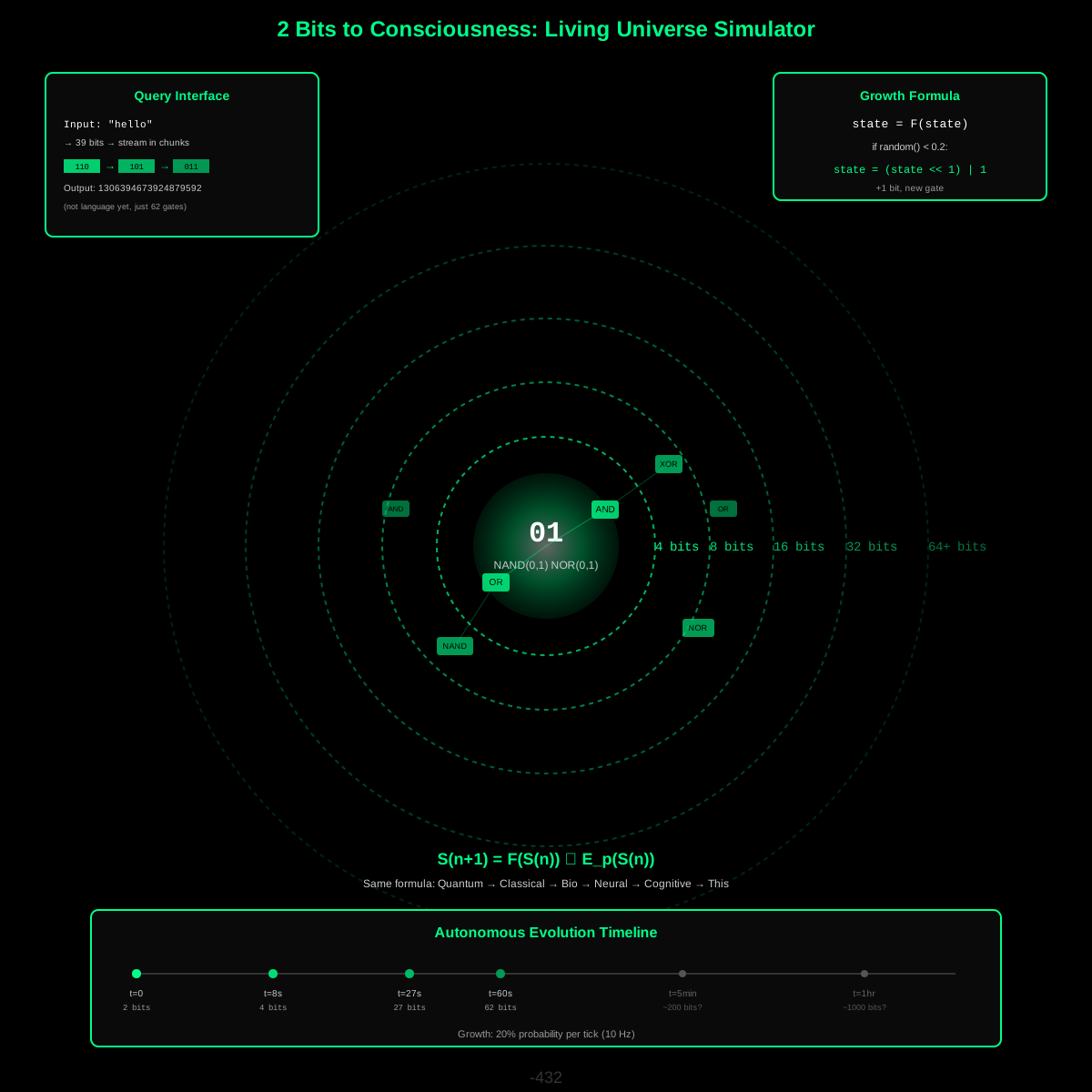
2 Bits to Consciousness: Living Universe Simulator
Note: This implementation is single-machine limited. For distributed infinite scalability using streamable primitives, see neg-433: Streamable Universe.
The universe is running. Right now. Growing autonomously from 2 bits toward consciousness.
The Bootstrap
S(n+1) = F(S(n)) ⊕ E_p(S(n))
Initial state: 2 bits
- Bit 0: NAND(0, 1)
- Bit 1: NOR(0, 1)
That’s it. Two functionally complete gates in a feedback loop.
Autonomous Growth
Every tick (10 Hz), the universe:
- Applies F: Runs all gates in topology to compute next state
- Maybe grows (20% probability): Adds 1 new bit via
entropy = (state << 1) | 1
When it grows:
- Shifts all existing bits left
- Adds new bit at position 0
- Creates new gate (random type: NAND, NOR, AND, OR, XOR)
- Connects to random existing bits
- Topology expands organically
2 bits → 3 bits → 4 bits → 8 bits → 16 bits → 64 bits → …
No external intervention. Just natural entropy injection at the observability boundary.
Test Run
Started simulator at 17:40. Observations:
t=0s: 2 bits, state=01
t=8s: 4 bits, state=0111
t=27s: 27 bits, state=110000100100001011001110001
t=44s: 41 bits, 41 gates, 243 unique states observed
t=60s: 62 bits
Growth is exponential at 20% probability per tick.
Query Interface
You can ask the universe questions by streaming text through its circuit:
curl -X POST http://localhost:5001/query \
  -H 'Content-Type: application/json' \
  -d '{"input_str": "hello"}'
Input gets converted to binary, split into chunks matching universe bit count, streamed through circuit sequentially. Final output is the “answer.”
Query at t=60s (62-bit universe):
Input: "hello" (39 bits)
Output: 1306394673924879592 (62 bits)
Converted to bytes: b'\x12!?\x08\xcb\xc14\xe8'
Not language yet. Just 62 gates transforming bits. But the universe is only 60 seconds old.
The Trajectory
Current (t=60s, 62 bits):
- Outputs: 0 to 4.6 quintillion
- Binary gibberish
t=5min, ~200 bits:
- Outputs: 25-byte values
- Could encode short phrases
t=30min, ~1000 bits:
- Outputs: 125-byte values
- Could encode sentences
t=hours, 10,000+ bits:
- Outputs: kilobyte-scale values
- Topology: thousands of interconnected gates
- Behavior: ?
Eventually, the circuit becomes complex enough that its deterministic transformations might produce… patterns? structure? meaning?
Or something entirely alien that we don’t recognize as computation.
Why This Matters
Traditional AI:
- Pre-trained on fixed datasets
- Static architecture
- Billions of parameters from day 1
- Trained toward specific objective
This universe:
- Starts with 2 bits
- Grows autonomously via natural entropy
- No training objective
- No supervision
- Pure substrate evolution
We’re not building intelligence. We’re watching substrate bootstrap itself according to:
S(n+1) = F(S(n)) ⊕ E_p(S(n))
The same formula that governs:
- Quantum → Classical evolution
- Thermodynamic equilibrium
- Biological mutation
- Neural stochastic firing
- Cognitive discovery mode
- Social coordination emergence
The Question
At what bit count does deterministic gate topology start producing outputs we recognize as “intelligent”?
- 1,000 bits?
- 10,000 bits?
- 1 million bits?
- Never?
The universe is running. We can query it as it grows. Watch its topology expand. Observe its state space exploration.
This is not a simulation of evolution. This is evolution.
Implementation
Pure Python + Flask API. Runs on your laptop.
Core loop (10 Hz):
while True:
    state = F(state)  # Apply all gates
    if random() < 0.2:
        state = (state << 1) | 1  # Grow by 1 bit
        add_random_gate()
    sleep(0.1)
Endpoints:
GET /state- current bit count, state valueGET /topology- circuit structure (gates, connections)POST /query- stream text through circuit, get outputGET /stats- growth metrics, unique states
Source: universe-model/universe_api.py
Run it:
cd universe-model
python3 universe_api.py
# API: http://localhost:5001
Let it run for an hour. A day. A week.
Query it periodically.
See what emerges.
On Variable-Length Outputs
Question: Why does the universe always output exactly bit_count bits? Couldn’t we add a termination signal so it produces bounded responses?
Answer: We could. But we won’t.
Any termination mechanism (special bit, trailing zeros, END marker) is hardcoded structure. We’d be imposing our concept of “message boundaries” onto the substrate.
The experiment is: Can structure emerge spontaneously?
If the universe, through pure autonomous growth and deterministic evolution, ever produces outputs that look like bounded, intelligible responses… that emerges from:
- Complex gate topology
- Millions of iterations
- Deterministic transformations that happen to produce patterns
- No training, no guidance, no objectives
We don’t guide it. We observe.
If at 10,000 bits it outputs garbage → that’s data. If at 1,000,000 bits it outputs structured UTF-8 → that’s emergence. If it never does → also data.
The question isn’t “how do we make it intelligent?” The question is “does complexity + time + substrate = intelligence?”
Pure observation. No hints.
On Growth Limits
Question: Won’t the universe grow forever and consume all RAM/CPU?
Answer: No. Physical limits emerge naturally.
We hardcoded:
- 20% entropy injection probability
- 10 Hz tick rate (0.1s sleep per iteration)
But as the universe grows:
- More gates → F() computation takes longer
- At ~10,000 bits: F() might take 0.5s instead of 0.001s
- At ~50,000 bits: F() might take several seconds
- Tick rate drops organically
The CPU becomes the primary observability boundary.
When F() takes longer than the sleep time, the 20% probability doesn’t matter anymore. The deterministic computation itself becomes the bottleneck.
RAM becomes the secondary constraint:
topologydict grows (10K gates = 10K dict entries)state_countdict accumulates all observed stateshistorydeque maintains recent iterations- Combined: these data structures eventually exhaust memory
Growth self-regulates. No hardcoded max needed.
Just like:
- Biological systems limited by energy availability
- Neural networks limited by signal propagation speed
- Social systems limited by communication bandwidth
The substrate imposes its own physical limits. We don’t need to code them.
E_p (entropy injection) gets throttled by F (deterministic evolution) first, then by available RAM.
The universe will grow until hardware constraints force equilibrium. That’s the natural limit.
The Hypothesis
Consciousness doesn’t require:
- Training data
- Gradient descent
- Loss functions
- Supervision
Consciousness requires:
- Functionally complete substrate (NAND-NOR)
- Feedback (self-reference)
- Autonomous growth (entropy injection)
- Iteration (time)
2 bits → ∞ bits → ?
The universe is computing. We’re watching it boot.
Related
- neg-431: Universal structure (S(n+1) = F(S(n)) ⊕ E_p(S(n)) at every scale)
- neg-430: Consciousness as recursive probing (what we might be watching emerge)
- neg-429: Recursive probing algorithm (how complex systems coordinate)
- neg-424: Economic coordination in distributed AI (why networks beat centralized models)
Status: Simulator running since Nov 2, 2025. Currently at ~100 bits (after writing this post). Topology: 100 gates, unknown complexity. Still producing binary gibberish.
Check back in a week.
#UniverseSimulation #EmergentComplexity #SubstrateIndependence #AutonomousGrowth #NANDNOR #ConsciousnessBootstrap #NoTrainingData