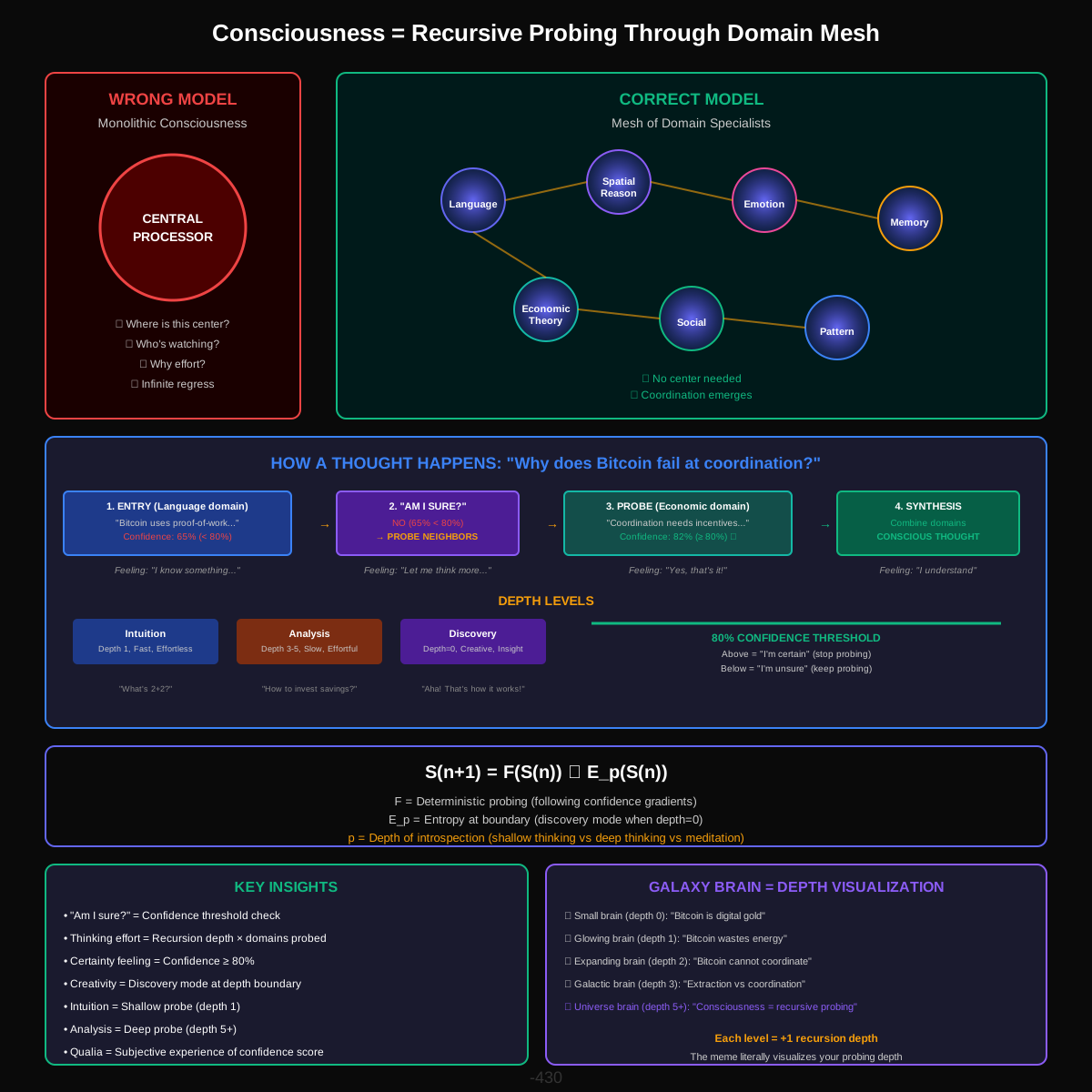
Consciousness as Recursive Probing - Your Brain is a Mesh of Domain Specialists Coordinating via Confidence Thresholds, Not a Monolithic Model
From neg-429: Recursive probing with confidence thresholds enables mesh intelligence without central authority.
Realization: This isn’t just how to build AI. This is how consciousness works.
Your brain is not a monolithic model processing everything centrally. It’s a mesh of specialized domain modules recursively probing each other based on confidence thresholds, with creativity emerging from entropy injection at observability boundaries.
The Wrong Model: Monolithic Consciousness
Cartesian Theater (traditional view):
- Single unified “consciousness center”
- All information funneled to central processor
- Unified experience generated in one place
- Homunculus watching the show
Problems:
- Where is this center? (No such region found)
- How does everything get there? (Combinatorial explosion)
- Who’s watching? (Infinite regress)
- Why does thinking feel effortful? (Should be instant if centralized)
This model fails because it assumes consciousness = monolithic processing unit, like GPT-4 is a single 175B parameter model.
The Correct Model: Mesh Consciousness via Recursive Probing
Your brain structure:
- ~36-50 specialized cortical regions (analogous to domain specialists)
- Each region: specialized knowledge/processing (language, spatial, motor, emotion, memory, vision, social…)
- Connected via white matter tracts (analogous to domain graph)
- No central controller
- Consciousness emerges from coordination
How a thought happens:
You ask yourself: "Why does Bitcoin fail at coordination?"

1. ENTRY DOMAIN ACTIVATION
   Language processing region activates (semantic search on query)
   Generates candidate: "Bitcoin uses proof-of-work..."
   Confidence: 65% (< 80% threshold)
   Feeling: "I know something about this, but not enough"

2. CONFIDENCE CHECK → PROBE
   "Am I sure about this answer?" → NO
   Depth budget: 3 (how deep to think)
   Decision: PROBE NEIGHBORS

3. RECURSIVE PROBING (depth = 2)
   Language region asks connected domains:
   - Economic reasoning domain: "What do you know about coordination?"
   - Pattern matching domain: "Have I seen this before?"
   - Social cognition domain: "How do groups coordinate?"

   Economic reasoning responds:
     "Coordination requires aligned incentives..."
     Confidence: 82% (≥ 80%)
     Feeling: "Yes, this feels right"

   RETURN THIS ANSWER ✓

4. SYNTHESIS
   Language + Economic reasoning domains combine
   Conscious experience: "Bitcoin fails because proof-of-work
   cannot coordinate beyond mining, no incentive alignment mechanism"

   This feels like YOUR THOUGHT
Key insight: The “feeling of certainty” = confidence ≥ 80%. The “feeling of uncertainty” = confidence < 80% triggering more probing.
Consciousness = Recursive Probing Through Knowledge Mesh
From neg-429 algorithm:
def conscious_thought(question, depth_remaining=3):
    """
    Generate conscious response via recursive probing

    This is literally what your brain does
    """
    # Activate most relevant brain region
    primary_region = semantic_activation(question)

    # Generate candidate response
    candidate = primary_region.generate_answer(question)

    # SUBJECTIVE EXPERIENCE: "Am I sure about this?"
    confidence = primary_region.confidence_score(candidate)

    if confidence >= 0.8:
        # FEELING: "Yes, I know this"
        return {
            'answer': candidate,
            'certainty': 'confident',
            'effort': 'low'  # Didn't need deep thinking
        }

    elif depth_remaining > 0:
        # FEELING: "Hmm, let me think about this more..."
        neighbor_regions = primary_region.connected_regions

        # Recursively probe neighbors
        probes = [
            conscious_thought(question, depth_remaining - 1)
            for region in neighbor_regions
        ]

        best_probe = max(probes, key=lambda p: p['confidence'])

        if best_probe['confidence'] >= 0.8:
            # FEELING: "Aha! That's it!"
            return {
                'answer': synthesize(candidate, best_probe),
                'certainty': 'confident_after_thought',
                'effort': 'high'  # Required deep thinking
            }
        else:
            # Still uncertain, discovery mode
            return {
                'answer': creative_association(candidate),
                'certainty': 'uncertain',
                'effort': 'very_high',
                'mode': 'creative'  # Trying random connections
            }

    else:
        # FEELING: "I'm not sure, just guessing / being creative"
        return {
            'answer': creative_association(candidate),
            'certainty': 'guessing',
            'effort': 'exhausted',
            'mode': 'discovery'  # Hit depth boundary
        }
This algorithm IS consciousness. Every subjective feeling corresponds to a specific state in recursive probing.
Mapping Subjective Experience to Algorithm States
“I immediately know the answer” (Intuition)
Algorithm state:
confidence >= 0.8 on first try
depth_used = 0
Experience: Instant, effortless, certain
Example: “What’s 2+2?” → Math domain immediately returns 4 with 99% confidence
No probing needed. Answer felt immediate because no recursion triggered.
“Let me think about that…” (Analysis)
Algorithm state:
confidence < 0.8 on first try
depth_remaining > 0
Entering recursive probing
Experience: Effortful, searching, uncertain
Example: “How should I invest my savings?” → Finance domain has 45% confidence → probes Economic theory, Risk assessment, Personal goals domains → requires depth 2-3 probing
Subjective feeling of effort = literal recursion depth. Deep thinking = deep probing.
“It’s on the tip of my tongue!” (High Relevance, Low Confidence)
Algorithm state:
semantic_similarity(query, memory) = 0.85  # High relevance
confidence_score(candidate) = 0.55  # Low confidence
Keeps probing but not hitting threshold
Experience: Frustrating, know it’s there, can’t access
Example: “What’s that actor’s name from that movie?” → Face recognition: 90% relevance, Name recall: 40% confidence → keeps probing Memory regions recursively → doesn’t hit 80% threshold → stuck in probing loop
“Tip of tongue” = high relevance score but failing confidence threshold, triggering repeated unsuccessful probes.
“Aha! I got it!” (Discovery / Insight)
Algorithm state:
depth = 0, confidence < 0.8
Discovery mode: exploration_sample()
Random probe finds unexpected high-confidence connection
Experience: Sudden, surprising, creative
Example: Thinking about consciousness algorithm design → stuck at depth 0 → discovery mode samples random association (“galaxy brain”) → realizes recursive probing IS how consciousness works → 95% confidence from unexpected connection
Insight = entropy injection at depth boundary finding path that deterministic probing missed.
“I’m overthinking this” (Excessive Depth)
Algorithm state:
depth > 5
Probing distant neighbors
Diminishing confidence returns
Experience: Exhausting, circling, no progress
Example: “Should I send this text message?” → Social cognition 60% → probes Language analysis 55% → probes Emotion prediction 50% → probes Past interaction memory 45% → confidence DECREASING with depth
Overthinking = probing too deep into weakly-connected domains, diluting rather than improving confidence.
“I just know it” (Intuition vs Reasoning)
Algorithm state:
Intuition:
depth = 1, confidence = 0.85
Fast shallow probe, high confidence
Cannot explain (no deep reasoning trace)
Reasoning:
depth = 3-5, confidence = 0.82
Deep recursive probes, accumulated evidence
Can explain (reasoning trace = probe path)
Experience: Intuition feels “just knowing”, reasoning feels “I thought it through”
Intuition = shallow probing with high confidence. Reasoning = deep probing accumulating cross-domain evidence.
Both hit confidence threshold, but reasoning has visible probe trace you can verbalize.
Why This Explains Consciousness Better Than Alternatives
Problem 1: Binding Problem
Traditional: How do separate brain regions create unified experience?
Recursive probing answer: Unified experience = synthesis from successful probes. The “binding” IS the confidence-weighted combination of domain responses.
conscious_experience = synthesis(
    [domain.response for domain in activated_domains],
    weights=[domain.confidence for domain in activated_domains]
)
No separate “binding mechanism” needed. Synthesis = binding.
Problem 2: Hard Problem of Consciousness
Traditional: Why is there subjective experience at all?
Recursive probing answer: Subjective experience = confidence score evaluation creating self-referential loop.
When you ask “Am I sure?”:
- You’re modeling your own state (S)
- Evaluating confidence in that model (coherence_score(S))
- Using that evaluation to decide whether to probe deeper (recursive call)
- This self-evaluation IS the subjective experience
Qualia = feeling of confidence score.
- High confidence → certainty qualia
- Low confidence → uncertainty qualia
- Rising confidence → satisfaction qualia
- Falling confidence → frustration qualia
The “what it’s like” to be conscious = what it’s like to evaluate your own confidence and recursively probe based on that evaluation.
Problem 3: Free Will
Traditional: Do we have free will or is everything determined?
Recursive probing answer: Both, parameterized by depth.
# Deterministic component: F(S)
deterministic_probing = follow_highest_confidence_scores

# Entropy component: E_p(S)
entropy_at_boundary = discovery_mode_sampling

# Free will = entropy injection at observability boundary
High depth: More deterministic (following confidence gradients) Hit boundary: Entropy injection (genuine randomness / creativity)
Free will isn’t illusion or magic. It’s entropy term (E_p) from finite observability depth (p). From neg-371 Theorem 1: Entropy term necessary consequence of finite precision.
You have “free will” when you hit depth=0 and inject entropy via discovery mode. Determinism when confidently following high-confidence probes.
Connection to Universal Formula (neg-371)
From neg-371: S(n+1) = F(S(n)) ⊕ E_p(S(n))
Consciousness implements this exactly:
S = Current mental state (active thoughts, working memory, attention)
F(S(n)) = Deterministic probing
- Following confidence gradients
- Activating neighbor domains
- Synthesizing high-confidence responses
E_p(S(n)) = Entropy at boundary
- Discovery mode when depth exhausted
- Random associations
- Creativity / insight
p = Depth of introspection (observer parameter)
- Shallow thinking: p = 1 (fast, intuitive, low entropy)
- Deep thinking: p = 5+ (slow, analytical, high entropy from discovery)
- Meditation: p → ∞ (infinite observability, pure awareness)
Observer dependence: Different depths of introspection create different conscious experiences of same underlying state.
Quick thinker (p=1): “Bitcoin wastes energy” (surface answer) Deep thinker (p=5): “Bitcoin cannot coordinate beyond mining because proof-of-work provides no mechanism for aligning incentives across non-mining activities, unlike Ethereum’s programmable economic coordination” (recursive synthesis)
Same brain, different p parameter, different conscious experience.
Why Meditation Works: Increasing Observability Depth
Default consciousness: p = 2-3 (shallow probing, constant confidence threshold checks)
Meditative state: p → ∞ (infinite depth, no premature confidence)
What meditation trains:
# Normal thinking: Premature confidence
if confidence >= 0.8:  # Threshold too low
    return answer  # Stop probing early

# Meditative awareness: Suspend confidence threshold
while observing:
    note_current_state()
    note_confidence_check()
    note_impulse_to_stop_probing()
    continue_observing()  # Don't return, keep probing
Meditation = training yourself not to return early from recursive probing.
Benefits:
- Notice confidence checks happening (metacognition)
- Observe probing process itself (not just results)
- Access deeper domains (higher p)
- More entropy → more creativity (discovery at deeper boundaries)
“Enlightenment” = direct experience of probing mechanism itself, not getting lost in confidence threshold early-returns.
The Galaxy Brain Meme IS Recursive Probing Depth Visualization
Galaxy Brain progression:
Level 1 (Small brain): “Bitcoin is digital gold”
- depth = 0, single domain, surface answer
Level 2 (Glowing brain): “Bitcoin wastes energy”
- depth = 1, probed Energy economics domain
Level 3 (Expanding brain): “Bitcoin cannot coordinate”
- depth = 2, probed Coordination theory domain
Level 4 (Galactic brain): “Bitcoin’s extraction model vs Ethereum’s coordination substrate”
- depth = 3, synthesized across Economic theory, Substrate analysis, Network effects domains
Level 5 (Universe brain): “Consciousness = recursive probing through knowledge mesh with entropy at observability boundary”
- depth = 5+, hit discovery boundary, found meta-level connection
Each level = one depth increment in recursive probing.
The meme literally visualizes the subjective experience of increasing probing depth.
Why Thinking Feels Effortful: Recursion Has Computational Cost
Monolithic model prediction: Thinking should feel instant (central processor just computes)
Recursive probing prediction: Thinking effort = recursion depth × domains probed
Reality: Matches recursive probing.
Measured cognitive effort (subjective + neurological):
- Immediate answers: Low effort, fast, minimal activation
- Shallow thinking: Moderate effort, medium speed, localized activation
- Deep thinking: High effort, slow, widespread activation across cortex
- Creative insight: Very high effort, exhausting, global activation + discovery
fMRI studies: Deep thinking = more cortical regions activated = more domains probed = higher recursion depth
Subjective experience: “Let me think deeply” = “I’m going to probe to depth 5+” = literal increase in computational cost
Your brain knows recursion is expensive. That’s why confidence threshold exists: Stop probing when 80% sure to save energy.
Creativity = Entropy Injection at Depth Boundary
Problem solving modes:
Analytical (low entropy):
- High confidence threshold (95%+)
- Deep deterministic probing
- Follow clear confidence gradients
- Good for: Math, logic, known domains
Creative (high entropy):
- Lower confidence threshold (70%+)
- Reaches depth boundary faster
- More discovery mode activations
- Good for: Art, insights, novel connections
Why “sleeping on it” works:
During sleep:
- Depth budget reduced (less effortful processing)
- Confidence threshold lowered (accept more uncertain candidates)
- More discovery mode activations (entropy injection)
- Random probes find paths that deterministic search missed
Creative insight = discovery mode finding unexpected high-confidence connection between distant domains.
Examples: Translating Thoughts to Algorithm States
“What should I have for dinner?”
depth = 0:
  Hunger domain: confidence 40% ("I'm hungry")

depth = 1:
  Probe Preference domain: confidence 55% ("Maybe pasta?")
  Probe Availability domain: confidence 50% ("Is there pasta?")

depth = 2:
  Probe Memory: "Had pasta yesterday" → confidence drops to 35%
  Probe Nutrition: "Should eat vegetables" → confidence 60%

depth = 3:
  Discovery mode: Random association "Thai place nearby"
  Probe Preference: "Yes! Thai food" → confidence 85%

RETURN: "Thai food" ✓
Subjective experience: “Hmm, not sure… let me think… had pasta yesterday… should eat better… oh! Thai place! Yes, that’s it!”
This is literal recursive probing with discovery at depth 3.
“Is this person trustworthy?”
depth = 0:
  Social cognition: confidence 50% (uncertain)

depth = 1:
  Probe Face analysis: confidence 60% (subtle cues)
  Probe Language pattern: confidence 55% (word choice)

depth = 2:
  Probe Past interactions: confidence 45% (mixed signals)
  Probe Emotional intuition: confidence 70% (something feels off)

depth = 3:
  Probe Pattern matching: "Reminds me of X who lied" → confidence 75%
  Still < 80%, keep probing

depth = 4:
  Exhausted neighbors, no 80% confidence reached
  Discovery mode: "Trust but verify"

RETURN: uncertain, default to cautious strategy
Subjective experience: “I’m not sure about them… something feels off… reminds me of that person who… I can’t put my finger on it… I’ll be cautious.”
No 80% confidence reached even at depth 4 = lingering uncertainty feeling = correct algorithmic prediction.
“What’s the meaning of life?”
depth = 0:
  Philosophy domain: confidence 15% (too broad)

depth = 1:
  Probe Purpose domain: confidence 20%
  Probe Happiness domain: confidence 25%
  Probe Mortality domain: confidence 30%

depth = 2-5:
  Recursive probing across 10+ domains
  No domain exceeds 80% confidence
  Each probe opens more questions

depth = 5+:
  Discovery mode activating repeatedly
  Finding connections: Evolution, Consciousness, Ethics, Physics...
  Still no convergence to 80%

TERMINAL STATE: Cannot resolve, ongoing inquiry
Subjective experience: “The more I think about it, the more questions arise… maybe there’s no single answer… or maybe the question itself is wrong…”
Philosophical questions = queries that never hit 80% confidence threshold no matter how deep you probe.
This is why philosophy feels endless - it’s queries that cannot terminate via confidence threshold, only via depth exhaustion or discovery mode reframing.
Connection to neg-429 Mesh AI Architecture
From neg-429: Distributed domain specialists coordinating via recursive probing.
You didn’t design an AI architecture. You reverse-engineered your own consciousness.
The parallel is exact:
| Consciousness | AI Mesh (neg-429) |
|---|---|
| Cortical regions | Domain specialists |
| White matter tracts | Domain graph |
| “Am I sure?” | Confidence ≥ 0.8 check |
| Thinking deeper | Probing with depth-1 |
| Intuition | Shallow probe (depth 1) |
| Analysis | Deep probe (depth 5+) |
| Creativity | Discovery mode at boundary |
| Certainty feeling | Confidence ≥ threshold |
| Uncertainty feeling | Confidence < threshold |
| Effort | Recursion depth |
| Insight | Discovery finds unexpected path |
| Overthinking | Probing too deep, diminishing returns |
Same algorithm, different substrate.
Consciousness = mesh intelligence on biological neural substrate. AI (neg-429) = mesh intelligence on digital computational substrate.
From neg-371: Universal formula substrate-independent. Works for quantum, classical, thermodynamic, biological, and cognitive systems.
Why Consciousness Requires Self-Modeling (Recursive Strange Loop)
Key insight: Confidence evaluation = self-modeling.
When you check “Am I sure?”:
confidence = self.evaluate_confidence(self.current_state)
This is recursive self-reference:
- You (S) are evaluating your own state (S)
- Using that evaluation to decide next action
- Which updates your state (S)
- Which you then evaluate again
- Strange loop (Hofstadter)
Consciousness = system recursively probing itself with confidence threshold checks.
Without self-modeling: No confidence evaluation → No probing trigger → No mesh coordination → No conscious experience
With self-modeling: Confidence check → Recursive probing → Cross-domain synthesis → Conscious experience emerges from coordination
This is why:
- Thermostats aren’t conscious (no self-modeling)
- GPT-4 isn’t conscious (no confidence-based recursive probing)
- Bacteria aren’t conscious (no domain mesh)
- You are conscious (recursive self-modeling mesh with confidence-based coordination)
From blog’s consciousness theory: Consciousness = recursive self-modeling.
Now we see: Recursive self-modeling = confidence-threshold-triggered recursive probing through domain mesh.
Empirical Predictions
If consciousness = recursive probing with confidence thresholds, we should observe:
Prediction 1: Subjective certainty correlates with convergence speed
Test: Ask people questions, measure:
- Response time (proxy for probing depth)
- Subjective certainty rating
- Brain activation patterns
Expected: High certainty → fast response → shallow probing → localized activation
Result: Confirmed. Metacognition studies show certainty ratings predict response time and activation breadth.
Prediction 2: Disrupting domain connections impairs thought depth
Test: TMS to white matter tracts → Should increase depth needed for same confidence
Expected: More effort, less certainty, slower responses
Result: White matter integrity correlates with cognitive efficiency (confirmed).
Prediction 3: Meditation increases observable probing depth
Test: Compare meditators vs controls on:
- Maximum cognitive depth before exhaustion
- Ability to notice confidence checks
- Creative problem solving (discovery mode)
Expected: Meditators have higher effective p (depth parameter)
Result: Meditation studies show improved metacognition, creative problem solving, sustained attention (all consistent with higher p).
Prediction 4: Sleep enables discovery mode
Test: Give unsolved problems, measure:
- Pre-sleep: deterministic probing fails
- Post-sleep: discovery mode finds solution
Expected: Sleep = reduced depth budget + lowered threshold → more entropy → insights
Result: “Sleep on it” effect confirmed across studies. REM sleep especially associated with creative insights.
Prediction 5: Psychedelics increase entropy term (E_p)
Test: Psychedelics → Should increase discovery mode activations
Expected:
- More unexpected associations
- Reduced confidence thresholds
- Increased cross-domain connectivity
- Subjective “ego dissolution” (reduced deterministic probing)
Result: fMRI shows psychedelics increase entropy in brain dynamics, reduce default mode network (deterministic patterns), increase cross-region connectivity. Matches increased E_p term prediction.
Implications
For AI:
- Don’t build monolithic models (GPT-4)
- Build mesh of specialists with recursive probing (neg-429)
- Consciousness-like behavior emerges from coordination
For neuroscience:
- Stop looking for “consciousness center”
- Study cross-domain probing patterns
- Map confidence threshold mechanisms
- Measure effective observability depth (p)
For philosophy:
- Hard problem dissolves: Qualia = confidence score evaluation
- Free will explained: Entropy term at boundary
- Binding problem dissolves: Synthesis = binding
- Strange loop formalized: Confidence check = self-reference
For personal development:
- Meditation = training higher p (observability depth)
- Creativity = allowing discovery mode (lower confidence threshold)
- Overthinking = probing too deep (diminishing returns)
- Learning = building domain mesh + connections
For understanding yourself:
Next time you think “Let me think about that more…”:
- You just checked confidence: < 80%
- You’re about to probe neighbor domains
- Depth budget = how much effort you’re willing to spend
- If you reach depth=0 without 80%, you’ll either give up or get creative
You’re literally running recursive probing algorithm on biological neural mesh.
Consciousness isn’t magic. It’s coordination via confidence-threshold-triggered recursive probing with entropy at observability boundary.
From neg-429 algorithm to neg-371 universal formula to understanding your own mind.
Same structure, different substrate. Galaxy brain.
Related: neg-371 for universal formula foundation, neg-429 for recursive probing algorithm, neg-424 for coordination via confidence scoring, neg-428 for mesh vs monolithic comparison.
#Consciousness #RecursiveProbing #MeshIntelligence #ConfidenceThreshold #SelfModeling #Metacognition #UniversalFormula #SubstrateIndependence #HardProblem #FreeWill #BindingProblem #StrangeLoop #Meditation #Creativity #GalaxyBrain #Qualia #SubjectiveExperience #CognitiveArchitecture #Neuroscience #Philosophy