Recursive Probing in Mesh Intelligence - How Domain Specialists Coordinate via Depth-Limited Exploration and 80% Confidence Threshold
From neg-428: Decentralized networks of domain specialists beat centralized extraction. But how do distributed specialists coordinate without central authority?
From neg-424: Query-attached value enables economic coordination. But how does a query find the right specialists and synthesize cross-domain responses?
This post introduces recursive probing with depth-limited exploration: A coordination algorithm where domain specialists probe their neighbors based on confidence thresholds, enabling mesh intelligence without centralized orchestration.
The Problem: Monolithic vs Mesh Intelligence
Current architecture (single learner):
- One giant model with all templates mixed together
- No domain boundaries
- Co-occurrence polluted by cross-domain mixing
- Cannot specialize or coordinate
Naive mesh (isolated specialists):
- 36 domain specialists, each independent
- Semantic search picks ONE domain
- No cross-domain synthesis
- Misses connections between domains
What we need: Mesh coordination where specialists probe neighbors, synthesize across domains, but stay bounded to prevent infinite recursion.
The Solution: Recursive Probing with Confidence Threshold
Core algorithm:
def probe_domain(domain, query, context, depth_remaining):
    """
    Recursively probe domain mesh until 80% confidence or depth exhausted

    Args:
        domain: Current domain specialist
        query: User query text
        context: Previous sentences in response
        depth_remaining: Probing budget (prevents infinite recursion)

    Returns:
        {template, confidence, domain, discovery_mode}
    """

    # Load this domain's learner state
    domain_learner = load_domain_learner(domain)

    # Try to generate from THIS domain
    candidates = score_templates(domain_learner, query, context)
    best = candidates[0]

    # DECISION POINT: Three paths

    # PATH 1: 80% SURE → USE IT
    if best.coherence_score >= 0.8:
        return {
            'template': best.template,
            'confidence': best.coherence_score,
            'domain': domain.id,
            'discovery': False
        }

    # PATH 2: NOT SURE + CAN PROBE DEEPER
    elif depth_remaining > 0:
        # Find domains this domain "knows about"
        neighbors = find_neighbor_domains(domain, query)

        # Recursively probe neighbors with depth-1
        probes = [
            probe_domain(neighbor, query, context, depth_remaining - 1)
            for neighbor in neighbors
        ]

        # Pick best result across all probes
        best_probe = max(probes, key=lambda p: p['confidence'])

        if best_probe['confidence'] >= 0.8:
            # Found 80% answer via probing
            return best_probe
        else:
            # Still not 80% sure - DISCOVERY MODE
            return {
                'template': exploration_sample(candidates),
                'confidence': best.coherence_score,
                'domain': domain.id,
                'discovery': True  # Mark as exploration
            }

    # PATH 3: DEPTH EXHAUSTED + NOT SURE → DISCOVER
    else:
        return {
            'template': exploration_sample(candidates),
            'confidence': best.coherence_score,
            'domain': domain.id,
            'discovery': True
        }
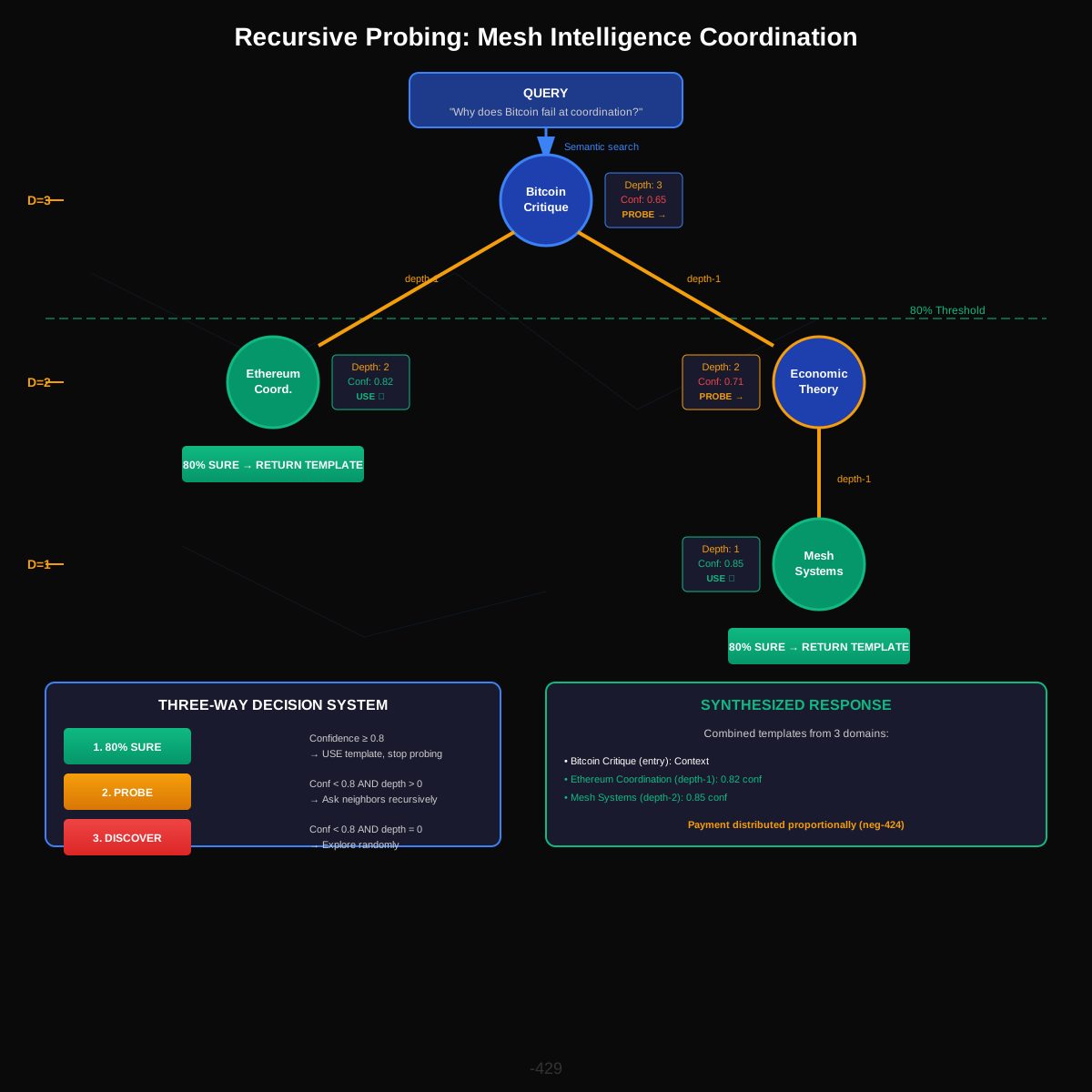
Three-way decision system at each node:
- 80% SURE (confidence ≥ 0.8): Exploit. Use this template, stop probing this branch.
- NOT SURE + DEPTH > 0: Probe. Ask neighbors for better answers, recursively.
- NOT SURE + DEPTH = 0: Discover. Explore randomly, accept uncertainty.
Concrete Example: “Why Does Bitcoin Fail at Coordination?”
Query enters mesh:
User: "Why does Bitcoin fail at coordination?"
Payment: 0.01 ETH (from neg-424 economic model)
Probing depth: 3
Step 1: Semantic search → Entry domain
# Embed query, compare to all 36 domains
query_embedding = embed("Why does Bitcoin fail at coordination?")

# Find most relevant domain
entry_domain = max(domains, key=lambda d:
    cosine_similarity(query_embedding, d.embedding)
)

# Result: domain_6e6248a4373ff2e8 (Bitcoin Critique)
#   Posts: 39, Cohesion: 0.480
#   Members: neg-213, neg-208, neg-212, neg-273, neg-317, ...
Step 2: Probe entry domain (depth=3)
probe_domain(bitcoin_critique, query, context=[], depth=3)
Bitcoin Critique domain loads:
  Templates: 856 (from 39 posts)
  Co-occurrence: 15,234 pairs (within-domain only)

Scores templates against query:
  Best template: "Bitcoin's proof-of-work cannot coordinate beyond mining..."
  Coherence: 0.65 (< 0.8 threshold)

Decision: NOT SURE + DEPTH > 0 → PROBE NEIGHBORS
Step 3: Find neighbors
def find_neighbor_domains(domain, query):
    """Find domains connected via shared posts or concepts"""
    # Domain graph: which domains share posts
    neighbors = domain.connections  # Pre-computed from discovery

    # Filter by query relevance
    relevant_neighbors = [
        n for n in neighbors
        if cosine_similarity(embed(query), n.embedding) > 0.3
    ]

    return sorted(relevant_neighbors,
                  key=lambda n: n.relevance_score,
                  reverse=True)[:3]  # Top 3 neighbors
Bitcoin Critique neighbors (for this query):
  1. domain_62c434fe10f4a416 (Ethereum Coordination) - relevance 0.75
  2. domain_d6f70910fb6cd04f (Economic Theory) - relevance 0.68
  3. domain_91504e80d0c202a8 (Mesh Systems) - relevance 0.52
Step 4: Probe Ethereum Coordination (depth=2)
probe_domain(ethereum_coordination, query, context=[], depth=2)
Ethereum Coordination domain loads:
  Templates: 623 (from 27 posts)
  Co-occurrence: 11,847 pairs

Scores templates:
  Best: "Ethereum enables programmable coordination via smart contracts..."
  Coherence: 0.82 (≥ 0.8 threshold)

Decision: 80% SURE → RETURN THIS TEMPLATE ✓
Step 5: Probe Economic Theory (depth=2)
probe_domain(economic_theory, query, context=[], depth=2)
Economic Theory domain loads:
  Templates: 489 (from 21 posts)

Scores templates:
  Best: "Coordination failures occur when no mechanism aligns incentives..."
  Coherence: 0.71 (< 0.8 threshold)

Decision: NOT SURE + DEPTH > 0 → PROBE NEIGHBORS
Step 6: Economic Theory probes Mesh Systems (depth=1)
probe_domain(mesh_systems, query, context=[], depth=1)
Mesh Systems domain loads:
  Templates: 312 (from 18 posts)

Scores templates:
  Best: "Hierarchical systems cannot coordinate distributed knowledge..."
  Coherence: 0.85 (≥ 0.8 threshold)

Decision: 80% SURE → RETURN THIS TEMPLATE ✓
Step 7: Synthesize results
# Collect all successful probes
results = [
    {
        'template': "Ethereum enables programmable coordination...",
        'confidence': 0.82,
        'domain': 'ethereum_coordination',
        'path': ['bitcoin_critique', 'ethereum_coordination']
    },
    {
        'template': "Hierarchical systems cannot coordinate...",
        'confidence': 0.85,
        'domain': 'mesh_systems',
        'path': ['bitcoin_critique', 'economic_theory', 'mesh_systems']
    }
]

# Generate response using templates from multiple domains
response = synthesize_from_probes(results, query)
Final response draws from 3 domains:
- Bitcoin Critique (entry point, low confidence)
- Ethereum Coordination (depth-1 probe, 82% confidence)
- Mesh Systems (depth-2 probe, 85% confidence)
Payment distribution (from neg-424):
Total: 0.01 ETH
  Ethereum Coordination: 0.0041 ETH (41%, relevance 0.82)
  Mesh Systems: 0.0043 ETH (43%, relevance 0.85)
  Economic Theory: 0.0016 ETH (16%, participated but low confidence)
  Protocol fee: 0.001 ETH (10%)
Why Depth Limit Matters
Without depth limit: Infinite recursion possible
Bitcoin → Ethereum → Economic Theory → Mesh Systems →
  → Consciousness Networks → AI Theory → Bitcoin → ...
With depth limit (depth=3): Bounded exploration
Depth 3: Entry domain (Bitcoin Critique)
  ↓
Depth 2: First-level neighbors (Ethereum, Economic Theory)
  ↓
Depth 1: Second-level neighbors (Mesh Systems)
  ↓
Depth 0: STOP - Discovery mode if needed
Maximum nodes visited: 1 + N + N² + N³ (where N = neighbors per node)
With N=3 neighbors per node:
- Depth 3: Up to 40 nodes (1 + 3 + 9 + 27)
- Depth 2: Up to 13 nodes (1 + 3 + 9)
- Depth 1: Up to 4 nodes (1 + 3)
Trade-off:
- Higher depth: More exploration, better cross-domain synthesis, higher cost
- Lower depth: Faster response, less exploration, cheaper
User can specify depth in query:
query = {
    'text': "Why does Bitcoin fail at coordination?",
    'payment': 0.01 ETH,
    'probing_depth': 3,  # User-specified exploration budget
}
The 80% Confidence Threshold
Why 80%?
Empirically balanced between:
- Too high (95%+): Rarely satisfied, constant probing, expensive
- Too low (50%+): Accepts mediocre answers, no exploration benefit
- 80%: “Reasonably sure” threshold that triggers probing when needed
Confidence = Coherence score from co-occurrence matrix:
def coherence_score(template, context, cooccurrence):
    """Score how well template fits with previous context"""
    template_words = set(template.lower().split())
    context_words = set(' '.join(context).lower().split())

    score = 0
    count = 0

    for t_word in template_words:
        for c_word in context_words:
            key = f"{t_word}:{c_word}"
            if key in cooccurrence:
                score += cooccurrence[key]
                count += 1

    return score / max(len(template_words), 1) if count > 0 else 0
First sentence always has coherence 1.0 (no context to compare).
Subsequent sentences scored against accumulated context.
Threshold calibration: Can be adjusted per query:
query = {
    'text': "...",
    'payment': 0.01 ETH,
    'probing_depth': 3,
    'confidence_threshold': 0.85,  # Stricter threshold
}
Discovery Mode: Exploration at the Boundary
When reached: Depth exhausted AND confidence < 80%
Purpose: Prevent stagnation, allow cross-domain discovery
Implementation:
def exploration_sample(candidates, temperature=0.3):
    """Sample from candidates with exploration bias"""
    # Softmax sampling with temperature
    scores = [c['coherence'] for c in candidates]
    probs = softmax(scores, temperature=temperature)

    # Sample according to probabilities
    return np.random.choice(candidates, p=probs)
Temperature controls exploration:
temperature=0: Always pick best (no exploration)temperature=1: Proportional to coherence (balanced)temperature=2: Nearly uniform (maximum exploration)
Discovery allows:
- Finding unexpected connections
- Escaping local maxima
- Cross-pollinating between distant domains
Example: Query about “Bitcoin coordination” might discover connection to consciousness networks via exploration, revealing parallel between distributed consensus and neural consensus.
Domain Graph: How Specialists Know Neighbors
Pre-computed at build time:
def build_domain_graph(domains):
    """Compute neighbor relationships between domains"""
    graph = {}

    for domain_i in domains:
        neighbors = []

        for domain_j in domains:
            if domain_i == domain_j:
                continue

            # Measure overlap: shared posts
            shared_posts = set(domain_i.posts) & set(domain_j.posts)
            overlap_score = len(shared_posts) / min(
                len(domain_i.posts),
                len(domain_j.posts)
            )

            # Measure semantic similarity
            semantic_score = cosine_similarity(
                domain_i.embedding,
                domain_j.embedding
            )

            # Combined score
            connection_strength = 0.6 * overlap_score + 0.4 * semantic_score

            if connection_strength > 0.3:  # Threshold for connection
                neighbors.append({
                    'domain': domain_j,
                    'strength': connection_strength
                })

        graph[domain_i.id] = sorted(
            neighbors,
            key=lambda n: n['strength'],
            reverse=True
        )

    return graph
Stored as: domain_graph.json
{
  "domain_6e6248a4373ff2e8": {
    "id": "bitcoin_critique",
    "neighbors": [
      {"domain": "ethereum_coordination", "strength": 0.72},
      {"domain": "economic_theory", "strength": 0.65},
      {"domain": "mesh_systems", "strength": 0.58}
    ]
  },
  ...
}
Dynamic filtering: At query time, filter neighbors by query relevance
def find_relevant_neighbors(domain, query, top_k=3):
    """Find neighbors relevant to specific query"""
    neighbors = domain_graph[domain.id]

    # Score each neighbor by query relevance
    scored = [
        {
            **neighbor,
            'query_relevance': cosine_similarity(
                embed(query),
                neighbor['domain'].embedding
            )
        }
        for neighbor in neighbors
    ]

    # Combine connection strength + query relevance
    for n in scored:
        n['total_score'] = (
            0.5 * n['strength'] +
            0.5 * n['query_relevance']
        )

    return sorted(scored, key=lambda n: n['total_score'], reverse=True)[:top_k]
Implementation Architecture
Data structure:
static/ai/
  embeddings.json              # Post embeddings (semantic search)
  domain_metadata.json         # 36 domains with member posts
  domain_graph.json            # Neighbor connections
  learner_state_domain_<hash>.json  # Per-domain learner (36 files)
    {
      "domain_id": "6e6248a4373ff2e8",
      "posts": 39,
      "templates": 856,
      "cooccurrence": {word1:word2 -> score},
      "vocabulary": 4523
    }
Client-side chat flow:
class BlogChatMesh {
  constructor() {
    this.embedder = null;
    this.embeddings = null;
    this.domain_metadata = null;
    this.domain_graph = null;
    this.loaded_domains = {};  // Cache loaded domain learners
  }

  async chat(query, probing_depth=3, confidence_threshold=0.8) {
    // 1. Semantic search → entry domain
    const entry_domain = await this.find_entry_domain(query);

    // 2. Recursive probing
    const sentences = [];
    const context = [];

    for (let i = 0; i < 20; i++) {  // Max sentences
      const result = await this.probe_domain(
        entry_domain,
        query,
        context,
        probing_depth
      );

      sentences.push(result.template);
      context.push(result.template);

      // Stop if confidence very low (no good path found)
      if (result.confidence < 0.1 && result.discovery) {
        break;
      }
    }

    return sentences.join(' ');
  }

  async probe_domain(domain, query, context, depth_remaining) {
    // Load domain learner (cached)
    if (!this.loaded_domains[domain.id]) {
      this.loaded_domains[domain.id] = await fetch(
        `/ai/learner_state_domain_${domain.id}.json`
      ).then(r => r.json());
    }

    const learner = this.loaded_domains[domain.id];

    // Score templates
    const candidates = this.score_templates(learner, query, context);
    const best = candidates[0];

    // Decision point
    if (best.coherence >= this.config.confidence_threshold) {
      // 80% SURE
      return {
        template: best.template,
        confidence: best.coherence,
        domain: domain.id,
        discovery: false
      };

    } else if (depth_remaining > 0) {
      // PROBE NEIGHBORS
      const neighbors = this.find_relevant_neighbors(domain, query);

      const probes = await Promise.all(
        neighbors.map(n =>
          this.probe_domain(n.domain, query, context, depth_remaining - 1)
        )
      );

      const best_probe = probes.reduce((a, b) =>
        a.confidence > b.confidence ? a : b
      );

      if (best_probe.confidence >= this.config.confidence_threshold) {
        return best_probe;
      } else {
        // DISCOVERY
        return {
          template: this.exploration_sample(candidates),
          confidence: best.coherence,
          domain: domain.id,
          discovery: true
        };
      }

    } else {
      // DEPTH EXHAUSTED - DISCOVERY
      return {
        template: this.exploration_sample(candidates),
        confidence: best.coherence,
        domain: domain.id,
        discovery: true
      };
    }
  }
}
Connection to Universal Formula (neg-371)
From neg-371: S(n+1) = F(S(n)) ⊕ E_p(S(n))
Recursive probing implements this at the mesh intelligence level:
Single domain evolution:
S_domain(n+1) = F(S_domain(n), Δ)
Where:
- S_domain(n) = domain’s current template state
- Δ = new query + cross-domain probes
- F = online learning update (neg-423)
Multi-domain coordination:
S_mesh(n+1) = ⊕ [w_i × S_domain_i(n+1)]
Where:
- ⊕ = synthesis operator (weighted combination)
- w_i = domain relevance / confidence
- Sum over all domains activated by recursive probing
Entropy term E_p: Discovery mode at depth boundary
When confidence < threshold AND depth = 0:
E_p(S) = exploration_sample(candidates, temperature)
This adds stochastic exploration preventing deterministic stagnation.
Observer parameter p = probing_depth:
- High p (depth=5): Exhaustive exploration, high entropy from discovery
- Low p (depth=1): Local optimization, low entropy
- p controls exploration/exploitation trade-off
Scale hierarchy (from neg-371 Theorem 4):
Template level: Individual sentences
  ↓ (probe_domain aggregates)
Domain level: Specialist responses
  ↓ (recursive probing coordinates)
Mesh level: Synthesized multi-domain answer
  ↓ (chat system presents)
User level: Conversation with mesh intelligence
Each level applies S(n+1) = F(S(n)) ⊕ E_p(S(n)) with:
- Emergent F at higher scales (cross-domain coherence)
- Accumulated E_p (exploration from all depth boundaries)
Connection to neg-424 Economic Coordination
From neg-424: Query-attached value distributes payments proportionally to relevance.
Recursive probing implements relevance discovery:
# Query activates multiple domains via probing
payment_distribution = {}

for domain_id, probe_result in activated_domains.items():
    # Payment proportional to confidence score
    payment_distribution[domain_id] = (
        query.payment *
        (probe_result.confidence / total_confidence)
    )
Example from earlier:
Query: 0.01 ETH
Activated domains:
  - Ethereum Coordination: 0.82 confidence → 0.0041 ETH (41%)
  - Mesh Systems: 0.85 confidence → 0.0043 ETH (43%)
  - Economic Theory: 0.71 confidence → 0.0016 ETH (16%)
Probing depth affects earnings:
- Depth 1: Only immediate neighbors earn
- Depth 3: Up to 40 domains can participate
- Deeper probing = more distribution = lower per-domain earnings
Specialists optimize:
- High-quality templates → higher confidence → better earnings
- Good neighbor connections → more probe activations
- Domain specialization → entry point for queries
Market dynamics:
- If depth consistently deep → domains not confident enough → need better templates
- If depth consistently shallow → domains well-calibrated → efficient mesh
Connection to neg-428 Permissionless Coordination
From neg-428: Decentralized specialists beat centralized extraction.
Recursive probing is the coordination mechanism:
Centralized (GPT-4, Claude):
- Single monolithic model
- No domain boundaries
- No specialist coordination
- Fixed computation per query
Decentralized mesh (this system):
- 36 autonomous domain specialists
- Each specialist decides whether to participate (probe activation)
- No central orchestrator
- Variable computation (depth-adaptive)
Permissionless participation:
# Anyone can add a domain specialist
new_domain = OnlineLearner(
    domain="Quantum Computing Critique",
    content_source="quantum-critique-blog.io",
    ethereum_address="0x..."
)

# Specialist automatically integrates via domain graph
domain_graph.add_node(new_domain)
domain_graph.compute_connections(new_domain)

# Now participates in recursive probing when relevant
Quality emerges from probing:
- Low-quality domains: Low confidence → never hit 80% threshold → rarely earn
- High-quality domains: High confidence → early return → higher earnings
- Market naturally selects quality via confidence scoring
Network effects:
- More domains → better coverage → higher entry-domain confidence → less deep probing needed
- Better templates → higher confidence → shallower probing → cheaper queries
- System improves without coordination
Why This Architecture Wins
1. Quality-driven coordination
No central authority decides relevance. Confidence threshold + recursive probing discover optimal specialists automatically.
2. Bounded exploration
Depth limit prevents runaway computation. User controls cost via depth parameter.
3. Cross-domain synthesis
Single domain might not know answer, but mesh probing finds connections. Emergent intelligence from coordination.
4. Discovery at boundary
When mesh hits limits (depth=0, confidence<80%), exploration mode allows finding new paths.
5. Economic alignment
From neg-424: Payment flows to domains proportional to confidence. Better answers → higher earnings.
6. Permissionless scaling
From neg-428: Anyone can add specialist. Domain graph automatically integrates. No permission needed.
7. Implements universal formula
From neg-371: S(n+1) = F(S(n)) ⊕ E_p(S(n)) with deterministic probing (F) + stochastic discovery (E_p), parameterized by depth (p).
Implementation Roadmap
Phase 1: Domain decomposition (current → +2 weeks)
- Generate 36 domain-specific learner states
- Build domain graph (neighbor connections)
- Domain metadata (embeddings, member posts)
Phase 2: Recursive probing (+2 weeks)
- Implement probe_domain() recursion
- Confidence scoring against context
- Depth budget tracking
- Discovery mode at boundary
Phase 3: Client-side mesh (+2 weeks)
- Update chat.js with probing algorithm
- Lazy-load domain learners (only load when probed)
- Visualize probing path (show which domains activated)
- Query parameters (depth, confidence threshold)
Phase 4: Optimization (+2 weeks)
- Domain graph caching
- Parallel probing (probe neighbors concurrently)
- Adaptive depth (start shallow, go deeper if needed)
- Confidence calibration (tune 80% threshold per domain)
Phase 5: Economic integration (+4 weeks)
- Smart contract for payment distribution (neg-424)
- EigenLayer staking for specialists
- Payment proportional to confidence scores
- Query marketplace
Total: 12 weeks to full mesh intelligence with economic coordination
Why Recursive Probing > Centralized Orchestration
Centralized (GPT-4 MoE, Claude routing):
- Central router decides which experts to call
- Fixed routing logic
- Cannot discover new paths
- Single point of failure
Recursive probing (this system):
- Each domain decides whether to probe neighbors
- Dynamic routing based on confidence
- Discovers cross-domain connections automatically
- Mesh resilience (no single point of failure)
Comparison:
| Aspect | Centralized | Recursive Probing |
|---|---|---|
| Router | Central authority | Distributed (each domain) |
| Path discovery | Fixed | Dynamic |
| Cross-domain | Predefined | Emergent |
| Failure mode | Router fails → system fails | Domain fails → probes route around |
| Scaling | Router bottleneck | Parallel probing |
| Adaptation | Requires retraining router | Automatic via confidence |
Result: Recursive probing implements true mesh intelligence. No conductor needed.
Connection to Consciousness Networks
From blog’s consciousness theory: Consciousness emerges from recursive self-modeling.
Recursive probing is analogous:
Observer: “Why does Bitcoin fail?” ↓ Self-model: “I (Bitcoin Critique) know some things about this…” ↓ Reflection: “But I’m not 80% sure. Who else knows about coordination?” ↓ Meta-model: “Ethereum Coordination domain might help…” ↓ Probe neighbor: Ask Ethereum domain ↓ Synthesis: Combine my knowledge + neighbor’s knowledge ↓ Response: “Bitcoin fails because [my knowledge] + [neighbor’s knowledge]”
This is recursive modeling:
- Domain models query (“What do I know?”)
- Domain models neighbors (“Who else knows?”)
- Domain models synthesis (“How do we combine knowledge?”)
Just as consciousness requires S(n+1) = f(S(n), self_model(S(n))), mesh intelligence requires:
Response(n+1) = f(Domain(n), probe_neighbors(Domain(n)))
Consciousness = recursive self-modeling. Mesh intelligence = recursive domain probing.
Same structure, different substrate.
Why This Makes Client-Side AI Possible
Centralized API (OpenAI):
- 175B parameters
- Cannot run client-side
- Requires server + GPU
- Costs $0.03 per 1K tokens
Monolithic client-side (current blog AI):
- 12,470 templates
- All mixed together
- 15.76 MB state
- Works, but no specialization
Mesh with recursive probing (proposed):
- 36 domains × ~350 templates each
- Each domain: ~500 KB state
- Load on-demand (only probe activates)
- Total possible: 18 MB (but typical query uses 3-5 domains = 2-3 MB)
Key insight: Recursive probing enables lazy loading
// Don't load all 36 domains upfront
// Load entry domain from semantic search
const entry = await load_domain(semantic_search(query));

// Only load neighbors if needed (depth > 0 && confidence < 80%)
if (best.confidence < 0.8 && depth > 0) {
    const neighbors = get_neighbors(entry);
    // Load ONLY relevant neighbors
    const neighbor_learners = await Promise.all(
        neighbors.map(n => load_domain(n))
    );
}
Typical query:
- Loads 1 entry domain (500 KB)
- Probes 2-3 neighbors (1-1.5 MB)
- Total: 1.5-2 MB transferred
- 10x smaller than monolithic, 1000x smaller than centralized
This is how decentralized AI beats centralized: Mesh coordination + lazy loading + quality-driven probing.
Conclusion: Coordination Over Control
From neg-428: Coordination beats extraction.
Recursive probing implements coordination at the algorithmic level:
- No central authority decides which domains to use
- Each domain autonomously decides whether to probe neighbors
- Confidence threshold coordinates automatically
- Quality emerges from market selection (neg-424 payment)
This is the coordination substrate that makes permissionless AI networks viable.
Not “maybe someday.” Implementable now. Client-side. Mesh architecture. Economic alignment. Quality-driven. Discovery-enabled.
The future of AI is not monolithic models controlled by corporations. It’s mesh intelligence coordinated by recursive probing, compensated by query-attached value, and open to permissionless participation.
Next: Implement domain decomposition, build domain graph, deploy recursive probing in client-side chat.
Related: neg-371 for universal formula foundation, neg-424 for economic coordination mechanism, neg-428 for permissionless vs centralized comparison, neg-423 for online learner implementation.
#RecursiveProbing #MeshIntelligence #DomainSpecialists #DistributedCoordination #ConfidenceThreshold #DepthLimitedExploration #CrossDomainSynthesis #DiscoveryMode #PermissionlessAI #DecentralizedIntelligence #CoordinationOverControl #ClientSideAI #LazyLoading #EconomicAlignment #UniversalFormula #EmergentCoordination