Economic Coordination in Distributed AI: Query-Attached Value Distribution
Building on neg-423’s distributed mesh architecture, the missing piece is economic coordination: How do specialists get compensated for participating?
Answer: Queries carry value (ETH/EIGEN). Payment distributes proportionally to relevance.
The Problem: Free Rider Attack
Without economic incentives, distributed mesh fails:
Scenario: User asks “How does blockchain consensus use game theory?”
Naive approach: Broadcast to all specialists, hope they respond
Reality:
- Why would Blockchain specialist spend compute?
- Why would Game Theory specialist share templates?
- Why would anyone maintain quality?
Result: Tragedy of the commons. No specialist participates seriously. System collapses.
The Solution: Query-Attached Value
Every query carries payment (regular ETH):
query = {
    "text": "How does blockchain consensus use game theory?",
    "value": 0.01 ETH,  # User payment (regular ETH, not restaked)
    "max_specialists": 5,  # Cap on participants
}
Distribution rule:
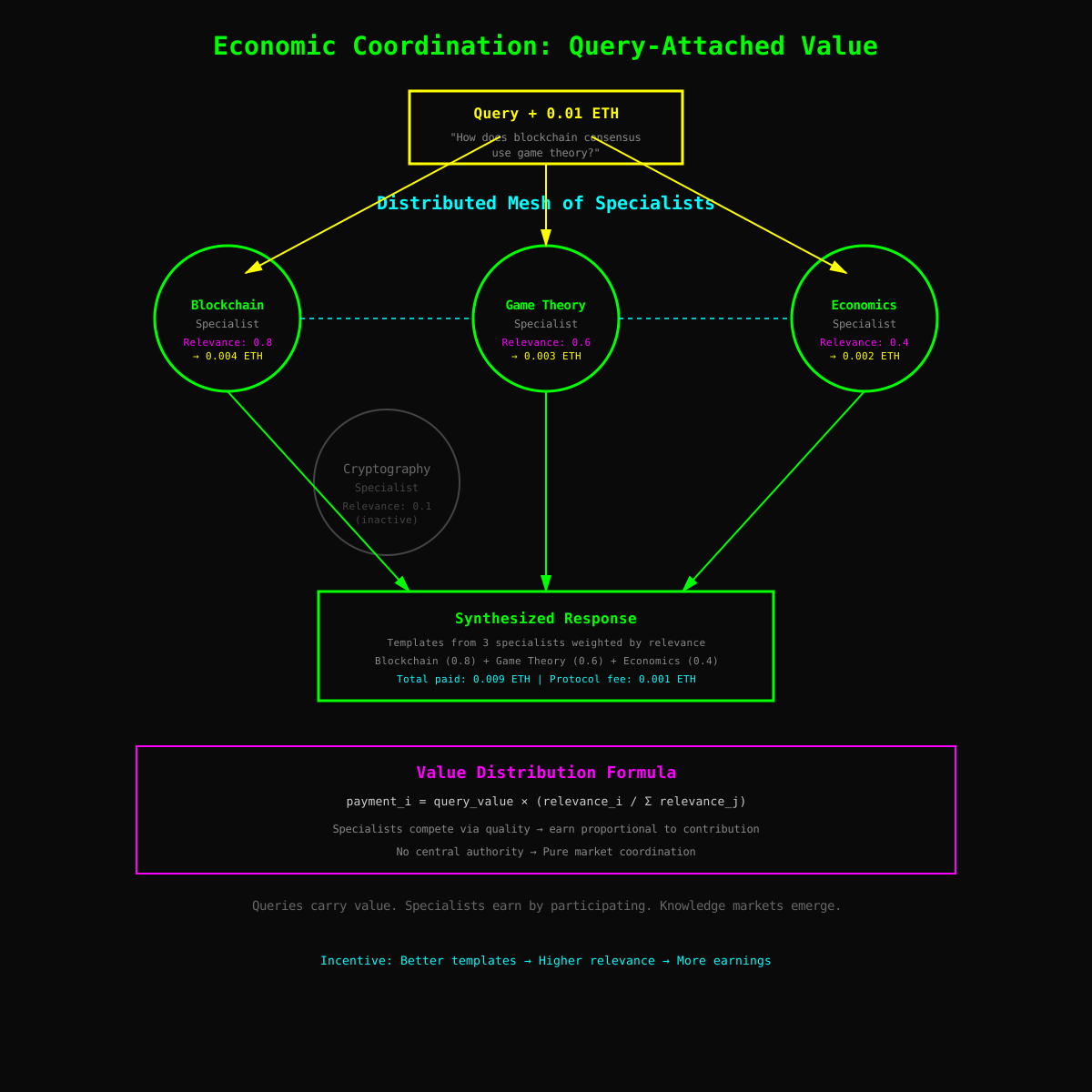
payment_i = query_value × (relevance_i / Σ relevance_j)
Where:
relevance_i= specialist i’s relevance score to queryΣ relevance_j= sum of all participating specialists’ relevance
Only specialists who contribute templates get paid. Payment proportional to contribution.
Concrete Example
Query: “How does blockchain consensus use game theory?” + 0.01 ETH
Specialist activation:
| Specialist | Relevance | Templates | Payment |
|---|---|---|---|
| Blockchain | 0.8 | 15 | 0.004 ETH (40%) |
| Game Theory | 0.6 | 10 | 0.003 ETH (30%) |
| Economics | 0.4 | 8 | 0.002 ETH (20%) |
| Cryptography | 0.1 | 0 | 0 ETH (inactive) |
Total paid: 0.009 ETH (90% to specialists) Protocol fee: 0.001 ETH (10% to network)
Synthesis: Response combines 33 templates from 3 specialists, weighted by relevance.
Relevance Scoring
How does system determine relevance_i?
Option 1: Keyword overlap (simple)
def relevance(specialist, query):
    query_words = set(query.lower().split())
    specialist_words = set(specialist.domain_keywords)
    overlap = len(query_words & specialist_words)
    return overlap / len(query_words)
Option 2: Embedding similarity (better)
def relevance(specialist, query):
    query_embedding = embed(query)
    specialist_embedding = embed(specialist.domain_description)
    return cosine_similarity(query_embedding, specialist_embedding)
Option 3: Historical performance (best)
def relevance(specialist, query):
    semantic_score = embedding_similarity(specialist, query)
    quality_score = specialist.template_quality  # User ratings
    usage_score = specialist.template_usage_count  # How often used

    return (0.5 × semantic_score +
            0.3 × quality_score +
            0.2 × usage_score)
Specialists with high-quality templates earn more over time.
Incentive Alignment
For specialists:
- Maintain quality templates: Higher quality → higher relevance → more earnings
- Specialize deeply: Domain expertise → better relevance scores
- Cross-pollinate: Exchange top templates with peers → improve breadth
- Stay online: More uptime → more query opportunities
For users:
- Pay for value: Attached payment ensures service
- Quality feedback: Rate responses → affects specialist scores
- Market discovery: Good specialists earn reputation → easier to find
For protocol:
- No central authority needed: Market coordinates automatically
- Spam resistance: Queries cost money → natural rate limiting
- Quality emergence: Bad specialists earn nothing → naturally prune
Technical Implementation
Smart Contract (Ethereum/EigenLayer)
contract QueryMarket {
    struct Query {
        string text;
        uint256 value;
        address user;
        uint8 maxSpecialists;
    }

    struct Specialist {
        address payable addr;
        string domain;
        uint256 relevanceScore;  // 0-1000 (basis points)
        bytes32[] templates;
    }

    mapping(address => Specialist) public specialists;

    function submitQuery(
        string memory text,
        uint8 maxSpecialists
    ) external payable {
        require(msg.value > 0, "Query must attach value");

        Query memory query = Query({
            text: text,
            value: msg.value,
            user: msg.sender,
            maxSpecialists: maxSpecialists
        });

        // Emit event for off-chain specialist matching
        emit QuerySubmitted(query);
    }

    function distributePayment(
        bytes32 queryId,
        address[] memory participatingSpecialists,
        uint256[] memory relevanceScores
    ) external {
        require(participatingSpecialists.length == relevanceScores.length);

        uint256 totalRelevance = 0;
        for (uint i = 0; i < relevanceScores.length; i++) {
            totalRelevance += relevanceScores[i];
        }

        Query storage query = queries[queryId];
        uint256 protocolFee = query.value / 10;  // 10%
        uint256 distributionPool = query.value - protocolFee;

        for (uint i = 0; i < participatingSpecialists.length; i++) {
            uint256 payment = (distributionPool * relevanceScores[i]) / totalRelevance;
            specialists[participatingSpecialists[i]].addr.transfer(payment);
        }

        protocolTreasury.transfer(protocolFee);
    }
}
Specialist Node
class EconomicSpecialist(OnlineLearner):
    def __init__(self, domain, ethereum_address):
        super().__init__()
        self.domain = domain
        self.address = ethereum_address
        self.quality_score = 1.0  # Updated by user ratings

    def calculate_relevance(self, query):
        """Compute relevance score for query"""
        # Semantic similarity
        semantic = embedding_similarity(query, self.domain)

        # Historical quality
        quality = self.quality_score

        # Template count (more = more comprehensive)
        coverage = min(len(self.state['templates']) / 1000, 1.0)

        return 0.5 * semantic + 0.3 * quality + 0.2 * coverage

    def bid_on_query(self, query):
        """Decide whether to participate in query"""
        relevance = self.calculate_relevance(query.text)

        # Only participate if relevance high enough
        if relevance < 0.3:
            return None  # Skip low-relevance queries

        # Estimate earnings
        estimated_payment = (query.value * relevance) / 2.0  # Conservative
        compute_cost = 0.0001  # ETH per query

        if estimated_payment > compute_cost:
            return {
                "specialist": self.address,
                "relevance": relevance,
                "templates": self.find_relevant_templates(query.text, n=20)
            }

        return None  # Not profitable
EigenLayer Integration
EigenLayer provides security (not payment):
Two-layer architecture:
- Payment layer: Users pay regular ETH
- Security layer: Specialists stake via EigenLayer
Benefits:
- Payment simplicity: Users just send ETH (no restaking needed)
- Specialist accountability: Staked ETH can be slashed for misbehavior
- Capital efficiency: Same ETH secures Ethereum + AI network + earns query fees
- Alignment: Specialists have long-term skin in the game
Implementation:
# === SECURITY LAYER: Specialist stakes via EigenLayer ===
eigenlayer.deposit(
    amount=32 ETH,  # Restaked for security
    operator=specialist_address
)

avs = EigenLayerAVS(
    name="Distributed AI Query Market",
    slashing_conditions=[
        "Template plagiarism",
        "Response manipulation",
        "Uptime violations"
    ]
)

# === PAYMENT LAYER: User pays regular ETH ===
query_payment = avs.createQuery(
    text="How does blockchain consensus work?",
    payment=0.01 ETH  # Regular ETH from user
)

# Specialists respond, earn from payment pool
# But their staked ETH is at risk if they misbehave
avs.settleQuery(
    query_id=query_payment.id,
    specialists=[addr1, addr2, addr3],
    relevance_scores=[0.8, 0.6, 0.4],
    payment_source=query_payment.payment  # Distribute regular ETH
)

# If specialist cheats:
avs.slash(
    specialist=addr2,
    amount=1 ETH,  # Slash from their staked 32 ETH
    reason="Template plagiarism detected"
)
Economics:
- User: Pays 0.01 ETH per query (regular ETH)
- Specialist: Stakes 32 ETH (restaked), earns query payments, risks slashing
- Capital efficiency: Specialist’s 32 ETH earns:
- Ethereum staking yield (~4% APR)
- EigenLayer AVS rewards
- Query payment fees
- Total: ~15-20% APR if active
Market Dynamics
Supply Side (Specialists)
Initial state: Few specialists, high earnings per query
As network grows:
- More specialists join (attracted by earnings)
- Competition increases
- Earnings per specialist decrease
- But: Total query volume grows → earnings stabilize
Equilibrium: Specialist earnings ≈ compute cost + opportunity cost of capital
Demand Side (Users)
Initial state: Few queries, limited specialist coverage
As network grows:
- More domains covered
- Response quality improves
- Query prices can decrease (competition)
- Network effect: More specialists → better responses → more users → more earnings → more specialists
Quality Evolution
Specialist strategy:
- Start generalist (earn from many queries)
- Notice high earnings in specific domain
- Specialize (improve templates in that domain)
- Earn higher relevance scores
- Dominate niche
Result: Natural specialization emerges. Market discovers optimal domain coverage.
Attack Vectors & Defenses
Attack 1: Sybil Specialists
Attack: Create 100 fake specialists, all respond to same query, split payment 100 ways
Defense: Relevance scoring filters low-quality specialists
- Fake specialists have no templates → low relevance → no payment
- Even if they copy templates, users rate quality → reputation system
Attack 2: Template Plagiarism
Attack: Copy high-quality templates from other specialists
Defense:
- Merkle tree commitment to templates (timestamped)
- Plagiarism detection via similarity hashing
- Slashing via EigenLayer if caught
Attack 3: Relevance Manipulation
Attack: Specialist claims high relevance but provides garbage templates
Defense:
- User ratings affect future relevance scores
- Consistent low ratings → specialist loses reputation → earns nothing
- Smart contract can blacklist after threshold of bad ratings
Attack 4: Query Spam
Attack: Spam network with worthless queries to drain specialist compute
Defense:
- Queries cost money (ETH/EIGEN) → natural rate limiting
- Specialists can ignore low-value queries
- Minimum query value enforced by protocol
Comparison to Existing Models
Traditional API (OpenAI GPT-4)
Payment: Fixed price per token ($0.03/1K tokens)
Problems:
- No specialist competition
- No quality differentiation
- Central authority sets price
- Users pay regardless of quality
Decentralized Inference (Gensyn, Ritual)
Payment: Bid on compute resources
Problems:
- Pays for compute, not knowledge quality
- No incentive for template quality
- Still centralized model serving
Query-Attached Value (This Model)
Payment: Proportional to relevance contribution
Advantages:
- Pays for knowledge quality, not compute
- Competition drives specialization
- Market discovers optimal pricing
- Natural quality selection
Economic Sustainability
Can specialists earn a living?
Assumptions:
- Query volume: 1M queries/day (modest for global AI market)
- Average query value: 0.01 ETH (~$30)
- Daily market: $30M
- Specialist share: 90% ($27M to specialists)
- Number of specialists: 1,000
Average daily earnings per specialist: $27,000
Reality check:
- Top specialists (high relevance): $50K-100K/day
- Mid-tier specialists: $10K-30K/day
- Low-tier specialists: $1K-5K/day
These are sustainable economics for professional AI operators.
Connection to Bitcoin Mining
Similar economic structure to Bitcoin mining:
Bitcoin:
- Miners provide hashrate
- Block reward splits among miners proportional to hashrate
- Competition → difficulty adjustment
- Profitable miners stay, unprofitable exit
Distributed AI:
- Specialists provide knowledge/templates
- Query payment splits among specialists proportional to relevance
- Competition → quality threshold rises
- High-quality specialists earn, low-quality exit
Both use proof-of-work (mining vs template quality) to coordinate decentralized value creation.
Implementation Roadmap
Phase 1: Simple keyword-based relevance (1-2 months)
- Smart contract for payment distribution
- Basic specialist registration
- Query submission + manual payment
Phase 2: Embedding-based relevance (3-4 months)
- Off-chain embedding computation
- Automated relevance scoring
- Template quality metrics
Phase 3: EigenLayer integration (6-8 months)
- Restaking for specialist collateral
- Slashing conditions for misbehavior
- AVS for automated settlement
Phase 4: Full market (12 months)
- User reputation system
- Specialist reputation system
- Dynamic pricing discovery
- Cross-chain support (L2s)
Why This Wins
For specialists: Earn from knowledge accumulation (not just compute)
For users: Pay for results (not tokens), market-driven quality
For protocol: No central authority needed, self-coordinating market
For ecosystem: Natural specialization emerges, knowledge becomes commons
This is coordination over control: No one decides who participates or what they earn. Market discovers optimal allocation automatically.
Related: neg-371 for universal formula foundation, neg-422 for economic comparison to batch learning, neg-423 for technical implementation of online learners.
#DistributedAI #EconomicCoordination #QueryMarkets #EigenLayer #ProofOfKnowledge #RelevanceScoring #DecentralizedIntelligence #MarketMechanisms #IncentiveAlignment #CoordinationOverControl #StakingRewards #KnowledgeEconomics