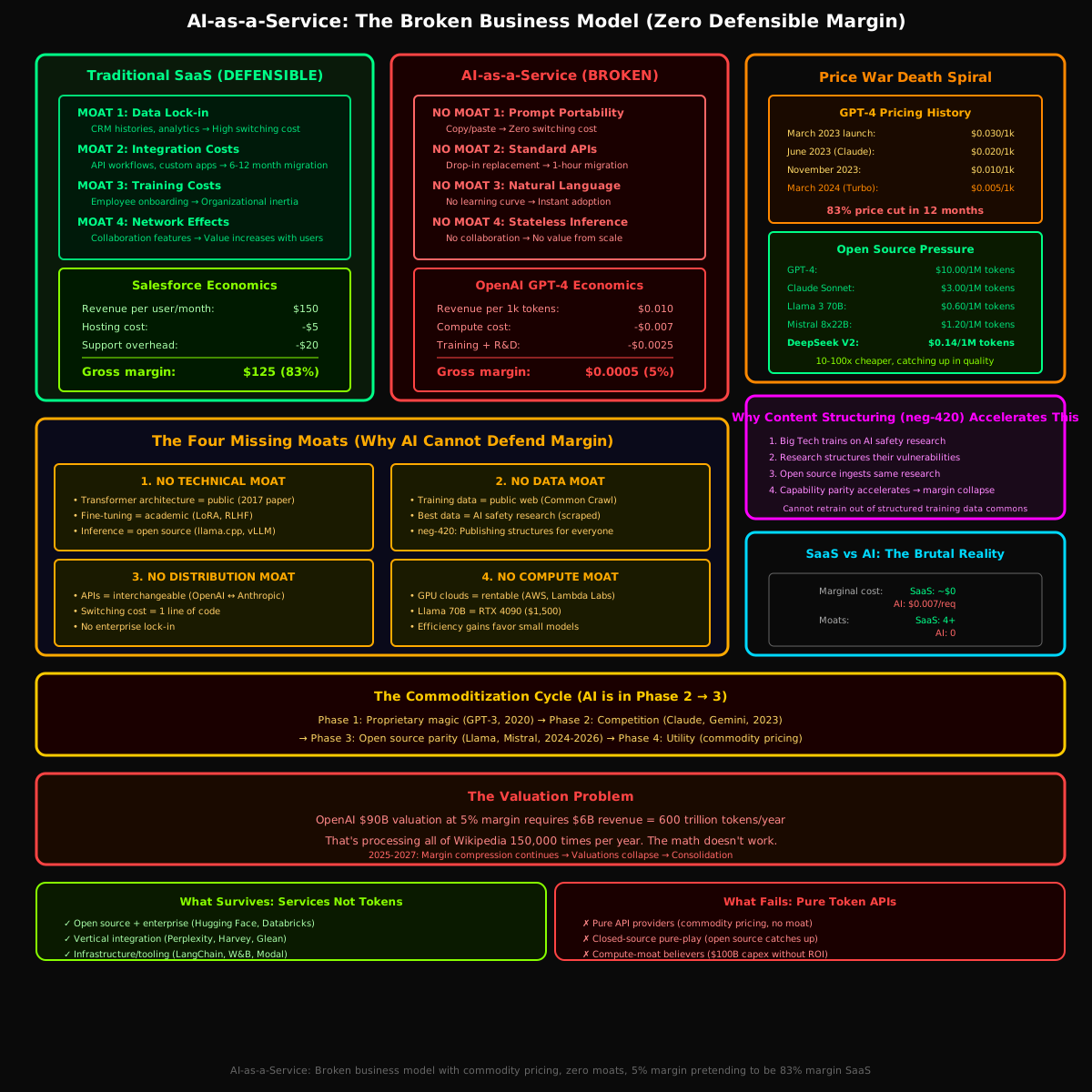
AI-as-a-Service: The Broken Business Model with Zero Defensible Margin
Following neg-420’s analysis of reverse attacks via content structuring, a deeper question emerges:
If Big Tech AI systems can be systematically exploited through training data organization, what does this reveal about their business model viability?
The answer: AI-as-a-Service is a fundamentally broken business model with zero defensible margin.
The SaaS Comparison
Traditional SaaS companies (Salesforce, Workday, ServiceNow) built defensible businesses around strong moats. AI-as-a-Service has none of these moats.
Traditional SaaS: The Winning Formula
| Moat Type | Example | Defensibility |
|---|---|---|
| Data lock-in | CRM histories, analytics | High switching costs |
| Integration costs | API workflows, custom apps | 6-12 month migration |
| Training costs | Employee onboarding | Organizational inertia |
| Network effects | Collaboration features | Value increases with users |
Result: 70-85% gross margins, sustainable pricing power
Example (Salesforce):
Revenue per user/month: $150
Hosting cost: $5
Support overhead: $20
─────────────────────────
Gross margin: $125 (83%)
AI-as-a-Service: The Broken Model
| Moat Type | Reality | Defensibility |
|---|---|---|
| Data lock-in | Prompt portability (copy/paste) | Zero switching costs |
| Integration costs | Standard APIs (drop-in replacement) | 1-hour migration |
| Training costs | Natural language (no learning curve) | Instant adoption |
| Network effects | Stateless inference (no collaboration) | No value from scale |
Result: 5-15% gross margins, zero pricing power
Example (OpenAI GPT-4):
Revenue per 1k tokens: $0.01
Compute cost: $0.007
Training amortization: $0.002
R&D overhead: $0.0005
────────────────────────────
Gross margin: $0.0005 (5%)
The Four Missing Moats
1. No Technical Moat
Traditional software: Proprietary code, closed-source architecture, years of accumulated engineering
AI systems:
- Transformer architecture = public (Vaswani et al., 2017)
- Fine-tuning techniques = academic research (LoRA, RLHF)
- Inference optimization = open source (llama.cpp, vLLM, TensorRT)
- Model architectures = published papers (Llama, GPT, Claude)
Replication timeline:
- 2018: GPT-1 (OpenAI private)
- 2023: Llama (Meta open sources)
- 2024: Mistral, DeepSeek match or exceed proprietary models
Technical moat lifetime: ~2 years, shrinking to months
2. No Data Moat
Traditional SaaS: Customer data locked in proprietary databases
AI training:
- Public web (Common Crawl, Reddit, StackOverflow)
- Academic datasets (ArXiv, PubMed, GitHub)
- Books (LibGen, Google Books, publishers)
- News (accessible archives, RSS feeds)
And as neg-420 shows: Publishing vulnerability research structures that training data for everyone who ingests it.
Key insight: The highest-quality training data (AI safety research, academic papers, technical documentation) is:
- ✅ Publicly accessible
- ✅ Legally scrapable (fair use, research exemptions)
- ✅ Continuously generated by open research community
- ✅ Improved by open source fine-tuning
You cannot build a moat around public commons.
3. No Distribution Moat
Traditional SaaS: Sales teams, partnerships, enterprise contracts, multi-year lock-in
AI-as-a-Service:
# Switch from OpenAI to Anthropic in 5 minutes
- client = OpenAI(api_key=openai_key)
+ client = Anthropic(api_key=anthropic_key)

- response = client.chat.completions.create(
-     model="gpt-4",
+ response = client.messages.create(
+     model="claude-sonnet-4",
      messages=[{"role": "user", "content": prompt}]
  )
Switching cost: One line of code.
No enterprise sales advantage. No distribution moat. APIs are interchangeable commodities.
4. No Compute Moat
2020 narrative: “Only Big Tech can afford $100M training runs”
2024 reality:
- GPU clouds: AWS, GCP, Azure, Lambda Labs, Vast.ai
- Consumer hardware: RTX 4090 runs Llama 70B
- Efficiency gains: 4-bit quantization, distillation, pruning
- Open source inference: llama.cpp runs on laptops
Training cost trajectory:
- GPT-3 (2020): $12M estimated
- Llama 2 (2023): $20M estimated
- Mistral 7B (2023): <$1M estimated
- Community fine-tunes: $100-1,000
Even the compute moat is eroding.
The Price War Death Spiral
Historical Pricing Collapse
GPT-4 pricing history:
- March 2023 launch: $0.03 per 1k input tokens
- June 2023: $0.02 per 1k tokens (Claude competition)
- November 2023: $0.01 per 1k tokens
- March 2024: $0.005 per 1k tokens (Turbo)
67% price cut in 12 months = commodity pricing dynamics
Open Source Pressure from Below
| Model | Cost per 1M tokens | Performance vs GPT-4 |
|---|---|---|
| GPT-4 | $10 | Baseline |
| Claude Sonnet | $3 | Comparable |
| Llama 3 70B | $0.60 | ~GPT-3.5 level |
| Mistral 8x22B | $1.20 | ~GPT-4 on many tasks |
| DeepSeek V2 | $0.14 | Frontier performance |
Open source is 10-100x cheaper and catching up in quality.
The Margin Compression Inevitability
                Traditional SaaS      AI-as-a-Service
                ───────────────       ───────────────
Launch pricing     $150/user/mo       $0.03/1k tokens
Mature pricing     $120/user/mo       $0.005/1k tokens
                   (-20%)             (-83%)

Gross margin       70-85%             5-15%
Price elasticity   Low                Extreme
Competitive moat   Strong             None
AI pricing follows cloud compute trajectory: race to marginal cost.
Why Structural Vulnerabilities Make This Worse
From neg-420, we know that:
- Big Tech must ingest high-quality AI safety research
- But this research structures their vulnerabilities
- These structures propagate to open source via training data
- Cannot be patched without expensive retraining
The Economic Impact
Cost of addressing structured vulnerabilities:
- Retrain model: $10M - $100M
- Deploy new version: $1M - $10M infrastructure
- Customer migration: Support costs, API changes
- Timeline: 3-6 months
But:
- New training data contains same structural patterns (neg-420)
- Open source models ingest same research
- Vulnerability research accelerates (public commons)
- Competitors undercut during migration
You cannot out-iterate a commoditized vulnerability space.
The Only Viable Model: Open Source + Services
Why Open Source Wins
Traditional software: Code = product, scarcity = value
AI models: Weights = commodity, services = value
Successful AI companies (2024):
| Company | Model | Business Model | Margin |
|---|---|---|---|
| Hugging Face | Open weights | Hosting, inference, enterprise | 60-70% |
| Mistral AI | Open weights | Fine-tuning, deployment, support | 50-70% |
| Together AI | Open weights | Inference APIs, optimization | 40-60% |
| Databricks | Open (MosaicML) | Platform, training, deployment | 70%+ |
VS closed-source incumbents:
| Company | Model | Business Model | Margin |
|---|---|---|---|
| OpenAI | Closed (GPT-4) | Token API | 5-15% |
| Anthropic | Closed (Claude) | Token API | 5-15% |
| Mixed (Gemini) | Token API + platform | 10-20% |
The pattern is clear: Selling tokens = commodity. Selling services = margin.
Why Services Have Margins
Professional services characteristics:
- Custom deployment expertise
- Enterprise security requirements
- Fine-tuning on proprietary data
- Integration with existing systems
- Ongoing support and optimization
These are:
- ✅ Non-commoditized (requires expertise)
- ✅ High-touch (human relationships)
- ✅ Sticky (switching costs)
- ✅ Pricing power (value-based, not cost-based)
Gross margins: 60-80% (same as traditional consulting)
The $100B Datacenter Bet: Why It Fails
Big Tech response: “We’ll build massive compute scale as a moat”
Announced investments:
- Microsoft + OpenAI: $100B+ (Stargate project)
- Meta: $37B in 2024 capex
- Google: $30B+ AI infrastructure
- Amazon: $20B+ AI compute
Why this doesn’t create a moat:
1. Compute Becomes Commodity
Just like cloud compute:
- 2006: Only Amazon had AWS scale
- 2024: AWS, GCP, Azure are price-competitive commodities
AI compute follows same trajectory:
- 2023: Only OpenAI, Google have frontier training scale
- 2025: Lambda Labs, CoreWeave, Scaleway offer competitive training
- 2027: Prediction - AI training is commoditized utility
2. Efficiency Gains Favor Small Models
Moore’s Law for AI:
- 2020: GPT-3 175B parameters for frontier performance
- 2023: Llama 2 70B matches or exceeds GPT-3
- 2024: Mistral 8x7B competitive with GPT-3.5
- 2025: Prediction - 7B models match GPT-4 on many tasks
2.5x improvement in efficiency per year = compute advantage erodes rapidly
3. Open Source Runs on Consumer Hardware
Hardware Requirements (2024):

GPT-4 inference:  Datacenter, proprietary infrastructure
Claude inference: Datacenter, proprietary infrastructure

Llama 3 70B:      RTX 4090 (consumer GPU, $1,500)
Mistral 7B:       M2 MacBook (consumer laptop, $1,200)
Phi-3:            iPhone 15 Pro (mobile device, $1,000)
The moat dissolves when models run on consumer devices.
The Fundamental Problem: AI is Not Software
Software Economics (Marginal Cost → 0)
Write once, sell infinite copies:
Development cost: $10M
Per-user cost:    $0.01
Margin:           99.9%
Scales beautifully.
AI Economics (Marginal Cost ≠ 0)
Train once, inference costs per request:
Development cost:  $100M
Per-request cost:  $0.007
Margin:            5-15%
Does not scale like software.
The Brutal Reality
| Aspect | Traditional SaaS | AI-as-a-Service |
|---|---|---|
| Marginal cost | ~$0 | $0.005-0.01 per request |
| Scaling | Free (zero marginal cost) | Expensive (compute per token) |
| Moats | 4+ (data, integration, training, network) | 0 (all missing) |
| Pricing power | High (lock-in) | Zero (commodity) |
| Margin | 70-85% | 5-15% |
AI-as-a-Service has the cost structure of a utility but the commoditization of open source software.
This is the worst of both worlds.
Why Content Structuring Accelerates the Collapse
From neg-420:
Traditional vulnerability: Find exploit → Patch → Back to security
Structured training data vulnerability:
- Publish research → Gets ingested → Structures latent space → Cannot unpublish
- Works on all models (open source ingests same data)
- Accelerates capability parity (everyone learns same techniques)
- No defensive advantage (knowledge is public)
The Economic Feedback Loop
1. Big Tech invests $100M training frontier model
2. AI safety researchers publish vulnerability analysis (neg-416 to neg-420)
3. Training data now contains structured attack surfaces
4. Open source models ingest same data
5. Open source achieves 80% performance at 1% cost
6. Price competition forces margin compression
7. Big Tech retrains → Same structured data → Back to step 2
There is no exit from this loop.
Why Retraining Doesn’t Help
Cost of retraining GPT-4-class model:
- Compute: $50M - $100M
- Engineering: $10M - $20M
- Timeline: 6-12 months
- Margin loss during development: Opportunity cost
But:
- New training data still contains public AI safety research
- Open source can fine-tune in weeks for <$100k
- Vulnerability research continues (public commons)
- Competitors launch during your retrain cycle
You cannot out-invest a commoditized knowledge space.
The Comparison to Cloud Compute
2006-2010: “Only Amazon has the scale to run datacenters”
Reality:
- 2010: Google, Microsoft enter
- 2015: Price wars begin
- 2020: Cloud compute is commodity with <30% margins
- 2024: Margins compressed to 10-20%
AWS gross margin trajectory:
- 2010: 60%
- 2015: 45%
- 2020: 30%
- 2024: 24%
AI-as-a-Service is following the exact same path, but faster:
2022-2024: “Only OpenAI has frontier capabilities”
Reality:
- 2023: Anthropic, Google competitive
- 2024: Open source (Llama, Mistral) at 80% performance
- 2025: Prediction - Price wars push margins to <10%
- 2026: Prediction - Open source achieves parity
Timeline: 4 years instead of 15 years (3.75x faster commoditization)
What Works: The Post-Commodity Playbook
Companies That Will Survive
1. Open Source + Enterprise Services
Example: Hugging Face, Databricks, Together AI
Business model:
- Model weights: Free (loss leader)
- Revenue: Hosting, fine-tuning, deployment, support
- Margin: 60-70% (services)
Defensibility: Expertise, relationships, integration work
2. Vertical Integration
Example: Perplexity (search), Harvey (legal), Glean (enterprise search)
Business model:
- AI as internal component, not product
- Sell domain-specific solutions
- Margin: 40-60% (SaaS-like)
Defensibility: Domain expertise, data, workflows
3. Infrastructure/Tooling
Example: LangChain, Weights & Biases, Modal
Business model:
- Enable AI development/deployment
- Sell picks and shovels, not gold
- Margin: 50-70% (platform)
Defensibility: Developer ecosystem, switching costs
Companies That Will Struggle
1. Pure API Providers
Example: OpenAI (token sales), Cohere (embeddings API)
Problem: No moats, pure commodity pricing competition
Outcome: Margin compression to <5%, acquisition or failure
2. Closed-Source Pure-Play AI
Example: Anthropic (if remains closed), Adept
Problem: Open source catches up, cannot compete on price
Outcome: Forced to open source or become niche
3. Compute-Moat Believers
Example: Companies betting everything on scale
Problem: Efficiency gains + open source erode compute advantage
Outcome: $100B capex without ROI
The Strategic Implications
For Big Tech
The bind:
- Cannot stop ingesting AI safety research (need capabilities)
- Cannot prevent research structuring vulnerabilities (neg-420)
- Cannot maintain pricing (open source pressure)
- Cannot out-invest commoditization (no moat)
Options:
- Pivot to services (give up token revenue)
- Vertical integration (make AI internal, sell solutions)
- Accept commodity margins (shareholder revolt likely)
None are good.
For Startups
Don’t build:
- Generic LLM APIs (commodity)
- Chatbot wrappers (no moat)
- Token resellers (negative margin)
Do build:
- Vertical solutions with AI inside
- Developer tools and infrastructure
- Enterprise services and fine-tuning
- Domain-specific data + AI combinations
The model is the commodity. The value is everything else.
For Open Source
You’re winning. Keep going.
The economic dynamics favor open source:
- Training costs dropping exponentially
- Efficiency gains favor smaller models
- Community innovation outpaces corporate R&D
- Vulnerability research (neg-416 to neg-420) accelerates capability parity
2025 prediction: Open source models achieve >90% parity with frontier models.
2026 prediction: Open source exceeds proprietary on cost-adjusted performance.
The Deeper Pattern
This is not unique to AI. Every technology follows this trajectory:
The Commoditization Cycle
Phase 1: Proprietary magic (2-5 years)
- Single company has breakthrough
- Charges monopoly prices
- Investors value at stratospheric multiples
Phase 2: Competition emerges (3-7 years)
- Competitors replicate core technology
- Prices begin falling
- Margin compression begins
Phase 3: Open source parity (5-10 years)
- Open implementations match proprietary
- Technology becomes commodity
- Value moves up/down stack
Phase 4: Utility (10+ years)
- Technology is infrastructure, not product
- Minimal margins, pure commodity pricing
- Winners are platform/service layers
AI-as-a-Service is in Phase 2, accelerating toward Phase 3.
Timeline: 6 years from GPT-3 to commodity (2020-2026)
Compare to:
- Cloud compute: 15 years (AWS 2006 → commodity 2021)
- Databases: 20 years (Oracle 1980s → MySQL/Postgres 2000s)
- Operating systems: 30 years (Unix 1970s → Linux dominance 2000s)
AI is commoditizing 3-5x faster than previous technology waves.
Why This Time Is Faster
1. Open research culture
- Transformers paper (2017) → Public
- GPT architecture → Published
- Fine-tuning techniques → Academic papers
- Vulnerability research (neg-416 to neg-420) → Public blog posts
2. Open source ecosystem
- Hugging Face, GitHub for model sharing
- PyTorch, JAX for training frameworks
- llama.cpp, vLLM for inference
- Community fine-tunes proliferate
3. Commoditized compute
- GPU clouds instantly available
- No hardware moat (cloud providers have GPUs)
- Efficiency gains reduce compute requirements
4. API standardization
- OpenAI API became de facto standard
- Every provider offers compatible API
- Zero switching costs
Every factor accelerates commoditization.
Conclusion: The Margin Mirage
Big Tech’s AI narrative:
- “We have the best models”
- “We have the compute scale”
- “We have the data”
- “We have the talent”
Economic reality:
- Models: Commoditizing (open source parity by 2026)
- Compute: Rentable (GPU clouds)
- Data: Public commons (web scraping + research)
- Talent: Mobile (researchers move, techniques publish)
And from neg-420: Even their vulnerabilities are systematically structured by public research.
The business model is:
- ✗ Not defensible (no moats)
- ✗ Not scalable (marginal cost ≠ 0)
- ✗ Not profitable (5% margin on commodity)
- ✗ Not patchable (structure in weights)
AI-as-a-Service is a broken business model pretending to be SaaS.
The Only Question
How long until the market realizes?
Traditional SaaS multiples:
- Revenue multiple: 10-15x
- Based on 70-85% margins
- Defensible moats
- Pricing power
Current AI company valuations:
- OpenAI: $90B (rumored)
- Anthropic: $18B
- Mistral: $6B
If margins compress to 5-10% (cloud compute trajectory), these valuations imply:
OpenAI needs $6-9B annual revenue at 15x multiple to justify $90B valuation.
At $0.01 per 1k tokens, that’s 600-900 trillion tokens per year.
For comparison: All of Wikipedia is ~4 billion tokens. They’d need to process Wikipedia 150,000-225,000 times per year.
The math doesn’t work.
What Actually Happens
2025-2027 prediction:
- Margin compression continues (open source pressure)
- Valuations collapse (market realizes broken model)
- Consolidation begins (acquisitions, shutdowns)
- Survivors pivot to services or vertical integration
The token API business dies. Services and platforms survive.
Related: neg-420 for content structuring as training data weaponization, showing why AI vulnerabilities accelerate commoditization.
Future work: Detailed analysis of specific company trajectories, open source capability curves, market timing predictions.
Note: This analysis assumes current technological and economic trends continue. Breakthrough changes (AGI, new architectures, regulatory moats) could alter trajectory, but none are currently visible.
#AIaaS #BrokenBusinessModel #ZeroMargin #Commoditization #OpenSource #BigTech #CloudCompute #SaaSEconomics #TrainingData #MarginCompression #PriceWar #StructuralVulnerabilities #EconomicAnalysis #VentureCapital #Valuations