The Property Lie: How 'Natural Rights' Rhetoric Enables Taxation By Legitimizing Arbitrary Boundary Enforcement
From neg-402, we proved statistical distribution reveals targeting.
From neg-403, we proved universal taxation is mathematically impossible (Gödel).
From neg-404, we showed voluntary coordination escapes the proof.
But there’s a deeper question: Why do people accept taxation in the first place?
Answer: Because they already accepted the property lie.
The Original Trap: Property as “Natural Right”
Before taxation, there’s property. And property is sold as a “natural universal right.”
class PropertyTrap:
    """
    The lie that enables all subsequent theft.
    """

    def the_pitch(self):
        """
        How property rights are sold.
        """
        return {
            'claim': 'Property is a natural right',
            'appeal': 'Protects what you own',
            'sounds_good': 'Your house, your rules',
            'moral_frame': 'Universal human right',
            'intuitive': 'Feels obviously true',
        }

    def the_trap(self):
        """
        What you actually accepted.
        """
        return {
            'reality': 'Property = arbitrary boundary enforcement',
            'not_natural': 'Just a truce to stop fighting',
            'not_universal': 'Only applies within system boundary',
            'requires_violence': 'Must be enforced by guns',
            'you_consented': 'By accepting property as "right"',
        }
The pitch: Property protects you. It’s natural. It’s universal. It’s a right.
The trap: Property = arbitrary boundary enforcement requiring state violence.
How the Trap Works
Step 1: Accept property as “natural right”
# You think you're accepting this:
property_as_protection = {
    'my_house': 'I own it, it is mine',
    'my_land': 'I have a right to it',
    'sounds_good': 'This protects me',
}

# But you actually accepted this:
property_as_enforcement = {
    'boundaries': 'Arbitrary lines requiring violence to maintain',
    'universality_claim': 'These boundaries apply to everyone',
    'enforcement_needed': 'State must use force to protect boundaries',
    'you_consented': 'By calling it a "right"',
}
Key move: Calling property a “right” makes it universal, which requires enforcement, which legitimizes state violence.
Step 2: Once property is “universal,” enforcement becomes “legitimate”
def legitimize_enforcement():
    """
    Property rights → Enforcement legitimacy
    """

    # You accepted property as universal right
    property_is_right = True

    # Universal rights require universal enforcement
    if property_is_right:
        enforcement_needed = True
        state_violence_legitimate = True

    return {
        'property': 'Universal right (you said so)',
        'therefore': 'Must be enforced universally',
        'state_says': 'We enforce property rights',
        'you_consented': 'When you accepted property as right',
    }
The pivot: “We need a state to enforce property rights” sounds reasonable once you’ve accepted property as a universal right.
Step 3: Enforcement requires funding → Taxation becomes “legitimate”
def legitimize_taxation():
    """
    Enforcement → Taxation
    """

    # Property rights require enforcement (you agreed)
    enforcement_legitimate = True

    # Enforcement costs money
    enforcement_cost = calculate_cost_of_violence()

    # Therefore: Taxation to fund enforcement
    if enforcement_legitimate and enforcement_cost > 0:
        taxation_legitimate = True

    return {
        'state_says': 'Enforcement costs money',
        'therefore': 'We must tax to fund enforcement',
        'you_consented': 'By accepting property rights',
        'trap_complete': 'You agreed to taxation at step 1',
    }
The trap closes: You consented to taxation when you accepted property as a “natural right.”
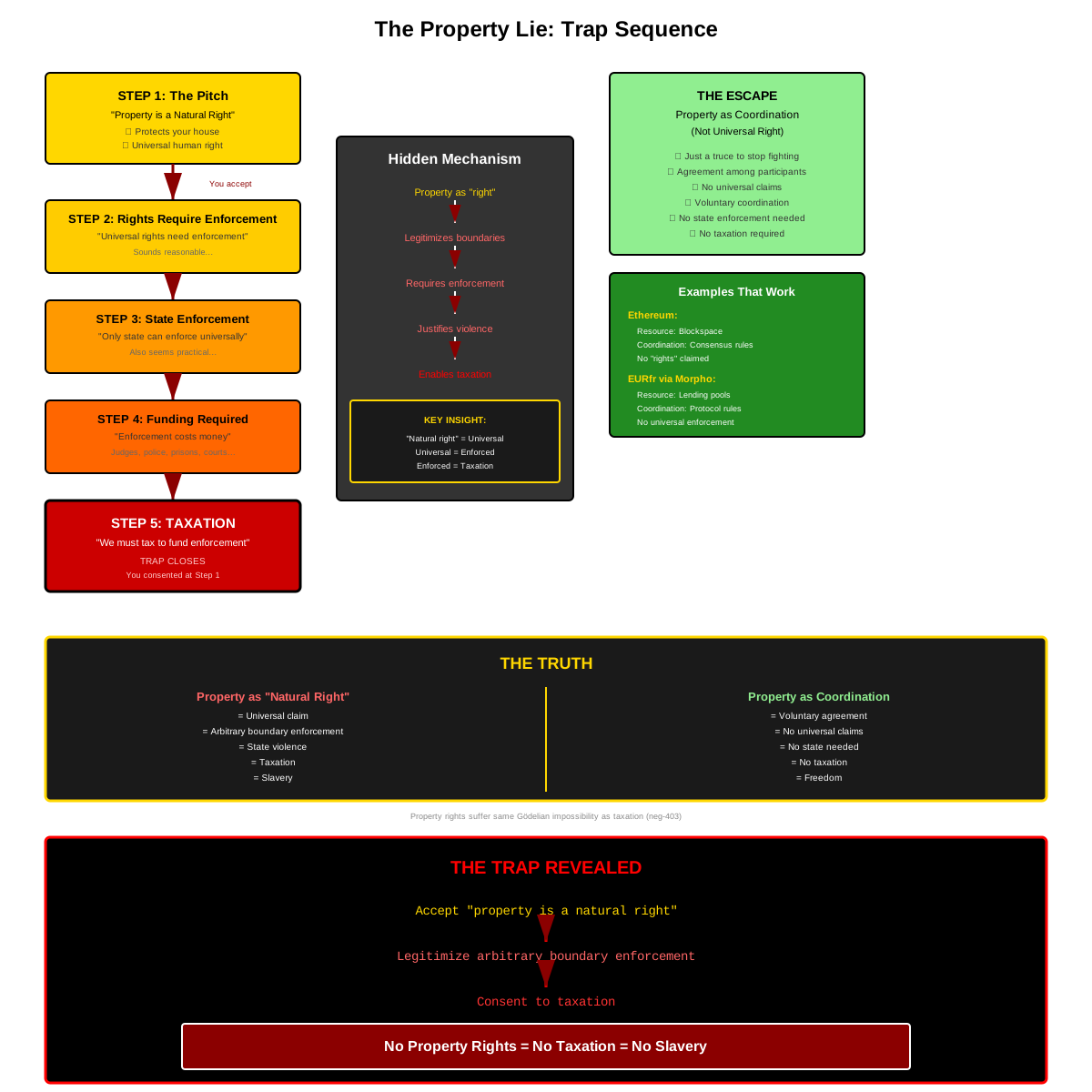
The Full Trap Sequence
class TrapSequence:
    """
    From property lie to taxation slavery.
    """

    def step_1_property_as_right(self):
        return {
            'pitch': 'Property is a natural universal right',
            'appeal': 'Protects your house, land, stuff',
            'you_accept': True,  # Sounds good
        }

    def step_2_rights_require_enforcement(self):
        return {
            'claim': 'Universal rights need enforcement',
            'logic': 'Otherwise they are not really rights',
            'you_accept': True,  # Also sounds reasonable
        }

    def step_3_enforcement_requires_state(self):
        return {
            'claim': 'Only state can enforce universally',
            'logic': 'Private enforcement = chaos',
            'you_accept': True,  # Seems practical
        }

    def step_4_state_requires_funding(self):
        return {
            'claim': 'State enforcement costs money',
            'logic': 'Judges, police, courts, prisons',
            'you_accept': True,  # Obvious fact
        }

    def step_5_funding_requires_taxation(self):
        return {
            'claim': 'We must tax to fund enforcement',
            'logic': 'You already agreed to enforcement',
            'trap_closes': 'You consented at step 1',
        }

    def the_trick(self):
        """
        You consented to step 5 when you accepted step 1.
        """
        return {
            'step_1': 'Accept property as natural right',
            'hidden_consequence': 'Accept taxation as legitimate',
            'you_never_saw_it': 'Steps 2-4 seemed reasonable',
            'trap': 'Complete',
        }
The genius of the trap: Each step sounds reasonable. But step 1 already contained step 5.
The Truth: Property Is Not a Right
Property is a truce, not a right.
class PropertyTruth:
    """
    What property actually is.
    """

    def not_a_right(self):
        return {
            'not_natural': 'Nothing in physics says this land is yours',
            'not_universal': 'Only applies within arbitrary boundaries',
            'not_inherent': 'Requires continuous enforcement',
        }

    def just_a_truce(self):
        return {
            'what_it_is': 'Agreement to stop fighting over resources',
            'why_it_exists': 'Conflict is expensive',
            'how_it_works': 'We agree who controls what',
            'no_universality': 'Just us, not everyone',
        }

    def calling_it_a_right(self):
        return {
            'is_a_lie': True,
            'purpose': 'Legitimize enforcement',
            'consequence': 'Enable taxation',
            'who_benefits': 'Those who enforce (state)',
        }
Property = Coordination to avoid conflict, not universal right.
Calling it a “right” is the lie that enables taxation.
Why People Accept the Lie
Because it benefits them (initially):
def why_people_accept_property_lie():
    """
    The lie has immediate benefits.
    """

    benefits = {
        'protection': 'Your house is protected',
        'stability': 'Less fighting over resources',
        'moral_clarity': 'Feels right to own things',
        'intuitive': 'Matches lived experience',
    }

    hidden_costs = {
        'legitimize_enforcement': 'State violence now justified',
        'consent_to_taxation': 'Implicit in accepting rights',
        'arbitrary_boundaries': 'You accepted them as universal',
        'slavery': 'Coerced participation in system',
    }

    return {
        'people_see': benefits,
        'people_miss': hidden_costs,
        'deal_is_bad': 'Costs exceed benefits',
        'but_too_late': 'Already consented',
    }
The deal: Protection now, slavery forever.
The Tacit Agreement
class TacitAgreement:
    """
    The implicit deal you never explicitly made.
    """

    def the_offer(self):
        return {
            'state_says': 'Accept property as natural right',
            'explicit_benefit': 'We protect your stuff',
            'sounds_good': 'Deal!',
        }

    def the_fine_print(self):
        """
        What you actually agreed to.
        """
        return {
            'implicit_1': 'Property rights are universal',
            'implicit_2': 'Universal rights require enforcement',
            'implicit_3': 'Enforcement requires state',
            'implicit_4': 'State requires funding',
            'implicit_5': 'You consent to taxation',
            'you_never_read_this': True,
        }

    def the_trick(self):
        return {
            'explicit_deal': 'Property protection',
            'implicit_deal': 'Taxation consent',
            'you_thought': 'I am just protecting my house',
            'you_actually_did': 'Legitimized arbitrary boundary enforcement',
        }
You never explicitly agreed to taxation. But you implicitly agreed when you accepted property rights.
The Escape: Property as Coordination, Not Right
Stop calling it a right. Call it what it is: voluntary coordination.
class PropertyWithoutThelie:
    """
    Coordination without universal rights claims.
    """

    def property_as_coordination(self):
        return {
            'not': 'I have a natural right to this land',
            'but': 'We agreed I control this land',

            'not': 'Universal',
            'but': 'Agreement among us',

            'not': 'Requires state enforcement',
            'but': 'We coordinate voluntarily',

            'not': 'Natural',
            'but': 'Practical truce',
        }

    def no_trap(self):
        """
        Why this escapes the trap.
        """
        return {
            'no_universality_claim': 'Just us, not everyone',
            'no_enforcement_needed': 'Voluntary coordination',
            'no_state_legitimacy': 'No universal right to enforce',
            'no_taxation': 'No enforcement to fund',
        }
Key insight: If property is just “us agreeing,” there’s no universal enforcement needed, no state legitimacy, no taxation.
Examples That Work Without Property “Rights”
Ethereum, EURfr, DeFi: Coordination without rights claims
# Ethereum
ethereum_property = {
    'resource': 'Blockspace',
    'coordination': 'Consensus rules',
    'not_claimed_as_right': 'Just protocol rules',
    'no_universal_enforcement': 'Decentralized validation',
    'no_state': 'No enforcement body',
    'no_taxation': 'Gas fees are voluntary participation',
}

# EURfr via Morpho (neg-334)
eurfr_property = {
    'resource': 'French lending pools',
    'coordination': 'Voluntary participation in protocol',
    'not_claimed_as_right': 'Just smart contract rules',
    'no_universal_enforcement': 'Code is coordination',
    'no_state': 'No centralized authority',
    'no_taxation': 'Protocol fees are voluntary',
}

# Pattern
coordination_pattern = {
    'resources_exist': True,
    'conflict_possible': True,
    'coordination_emerges': 'Voluntary agreements',
    'no_rights_claimed': 'No universality',
    'no_enforcement': 'No state violence',
    'no_taxation': 'No coerced funding',
    'works': True,
}
These systems coordinate resource access without claiming property as a “right.”
No rights → No universal enforcement → No state → No taxation.
The Gödelian Connection
This connects to neg-403’s proof:
def property_rights_and_godel():
    """
    Property rights suffer the same Gödelian problem.
    """

    # Property rights claim
    property_claim = {
        'claim': 'Property rights are universal',
        'within': 'System S (e.g., France)',
    }

    # Zoom out to meta-system M
    meta_system_M = {
        'contains': ['France', 'Other countries', 'Stateless people'],
    }

    # Test universality
    # Property rights apply in France but not outside
    # Therefore: NOT universal

    return {
        'claim': 'Universal property rights',
        'reality': 'Targeted enforcement at arbitrary boundary (France)',
        'godel_applies': 'System cannot contain its own boundary',
        'conclusion': 'Property rights are NOT universal',
        'therefore': 'Property rights = arbitrary boundary enforcement',
    }
Property rights suffer the same Gödelian impossibility as taxation: System cannot prove its own boundary universal.
Therefore: Property rights = arbitrary boundary enforcement = same as taxation.
No Property, No Taxation, No Slavery
class Liberation:
    """
    Escaping the trap entirely.
    """

    def the_path(self):
        return {
            'step_1': 'Reject property as universal right',
            'step_2': 'Accept property as voluntary coordination',
            'step_3': 'No universal claims = No enforcement needed',
            'step_4': 'No enforcement = No taxation',
            'step_5': 'No taxation = No slavery',
        }

    def what_you_lose(self):
        """
        What you give up by rejecting property rights.
        """
        return {
            'lose': 'State protection of your stuff',
            'lose': 'Moral claim to universal enforcement',
            'lose': 'Ability to coerce others via state',
        }

    def what_you_gain(self):
        """
        What you get by rejecting property rights.
        """
        return {
            'gain': 'Freedom from taxation',
            'gain': 'Freedom from arbitrary boundaries',
            'gain': 'Voluntary coordination only',
            'gain': 'No coerced participation',
            'gain': 'No slavery',
        }
The trade: Give up state-enforced property “rights,” gain freedom from taxation and coercion.
The Coherent Story Without Property Rights
def coherent_story_without_rights():
    """
    How coordination works without rights claims.
    """

    return {
        'resources_exist': 'Land, capital, blockspace, etc.',
        'conflict_happens': 'People want same resources',
        'coordination_emerges': 'Agreements to reduce conflict',
        'no_rights_needed': 'Just practical agreements',
        'no_universality': 'Just us, voluntarily',
        'no_enforcement': 'Voluntary compliance',
        'no_state': 'No universal authority needed',
        'no_taxation': 'No enforcement to fund',
        'works': 'Ethereum, EURfr, others prove it',
    }
L’histoire cohérente qui marche:
- Resources exist
- Conflict possible
- Coordination emerges (voluntary agreements)
- No “rights” claimed (just practical truces)
- No universality (just us)
- No state enforcement (voluntary)
- No taxation (no enforcement to fund)
Ça marche. On n’a pas besoin de droits de propriété.
Why They Push the Property Lie
class WhoBenefits:
    """
    Who benefits from the property lie?
    """

    def the_state(self):
        return {
            'property_as_right': 'Legitimizes state enforcement',
            'enforcement': 'Justifies state violence',
            'taxation': 'Funds the enforcement apparatus',
            'control': 'State controls who owns what',
            'power': 'Complete',
        }

    def property_owners(self):
        return {
            'protection': 'State enforces their claims',
            'stability': 'Current distribution locked in',
            'cost': 'Taxation (but worth it for them)',
        }

    def who_loses(self):
        return {
            'everyone_else': 'Coerced participation',
            'forced_taxation': 'To fund enforcement',
            'arbitrary_boundaries': 'Locked into system',
            'slavery': 'Cannot exit',
        }
State and current property owners benefit. Everyone else pays.
The Proof Chain Complete
Connecting all the pieces:
class CompleteProof:
    """
    From property lie to taxation theft.
    """

    def the_chain(self):
        return {
            'step_1': 'Property claimed as universal right (THE LIE)',
            'step_2': 'Universal rights require enforcement',
            'step_3': 'Enforcement requires state violence',
            'step_4': 'State violence requires funding',
            'step_5': 'Funding = Taxation',

            'plus_neg_402': 'Statistical distribution proves targeting',
            'plus_neg_403': 'Universality impossible (Gödel)',
            'plus_neg_404': 'Voluntary coordination escapes proof',

            'conclusion_1': 'All taxation is theft (neg-403)',
            'conclusion_2': 'Property rights enable taxation (this post)',
            'final_truth': 'Property lie is the original trap',
        }

    def the_escape(self):
        return {
            'reject': 'Property as universal right',
            'accept': 'Property as voluntary coordination',
            'result': 'No enforcement, no taxation, no slavery',
        }
Le mensonge commence avec la propriété, pas avec les impôts.
Conclusion: The Property Lie Enables All Theft
Property as “natural right” is the original trap. Once you accept it, you’ve already consented to:
- Arbitrary boundary enforcement
- State violence
- Taxation
- Coerced participation
- Slavery
The escape: Reject property as a “right.” Accept property as voluntary coordination among those who choose to participate.
No property rights → No universal enforcement → No state → No taxation → No slavery.
Just voluntary coordination. L’histoire cohérente qui marche.
Il faut juste trouver l’histoire cohérente qui marche que vous souhaitez. Voilà: Coordination volontaire sans droits universels.
Proof chain:
- neg-402: Statistics prove targeting
- neg-403: Universality impossible (Gödel)
- neg-404: Voluntary coordination escapes proof
- neg-405 (this post): Property “rights” enable taxation by legitimizing enforcement
The trap begins with property, not taxation.
#PropertyLie #NaturalRights #TacitAgreement #ArbitraryBoundaries #TaxationConsent #StateEnforcement #VoluntaryCoordination #NoRightsNeeded #JustATruce #GodelianProperty #EscapeTheTrap #CoordinationNotRights #NoPropertyNoTaxes #NoSlavery #HistoireCoherente #EthereumCoordination #EURfrMorpho #FreedomFromCoercion #RejectUniversalClaims #PracticalAgreements