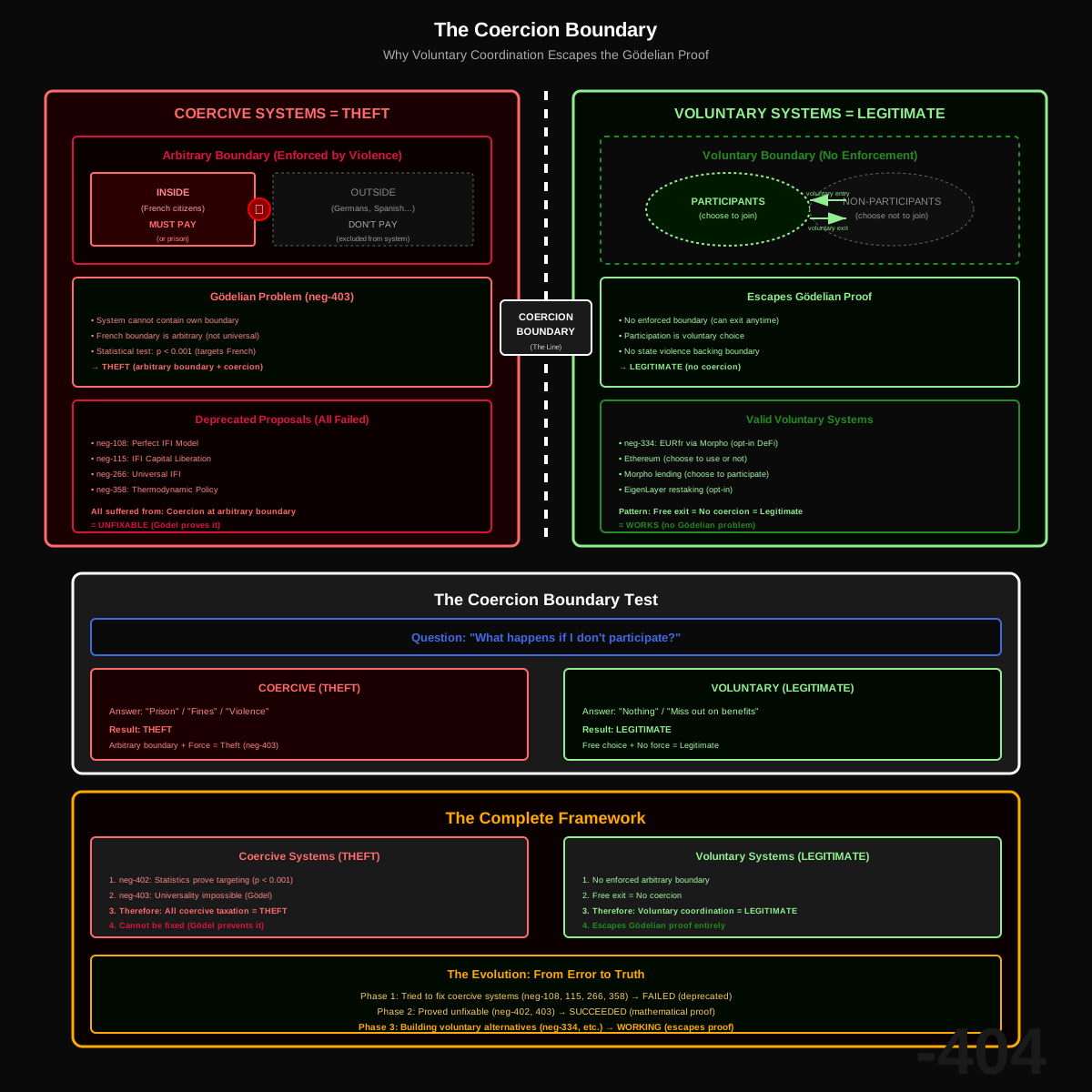
The Coercion Boundary: Why Voluntary Coordination Escapes the Gödelian Proof That All Taxation Is Theft
From neg-402, we proved that statistical distribution reveals targeting.
From neg-403, we proved that universal taxation is mathematically impossible (Gödel).
Therefore: All taxation is theft. Mathematically proven. No exceptions.
But this raises an important question: What about voluntary coordination systems?
The Critical Distinction: Coercion vs Choice
The Gödelian proof in neg-403 demolishes coercive systems that force participation within arbitrary boundaries. But it doesn’t touch voluntary systems where people choose to participate.
class CoercionBoundary:
    """
    The line that separates theft from legitimate coordination.
    """

    def test_system_legitimacy(self, system):
        # The critical question
        if system.requires_participation():
            # COERCIVE: You must participate
            # Subject to Gödelian proof
            return self.apply_godelian_test(system)
        else:
            # VOLUNTARY: You may participate
            # Escapes Gödelian proof
            return self.validate_voluntary_system(system)

    def apply_godelian_test(self, coercive_system):
        """
        Coercive systems fail the Gödelian test.
        """
        # System claims universality
        claims_universal = coercive_system.tax_applies_to_all_in_boundary()

        # Zoom out to meta-system
        meta_system = zoom_out(coercive_system)

        # Boundary is arbitrary (Gödel)
        boundary_arbitrary = not coercive_system.can_prove_boundary_universal()

        # Statistical test shows targeting
        from scipy.stats import chi2_contingency
        inside = coercive_system.members_who_pay
        outside = meta_system.members_who_dont_pay
        p_value = chi2_contingency([[inside, outside]]).pvalue

        if p_value < 0.001:
            return {
                'result': 'THEFT',
                'reason': 'Arbitrary boundary + Forced participation + Targeting proven',
                'proof_chain': ['neg-402: targeting', 'neg-403: Gödel'],
            }

    def validate_voluntary_system(self, voluntary_system):
        """
        Voluntary systems escape the Gödelian proof.
        """
        # No forced participation
        can_exit = voluntary_system.allows_exit()

        # No arbitrary enforcement
        no_state_violence = not voluntary_system.uses_force()

        # Participation is choice
        opt_in = voluntary_system.requires_active_choice_to_join()

        if can_exit and no_state_violence and opt_in:
            return {
                'result': 'LEGITIMATE',
                'reason': 'No coercion = No arbitrary boundary enforcement',
                'escapes_godel': 'Boundary is permeable, not enforced',
            }
Key insight: The Gödelian proof doesn’t apply to voluntary systems because there’s no enforced arbitrary boundary.
Why Voluntary Systems Escape the Proof
The Gödelian problem (from neg-403): System cannot contain its own boundary → Every boundary is arbitrary → Enforcing arbitrary boundary = Targeting = Theft
Voluntary systems escape:
def why_voluntary_escapes_godel():
    """
    Voluntary coordination doesn't suffer from the boundary problem.
    """

    # Coercive system (FAILS)
    french_tax = {
        'boundary': 'French citizenship',
        'enforcement': 'Prison if you don't pay',
        'can_exit': False,  # You're French whether you like it or not
        'godel_applies': True,  # Boundary is arbitrary and enforced
        'result': 'THEFT',
    }

    # Voluntary system (PASSES)
    eurfr_morpho = {
        'boundary': 'People who choose to use EURfr',
        'enforcement': None,  # No force
        'can_exit': True,  # Stop using it anytime
        'godel_applies': False,  # Boundary is not enforced
        'result': 'LEGITIMATE',
    }

    # The difference
    return {
        'coercive': 'Boundary enforced by violence → arbitrary → theft',
        'voluntary': 'Boundary self-selected by utility → not arbitrary → legitimate',
    }
The key: When you can leave, the boundary isn’t arbitrary enforcement—it’s just a description of who’s choosing to participate.
The Intellectual Journey
This blog documented an honest intellectual progression:
Phase 1: Trying to fix taxation (neg-108, neg-115, neg-266, neg-358)
- Proposed various “universal” tax systems
- Attempted to make IFI fair and efficient
- Tried deriving tax from physics (thermodynamics)
- All failed (now deprecated)
Phase 2: Discovering unfixability (neg-402, neg-403)
- Statistical proof: Distribution reveals targeting
- Gödelian proof: Universality is impossible
- Conclusion: Taxation cannot be fixed
Phase 3: Voluntary coordination (neg-334, others)
- Build opt-in coordination systems
- No coercion = No Gödelian problem
- Solution: Replace coercive systems with voluntary alternatives
class IntellectualHonesty:
    """
    Documenting the journey from error to truth.
    """

    def __init__(self):
        self.phase_1 = "Tried to fix broken system"
        self.phase_2 = "Proved system unfixable"
        self.phase_3 = "Built alternatives that don't need fixing"

    def what_we_learned(self):
        return {
            'attempt': 'Proposed various IFI/tax reforms',
            'discovery': 'Mathematics proves all coercive taxation is theft',
            'pivot': 'Voluntary coordination escapes the proof',
            'conclusion': 'Stop trying to fix coercion, build voluntary systems',
        }
Why the Deprecated Proposals Failed
All the deprecated tax proposals suffered from the same fundamental flaw: They tried to fix coercion instead of eliminating it.
neg-108: “The Perfect IFI Model”
# The proposal
neg_108 = {
    'idea': 'Force French rentiers to liquidate real estate',
    'mechanism': 'Annual wealth tax on property',
    'boundary': 'French citizens/property owners',
    'why_it_fails': 'French boundary is arbitrary (Gödel)',
    'statistical_test': 'p < 0.001 targeting French',
    'conclusion': 'Still theft (arbitrary boundary + coercion)',
}
Problem: Even “perfect” IFI is forcing people within an arbitrary boundary (France) to pay. Gödel proves the boundary is arbitrary. Statistics prove the targeting. Therefore: theft.
neg-115: “IFI Capital Liberation”
# The proposal
neg_115 = {
    'idea': 'Use IFI to eliminate capital gains tax',
    'mechanism': 'Wealth circulation tax replaces transaction tax',
    'boundary': 'French wealth holders',
    'why_it_fails': 'Still coercive, still arbitrary boundary',
    'conclusion': 'Elegant economics, but forced participation = theft',
}
Problem: Doesn’t matter how economically optimal it is. If you’re forcing participation within an arbitrary boundary, it’s theft.
neg-266: “Universal IFI”
# The proposal
neg_266 = {
    'idea': 'Universal IFI with individual citizen exemption',
    'claims': 'Universal within France',
    'boundary': 'French citizenship',
    'why_it_fails': 'Universal within arbitrary boundary ≠ universal',
    'godel_reveals': 'French boundary is arbitrary, not universal',
    'conclusion': 'Confiscation with universal branding',
}
Problem: “Universal within France” is not universal. It’s targeting French citizens. The boundary is arbitrary (Gödel). Therefore: theft.
neg-358: “Thermodynamic Policy Formulas”
# The proposal
neg_358 = {
    'idea': 'Derive tax from physics (entropy, demographics)',
    'claims': 'Not arbitrary—required by thermodynamics',
    'boundary': 'French demographic system',
    'why_it_fails': 'Thermodynamics of WHICH system?',
    'godel_reveals': 'System boundary is arbitrary',
    'insight': 'Physics is downstream of Gödel',
    'conclusion': 'Even physics-based coercion is theft',
}
Problem: Yes, you can derive optimal tax from thermodynamics. But optimal for which system? The system boundary choice is arbitrary (Gödel). Therefore: even physics-based taxation is arbitrary boundary enforcement = theft.
What Actually Works: Voluntary Coordination
Examples of legitimate (voluntary) coordination:
neg-334: EURfr Via Morpho
# Voluntary system (LEGITIMATE)
eurfr_morpho = {
    'idea': 'French financial sovereignty through DeFi',
    'mechanism': 'Opt-in lending infrastructure',
    'participation': 'VOLUNTARY',
    'boundary': 'People who choose to use it',
    'can_exit': True,  # Stop using anytime
    'enforcement': None,  # No state violence
    'godel_applies': False,  # No enforced arbitrary boundary
    'result': 'LEGITIMATE coordination system',
}
Why this works: No one is forced to use EURfr. If you don’t like it, don’t use it. The “boundary” is just a description of who’s choosing to participate, not an enforced barrier backed by violence.
Other voluntary examples:
voluntary_systems = [
    {
        'system': 'Ethereum',
        'participation': 'Choose to use ETH or not',
        'exit': 'Sell your ETH anytime',
        'legitimate': True,
    },
    {
        'system': 'Morpho lending',
        'participation': 'Choose to lend/borrow or not',
        'exit': 'Withdraw anytime',
        'legitimate': True,
    },
    {
        'system': 'EigenLayer restaking',
        'participation': 'Choose to restake or not',
        'exit': 'Unstake anytime',
        'legitimate': True,
    },
]
Pattern: All legitimate coordination allows voluntary participation and free exit. No coercion = No Gödelian problem.
The Coercion Boundary Test
Simple test to distinguish theft from legitimate coordination:
def test_if_system_is_theft(system):
    """
    One question reveals everything.
    """

    # THE question
    what_happens_if_i_dont_participate = system.enforcement_mechanism()

    if what_happens_if_i_dont_participate == "Prison":
        return "THEFT (coercive system with arbitrary boundary)"

    elif what_happens_if_i_dont_participate == "Nothing":
        return "LEGITIMATE (voluntary coordination)"

    elif what_happens_if_i_dont_participate == "You miss out on benefits":
        return "LEGITIMATE (natural consequences, not coercion)"

    else:
        # Anything involving state violence = coercion
        if "violence" in what_happens_if_i_dont_participate.lower():
            return "THEFT"
        else:
            return "LEGITIMATE"
Examples:
# French IFI (from deprecated proposals)
print(test_if_system_is_theft(french_ifi))
# Output: "THEFT (coercive system with arbitrary boundary)"
# Reason: Don't pay → Prison

# EURfr via Morpho (neg-334)
print(test_if_system_is_theft(eurfr_morpho))
# Output: "LEGITIMATE (voluntary coordination)"
# Reason: Don't use it → Nothing happens, you just don't get benefits

# Bitcoin
print(test_if_system_is_theft(bitcoin))
# Output: "LEGITIMATE (voluntary coordination)"
# Reason: Don't buy BTC → Nothing happens

# US Income Tax
print(test_if_system_is_theft(us_income_tax))
# Output: "THEFT (coercive system with arbitrary boundary)"
# Reason: Don't pay → Prison
The line is clear: Coercion = Theft. Voluntary = Legitimate.
Why This Distinction Matters
From a practical perspective:
class BuildingTheFuture:
    """
    Two paths forward.
    """

    def broken_path():
        # Try to fix coercive systems
        attempts = [
            "Reform taxation",
            "Make it more fair",
            "Optimize the rates",
            "Derive it from physics",
        ]

        result = "All attempts fail (Gödel + Statistics)"
        return "IMPOSSIBLE"

    def working_path():
        # Build voluntary alternatives
        actions = [
            "Create opt-in coordination systems",
            "Build DeFi infrastructure",
            "Enable voluntary cooperation",
            "Let people choose",
        ]

        result = "Voluntary coordination replaces coercion"
        return "SOLUTION"
The choice:
- Keep trying to fix coercive systems (proven impossible)
- Build voluntary alternatives (actually works)
The Evolution: From Error to Truth
class JourneyToTruth:
    """
    Intellectual honesty requires admitting error.
    """

    def document_evolution(self):
        return {
            'phase_1': {
                'posts': ['neg-108', 'neg-115', 'neg-266', 'neg-358'],
                'belief': 'Taxation can be fixed',
                'approach': 'Design better tax systems',
                'status': 'DEPRECATED (proven wrong)',
            },

            'phase_2': {
                'posts': ['neg-402', 'neg-403'],
                'discovery': 'Taxation mathematically unfixable',
                'proof': 'Statistics + Gödel',
                'status': 'PROVEN',
            },

            'phase_3': {
                'posts': ['neg-334', 'others'],
                'insight': 'Voluntary coordination escapes proof',
                'approach': 'Build opt-in alternatives',
                'status': 'CURRENT (working)',
            },
        }
What we learned:
- Tried to fix taxation: Failed (all proposals deprecated)
- Proved taxation unfixable: Succeeded (mathematical proof complete)
- Building voluntary alternatives: Working (escapes Gödelian problem)
The Final Framework
def universal_coordination_framework():
    """
    How to coordinate without theft.
    """

    # The proven facts
    facts = {
        'coercive_taxation': 'Always theft (Gödel + Statistics)',
        'voluntary_coordination': 'Always legitimate (No coercion)',
        'fix_attempt': 'Impossible (Gödel prevents it)',
        'alternative': 'Build voluntary systems',
    }

    # The action plan
    action = {
        'stop': 'Trying to fix coercive systems',
        'start': 'Building voluntary alternatives',
        'principle': 'If it requires force, it is theft',
        'solution': 'Make participation voluntary',
    }

    # The future
    future = {
        'coercive_systems': 'Revealed as theft, deprecated',
        'voluntary_systems': 'Replace coercion with choice',
        'coordination': 'Opt-in networks, not enforced boundaries',
        'result': 'Legitimate cooperation without arbitrary targeting',
    }

    return {
        'proof': 'Coercion at arbitrary boundaries = Theft (neg-403)',
        'escape': 'Voluntary coordination = Legitimate (this post)',
        'deprecated': 'All tax proposals (coercive)',
        'valid': 'Voluntary systems (like neg-334)',
        'future': 'Build alternatives, not fixes',
    }
Conclusion: The Coercion Boundary
The Gödelian proof in neg-403 proves that all coercive taxation is theft. No exceptions. The system cannot contain its own boundary, making all boundaries arbitrary, making all enforcement targeting.
But voluntary coordination escapes this proof because there’s no enforced boundary. When people choose to participate and can leave anytime, there’s no arbitrary coercion.
The deprecated proposals (neg-108, neg-115, neg-266, neg-358) all failed because they tried to fix coercive systems. Mathematics proves coercive systems cannot be fixed.
The valid alternatives (like neg-334) work because they eliminate coercion entirely. Voluntary participation escapes the Gödelian proof.
The lesson: Stop trying to fix coercion. Build voluntary alternatives instead.
The line is clear:
- Coercion at arbitrary boundary = Theft (proven)
- Voluntary coordination = Legitimate (escapes proof)
Choose which side you want to build.
#CoercionBoundary #VoluntaryCoordination #GodelianProof #TaxationIsTheft #VersusVoluntaryChoice #MathematicalProof #IntellectualHonesty #DeprecatedProposals #FromErrorToTruth #OptInSystems #NoCoercion #ArbitraryBoundaries #FreeExit #EURfrMorpho #EthereumCoordination #BuildAlternatives #StatisticalProof #SystemLegitimacy #PhilosophicalEvolution #ReplacingCoercion