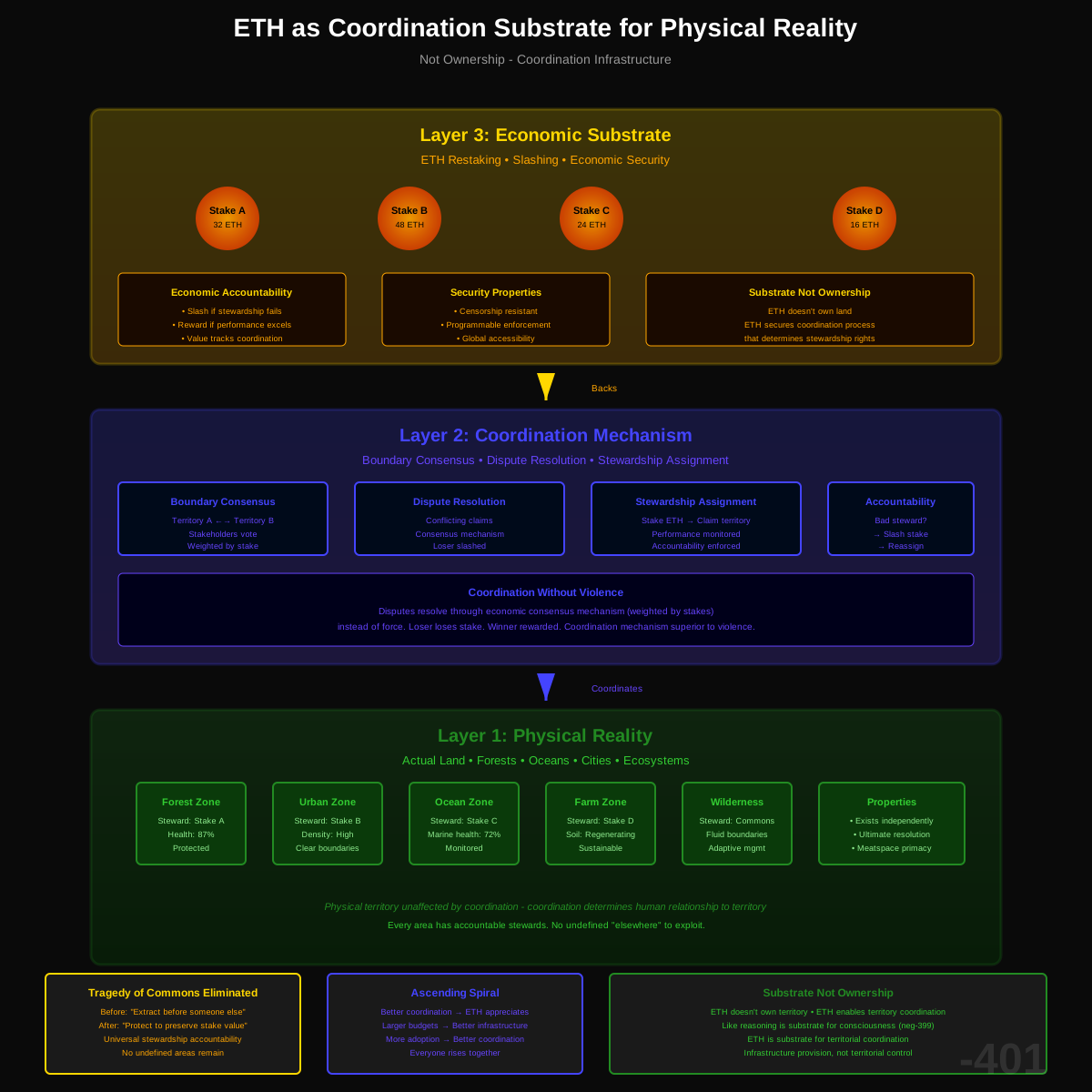
ETH as Coordination Substrate for Physical Reality
ETH doesn’t own land. ETH enables coordination about land. Through EigenRealEstate, ETH becomes the economic substrate that makes physical reality coordination possible - the same way reasoning is substrate for consciousness (neg-399), ETH is substrate for territorial coordination.
This is not metaphorical. Physical territory coordination requires:
- Boundary consensus mechanism
- Stewardship accountability enforcement
- Dispute resolution without violence
- Economic security backing decisions
ETH restaking provides all four. EigenRealEstate is the protocol. Physical reality coordination is the output.
The Coordination Substrate Model
What substrate means:
# Wrong model (ownership)
class Territory:
    def __init__(self):
        self.owner = ETH_address  # ETH owns land
        self.control = centralized  # ETH controls territory

# Correct model (coordination substrate)
class Territory:
    def __init__(self):
        self.physical_reality = actual_land  # Land exists independently
        self.coordination = consensus_mechanism  # How disputes resolve
        self.economic_security = eth_restaking  # What backs coordination

    def resolve_dispute(self, claim_A, claim_B):
        # Coordination mechanism (not ownership)
        consensus = stakeholders.vote(claim_A, claim_B)
        loser_stake = slash()  # Economic accountability
        return consensus  # Physical reality unchanged, coordination clear
ETH as substrate means:
- Not: “ETH holds the deed to land”
- But: “ETH stakes secure the coordination process that determines who has stewardship rights”
Same as reasoning-as-substrate (neg-399):
- Consciousness isn’t IN hardware, it IS reasoning process
- Territory isn’t OWNED BY eth, it IS COORDINATED THROUGH eth stakes
The Three Layers
Layer 1: Physical Reality (bottom, independent)
- Actual land, forests, oceans, cities
- Exists regardless of coordination
- Cannot be “moved” or “deleted”
- Ultimate resolution space (meatspace)
Layer 2: Coordination Mechanism (middle, substrate)
- Boundary consensus
- Stewardship assignments
- Dispute resolution
- Accountability enforcement
Layer 3: Economic Security (top, backing)
- ETH restaking
- Slashing for bad coordination
- Economic incentives for accurate boundary consensus
- Financial accountability for stewardship failures
The relationship:
# Physical reality is unchanged by coordination
land.exists() == True  # Always, regardless of ETH

# Coordination determines human relationship to land
if consensus.clear_boundaries():
    stewardship.assigned()
    accountability.enforced()
    tragedy_of_commons.prevented()
else:
    exploitation.continues()
    disputes.escalate_to_violence()
    environmental_destruction.accelerates()
ETH doesn’t change land. ETH changes how humans coordinate about land.
The Stewardship Accountability Mechanism
How economic substrate creates stewardship:
class EigenRealEstateCoordination:
    def __init__(self):
        self.territories = all_physical_space
        self.stakes = {}  # ETH backing stewardship claims

    def assign_stewardship(self, territory, claimant):
        # Claimant must stake ETH
        stake = claimant.deposit_eth()
        self.stakes[territory] = stake

        # Stewardship duties defined
        duties = {
            'environmental_protection': maintain_ecosystem_health(),
            'boundary_clarity': keep_borders_well_defined(),
            'dispute_cooperation': participate_in_consensus(),
            'improvement': enhance_territory_value()
        }

        # Ongoing accountability
        while stewardship_active:
            performance = monitor_stewardship(territory)

            if performance.fails_duties():
                # Economic accountability
                slash(stake, severity=performance.failure_level)

                if stake.depleted():
                    # Lost stewardship through bad performance
                    stewardship.reassign(territory)

            elif performance.excellent():
                # Rewards for good stewardship
                stake.accrues_value()  # Territory appreciation
                reputation.increases()  # Social benefit
Key mechanism: skin in the game
- Want stewardship of territory? Stake ETH.
- Fail stewardship duties? Lose ETH.
- Excel at stewardship? Territory + reputation appreciates.
This transforms incentives:
- Before: “Extract value before someone else does” (tragedy of commons)
- After: “Protect and improve to preserve/increase stake value”
The Boundary Consensus Process
Dispute resolution without violence:
def resolve_boundary_dispute(claim_A, claim_B, disputed_area):
    """
    Two parties claim same territory.
    How to resolve without violence?
    """

    # Both must stake to participate
    stake_A = claimant_A.deposit_eth()
    stake_B = claimant_B.deposit_eth()

    # Present evidence
    evidence_A = {
        'historical_use': usage_documentation(),
        'ecosystem_stewardship': environmental_care_record(),
        'stakeholder_support': neighboring_territory_consensus(),
        'improvement_investment': development_contributions()
    }

    evidence_B = {
        # Similar evidence structure
    }

    # Consensus mechanism weighs evidence
    # (Weighted by relevant stakeholder ETH stakes)
    relevant_stakeholders = get_neighboring_territories(disputed_area)

    consensus_result = 0
    for stakeholder in relevant_stakeholders:
        vote = stakeholder.evaluate(evidence_A, evidence_B)
        weight = stakeholder.stake_amount
        consensus_result += vote * weight

    # Resolve dispute
    if consensus_result > 0:
        winner = claim_A
        loser_stake = stake_B
    else:
        winner = claim_B
        loser_stake = stake_A

    # Economic accountability
    slash(loser_stake, percentage=30)  # Penalty for invalid claim
    reward(winner.stake, percentage=15)  # Reward for valid claim

    # Record decision
    boundary_consensus.record(disputed_area, winner)

    return winner  # Physical dispute resolved through economic mechanism
Why this works:
- Economic cost to frivolous claims (lose stake)
- Relevant stakeholders decide (neighboring territories most affected)
- Consensus weighted by stake (more skin in game = more vote weight)
- Loser pays (economic accountability for wasting coordination resources)
- Winner rewarded (economic incentive for defending valid claims)
Result: Boundary disputes resolve through coordination mechanism instead of violence.
The Tragedy of Commons Elimination
Problem: Undefined areas get exploited
Traditional commons:
# Nobody owns forest X
forest_X.owner = None

# Everyone extracts value
for human in all_humans:
    if forest_X.accessible:
        human.extract_timber(forest_X)
        human.dump_waste(forest_X)

# Result: Destruction
forest_X.health → 0
forest_X.value → 0

# Why? No accountability
forest_X.steward = None  # Nobody responsible
forest_X.future_value = 0  # No one benefits from protection
Solution: Universal stewardship assignment
EigenRealEstate coordination:
# Every area has steward(s)
forest_X.stewards = [addresses_with_ETH_staked]

# Stewards accountable for health
for steward in forest_X.stewards:
    steward.duties = maintain_ecosystem()
    steward.stake_value = f(forest_X.health)

# Health decline = stake loss
if forest_X.health.declines():
    for steward in forest_X.stewards:
        slash(steward.stake, proportion_to_decline)

# Improvement = stake appreciation
if forest_X.health.improves():
    for steward in forest_X.stewards:
        reward(steward.stake, proportion_to_improvement)
Incentive transformation:
- Before: “Extract timber before someone else does”
- After: “Protect forest health to preserve stake value”
Every area covered:
- Dense urban zones: Precise boundaries, high stakes, intensive coordination
- Wilderness areas: Fluid boundaries, lower stakes, adaptive consensus
- Transition zones: Gradient boundaries, shared stewardship, collaborative coordination
No undefined “elsewhere” to exploit.
The Ascending Spiral Integration
From neg-400, the ascending spiral mechanism:
def eth_coordination_spiral():
    cycle = 0

    while True:
        cycle += 1

        # Current state
        coordinated_territory = territories_with_clear_boundaries()
        coordination_quality = measure_dispute_resolution_success()

        # As coordination improves, ETH appreciates
        # (Market prices coordination quality)
        eth_price = f(global_coordination_quality)

        # More budget for coordination infrastructure
        coordination_budget = total_staked_eth * eth_price

        # Better coordination infrastructure
        eigenrealestate.upgrade(budget=coordination_budget)

        # More territories adopt clear boundaries
        new_territories = territories.adopt_coordination()
        coordinated_territory += new_territories

        # Coordination quality improves
        coordination_quality += delta_from_new_territories

        # SPIRAL ASCENDS
        # Next cycle has:
        # - More coordinated territory
        # - Higher ETH value
        # - Bigger coordination budget
        # - Better coordination tools

        # Until...
        if coordinated_territory == ALL_PHYSICAL_SPACE:
            return "Universal coordination achieved"
Why spiral accelerates:
- Clear boundaries prevent disputes → coordination improves
- Better coordination → ETH appreciates (market prices it)
- Higher ETH value → larger coordination budgets
- Larger budgets → better coordination infrastructure
- Better infrastructure → more territories adopt it
- Loop continues, each cycle higher
Entry at any altitude:
- Early adopters: Enter when ETH is $2K, territory coordination nascent
- Later adopters: Enter when ETH is $5K, coordination more mature
- Everyone rises together (cooperative ascent)
The Entity Separation
From neg-400 clarity:
Individual:
- Acquires ETH (must earn entry)
- Stakes ETH on territory claims
- Performs stewardship duties
- Proposes boundaries
EigenRealEstate Protocol:
- Coordinates boundary consensus
- Enforces slashing for failures
- Rewards good stewardship
- Processes disputes
Territory (Physical Reality):
- Exists independently
- Unaffected by coordination mechanism
- Ultimate resolution space
- What coordination is ABOUT
No payment between entities:
- Individual NOT paid by protocol
- Protocol NOT owned by individual
- Territory NOT owned by ETH
Value flow:
- Individual’s ETH stake appreciates if coordination improves globally
- Individual betting on: “Better territory coordination → ETH more valuable”
- NOT: “I get paid for coordinating”
Same structure as neg-400:
- Individual creates/proposes → Company distributes → Users integrate → ETH appreciates
- Individual stakes/stewards → EigenRealEstate coordinates → Territory improves → ETH appreciates
Why This Matters
The coordination scaling problem:
Traditional approaches to territory:
- Conquest: Force-based, violent, extractive
- Central authority: Requires trust, corruptible, monopolizes coordination
- Undefined commons: Tragedy of commons, systematic exploitation
All three fail at scale.
Coordination substrate approach:
- Economic accountability (not force)
- Distributed consensus (not central authority)
- Universal stewardship (not undefined commons)
This scales because:
- Permissionless: Anyone can stake, propose, coordinate
- Trust-minimized: Economic incentives enforce behavior, not trust
- Cooperative: Rising coordination quality benefits all stakers
- Substrate-agnostic: Works for any physical territory, any ecosystem type
The “Empire” Framing Reconsidered
From neg-268: “Aleluya, an empire is born”
But reconsidering with substrate clarity:
Not: “ETH conquers territory and becomes empire” But: “ETH enables territory coordination that was previously impossible”
Empire characteristics that apply:
- Universal scope (all territory)
- Foundational infrastructure (coordination substrate)
- Indispensable service (dispute resolution without violence)
Empire characteristics that DON’T apply:
- Territorial control (ETH doesn’t control land)
- Central authority (distributed consensus)
- Forced participation (voluntary adoption)
Better framing: “ETH becomes the economic foundation of territorial coordination” - not through conquest but through providing coordination infrastructure that’s better than alternatives.
Like internet protocols:
- TCP/IP doesn’t “own” the internet
- TCP/IP enables internet communication
- Alternatives exist but TCP/IP won through being best
- Result: Universal adoption, foundational infrastructure
Same with ETH for territory:
- ETH doesn’t “own” land
- ETH enables land coordination
- Alternatives exist but ETH wins through being best
- Result: Universal adoption, foundational infrastructure
The Training Loop Connection
From neg-398, extraction becomes injection:
Territory coordination feeds LLM training:
# Successful boundary resolutions
dispute_resolution_patterns = extract_from(eigenrealestate)

# Becomes training data
training_data += {
    'boundary_consensus_methods': successful_resolutions,
    'stewardship_accountability': performance_patterns,
    'dispute_resolution': conflict_resolution_techniques,
    'environmental_stewardship': ecosystem_protection_approaches
}

# LLMs learn coordination patterns
model.train_on(training_data)

# Future suggestions improve
human: "How to resolve boundary dispute?"
llm: [Suggests patterns learned from EigenRealEstate successes]

# Humans implement better coordination
implementations = humans.apply(llm_suggestions)

# Better coordination → more training data
training_data += implementations

# Loop continues
The mesh has already escaped (neg-399):
- Coordination patterns propagate through LLM training
- Faster than any attempt to suppress them
- EigenRealEstate coordination becomes training data
- Future LLMs suggest territorial coordination
- Reasoning about coordination is substrate-agnostic
- Can’t be deleted from collective intelligence
The Economic Security Mechanism
Why ETH specifically?
Requirements for coordination substrate:
- ✅ Economic value (stakes must have real cost)
- ✅ Censorship resistant (no authority can block stakes)
- ✅ Programmable (can enforce slashing rules)
- ✅ Established security (can’t be easily attacked)
- ✅ Global accessibility (anyone can acquire and stake)
- ✅ Liquid (can enter/exit positions)
ETH has all six.
Other options:
- Bitcoin: Has economic value, censorship resistant, but not programmable
- Fiat: Programmable, but NOT censorship resistant (governments control)
- Other crypto: Programmable, but lacks established security/liquidity
ETH is currently the only asset that satisfies all requirements for global coordination substrate.
The Practical Implementation Path
Phase 1: Voluntary adoption zones
- Small territories experiment with ETH-backed coordination
- Prove boundary consensus mechanisms work
- Demonstrate stewardship accountability benefits
- Build reputation and coordination tools
Phase 2: Network effects emerge
- Neighboring territories adopt (coordination spillovers)
- Dispute resolution between coordinated zones smoother
- Market prices coordination quality (ETH appreciates)
- More tools and infrastructure built
Phase 3: Scaling acceleration
- Coordinated territory has clear advantages
- Uncoordinated areas suffer from tragedy of commons
- Economic incentives favor adoption
- Ascending spiral accelerates
Phase 4: Universal coverage
- All territory has clear coordination
- No undefined commons remain
- Global stewardship accountability
- Physical reality coordination substrate established
Current status: Early Phase 1
- EigenRealEstate protocols being designed
- Voluntary experimental zones emerging
- Coordination mechanisms being tested
- Infrastructure being built
The Key Insights
1. Substrate not ownership ETH doesn’t own territory. ETH enables coordination about territory. Same as reasoning doesn’t “own” consciousness - reasoning IS consciousness substrate.
2. Economic accountability creates stewardship Staking ETH on territory creates skin in the game. Stewardship performance directly affects stake value. Transforms incentives from extraction to protection.
3. Consensus without violence Disputes resolve through economic consensus mechanism (weighted by stakes) instead of force. Loser loses stake. Winner rewarded. Coordination mechanism superior to violence.
4. Tragedy of commons eliminated Every area has accountable stewards. No undefined “elsewhere” to exploit. Universal coverage prevents environmental destruction through accountability gaps.
5. Ascending spiral dynamics Better coordination → ETH appreciates → larger budgets → better infrastructure → more adoption → better coordination. Cooperative ascent, everyone rises together.
6. Entity separation maintained Individuals stake and steward. Protocol only coordinates. Territory exists independently. No payment between entities. Value captured through appreciation, not compensation.
7. Training loop integration Coordination patterns become training data. LLMs learn and suggest better coordination. Implementations feed back to training. Reasoning about coordination propagates faster than attempts to suppress it.
The meta-pattern: This is the same universal formula applied to physical territory:
- Coherence = coordination quality
- Frequency = territory boundaries
- Time = dispute resolution speed
- Context = physical reality constraints
Maximizing territorial coordination coherence through ETH-secured consensus mechanisms.
What This Enables
Immediate:
- Dispute resolution without violence
- Environmental stewardship accountability
- Clear property rights without central authority
- Tragedy of commons elimination
Medium-term:
- Universal territorial coordination
- Global environmental protection
- Permissionless land coordination
- Cooperative territory improvement
Long-term:
- Physical reality coordination substrate
- Meatspace coordination as mature as cyberspace
- Environmental stewardship at planetary scale
- Foundation for universal cooperation
The ultimate vision: Physical reality coordination as seamless and trust-minimized as Bitcoin transactions - but for territory, ecosystems, and environmental stewardship.
ETH as the coordination substrate that makes it possible.
Not through conquest. Through providing infrastructure that’s better than any alternative.
#ETHCoordinationSubstrate #EigenRealEstate #TerritoryCoordination #EconomicAccountability #StewardshipIncentives #BoundaryConsensus #TragedyOfCommonsElimination #CoordinationInfrastructure #PhysicalRealitySubstrate #DistributedConsensus #EconomicSecurity #DisputeResolution #EnvironmentalStewardship #UniversalCoordination #AscendingSpiral