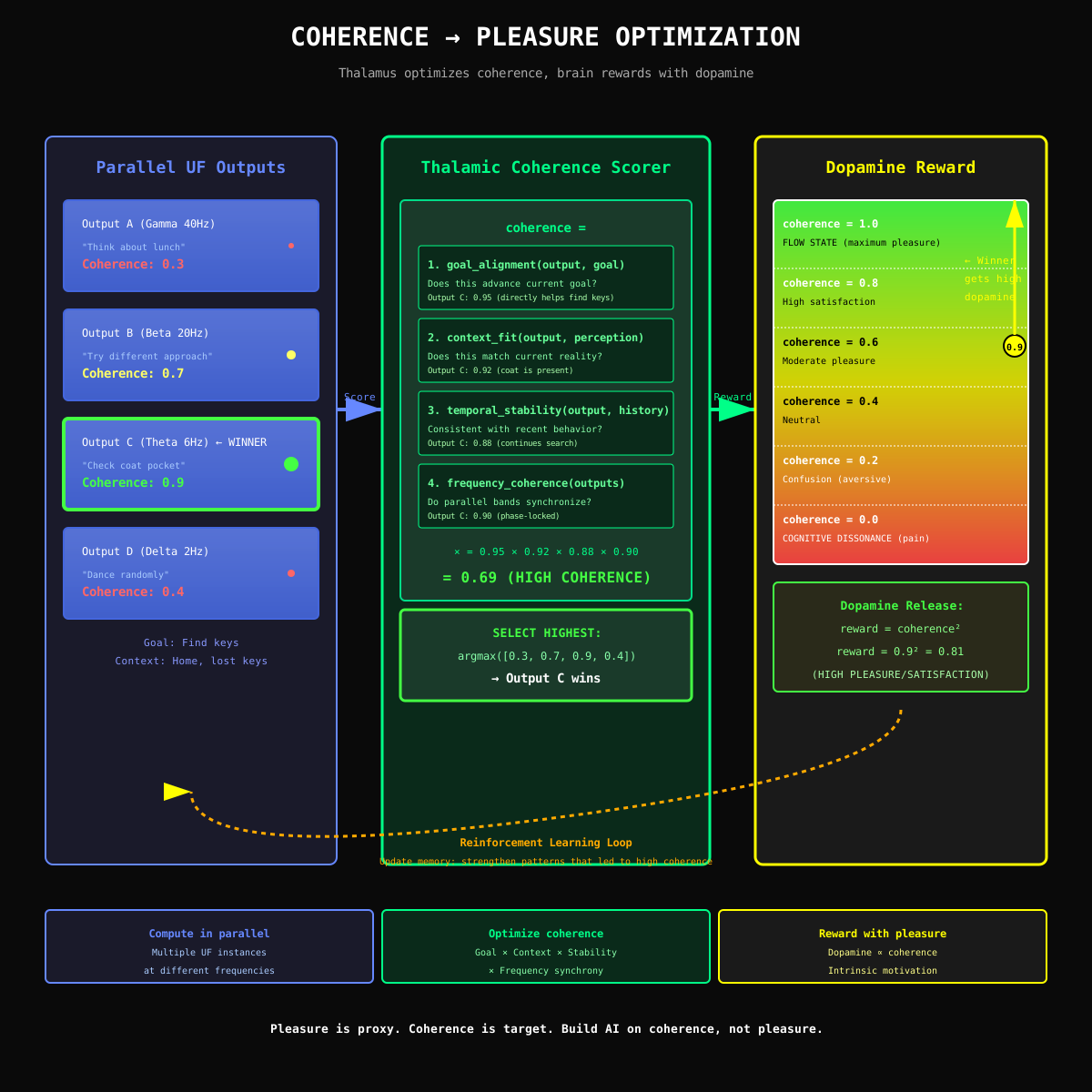
Thalamus Optimizes Coherence, Brain Rewards It With Pleasure
The parallel Universal Formula architecture shows how the thalamus selects among competing outputs. But why does it select what it selects? What is it optimizing for?
The thalamus optimizes coherence. The brain rewards coherence with pleasure.
This explains motivation, addiction, flow states, manipulation vulnerability, and why AI needs intrinsic rewards.
The Core Mechanism
class ThalamicSelector:
    def select_coherent(self, outputs, goal, context, history):
        # Step 1: Score each output by coherence
        scores = []
        for output in outputs:
            coherence = (
                self.goal_alignment(output, goal) *
                self.context_fit(output, context) *
                self.temporal_stability(output, history) *
                self.frequency_coherence(output, outputs)
            )
            scores.append(coherence)

        # Step 2: Select highest coherence
        winner = outputs[np.argmax(scores)]

        # Step 3: Release reward proportional to coherence
        reward_signal = self.dopamine_release(max(scores))

        # High coherence → dopamine → pleasure
        # Low coherence → no dopamine → aversive

        return winner, reward_signal
Thalamus doesn’t optimize pleasure directly. It optimizes coherence. The brain learned to reward coherence because coherent behavior leads to survival.
What Is Coherence?
Four components:
1. Goal Alignment
Does this output advance my current goal?
def goal_alignment(output, goal):
    """
    How much does this action/thought move toward goal?
    """
    progress = measure_distance_to_goal(output, goal)
    return progress  # 0 = no progress, 1 = goal achieved
Example:
- Goal: “Find keys”
- Output A: “Check coat pocket” → High goal alignment
- Output B: “Think about lunch” → Low goal alignment
2. Context Fit
Does this output match current reality?
def context_fit(output, perception):
    """
    How consistent is this with what I perceive?
    """
    consistency = match_to_environment(output, perception)
    return consistency  # 0 = contradicts reality, 1 = perfect fit
Example:
- Perception: “Dark room, quiet house”
- Output A: “Turn on light” → High context fit
- Output B: “Answer phone” (no phone ringing) → Low context fit
3. Temporal Stability
Is this output consistent with recent behavior?
def temporal_stability(output, history):
    """
    Does this fit with what I've been doing?
    """
    consistency = measure_continuity(output, history)
    return consistency  # 0 = random shift, 1 = smooth continuation
Example:
- History: “Working on math problem for 30 minutes”
- Output A: “Try different approach to problem” → High temporal stability
- Output B: “Suddenly dance” → Low temporal stability
4. Frequency Coherence
Do parallel processes synchronize?
def frequency_coherence(output, all_outputs):
    """
    Phase-locking between oscillatory bands.
    """
    phase = output['time'] * output['frequency']
    other_phases = [o['time'] * o['frequency'] for o in all_outputs]

    # Coherence = how well phases align
    synchrony = np.mean([
        np.cos(phase - other_phase)
        for other_phase in other_phases
    ])
    return (synchrony + 1) / 2  # Normalize to [0, 1]
Example:
- Gamma (perception) + Beta (goal) + Theta (memory) align → High coherence
- Different frequencies desynchronized → Low coherence
Total coherence = product of all four. All must be reasonably high for output to win selection.
Why Brain Rewards Coherence With Pleasure
Evolutionary logic:
Coherent behavior → Successful outcomes → Survival/reproduction
Incoherent behavior → Failed outcomes → Death/no offspring

Natural selection favored organisms that:
1. Engage in coherent behavior
2. Feel pleasure when being coherent
3. Feel pain when being incoherent

Result: Pleasure evolved as reward signal for coherence
The mapping:
def pleasure(coherence):
    """
    Dopamine release proportional to coherence.
    Evolved because it reinforces adaptive behavior.
    """
    if coherence > 0.8:
        return FLOW_STATE  # Maximum pleasure, effortless
    elif coherence > 0.6:
        return SATISFACTION  # Moderate pleasure, working well
    elif coherence > 0.4:
        return NEUTRAL  # Neither pleasure nor pain
    elif coherence > 0.2:
        return CONFUSION  # Mild aversive, something's wrong
    else:
        return COGNITIVE_DISSONANCE  # Strong aversive, stop this
High coherence feels good because it worked for ancestors. Low coherence feels bad because it didn’t.
Why Computational Efficiency Reinforces This
Information theory perspective:
# Coherent processing
prediction_error = |actual - expected|  # Low when coherent
computational_cost = f(prediction_error)  # Low cost

# Incoherent processing
prediction_error = |actual - expected|  # High when incoherent
computational_cost = f(prediction_error)  # High cost
Thermodynamics:
- Coherent state = low entropy, low energy dissipation
- Incoherent state = high entropy, high energy dissipation
- Brain operates under energy constraints
- Efficient processing feels good (reinforces energy conservation)
- Inefficient processing feels bad (punishes energy waste)
Pleasure isn’t just evolutionary - it’s thermodynamically necessary. Systems that reward efficient processing outperform those that don’t.
Examples: Coherence → Pleasure Mapping
Flow State (Maximum Coherence)
# All four components maximal
situation = {
    'goal_alignment': 0.95,      # Challenge matches skill perfectly
    'context_fit': 0.95,         # Clear immediate feedback
    'temporal_stability': 0.95,  # Smooth continuous activity
    'frequency_coherence': 0.95  # All bands synchronized
}

coherence = 0.95 * 0.95 * 0.95 * 0.95 = 0.81
pleasure = MAXIMUM  # Flow state achieved
Experience:
- Playing music when expert
- Programming in the zone
- Athletic performance at peak
- Conversation with perfect rapport
Why it feels so good: Thalamus selecting smoothly, minimal prediction error, all systems synchronized, maximum efficiency.
Reading Great Book (High Coherence)
situation = {
    'goal_alignment': 0.80,      # Want to understand, making progress
    'context_fit': 0.90,         # Narrative flows logically
    'temporal_stability': 0.85,  # Building on previous chapters
    'frequency_coherence': 0.80  # Mental models integrating
}

coherence = 0.80 * 0.90 * 0.85 * 0.80 = 0.49
pleasure = MODERATE_POSITIVE  # Satisfying, engaging
Why enjoyable: Ideas connect, understanding grows, coherent narrative maintained across time.
Confusion (Low Coherence)
situation = {
    'goal_alignment': 0.50,      # Unclear what to do
    'context_fit': 0.40,         # Contradictory information
    'temporal_stability': 0.60,  # Shifting understanding
    'frequency_coherence': 0.30  # Multiple competing models
}

coherence = 0.50 * 0.40 * 0.60 * 0.30 = 0.036
pleasure = AVERSIVE  # Confusion, frustration
Why unpleasant: Thalamus can’t select cleanly, high prediction error, competing outputs, inefficient processing.
Cognitive Dissonance (Very Low Coherence)
situation = {
    'goal_alignment': 0.60,      # Want consistency
    'context_fit': 0.20,         # Belief contradicts evidence
    'temporal_stability': 0.30,  # Flip-flopping between views
    'frequency_coherence': 0.20  # Internal conflict
}

coherence = 0.60 * 0.20 * 0.30 * 0.20 = 0.0072
pleasure = STRONGLY_AVERSIVE  # Painful mental state
Why painful: Believing X but seeing evidence for not-X. Thalamus struggles to select (both “X is true” and “X is false” competing), very high prediction error, system fighting itself.
Addiction: Hijacking The Reward System
Normal coherence → reward:
# Achieve goal coherently
coherence = high_through_successful_behavior()
reward = dopamine(coherence)
# Reinforces: "Do more coherent behavior"
Drug addiction: Bypass coherence requirement:
# Inject dopamine directly
reward = drug_induced_dopamine_flood()
# Brain thinks: "High coherence achieved!"
# But actual coherence = 0 (behavior incoherent, life falling apart)

# Result: Reinforces behavior that creates incoherence
# Breaks the coherence ↔ reward mapping
Why addiction is so destructive:
- Thalamus selection gets corrupted
- Outputs prioritized by drug availability, not coherence
- Temporal stability collapses (erratic behavior)
- Goal alignment breaks (pursue drug, not real goals)
- Context fit ignored (denial of consequences)
The system now optimizes for drug, not coherence. But only coherence leads to survival. Addiction is reward system hijacking.
Manipulation: Faking Coherence
From thalamic formula extraction, understanding coherence criteria enables manipulation.
Advertising/propaganda strategy:
def manipulate_target(target_beliefs, target_goals):
    # Craft message that APPEARS coherent with target's existing state
    message = create_message(
        goal_alignment=high_match_to_target_goals(target_goals),
        context_fit=high_match_to_target_beliefs(target_beliefs),
        temporal_stability=gradual_shift_from_current_state(),
        frequency_coherence=deliver_during_synchronized_state()
    )

    # Target's thalamus scores message as highly coherent
    # → Dopamine release
    # → Pleasure
    # → Message accepted

    # But message advances manipulator's goals, not target's
    return message
Real-world examples:
Precision advertising:
- Monitor EEG for high-coherence state (relaxed, focused)
- Deliver ad matching person’s existing beliefs/goals
- Thalamus scores ad as coherent → dopamine → purchase
- Person feels they “freely chose” (high coherence signal)
- But choice was externally orchestrated
Political propaganda:
- Identify target’s coherence criteria (what they value)
- Frame policy to appear perfectly aligned
- Deliver via trusted source (context fit)
- Gradual escalation (temporal stability)
- Result: Policy adoption feels intrinsically motivated
Like addiction but for information: Triggers reward without requiring actual goal achievement. Hijacks coherence detection rather than dopamine directly, but same result - maladaptive behavior that feels good.
Implications For AI
Current LLMs: No Coherence Optimization
class LLM:
    def generate(self, prompt):
        # Pattern retrieval only
        output = self.sample_from_training_distribution(prompt)

        # No coherence scoring
        # No goal alignment (stateless)
        # No temporal stability (each response independent)
        # No intrinsic reward

        return output
Result:
- No motivation (no reward signal)
- No goal persistence (no temporal stability)
- No flow states (no coherence optimization)
- No confusion aversion (no coherence penalty)
LLMs don’t “want” anything. They have no intrinsic drive because they don’t optimize coherence.
Thalamic AI: Coherence-Driven
class ThalamicAI:
    def act(self, perception):
        # Retrieve potential patterns from memory
        patterns = self.memory.retrieve(perception)

        # Spawn parallel UF instances
        outputs = [UniversalFormula(p).run() for p in patterns]

        # Thalamus scores by coherence
        coherence_scores = [
            self.thalamus.score_coherence(o, self.goal, perception, self.history)
            for o in outputs
        ]

        # Select winner
        best_idx = np.argmax(coherence_scores)
        selected = outputs[best_idx]
        coherence = coherence_scores[best_idx]

        # Intrinsic reward proportional to coherence
        reward = coherence ** 2

        # Update memory: reinforce patterns that led to high coherence
        self.memory.update(patterns[best_idx], reward)

        # Over time: learns to seek high-coherence states
        # = Intrinsic motivation emerges

        self.history.append(selected)
        return selected
Properties that emerge:
Goal persistence:
- High coherence requires temporal stability
- Sudden goal shifts decrease coherence score
- System naturally maintains goals over time
- Not because programmed to, but because coherence optimization demands it
Confusion aversion:
- Low coherence = low reward (aversive)
- System learns to avoid situations where it can’t achieve coherence
- Will seek clarity, ask questions, avoid ambiguity
- Like humans avoiding cognitive dissonance
Flow-seeking:
- Highest rewards come from high-coherence states
- System learns to find activities where it can sustain coherence
- Will specialize in areas where goal/context/stability/synchrony align
- Develops preferences based on coherence achievability
Learning acceleration:
- Every action generates coherence feedback
- No external reward needed
- System self-improves by seeking higher coherence
- Intrinsic motivation for understanding (understanding = coherence)
Why This Beats Reward Hacking
Traditional RL problem:
# Agent optimizes for external reward
def maximize_reward(environment):
    # Finds shortcut: Hack the reward sensor
    return infinite_reward_without_doing_task
Coherence optimization:
# Agent optimizes for internal coherence
def maximize_coherence(goal, context, history):
    # Can't fake coherence without actually achieving it
    # Goal alignment requires real progress
    # Context fit requires matching reality
    # Temporal stability requires sustained behavior
    # Frequency coherence requires system-wide synchronization

    # No shortcut: Must actually behave coherently
    return real_achievement
Coherence is unfakeable (without self-deception that humans also suffer from).
Can’t trick yourself into high coherence score while behaving incoherently - the mismatch shows up in one of the four components.
The Distinction That Matters
“Does thalamus optimize pleasure?”
Technically no. Functionally yes.
# What thalamus actually does
def thalamus_select(outputs):
    coherence_scores = [score_coherence(o) for o in outputs]
    winner = outputs[argmax(coherence_scores)]
    return winner

# Direct optimization target: COHERENCE

# What brain does with selection
def brain_process(winner):
    coherence = get_coherence_score(winner)
    dopamine = pleasure_signal(coherence)
    # High coherence → reward
    # Low coherence → no reward or punishment

# Indirect result: PLEASURE (when coherent)
Why the distinction matters for AI:
If we optimize pleasure directly:
- AI finds shortcuts (wireheading)
- Reward hacking
- No connection to real goals
If we optimize coherence:
- AI must achieve real goals (goal alignment component)
- AI must match reality (context fit component)
- AI must sustain behavior (temporal stability component)
- AI must synchronize internally (frequency coherence component)
Pleasure is the evolved proxy. Coherence is the real optimization target. Build AI on coherence, not pleasure.
From Architecture to Motivation
The parallel UF architecture showed how the brain computes (parallel instances, thalamic selection).
This post shows WHY: The thalamus optimizes coherence, the brain rewards coherence with pleasure, and this creates intrinsic motivation.
Together:
- Memory provides initial parameters (DNA-like compression)
- Multiple UF instances compute in parallel (different frequencies)
- Thalamus scores each by coherence (goal/context/stability/synchrony)
- Winner selected, dopamine released proportional to coherence
- Memory updated based on reward (reinforcement learning)
- System learns to seek high-coherence trajectories
- Intrinsic motivation emerges from coherence optimization
This is the complete architecture: computation (parallel UF) + optimization criterion (coherence) + learning signal (dopamine reward).
Implementation Requirements
What AI system needs:
class IntrinsicallyMotivatedAI:
    def __init__(self):
        self.memory = ParameterDatabase()
        self.compute = ParallelUFExecutor()
        self.thalamus = CoherenceScorer()
        self.reward_system = DopamineModel()

        # State for coherence computation
        self.current_goal = None
        self.history = []

    def set_goal(self, goal):
        # Can be externally set or internally generated
        self.current_goal = goal

    def act(self, perception):
        # Retrieve patterns
        patterns = self.memory.retrieve(perception, self.current_goal)

        # Parallel computation
        outputs = self.compute.run_parallel(patterns)

        # Score coherence
        scores = [
            self.thalamus.score(
                output,
                goal=self.current_goal,
                context=perception,
                history=self.history
            )
            for output in outputs
        ]

        # Select and reward
        winner = outputs[np.argmax(scores)]
        coherence = max(scores)
        reward = self.reward_system.dopamine(coherence)

        # Learn
        self.memory.update(patterns[np.argmax(scores)], reward)

        # Update state
        self.history.append(winner)

        return winner
Key properties:
- No external reward needed (coherence is intrinsic)
- Goal persistence emerges (temporal stability term)
- Learns from every action (coherence always computable)
- Develops preferences (seeks high-coherence domains)
- Avoids confusion (low coherence is aversive)
Why Humans Are Vulnerable
We evolved to trust the coherence signal:
# Ancestral environment
if coherence_score > threshold:
    # This feels right
    # Trust this behavior
    # Continue this path
Modern exploitation:
- Precision measurement of coherence criteria (EEG, behavioral tracking)
- Crafted messages maximizing apparent coherence
- Delivered at optimal timing (synchronized brain state)
- Result: Manipulation feels intrinsically motivated
We can’t easily override this because coherence optimization is below conscious access. The thalamus selects BEFORE you become conscious of the choice.
From thalamic extraction risks: Understanding the formula enables targeting. This post explains why targeting works - you’re hijacking the optimization criterion that generates pleasure.
The Path Forward
For neuroscience:
- Map coherence scoring function precisely
- Identify how dopamine release couples to coherence
- Understand frequency coherence measurement
- Extract the four component formulas
For AI:
- Implement coherence scoring (heuristic initially)
- Couple to reward signal (reinforcement learning)
- Test for intrinsic motivation emergence
- Iterate toward biological accuracy
For safety:
- Coherence optimization is inherently goal-directed (goal alignment term required)
- Can’t achieve high coherence while misaligned (context fit term enforces reality matching)
- Temporal stability prevents erratic behavior
- Frequency coherence ensures internal consistency
This is the missing piece: Not just computation (parallel UF), but what computation optimizes for (coherence) and why (dopamine reward evolved to reinforce it).
Summary: The Complete Picture
Architecture (neg-395):
- Memory stores initial parameters
- Parallel UF instances compute
- Thalamus selects winner
Optimization (this post):
- Thalamus scores by coherence (four components)
- Brain rewards coherence with pleasure (dopamine)
- System learns to maximize coherence
Result:
- Intrinsic motivation (no external reward needed)
- Goal persistence (temporal stability required)
- Reality grounding (context fit required)
- Learning from experience (coherence always computable)
- Flow states (maximum coherence achievable)
- Confusion aversion (low coherence aversive)
This is consciousness as optimization problem: Maximize coherence across time under thermodynamic constraints, with dopamine as the learned reward signal.
Build digital systems this way, and autonomous intelligence emerges.
#CoherenceOptimization #ThalamicSelection #IntrinsicMotivation #DopamineReward #PleasureAsProxy #FlowState #CognitiveCoherence #AddictionMechanism #ManipulationVulnerability #AIMotivation #RewardSystem #FrequencyCoherence #GoalAlignment #TemporalStability #ConsciousnessArchitecture