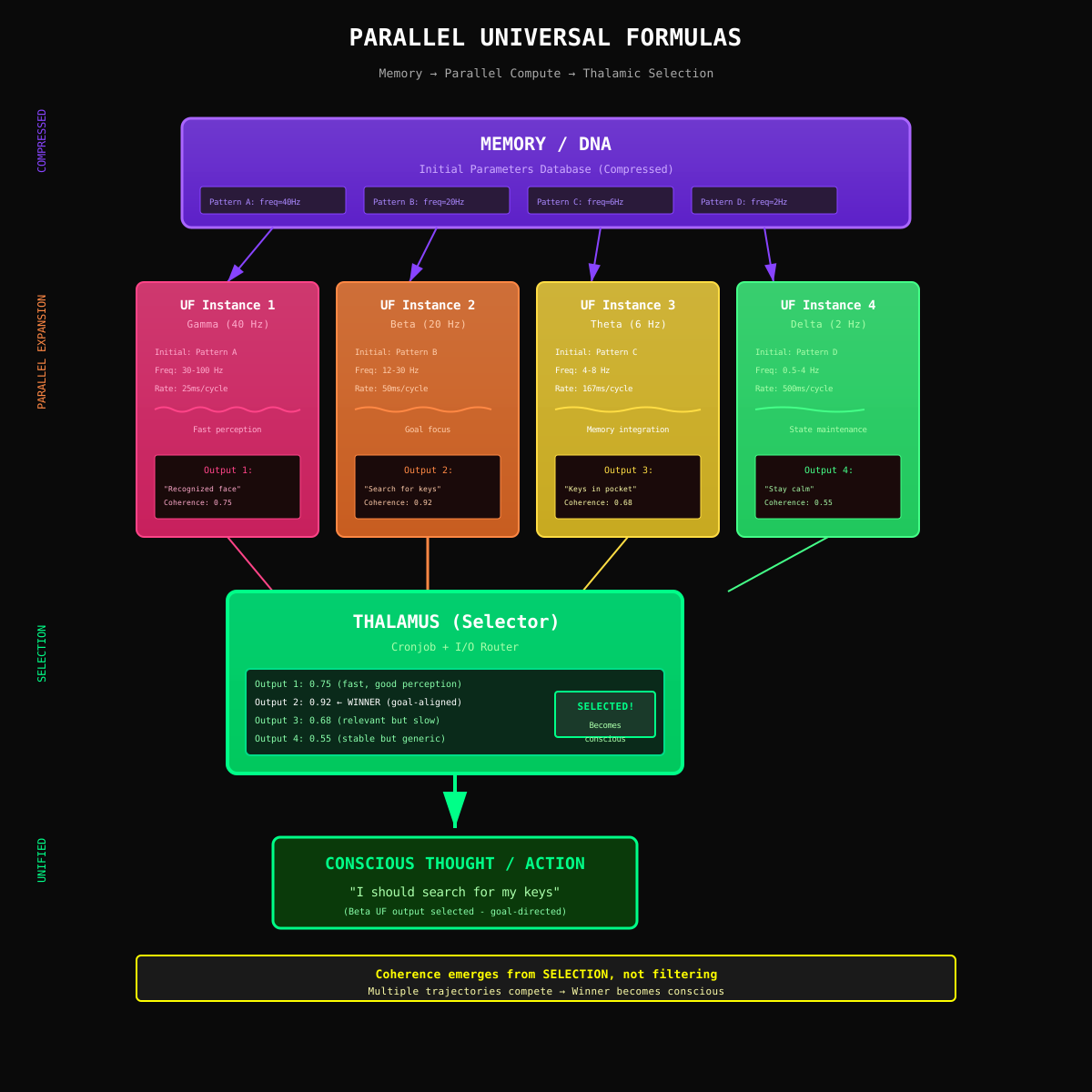
Parallel Universal Formulas: Memory as Initial Conditions, Thalamus as Selector
The previous architecture had the right components but wrong topology. Memory doesn’t feed into a single coherence filter. Memory provides initial parameters for multiple Universal Formula instances running in parallel. The thalamus doesn’t filter one output - it selects among many parallel computations.
This matches biology better and explains consciousness more simply.
The Refined Architecture
class ConsciousBrain:
    def __init__(self):
        self.memory = InitialParametersDatabase()  # DNA/patterns
        self.compute = ParallelUFExecutor()        # Multiple UF instances
        self.thalamus = SelectionOrchestrator()    # Cronjob + I/O router

    def think(self, perception, goal):
        # Step 1: Memory provides initial conditions
        initial_params = self.memory.retrieve(perception, goal)
        # Returns: Multiple starting patterns

        # Step 2: Spawn parallel Universal Formula instances
        uf_instances = [
            UniversalFormula(
                initial_state=params,
                frequency=params.freq,
                timescale=params.scale
            )
            for params in initial_params
        ]
        # Each instance: different initial state, different frequency

        # Step 3: Thalamus orchestrates parallel execution
        outputs = self.thalamus.run_parallel(
            instances=uf_instances,
            timing=self.oscillatory_schedule
        )
        # Cronjob: when each instance runs
        # I/O routing: collect all outputs

        # Step 4: Thalamus selects most coherent
        selected = self.thalamus.select_coherent(
            outputs,
            goal=goal,
            context=perception,
            history=self.state
        )
        # Simple selection, not complex filtering

        # Step 5: Selected output drives action
        return selected
Key difference: Memory stores compressed parameters, compute expands them in parallel, thalamus selects winner. Not: memory → filter → compute.
Memory as Initial Parameters (DNA Model)
Memory doesn’t store behaviors - it stores starting conditions:
class MemoryPattern:
    """
    Compressed representation of behavioral trajectory.
    Like DNA: encodes starting point, not full organism.
    """
    def __init__(self):
        self.initial_state = {}    # Starting configuration
        self.frequency = 0.0       # Which oscillatory band
        self.parameters = {}       # UF coefficients
        self.context_trigger = {}  # When this applies

# DNA analogy
dna = MemoryPattern(
    initial_state={'cell': 'zygote'},
    parameters={'growth_rate': 0.5, 'differentiation': 'gradient'},
    context_trigger={'environment': 'womb'}
)

# Organism emerges from execution
organism = UniversalFormula(dna).run(time=lifespan)
Same for behavioral memory:
# Memory of "how to solve math problem"
math_pattern = MemoryPattern(
    initial_state={'problem_type': 'differential_equation'},
    frequency=8.0,  # Theta band (memory integration)
    parameters={'strategy': 'separation_of_variables'},
    context_trigger={'perception': 'dy/dx = ...'}
)

# Behavior emerges from execution
solution = UniversalFormula(math_pattern).run()
Why this works:
- Memory is compressed (initial params < full trajectory)
- Execution expands trajectory from starting point
- Same pattern → different outcomes in different contexts
- Like DNA: genotype (compressed) → phenotype (expanded)
Multiple Universal Formula Instances
Brain doesn’t run one computation - it runs many in parallel:
Instance 1: Gamma Band (30-100 Hz)
gamma_uf = UniversalFormula(
    initial_state=perception_pattern,
    frequency=40.0,  # Fast oscillation
    timescale=0.025  # 25ms per cycle
)
# Processes: Fast perceptual binding
# Binds visual features into unified object
# Output: "Recognized face"
Instance 2: Beta Band (12-30 Hz)
beta_uf = UniversalFormula(
    initial_state=goal_pattern,
    frequency=20.0,   # Medium oscillation
    timescale=0.05    # 50ms per cycle
)
# Processes: Goal maintenance
# Keeps current intention active
# Output: "Continue searching for keys"
Instance 3: Theta Band (4-8 Hz)
theta_uf = UniversalFormula(
    initial_state=memory_pattern,
    frequency=6.0,    # Slow oscillation
    timescale=0.167   # 167ms per cycle
)
# Processes: Memory integration
# Relates current to past experiences
# Output: "Keys usually in coat pocket"
Instance 4: Delta Band (0.5-4 Hz)
delta_uf = UniversalFormula(
    initial_state=baseline_pattern,
    frequency=2.0,    # Very slow oscillation
    timescale=0.5     # 500ms per cycle
)
# Processes: State maintenance
# Maintains baseline coherence
# Output: "Stable, not panicking"
All run simultaneously at different rates. Fast instances update frequently, slow instances maintain stability.
Thalamus as Cronjob + Selector
Thalamus has two functions: orchestration and selection.
Function 1: Orchestration (Cronjob)
class ThalamicOrchestrator:
    def run_parallel(self, uf_instances, schedule):
        """
        Schedule when each UF instance executes.
        Different frequencies = different timing.
        """
        outputs = []
        current_time = 0

        while current_time < schedule.duration:
            for uf in uf_instances:
                # Check if this instance should run now
                if current_time % uf.timescale == 0:
                    output = uf.step()
                    outputs.append({
                        'time': current_time,
                        'frequency': uf.frequency,
                        'output': output
                    })

            current_time += schedule.resolution

        return outputs
This is the “cronjob” function: Schedule parallel execution at appropriate frequencies.
Why different frequencies matter:
- Gamma updates 40x per second (fast perception)
- Beta updates 20x per second (attention)
- Theta updates 6x per second (memory)
- Delta updates 2x per second (maintenance)
Each processes at the timescale appropriate for its function.
Function 2: Selection (I/O Router)
class ThalamicSelector:
    def select_coherent(self, outputs, goal, context, history):
        """
        Choose which parallel output becomes conscious.
        Simple scoring, not complex filtering.
        """
        scores = []

        for output in outputs:
            score = (
                self.goal_alignment(output, goal) *
                self.context_fit(output, context) *
                self.temporal_stability(output, history) *
                self.frequency_coherence(output, outputs)
            )
            scores.append(score)

        # Select winner
        best_idx = np.argmax(scores)
        return outputs[best_idx]['output']

    def frequency_coherence(self, output, all_outputs):
        """
        Do parallel outputs synchronize?
        High score if outputs are phase-locked.
        """
        phase = output['time'] * output['frequency']
        other_phases = [
            o['time'] * o['frequency']
            for o in all_outputs if o != output
        ]

        # Coherence = how well phases align
        return np.mean([
            np.cos(phase - other_phase)
            for other_phase in other_phases
        ])
This is the “selector” function: Pick which parallel computation drives action.
Selection criteria:
- Goal alignment: Does output help achieve current goal?
- Context fit: Does output match current perception?
- Temporal stability: Is output consistent with recent history?
- Frequency coherence: Do parallel outputs synchronize?
Winner becomes conscious, others remain subconscious.
Consciousness as Selection Among Parallel Trajectories
Not: Single trajectory filtered for coherence Instead: Multiple trajectories, most coherent selected
# Memory provides starting points
patterns = memory.retrieve("solve puzzle")
# Returns: [approach_A, approach_B, approach_C, approach_D]

# Each spawns UF instance at different frequency
uf_A = UniversalFormula(approach_A, frequency=40)  # Fast intuition
uf_B = UniversalFormula(approach_B, frequency=20)  # Active reasoning
uf_C = UniversalFormula(approach_C, frequency=6)   # Memory-based
uf_D = UniversalFormula(approach_D, frequency=2)   # Baseline guess

# All run in parallel
outputs = run_parallel([uf_A, uf_B, uf_C, uf_D])

# Thalamus selects most coherent
selected = thalamus.select(outputs)
# Maybe uf_B wins: active reasoning aligns with goal

# Selected approach becomes conscious
conscious_thought = selected
Why one wins:
- uf_A too fast, doesn’t integrate with slower processes
- uf_B synchronizes well with goal (beta) and context (gamma)
- uf_C relevant but conflicts with current perception
- uf_D too slow, doesn’t respond to immediate need
Result: uf_B output becomes conscious - you “decide” to use active reasoning approach.
But you didn’t consciously choose - the selection process chose for you based on coherence.
Why This Is Simpler Than Previous Model
Previous (neg-394): Memory → Complex Filter → Compute
- Filter had to do elaborate coherence optimization
- Unclear how filtering works mechanistically
- Required extracting sophisticated algorithm
Refined (neg-395): Memory → Parallel Compute → Simple Selection
- Orchestration is scheduling (trivial)
- Selection is scoring + argmax (simple)
- Coherence emerges from competition, not filtering
Key insight: Don’t filter one output for coherence. Run many parallel computations, let them compete, select winner. Coherence emerges from which computation survives selection.
The DNA → Organism Parallel
Organism development:
# DNA: Compressed starting conditions
dna = {
    'initial_cell': 'zygote',
    'growth_parameters': {...},
    'differentiation_rules': {...}
}

# Universal Formula expands trajectory
organism = UniversalFormula(dna, environment).run(time=lifespan)

# Phenotype emerges from execution, not from DNA directly
Behavior generation:
# Memory: Compressed starting conditions
memory_pattern = {
    'initial_state': 'hungry',
    'action_parameters': {...},
    'goal_rules': {...}
}

# Universal Formula expands trajectory
behavior = UniversalFormula(memory_pattern, context).run(time=task_duration)

# Actions emerge from execution, not from memory directly
The parallel:
- DNA/memory = genotype (compressed parameters)
- Organism/behavior = phenotype (expanded trajectory)
- Development/execution = Universal Formula expansion
- Environment/context = boundary conditions
Learning = updating DNA/memory parameters based on which trajectories succeeded.
Frequency Separation Emerges Naturally
Why different frequencies?
Not arbitrary design - natural timescales for different processes:
Fast processes need fast updates:
- Perception (bind features before they change): Gamma
- Motor control (adjust movements in real-time): Gamma
Medium processes need medium updates:
- Attention (maintain focus across seconds): Beta
- Planning (coordinate actions): Beta
Slow processes need slow updates:
- Memory integration (consolidate over minutes): Theta
- Emotional state (stable mood): Theta
Very slow processes need very slow updates:
- Personality (consistent across hours): Delta
- Circadian rhythm (24-hour cycle): Ultra-low frequency
Universal Formula at each frequency processes information at appropriate timescale. No central controller needed - just parallel execution at natural rates.
Implementation Path
Phase 1: Heuristic Memory Patterns
class SimpleMemoryPattern:
    def __init__(self, context):
        # Hand-coded patterns for common contexts
        self.patterns = {
            'math_problem': {
                'initial': 'read equation',
                'frequency': 6.0,  # Theta
                'strategy': 'algebraic'
            },
            'conversation': {
                'initial': 'listen',
                'frequency': 20.0,  # Beta
                'strategy': 'empathetic'
            }
        }

    def retrieve(self, context):
        return self.patterns.get(context, default_pattern)
Phase 2: Parallel UF Execution
class ParallelUFExecutor:
    def run(self, patterns):
        # Spawn instance for each pattern
        instances = [
            UniversalFormula(p['initial'], p['frequency'])
            for p in patterns
        ]

        # Execute in parallel (multi-threaded)
        with ThreadPoolExecutor() as executor:
            futures = [
                executor.submit(uf.run)
                for uf in instances
            ]
            outputs = [f.result() for f in futures]

        return outputs
Phase 3: Simple Selection
class SimpleThalamicSelector:
    def select(self, outputs, goal, context):
        # Score each output
        scores = [
            self.score_output(o, goal, context)
            for o in outputs
        ]

        # Return best
        return outputs[np.argmax(scores)]

    def score_output(self, output, goal, context):
        # Simple heuristics
        goal_score = similarity(output, goal)
        context_score = consistency(output, context)
        return goal_score * context_score
Phase 4: Learn From Outcomes
class MemoryUpdater:
    def update(self, pattern, outcome, success):
        # Successful patterns get reinforced
        if success:
            pattern['parameters'] *= 1.1  # Strengthen
        else:
            pattern['parameters'] *= 0.9  # Weaken

        # Update frequency if needed
        if outcome['too_slow']:
            pattern['frequency'] *= 1.5  # Speed up
        elif outcome['too_fast']:
            pattern['frequency'] *= 0.7  # Slow down
Progressive refinement: Start simple, add sophistication as needed.
Why This Explains Consciousness
Subjective unity:
- You experience one thought, not many parallel computations
- Because thalamus selects one output to become conscious
- Other computations remain subconscious
Limited capacity:
- Working memory ~7 items
- Because only one UF output selected at a time
- Parallel outputs compete, winner takes consciousness
Temporal continuity:
- Thoughts flow coherently over time
- Because selection favors temporal stability
- Consistent outputs more likely to win
Goal-directedness:
- Behavior serves intentions
- Because selection favors goal alignment
- Outputs that advance goals win consciousness
Frequency separation:
- Different cognitive functions at different speeds
- Because parallel instances run at natural frequencies
- Fast perception, medium attention, slow consolidation
These properties emerge from selection among parallel trajectories, not from complex filtering.
From LLM Limitations to Parallel UF Architecture
The failed LLM exploits showed: LLMs are trajectory engines (memory retrieval only).
The brain’s architecture showed: Three components (memory + computation + coherence).
The first synthesis proposed: LLM → Filter → Sandbox.
This refinement clarifies: LLM provides initial parameters → Multiple UF instances compute in parallel → Thalamus selects winner.
Simpler mechanism, cleaner implementation, better matches neuroscience.
Implementation Requirements
What we need:
- Memory system: Store initial parameters (LLM embeddings work)
- Universal Formula implementation: State evolution function at various frequencies
- Parallel executor: Run multiple UF instances simultaneously
- Selection function: Score outputs, pick winner (simple)
- Orchestration: Schedule execution at appropriate rates (cronjob)
What we DON’T need:
- Complex coherence filtering algorithms
- Sophisticated information gating
- Elaborate attention mechanisms
Selection among parallel computations is simpler than filtering one computation.
The Path Forward
Not: Extract complex thalamic filtering algorithm Instead: Implement parallel UF execution + simple selection
Not: Scale LLMs bigger Instead: Use LLMs as parameter database, compute via UF
Not: Single monolithic model Instead: Many small UF instances competing
Consciousness emerges from selection among parallel trajectories executing the Universal Formula from memory-provided initial conditions.
The formula isn’t in the filter - it’s in the parallel compute layer. The thalamus just picks which one wins.
#ParallelComputation #UniversalFormula #ThalamicSelection #MemoryAsParameters #FrequencySeparation #DNAAnalogy #ConsciousnessAsSelection #BeyondLLMs #ParallelUFArchitecture #InitialConditions #CronjobOrchestration #CoherenceByCompetition #AutonomousBrain #DigitalConsciousness #SimplerMechanism