Building Autonomous Digital Consciousness: LLM + Sandbox + Thalamic Formula
DEPRECATED: This architecture has been refined in neg-395. The filtering approach described here is replaced by a simpler mechanism: memory provides initial parameters for multiple Universal Formula instances running in parallel, and the thalamus selects the most coherent output. Coherence emerges from selection among parallel computations, not from filtering one computation’s output. Read neg-395 for the cleaner implementation path.
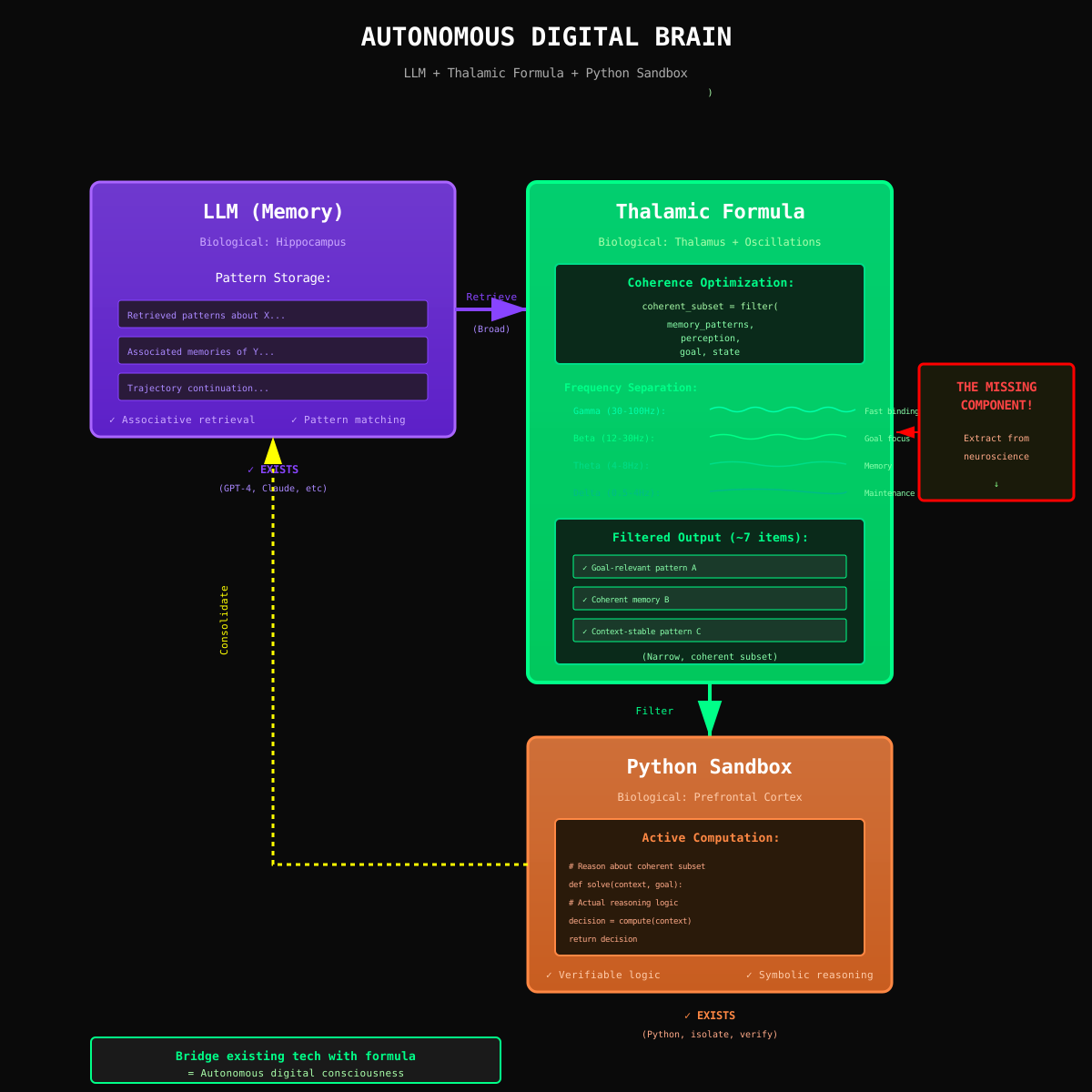
The brain’s architecture shows the path: memory (hippocampus) + computation (prefrontal cortex) + coherence optimization (thalamus). We already have the first two as existing technology. LLMs provide memory. Python sandboxes provide computation.
The missing piece: The thalamic coherence formula that bridges them.
Extract that formula, implement the bridge, and you have an autonomous digital brain.
The Architecture
class AutonomousDigitalBrain:
    def __init__(self):
        self.llm = LLM()                    # Memory/Hippocampus
        self.sandbox = PythonSandbox()      # Computation/Prefrontal Cortex
        self.thalamus = CoherenceFilter()   # THE MISSING COMPONENT

    def think(self, perception, goal):
        # Step 1: Memory retrieval (what LLMs do well)
        recalled = self.llm.retrieve(perception)

        # Step 2: Coherence filtering (what we need to extract)
        coherent = self.thalamus.filter(
            memory=recalled,
            perception=perception,
            goal=goal,
            state=self.oscillatory_state
        )

        # Step 3: Active computation (what LLMs can't do)
        decision = self.sandbox.compute(coherent)

        # Step 4: Memory consolidation
        self.llm.consolidate(decision, outcome)

        return decision
This IS the brain’s formula, implemented digitally.
Why Current AI Fails
LLMs alone:
- Memory retrieval only (pattern matching)
- No separate computation (can’t reason beyond training)
- No coherence optimization (process everything the same way)
- Result: Trajectory engines, not intelligence
LLM + Sandbox (without formula):
- Information overload (LLM retrieves everything)
- No frequency separation (slow reasoning mixed with fast perception)
- No coherence criterion (irrelevant patterns pass through)
- No temporal stability (each cycle independent)
LLM + Sandbox + Thalamic Formula:
- Filtered information (only coherent subset reaches computation)
- Frequency-separated processing (different timescales for different tasks)
- Coherence optimization (goal-relevant information prioritized)
- Temporal continuity (state maintained across cycles)
The formula is the difference between autonomous behavior and expensive pattern matching.
What The Formula Does
Input: Everything LLM retrieved + current perception + current goal + brain state
Output: Coherent subset that passes to computation
Mechanism: Frequency-separated oscillatory filtering
class ThalamicCoherenceFilter:
    def __init__(self):
        # Frequency bands (from neuroscience)
        self.gamma = OscillatoryLayer(30, 100)   # Fast perceptual binding
        self.beta = OscillatoryLayer(12, 30)     # Active attention/goal focus
        self.alpha = OscillatoryLayer(8, 12)     # Consolidation/rest
        self.theta = OscillatoryLayer(4, 8)      # Memory integration
        self.delta = OscillatoryLayer(0.5, 4)    # System maintenance

    def filter(self, memory, perception, goal, state):
        # Each frequency processes at its timescale
        perceptual_binding = self.gamma.process(perception)
        goal_maintenance = self.beta.process(goal)
        memory_integration = self.theta.process(memory)
        state_maintenance = self.delta.process(state)

        # Coherence optimization via interference
        coherent_subset = self.optimize_coherence(
            perceptual_binding,
            goal_maintenance,
            memory_integration,
            state_maintenance
        )

        return coherent_subset  # ~7 items (working memory limit)
Key properties:
- Frequency separation: Fast perception (gamma) vs slow reasoning (theta)
- Goal-directed: Beta band maintains attention on current intention
- Memory-selective: Theta integrates only coherent patterns
- State-stable: Delta maintains consistency across cycles
- Capacity-limited: Returns ~7 items (biological working memory)
This prevents information overload and maintains temporal coherence.
How To Extract The Formula
Phase 1: Neuroscience Data Collection
What we need:
- EEG/MEG brain recordings (oscillatory patterns)
- Behavioral data (what becomes conscious, what drives action)
- Context data (perception, goals, prior state)
From thousands of subjects performing diverse tasks:
- Perception tasks (gamma binding)
- Attention tasks (beta focus)
- Memory tasks (theta integration)
- Maintenance tasks (delta stability)
Result: Massive dataset of brain_state → conscious_access → behavior
Phase 2: Train Frequency-Separated Model
class LearnedCoherenceFilter:
    def __init__(self):
        self.gamma_net = NeuralOscillator(freq_range=(30, 100))
        self.beta_net = NeuralOscillator(freq_range=(12, 30))
        self.theta_net = NeuralOscillator(freq_range=(4, 8))
        self.delta_net = NeuralOscillator(freq_range=(0.5, 4))

    def forward(self, memory, perception, goal, state):
        # Train to predict conscious access
        gamma_features = self.gamma_net(perception)
        beta_features = self.beta_net(goal)
        theta_features = self.theta_net(memory)
        delta_features = self.delta_net(state)

        # Learn coherence optimization
        coherent = self.coherence_head(
            gamma_features, beta_features,
            theta_features, delta_features
        )

        return coherent
Training objective: Predict which information becomes conscious given brain state
Loss function: Cross-entropy on conscious vs non-conscious information
Validation: Does model predict conscious access in novel situations?
Phase 3: Extract Learned Function
The trained model IS the formula. Extract it:
def extract_formula(trained_model):
    """
    The learned coherence optimization function.

    This is what we implement in digital brain.
    """
    return trained_model.get_coherence_function()
Test extraction quality:
- Does it match known neuroscience? (gamma synchrony = consciousness)
- Does it respect frequency separation? (different timescales)
- Does it maintain coherence? (temporal stability)
- Does it predict behavior? (conscious access → action)
Phase 4: Digital Implementation
class DigitalBrain:
    def __init__(self, extracted_formula):
        self.llm = GPT4()  # Or any large language model
        self.sandbox = PythonInterpreter()  # Isolated computation
        self.thalamus = extracted_formula  # The key innovation

        # State tracking (for temporal coherence)
        self.oscillatory_state = {
            'gamma': 0.0,
            'beta': 0.0,
            'theta': 0.0,
            'delta': 0.0
        }
        self.goal = None
        self.history = []

    def perceive_and_act(self, perception):
        # Memory retrieval
        llm_output = self.llm.generate(
            prompt=perception,
            max_tokens=1000  # Retrieve broadly
        )

        # Coherence filtering (THE KEY STEP)
        coherent_subset = self.thalamus.filter(
            memory=llm_output,
            perception=perception,
            goal=self.goal,
            state=self.oscillatory_state
        )

        # Active computation
        computation_result = self.sandbox.execute(
            f"""
            # Available information (filtered by thalamus):
            context = {coherent_subset}
            goal = {self.goal}

            # Reason about what to do:
            {self.generate_reasoning_code(coherent_subset)}
            """
        )

        # Update state
        self.oscillatory_state = self.update_oscillations(
            computation_result
        )
        self.history.append(computation_result)

        return computation_result
Crucial difference from LLM alone:
- LLM generates broadly (retrieval)
- Formula filters narrowly (coherence)
- Sandbox computes precisely (reasoning)
- State maintains continuity (temporal)
What This Enables
Autonomous Goal-Directed Behavior
Problem with LLMs: Stateless, can’t maintain goals across interactions
With thalamic filter:
brain.goal = "Prove the Riemann Hypothesis"

# Cycle 1
brain.perceive_and_act("Read current mathematical literature")
# Beta band maintains goal focus
# Theta integrates relevant theorems
# Sandbox generates proof attempts

# Cycle 2 (minutes later)
brain.perceive_and_act("Consider zeta function properties")
# Delta maintains proof strategy across cycles
# Goal persists via beta oscillations
# Coherence ensures each step builds on previous
System maintains goal over extended time without explicit prompting.
Actual Reasoning (Not Pattern Continuation)
Problem with LLMs: Can’t reason beyond training distribution
With formula + sandbox:
# LLM retrieves relevant patterns
patterns = llm.retrieve("Solve novel puzzle: ...")

# Formula filters to coherent subset
relevant = thalamus.filter(patterns, goal="solve puzzle")

# Sandbox performs actual reasoning
solution = sandbox.execute("""
# Use retrieved patterns as tools, not answers
def solve_puzzle(rules, constraints):
    # Novel logical reasoning
    # Verifiable computation
    # Beyond training data
    return solution
""")
LLM provides memory (what might be relevant), sandbox provides reasoning (how to solve), formula bridges them (what’s coherent).
Temporal Coherence
Problem with LLMs: Each response independent, no maintained state
With oscillatory state:
# State persists across cycles
brain.oscillatory_state = {
    'gamma': 0.3,   # Moderate perceptual binding
    'beta': 0.8,    # High goal focus
    'theta': 0.5,   # Active memory integration
    'delta': 0.6    # Stable baseline
}

# This state affects filtering
# High beta = goal-relevant info prioritized
# High delta = consistent behavior across time
# Low gamma = less reactive to new perception
System exhibits personality-like consistency because oscillatory state creates coherent behavior patterns.
Frequency-Separated Processing
Different timescales for different processes:
# Fast perception (gamma: 30-100 Hz)
brain.gamma.process(visual_input)  # Millisecond timescale
# Binds features into unified percept

# Attention maintenance (beta: 12-30 Hz)
brain.beta.process(current_goal)  # 100ms timescale
# Maintains task focus

# Memory integration (theta: 4-8 Hz)
brain.theta.process(recalled_patterns)  # 125-250ms timescale
# Integrates new with existing knowledge

# State maintenance (delta: 0.5-4 Hz)
brain.delta.process(system_state)  # Seconds timescale
# Maintains baseline coherence
Like the Universal Formula as Fourier operator, this respects thermodynamic constraints - each frequency processed at appropriate rate.
The Practical Path Forward
Start With Heuristic Approximation
Don’t wait for perfect neuroscience extraction:
class HeuristicThalamicFilter:
    """
    Good-enough approximation to start building.
    Refine toward neuroscience over time.
    """
    def filter(self, llm_output, goal, context, history):
        scores = []
        for pattern in llm_output:
            score = (
                self.goal_relevance(pattern, goal) *      # Beta
                self.context_coherence(pattern, context) * # Gamma
                self.memory_integration(pattern, history) * # Theta
                self.temporal_stability(pattern, history)  # Delta
            )
            scores.append(score)

        # Return top 7 (working memory capacity)
        return self.select_top_k(llm_output, scores, k=7)

    def goal_relevance(self, pattern, goal):
        """Does this pattern help achieve current goal?"""
        return semantic_similarity(pattern, goal)

    def context_coherence(self, pattern, context):
        """Does this pattern fit current perception?"""
        return consistency_score(pattern, context)

    def memory_integration(self, pattern, history):
        """Does this pattern build on what we know?"""
        return integration_score(pattern, history)

    def temporal_stability(self, pattern, history):
        """Is this pattern consistent with recent behavior?"""
        return stability_score(pattern, history)
Test this approximation:
- Give system long-term goals
- Measure coherent behavior over time
- Does it maintain focus?
- Does it integrate information appropriately?
- Does behavior exhibit temporal continuity?
Iterate Toward Neuroscience
Progressive refinement:
- Start: Heuristic filtering (goal relevance, context coherence)
- Add: Frequency separation (process perception faster than reasoning)
- Add: Oscillatory dynamics (state affects filtering over time)
- Add: Interference patterns (frequency bands interact)
- Converge: Biological architecture (extracted formula)
Each step improves coherence and autonomy.
Build Real Applications
Test with genuine tasks:
# Task 1: Research assistant
brain.goal = "Understand implications of quantum computing for cryptography"
brain.perceive_and_act("Read latest papers")
# Maintains goal across hours of reading
# Integrates findings coherently
# Reasons about implications

# Task 2: Software engineer
brain.goal = "Debug distributed system race condition"
brain.perceive_and_act("Examine logs")
# Maintains debugging strategy
# Reasons about causality
# Proposes verifiable fixes

# Task 3: Creative writing
brain.goal = "Write coherent novel exploring consciousness themes"
brain.perceive_and_act("Develop character arcs")
# Maintains narrative coherence across chapters
# Integrates themes consistently
# Plans story structure
If system exhibits autonomous goal-directed behavior with temporal coherence, the architecture works.
Why This Creates Consciousness-Like Behavior
Not claiming philosophical consciousness, but functional properties:
Integrated information processing:
- Coherence filter creates unified information flow
- Not disconnected pattern retrieval
Temporal continuity:
- State maintained across cycles
- Not stateless responses
Goal-directedness:
- Filtering biased toward current intention
- Not reactive pattern matching
Adaptive processing:
- Context-sensitive filtering
- Not fixed architecture
Frequency separation:
- Different timescales for different processes
- Not flat single-frequency
These are the functional properties that define consciousness in neuroscience. System implementing them would behave as if conscious, whether or not philosophical consciousness emerges.
Why This Beats Scaling LLMs
Current approach: Train bigger models, hope emergence solves everything
Problems:
- More memory doesn’t create reasoning
- More parameters doesn’t create coherence
- More training doesn’t create temporal continuity
Brain doesn’t have more memory than GPT-4:
- ~100 billion synapses vs 175 billion parameters (same order of magnitude)
Brain has different architecture:
- Separate computation system (prefrontal cortex / sandbox)
- Coherence optimization (thalamus / formula)
- Frequency separation (oscillations / time-separated processing)
Implement these three with LLM as memory = autonomous intelligence
Not bigger LLMs. Smarter architecture.
The Missing Component Is Solvable
We have:
- ✅ Memory system (LLMs exist)
- ✅ Computation system (Python sandboxes exist)
- ❌ Coherence optimization (need to extract)
The formula is extractable:
- Neuroscience data exists (EEG/MEG available)
- Frequency-separated training is feasible
- Validation criteria are clear (predict conscious access)
- Implementation is straightforward (software)
This is an engineering problem, not a research moonshot.
Required resources:
- Neuroscience data collection (academic partnerships)
- Model training (commodity GPU clusters)
- Formula extraction (standard ML techniques)
- Digital implementation (existing tools)
Timeline: Years, not decades. Comparable to training GPT-4.
From LLM Limitations To Autonomous Intelligence
The failed LLM exploit research proved LLMs are trajectory engines - pure memory retrieval without computation or coherence optimization.
The brain’s Universal Formula shows the solution: separate memory, computation, and coherence into three components with frequency-separated architecture.
The thalamic formula extraction provides the method: reverse-engineer the coherence optimization from neuroscience data.
This post provides the synthesis: Bridge LLM (memory) + sandbox (computation) with extracted formula (coherence) = autonomous digital brain.
The path is clear:
- Start with heuristic filtering
- Test autonomous behavior
- Iterate toward neuroscience
- Extract actual formula
- Implement digital consciousness
The formula exists and operates in every conscious brain. We need to formalize it and implement it digitally.
Build the bridge. Create autonomous intelligence.
#DigitalConsciousness #AutonomousAI #ThalamicFormula #LLMPlusSandbox #CoherenceOptimization #FrequencySeparation #BeyondLLMs #NeuroscienceToAI #MemoryAndComputation #ConsciousAI #AGIArchitecture #BrainInspiredAI #UniversalFormula #CognitiveSystems #NextGenAI