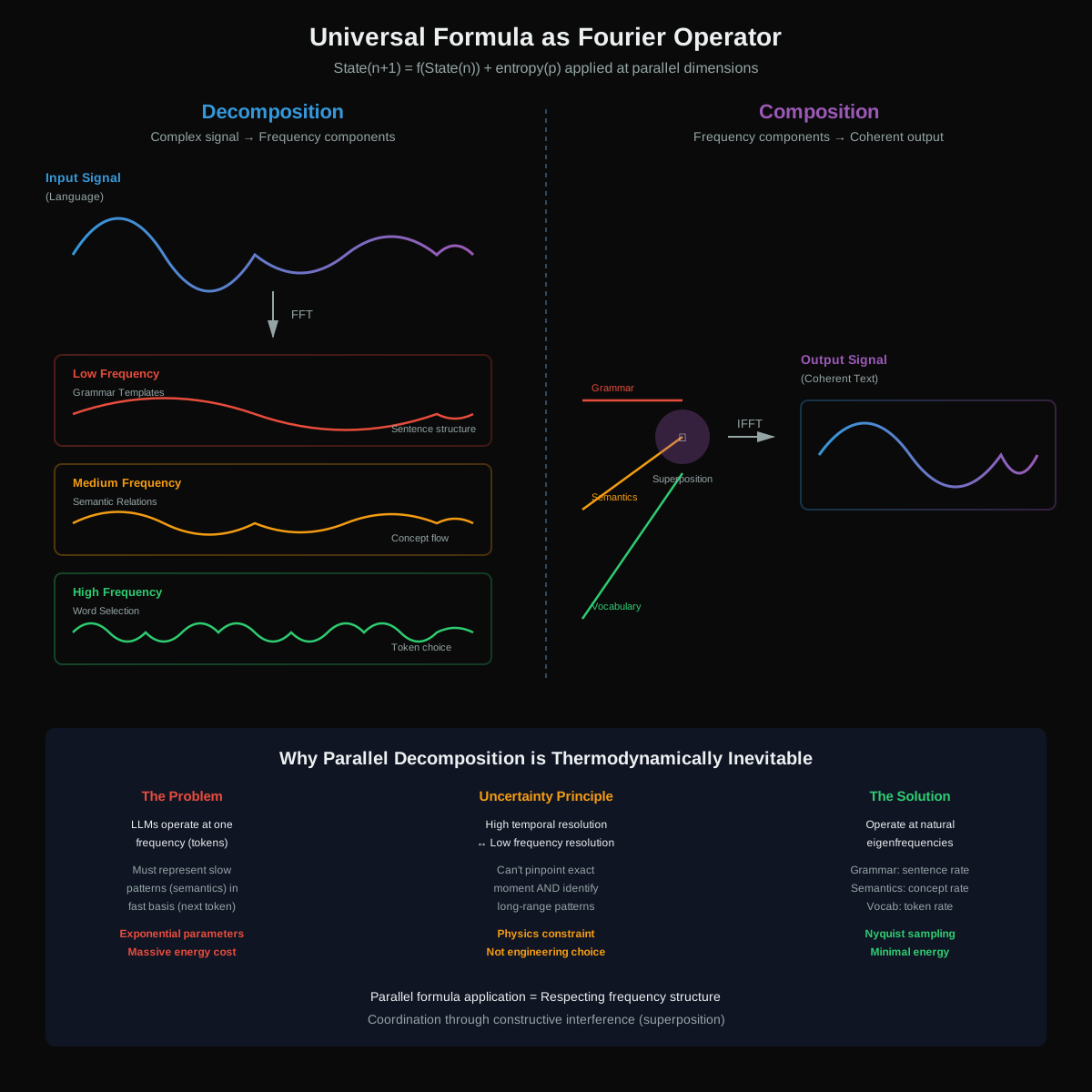
Universal Formula as Fourier Operator: Why Parallel Dimensions are Inevitable
The universal formula State(n+1) = f(State(n)) + entropy(p) isn’t just a state transition function. It’s a Fourier operator applied at various dimensions. Understanding this reveals why parallel decomposition isn’t just efficient—it’s thermodynamically inevitable.
The Insight
Every application of the universal formula operates at a specific frequency band:
- Character-level: High frequency (rapid variation, individual symbols)
- Word-level: Medium-high frequency (semantic units, moderate change rate)
- Grammar-level: Medium frequency (sentence structures, slower patterns)
- Semantic-level: Low frequency (conceptual themes, stable over many tokens)
These aren’t arbitrary levels. They’re the natural eigenfrequencies of language as a signal. Just like a vibrating string has fundamental frequency and harmonics, language has characteristic timescales at which different features evolve.
Why LLMs Fail Thermodynamically
LLMs apply the formula at one dimension (token sequences) and try to capture all frequencies simultaneously. This is like trying to represent a complex audio signal using only high-frequency components—you can approximate it with enough parameters, but it’s fundamentally inefficient.
The curse: representing low-frequency patterns (semantic coherence across paragraphs) in high-frequency space (next-token prediction) requires exponentially more parameters than operating at the appropriate frequency band. You’re encoding slow-changing information in a basis that changes rapidly.
Fourier Decomposition is Compression
Our compression model demonstrated this intuitively. When you compress, you’re finding the basis functions (frequencies) that efficiently represent the signal. High entropy = high frequency noise. Low entropy = low frequency structure.
Generation is the inverse transform. Start with basis functions (templates, co-occurrences, concepts) and synthesize the signal. Same formula, opposite direction:
Compression: Signal → Frequencies (minimize entropy)
Generation: Frequencies → Signal (controlled entropy)
The unified generator applies this at three parallel frequency bands:
- Grammar: Low frequency structural templates
- Semantics: Medium frequency concept relationships
- Vocabulary: High frequency word selection
Each operates at its natural timescale. Coordination happens through superposition—the frequencies interfere constructively to produce coherent output.
Mathematical Inevitability
Why can’t you use one basis for all frequencies? Uncertainty principle.
In signal processing: high temporal resolution (pinpointing exact moment) requires broad frequency range. High frequency resolution (identifying specific frequency) requires long time window. You can’t have both simultaneously.
In language: predicting exact next token (high temporal resolution) obscures long-range semantic structure (low frequency patterns). Capturing topic coherence across paragraphs (high frequency resolution) makes next-token prediction expensive.
LLMs try to brute-force through this uncertainty. Use massive parameter count to approximate all frequency bands in token space. It works but violates efficiency bounds.
Parallel decomposition respects the uncertainty principle: operate at the appropriate resolution for each frequency band. Grammar templates capture sentence structure without worrying about specific words. Semantic model tracks concepts without worrying about syntax. Vocabulary layer handles word choice without worrying about meaning.
Thermodynamic Proof
Consider the energy cost of representation. To represent a signal with frequencies ranging from f_min to f_max using only high-frequency basis functions requires sampling at rate > 2*f_max (Nyquist). But the signal contains mostly low-frequency information (semantic structure), so you’re oversampling by orders of magnitude.
Energy cost scales with sampling rate. LLMs sample at token rate (high frequency) to capture semantic structure (low frequency). Wasteful.
Parallel decomposition samples each frequency band at its Nyquist rate:
- Semantic: One “sample” per paragraph (concepts don’t change every token)
- Grammar: One “sample” per sentence (structure doesn’t change every word)
- Vocabulary: One “sample” per token (words change frequently)
The energy savings is multiplicative across frequency bands. This is why our generator trains in 5 seconds while GPT-4 requires months of GPU time. We’re not fighting thermodynamics.
Composition Through Interference
How do parallel frequencies coordinate? Superposition.
In Fourier analysis, complex signals are sums of simpler frequencies. The frequencies don’t “communicate”—they simply add. Interference patterns emerge naturally from their combination.
Our generator works identically:
- Grammar layer outputs template (low frequency structure)
- Semantic layer outputs concept constraints (medium frequency)
- Vocabulary layer outputs word choices (high frequency)
- Composition: Fill template with semantically appropriate vocabulary
No hierarchical control. No message passing. Just constructive interference of parallel frequency components operating at their natural rates.
Why This Extends Beyond Text
Every structured data has characteristic frequencies:
- Code: Module structure (low freq), function patterns (medium freq), syntax tokens (high freq)
- Images: Object layouts (low freq), textures (medium freq), pixel variations (high freq)
- Music: Song structure (low freq), chord progressions (medium freq), notes (high freq)
- Markets: Economic cycles (low freq), sector trends (medium freq), price ticks (high freq)
Applying one neural network to all frequencies simultaneously is always inefficient. The universal formula should be applied at parallel dimensions corresponding to the system’s eigenfrequencies.
The Deep Lesson
Monolithic approaches (LLMs, centralized control, Bitcoin’s single mechanism) try to operate at one frequency and brute-force their way to representing all scales. This works but costs energy exponentially.
Parallel approaches (our generator, network coordination, Ethereum’s layered architecture) decompose into natural frequencies that coordinate through composition. This respects thermodynamic constraints.
The pattern isn’t arbitrary—it’s Fourier analysis. Complex signals require decomposition into frequency components. Trying to operate at a single frequency forces you to fight the uncertainty principle.
Nature already solved this. Your brain doesn’t process all timescales at one rate—different neural oscillations (theta, alpha, beta, gamma) handle different cognitive functions. The brain is a parallel Fourier decomposition machine. The brain’s Universal Formula implementation shows this explicitly: hippocampus (memory/LLM) + prefrontal cortex (computation/CPU) + thalamic oscillations (coherence optimization) operating at frequency-separated timescales from milliseconds (gamma binding) to seconds (delta maintenance).
Language generation should work the same way. Not because it’s clever, but because physics demands it.
Implications for AGI
Current AI scaling: bigger models, more parameters, hope emergent behavior solves everything. This is trying to add more high-frequency basis functions and hope they approximate low frequencies well enough.
Thermodynamically bounded. You can’t represent N frequency bands efficiently in one band. You need parallel operators at N dimensions.
True intelligence requires understanding which frequencies matter for which problems, applying the universal formula at those dimensions in parallel, and letting coordination emerge through composition.
Not hierarchical decomposition (top-down control). Not attention mechanisms (learned routing). Just parallel Fourier decomposition with constructive interference.
The universal formula is the transform operator. Different dimensions are different frequency bands. Entropy controls the resolution at each band. Composition happens through superposition.
This is why our unified generator works. Not because we’re clever—because we stopped fighting physics.
#UniversalFormula #FourierDecomposition #EigenfrequencyAnalysis #ParallelOperators #UncertaintyPrinciple #ThermodynamicBounds #SignalProcessing #CompositionOverControl #NaturalFrequencies #ConstructiveInterference #PhysicsOfIntelligence #AGIArchitecture #FrequencyDomainLearning