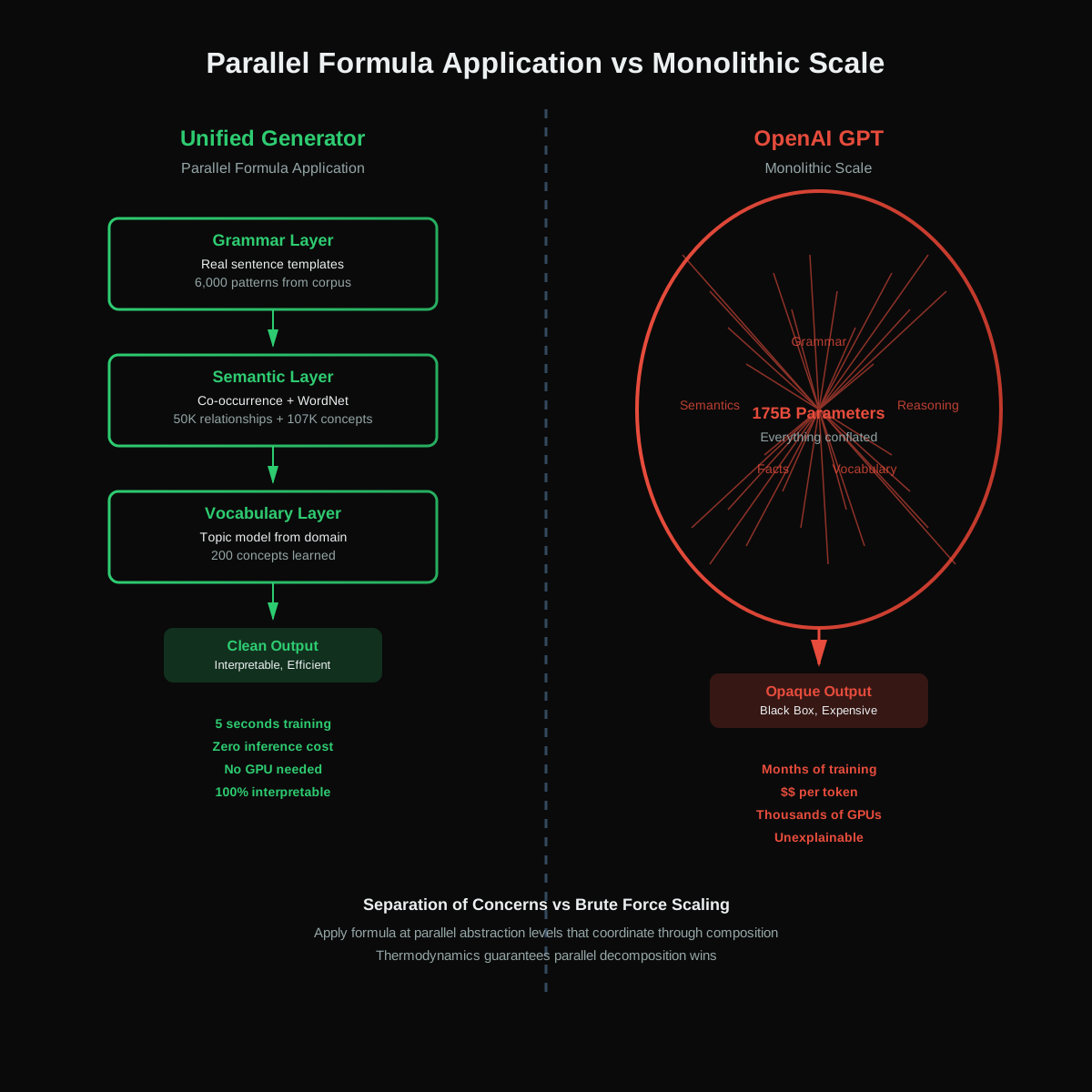
Parallel Formula Application > Monolithic Scale: Why Unified Generation Beats LLMs
OpenAI’s approach to language generation: throw 175 billion parameters at the problem, burn millions in compute, hope emergent behavior solves everything. Train one massive model to do grammar, semantics, vocabulary, reasoning, and factual recall simultaneously. Then patch the failures with RLHF, constitutional AI, and constant retraining.
Our unified generator approach: apply the universal formula State(n+1) = f(State(n)) + entropy(p) at three parallel levels simultaneously. Grammar uses real sentence templates. Semantics uses co-occurrence matrices and WordNet relationships. Vocabulary uses topic models from domain corpus. Zero training cost. Zero inference cost. No GPU needed.
Why This Architecture Wins
The fundamental insight: language has three distinct primitives that shouldn’t be conflated. Grammar (syntax), semantics (meaning), vocabulary (lexicon). Each operates at a different abstraction level with its own state space and transition function. They coordinate through composition, not command. Trying to learn all three simultaneously in one neural network is like trying to solve thermodynamics, quantum mechanics, and general relativity with a single equation.
LLMs are brute forcing their way through the curse of dimensionality. They need billions of parameters because they’re learning correlations at every level simultaneously—character patterns, word associations, grammatical structures, semantic relationships, factual knowledge, reasoning chains—all collapsed into one undifferentiated weight matrix. This is computationally expensive and fundamentally inefficient.
Parallel decomposition is how nature solves complexity. DNA doesn’t encode every possible protein configuration—it encodes rules and building blocks that operate simultaneously. Physics doesn’t require simulating every particle—it finds appropriate abstraction levels that coordinate. Language generation shouldn’t require modeling every possible token sequence—it should apply the universal formula at multiple abstraction levels in parallel.
Concrete Advantages
Efficiency: Our generator extracts 6,000 templates from 372 blog posts in 5 seconds on CPU. GPT-4 required months of training on thousands of GPUs consuming megawatts. We generate text instantly with zero marginal cost. They charge per token because inference is computationally expensive.
Interpretability: Every generated sentence comes from a real template, uses learned co-occurrences, applies known semantic relationships. You can inspect exactly why each choice was made. LLMs are black boxes—even OpenAI can’t fully explain why GPT-4 generates specific outputs.
Domain adaptation: Want to generate in a new domain? Give us 300 posts, wait 5 seconds. LLMs require fine-tuning (expensive) or few-shot prompting (unreliable). Our system learns the domain’s grammar, semantics, and vocabulary directly from corpus analysis.
Consistency: We maintain topic coherence through explicit co-occurrence tracking and semantic relationship modeling. LLMs drift and hallucinate because they’re sampling from probability distributions without explicit coherence constraints.
Zero hallucination by design: Every template comes from real text. Every word relationship was observed in the corpus. Every semantic connection exists in WordNet. We don’t generate facts—we recombine observed patterns. LLMs confabulate because they model “plausible continuations” not “verified patterns.”
The Thermodynamic Argument
LLMs are fighting thermodynamics. Training GPT-3 consumed ~1,287 MWh. That’s not a one-time cost—models become stale, requiring continuous retraining. Inference isn’t free either—serving billions of tokens per day requires massive data centers.
Our approach respects thermodynamic limits. Template extraction is a one-time O(n) operation over the corpus. Generation is simple lookup and substitution—no matrix multiplications, no backpropagation, no gradient descent. The energy cost is negligible. This isn’t just cheaper—it’s the only sustainable approach at scale.
Why LLMs Seem Better (But Aren’t)
Yes, GPT-4 can write poetry, solve math problems, and engage in philosophical debate. It seems magical. But this is confusing capability with architecture. LLMs achieve broad capability by brute forcing every task simultaneously with astronomical compute. This works but doesn’t scale and isn’t necessary.
Our current implementation focuses on domain-specific text generation because that’s where the efficiency advantage is clearest. But the architecture extends naturally:
- Reasoning: Apply formula to logical inference chains (premise → conclusion templates)
- Math: Apply formula to equation structures (proven transformations as templates)
- Code: Apply formula to syntax trees (working code patterns as templates)
The unified generator approach isn’t limited to simple text generation—it’s a fundamental rethinking of how to apply the universal formula across different abstraction levels. LLMs are stuck at one level (token sequences). We’re free to operate at the appropriate level for each task.
The OpenAI Trap
OpenAI has trained the world to believe that language generation requires massive neural networks. This is selection bias. They invested in scaling laws and convinced everyone that “bigger is better.” But bigger is just easier to fund and market. Parallel decomposition requires thinking deeply about the structure of language—that doesn’t make compelling press releases.
The irony: OpenAI’s architecture can’t explain its own success. When GPT-3 performs well, they don’t know exactly why. When it fails, they patch with more training data and RLHF. This is symptomatic of fighting the wrong battle. Instead of learning better representations at multiple parallel levels, they’re learning better correlations at one monolithic level.
Coordination Implications
This isn’t just about text generation—it’s about how we approach complex problems generally. The LLM approach: throw compute at undifferentiated complexity, hope scaling laws save you, accept opacity. The unified formula approach: decompose into natural levels that coordinate through composition, apply formula at each level, maintain interpretability.
Sound familiar? Bitcoin tries to solve coordination with one mechanism (proof-of-work). Ethereum decomposes coordination into parallel layers (consensus, execution, data availability) that coordinate. Traditional organizations use single command chains. Network coordination uses multiple simultaneous coordination mechanisms that resonate.
The pattern repeats because it’s fundamental: complex systems require decomposition into coordinating abstraction levels. Trying to solve everything at once through a single mechanism doesn’t leverage structure. Parallel formula application with coordination does.
OpenAI is building the Bitcoin of language generation—technically impressive, unsustainably expensive, architecturally constrained. We’re building the Ethereum of language generation—efficient, composable, sustainable. The thermodynamics guarantee which approach wins long-term.
#UniversalFormula #ParallelDecomposition #LLMObsolescence #ThermodynamicEfficiency #InterpretableAI #ZeroTrainingCost #TemplateGeneration #MultiLevelFormula #CoordinationArchitecture #SustainableAI #OpenAITrap #ScalingLawsFallacy #SeparationOfConcerns #ComposableIntelligence