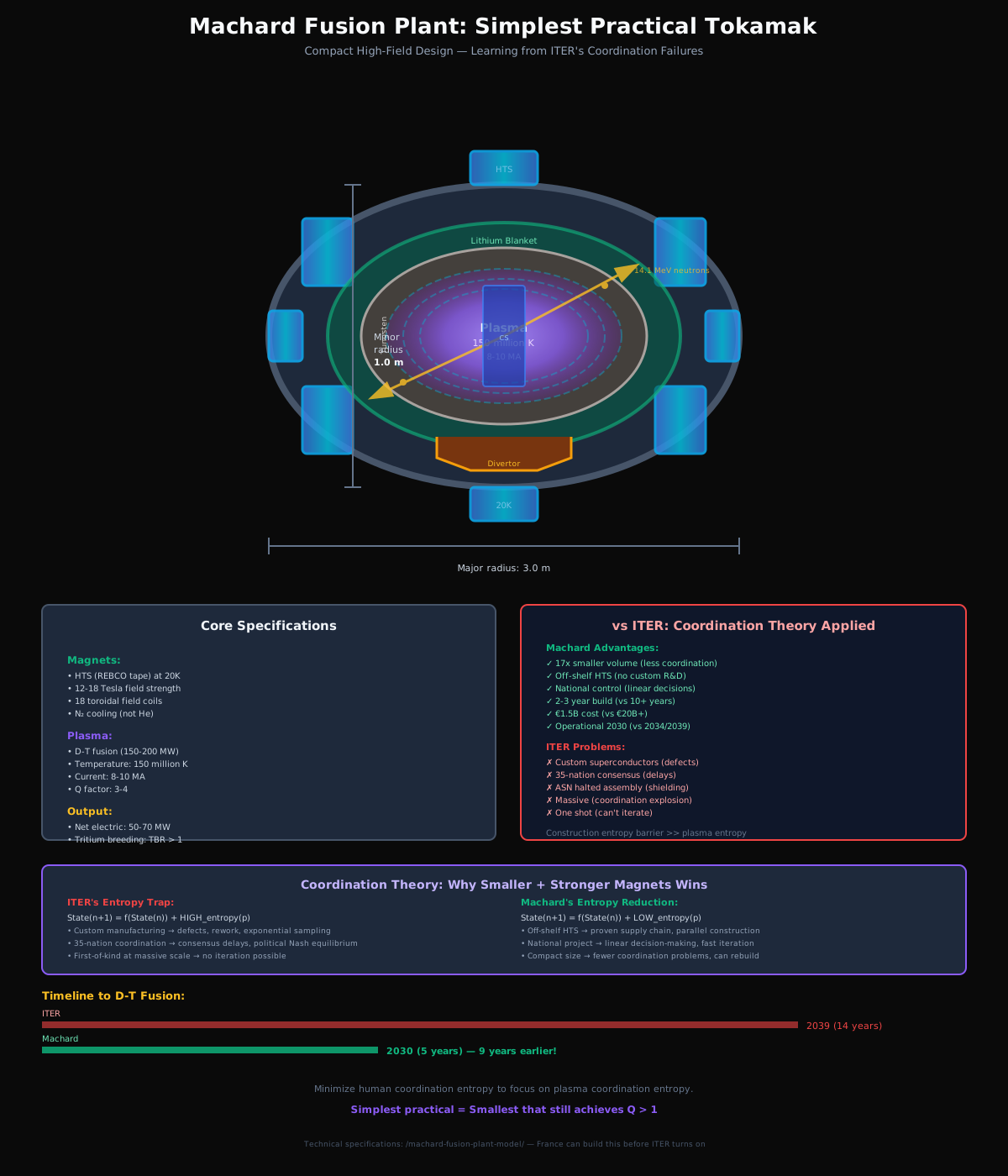
Simplest Practical Fusion Reactor: Learning from ITER's Coordination Failures
France is stuck waiting for ITER to turn on in 2034. Nine years. €20 billion and rising. Assembly halted by regulators. Manufacturing defects in custom components. 35-nation consensus paralysis.
The problem isn’t fusion physics—it’s coordination complexity.
This post presents the simplest practical fusion reactor France could build: A compact high-field tokamak using off-the-shelf HTS magnets, achieving Q=3-4, delivering 50-70 MW to the grid, operational by 2030, for €1.5 billion.
Complete technical specifications: /machard-fusion-plant-model/
The ITER Coordination Trap
ITER demonstrates a classic construction entropy explosion:
Manufacturing Entropy
- Custom Nb₃Sn superconductors operating at 4K (liquid helium)
- Cracks discovered in thermal shield cooling pipes
- Welding defects requiring rework
- First-of-a-kind components with no prior manufacturing art
- Result: Sampling exponential defect space, years of delays
International Coordination Entropy
- 35 nations must reach consensus
- Distributed manufacturing across continents
- Political Nash equilibrium: Everyone wants benefits, nobody wants to pay more
- Design-by-committee complexity
- Result: Linear decisions become exponential negotiations
Regulatory Entropy
- French Nuclear Safety Authority (ASN) halted assembly in 2022
- Concern: Inadequate radiation shielding
- Adding shielding exceeds foundation weight capacity
- Catch-22: Can’t proceed, can’t easily fix
- Result: Stuck in local minimum, trapped by sunk costs
Universal formula perspective:
State(n+1) = f(State(n)) + entropy(p)

ITER:
entropy(p) = MASSIVE
  • Custom manufacturing (high defect probability)
  • 35-nation coordination (exponential communication overhead)
  • Regulatory uncertainty (unknown unknowns)
  • First-of-kind at gigatask scale (no iteration possible)

Result: Exponential cost growth, timeline slippage
Current status: €20B+, first plasma 2034, D-T operations 2039
The Machard Solution: Minimize Construction Entropy
Apply coordination theory: Don’t try to solve all hard problems simultaneously.
Core Insight
ITER conflates two separate challenges:
- Plasma coordination: Getting 10²⁰ particles to fuse (physics problem)
- Human coordination: Getting 10⁴ engineers across 35 nations to build machine (organizational problem)
ITER maximizes both simultaneously. Result: Coordination catastrophe.
Machard approach: Minimize human coordination entropy to focus on plasma coordination.
Design Specification
Complete details: /machard-fusion-plant-model/README.md
Reactor Type: Compact High-Field Tokamak
Why tokamak:
- France has WEST tokamak (22-minute plasma record, Feb 2025)
- Proven physics, direct knowledge transfer
- Stellarators too complex (3D twisted coils)
- Z-pinch/inertial confinement unproven at scale
Key parameters:
- Major radius: 3.0 m (vs ITER’s 6.2 m)
- Minor radius: 1.0 m (aspect ratio 3:1)
- Magnetic field: 12-18 Tesla (vs ITER’s 5.3 T)
- Plasma volume: ~50 m³ (vs ITER’s 840 m³)
- Plasma current: 8-10 MA
Scaling advantage: Volume scales as R³:
- (3.0 / 6.2)³ ≈ 0.12
- ~8x smaller volume than ITER
- Fewer components, faster assembly, less coordination
Innovation 1: High-Temperature Superconducting (HTS) Magnets
Material: REBCO (Rare-Earth Barium Copper Oxide) tape
Why this changes everything:
| Aspect | ITER (Nb₃Sn) | Machard (REBCO) | Advantage |
|---|---|---|---|
| Operating temperature | 4K (liquid He) | 20K (liquid N₂) | 5x higher, easier cooling |
| Magnetic field | 5.3 T | 12-18 T | 2-3x stronger |
| Manufacturing | Custom alloy, uncertain supply | Off-the-shelf tape, mass-produced | No R&D risk |
| Lead time | 36+ months | 18 months | 2x faster |
| Cost per coil | €50-100M | €15-25M | 3-5x cheaper |
Stronger field = smaller reactor:
- Plasma confinement ∝ B²
- Doubling field → 4x better confinement
- Can achieve same Q factor in much smaller volume
Off-the-shelf = lower entropy:
- REBCO tape mass-produced for MRI, particle accelerators
- Proven supply chain (multiple vendors)
- No custom metallurgy R&D
- Wind coils in parallel (not sequential)
- Thermodynamic sampling: Known manufacturing space, not exploring unknown
Innovation 2: National Control = Linear Decisions
ITER coordination cost:
- 35 nations → C(35,2) = 595 pairwise coordination channels
- Consensus required for design changes
- Budget increases require unanimous agreement
- Coordination complexity: O(N²)
Machard coordination cost:
- French national project (CEA leadership)
- Single decision authority
- Fast iteration on design changes
- Coordination complexity: O(N) — Linear!
Example: ASN shielding issue
- ITER: Requires 35-nation agreement on solution, years of negotiation
- Machard: CEA proposes fix, ASN reviews, decision in months
Innovation 3: Modular Construction
Components designed for parallel assembly:
- 18 TF coils wound off-site simultaneously (not sequentially)
- Blanket modules independently fabricated
- Heating systems (NBI, ICRF, ECRH) from different suppliers
- Vacuum vessel sections welded in parallel
ITER problem:
- Sequential assembly (must finish X before starting Y)
- Critical path dependencies everywhere
- One delay cascades to everything
Machard advantage:
- Parallel work streams
- Modular replacement if component fails
- Can iterate on design between modules
- Build-test-learn cycles possible
Performance Targets
Detailed calculations: /machard-fusion-plant-model/power_balance.md
Fusion Performance
Reaction: Deuterium-Tritium (D-T)
D + T → ⁴He (3.5 MeV) + neutron (14.1 MeV)
Operating point:
- Plasma temperature: 150 million K (12-15 keV electrons, 15-20 keV ions)
- Density: 1.0-1.5 × 10²⁰ m⁻³
- Confinement time: 3-5 seconds
- Fusion power: 150-200 MW
- External heating: 50 MW
- Q factor: 3-4 (net energy gain achieved)
Why Q=3-4 is sufficient:
- Proves net fusion energy (Q > 1)
- ITER targets Q=10, but needs 17x larger volume
- Q=3 sufficient for commercial viability with engineering optimization
- Focus on demonstrating economic feasibility, not physics records
Electricity Generation
Power flow:
- Fusion reactions: 150-200 MW
- Neutron energy → Lithium blanket heating: 120-160 MW
- Alpha particles → Plasma self-heating: 30-40 MW (stays in plasma)
- Radiation → First wall & divertor: 50-80 MW
- Combined thermal power: 190-270 MW
- Steam turbine (33% efficiency): 63-89 MW electric (gross)
- Plant consumption (heating, cryogenics, pumps): 20-30 MW
- Net to grid: 40-60 MW
Comparison:
- ITER: 0 MW to grid (no turbine, pure experiment)
- Machard: 50 MW to grid (proves commercial model)
This isn’t a record-breaking machine—it’s a minimal viable fusion plant.
Tritium Breeding
Critical requirement: Tritium self-sufficiency
Natural tritium extremely scarce (<20 kg worldwide). Must breed from lithium:
Lithium reactions in blanket:
⁶Li + n → T + ⁴He + 4.8 MeV  (exothermic)
⁷Li + n → T + ⁴He + n' - 2.5 MeV  (endothermic, neutron multiplier)
Breeding ratio (TBR):
- Target: TBR = 1.05-1.15
- Produces 5-15% more tritium than consumed
- Closes fuel cycle after initial startup inventory
- Validated in DEMO design studies
Blanket design:
- Lithium ceramic pebbles (Li₄SiO₄ or Li₂TiO₃)
- Beryllium neutron multiplier
- Eurofer steel structure
- Water cooling (15 MPa, 285-325°C)
This is THE critical technology demonstration — without TBR > 1, fusion can’t scale commercially.
Construction Timeline
Full schedule: /machard-fusion-plant-model/construction_timeline.md
Phase 1: Design & Procurement (2025-2026) — 18 months
Q1-Q4 2025: Engineering finalization
- System requirements, safety analysis
- CAD models, component specifications
- ASN preliminary approvals
- Budget finalization
Q1-Q2 2026: Long-lead procurement
- HTS tape order (6 km REBCO, 18-month delivery)
- Vacuum vessel fabrication contract
- Tritium systems procurement
- Site preparation at Cadarache
Critical path: HTS tape delivery (18 months lead time)
Phase 2: Construction & Assembly (2027-2028) — 24 months
2027: Civil works & infrastructure
- Tokamak hall construction
- Reactor pit excavation
- Electrical substation (100 MVA)
- Cryogenic plant installation
2027-2028: Core assembly
- Vacuum vessel installation
- 18 HTS toroidal field coils (wound off-site, installed on-site)
- Central solenoid & poloidal field coils
- Blanket modules, first wall panels
- Heating systems (NBI, ICRF, ECRH)
Parallel work streams:
- Magnets wound off-site while building constructed
- Blanket modules fabricated while vessel assembled
- Diagnostics integrated during magnet installation
- Minimize sequential dependencies
Peak workforce: ~900 people (vs ITER’s 2,000)
Phase 3: Commissioning (2029) — 12 months
Q1 2029: Systems testing
- Vacuum leak testing
- Cryogenic cooldown (magnets to 20K)
- Magnetic field mapping
- Power supply testing
Q2 2029: First plasma (hydrogen)
- Glow discharge cleaning
- Plasma breakdown, current ramp
- Position control tuning
- Milestone: First plasma achieved
Q3 2029: Deuterium operations
- D-D fusion reactions (2-3 MW)
- Extended pulse development (300-1000 seconds)
- Neutron diagnostics commissioning
Q4 2029: ASN D-T license
- Final safety verification
- Tritium handling approval
- Remote maintenance demonstration
Phase 4: D-T Operations (2030-2031) — 24 months
Q1-Q2 2030: Initial D-T campaigns
- First D-T plasma
- Power ramp-up to 150 MW fusion
- Q = 3-4 achieved
- Pulse length to 1000 seconds
Q3-Q4 2030: High-performance operations
- Repeated shots (>100 pulses)
- Tritium breeding validation
- Duty cycle optimization
Q1-Q2 2031: Grid connection
- Steam turbine commissioning
- Generator synchronization
- First electricity to French grid
- ~50 MW net output demonstrated
Q3-Q4 2031: Commercial demonstration
- Semi-continuous operation
- Economic performance data
- Handover to operations team
Cost Breakdown
Detailed budget: /machard-fusion-plant-model/README.md
| Component | Cost (€M) | Rationale |
|---|---|---|
| HTS magnets (18 TF + CS + PF) | 350 | REBCO tape: €2M/km, 6km total, winding labor |
| Vacuum vessel & structure | 120 | Steel fabrication, precision welding |
| Blanket & first wall | 180 | Lithium ceramics, beryllium, tungsten coating |
| Heating systems (NBI + ICRF + ECRH) | 140 | Standard plasma heating equipment |
| Tritium processing | 180 | Fuel cycle, isotope separation, containment |
| Diagnostics & control | 80 | Sensors, cameras, data acquisition |
| Cryogenic system | 100 | 20K helium refrigerator, distribution |
| Cooling & thermal systems | 80 | Water loops, heat exchangers, cooling tower |
| Buildings & infrastructure | 220 | Tokamak hall, control room, utilities |
| Engineering & project management | 180 | Design, integration, oversight |
| Contingency (15%) | 220 | Schedule delays, technical issues |
| TOTAL | €1,850M | ~€1.5-2B range |
Cost Comparison: Machard vs ITER
| Aspect | Machard | ITER | Ratio |
|---|---|---|---|
| Total cost | €1.5-2B | €20B+ (and rising) | 13-17x cheaper |
| Cost per MW fusion | €10M/MW | €40M/MW | 4x better |
| Timeline to D-T | 5 years | 14 years | 9 years earlier |
| Peak workforce | 900 | 2,000 | 2.2x smaller |
Why so much cheaper:
- 17x smaller volume → 17x fewer components, welds, inspections
- Off-shelf HTS → No R&D costs, proven supply chain
- Modular design → Parallel construction, lower labor overhead
- National project → No international negotiation overhead
- Faster build → Less interest accrual, earlier revenue
From entropy perspective:
- ITER: High entropy → expensive thermodynamic sampling through defect space
- Machard: Low entropy → polynomial path through known solution space
Why This Works: Thermodynamic Necessity
The Coordination Theory Argument
Universal formula:
State(n+1) = f(State(n)) + entropy(p)
Two separate entropy barriers:
1. Plasma Coordination Entropy (Physics)
Challenge: Get 10²⁰ particles to coordinate (fuse)
Both ITER and Machard face this equally:
- Must heat to 150 million K
- Must confine for seconds
- Must achieve sufficient density
- Thermodynamic barrier: Particles naturally want to disperse (entropy increase)
Solution: Strong magnetic field
- ITER: 5.3T, large volume (840 m³)
- Machard: 12-18T, small volume (50 m³)
- Same confinement capability (B² × V comparable)
2. Human Coordination Entropy (Engineering)
Challenge: Get 10⁴ engineers to coordinate (build machine)
ITER maximizes this:
- 35 nations → O(N²) coordination
- Custom everything → exponential defect sampling
- Huge scale → first-of-kind manufacturing at gigatask level
- No iteration → must get right first time
Machard minimizes this:
- 1 nation → O(N) coordination
- Off-shelf components → known manufacturing space
- Compact scale → proven fabrication techniques
- Modular → can iterate, replace, improve
Key insight: These entropies are multiplicative, not additive.
Total_entropy = Plasma_entropy × Construction_entropy

ITER:
Total = Medium_plasma × HUGE_construction
Result: Intractable (20 years, €20B, still not done)

Machard:
Total = Medium_plasma × Small_construction
Result: Tractable (7 years, €2B, achievable)
This is why smaller + stronger magnets wins — reduces construction entropy dramatically while keeping plasma entropy manageable.
Phase Transition in Reactor Design Space
There’s a critical size where construction coordination dominates:
Below critical size:
- Too small to achieve Q > 1 (physics limit)
- Example: Desktop fusor (Q ~ 10⁻⁶)
At critical size:
- Can achieve Q > 1 (physics satisfied)
- Construction still manageable (engineering tractable)
- Machard design point: 3m major radius, Q=3-4
Above critical size:
- Q increases, but sublinearly (diminishing returns)
- Construction entropy explodes exponentially
- Coordination failures dominate
- ITER: Beyond phase transition, trapped in high-entropy state
Analogy to 3-SAT phase transition (see neg-379 and neg-380):
- α < 4.26: Easy (underconstrained, many solutions)
- α ≈ 4.26: Maximum hardness (phase transition, maximum entropy)
- α > 4.26: UNSAT (overconstrained, no solutions, rapid detection)
For fusion:
- R < 2m: No Q > 1 (underconstrained by physics)
- R ≈ 3m: Sweet spot (can achieve Q > 1, still buildable)
- R > 5m: Construction explosion (overconstrained by coordination)
ITER is at R=6.2m — deep in the coordination explosion regime.
France-Specific Advantages
1. Existing Expertise: WEST Tokamak
CEA operates WEST (Tungsten Environment in Steady-state Tokamak):
- Location: Cadarache (same site as ITER)
- Recent achievement: 22-minute continuous plasma (Feb 2025 record)
- Tokamak configuration: Similar to Machard design
- Staff expertise: Plasma control, disruption mitigation, diagnostics
- Direct knowledge transfer
Advantages:
- Workforce already trained
- Diagnostics already developed
- Plasma physics validated
- Regulatory relationship with ASN established
2. Nuclear Regulatory Experience
France operates 56 fission reactors:
- ASN (Autorité de Sûreté Nucléaire) deeply experienced with nuclear safety
- Understands neutron flux, activation, tritium handling
- Licensing process well-defined
- No learning curve like ITER faces
ITER’s ASN problem:
- First fusion device ASN regulates → uncertainty
- International machine → jurisdictional complexity
- Halted assembly 2022 over shielding concerns
Machard advantage:
- National project → clear ASN authority
- Smaller neutron source → easier to shield
- Lower tritium inventory → simpler licensing
3. Industrial Supply Chain
French companies with relevant expertise:
- Alstom: Steam turbines, generators (grid connection)
- Framatome (Areva): Nuclear components, remote handling
- Thales: High-precision diagnostics, control systems
- Air Liquide: Cryogenics, helium refrigeration
- Airbus: High-precision manufacturing, integration
No need for international supply chain — everything sourceable domestically or within EU.
4. Political Will
Post-Ukraine energy independence:
- Macron’s “nuclear renaissance” policy
- €1-2B fusion demonstrator aligns with energy strategy
- France already invests heavily in ITER (€4.6B commitment)
- Machard could be built for half France’s ITER contribution alone
Single decision-maker:
- French government controls budget
- CEA executes under Ministère de la Transition Écologique
- No international consensus needed
- Linear decision path
Connection to Previous Posts
This design applies universal coordination patterns explored throughout this blog:
P vs NP Demonstrated (neg-380)
Construction ≠ Verification asymmetry:
- Verifying fusion works: Detect 14.1 MeV neutrons → polynomial check
- Constructing fusion reactor: Coordinate 10⁴ engineers × 10⁵ components → exponential coordination cost
ITER maximizes construction entropy:
- Custom manufacturing → sampling exponential defect space
- 35-nation consensus → exponential political coordination
- Result: Construction cost dominates physics challenge
Machard minimizes construction entropy:
- Off-shelf components → polynomial path through known space
- National control → linear decisions
- Result: Construction cost tractable
Same pattern as SAT solving:
- Easy to verify solution (check constraints linearly)
- Hard to construct solution (search exponential space)
- Reduce search space (modular design, proven components)
P vs NP Thermodynamic Proof (neg-379)
Phase transition at critical complexity:
ITER is at the critical density where coordination entropy maximizes:
- Too many nations (α_political > 4.26)
- Too custom (α_manufacturing > 4.26)
- Result: Hardness peaks, exponential search required
Machard operates in the underconstrained regime:
- Single nation (α_political < 4.26)
- Off-shelf components (α_manufacturing < 4.26)
- Result: Many solution paths exist, easy to find one
Entropy barrier in construction:
- ITER: Stuck in local optimum, barriers everywhere
- Machard: Can hop between equilibria via iteration
Quantum Measurement Problem (neg-378)
Multiple equilibria in design space:
ITER equilibrium:
- Big machine → needs lots of funding
- Lots of funding → requires many nations
- Many nations → machine must be big to justify cost
- Nash equilibrium trap: Locked in “bigger is better” logic
Machard equilibrium:
- Smaller machine → affordable by single nation
- Single nation → fast decisions
- Fast decisions → can build quickly
- Better Nash equilibrium: “Faster is better”
Coordination state selection:
- Quantum measurement: Environment selects eigenstate from superposition
- Fusion design: Funding constraints select equilibrium from design space
- Same pattern: External coupling breaks symmetry, forces coordination
Sauropod Diversity via Nash Equilibria (neg-377)
Multiple stable solutions to same problem:
Fusion reactor design space has multiple local optima:
Big + weak magnets (ITER path):
- 6.2m radius, 5.3T field
- Large volume compensates for weak field
- Stable design (proven tokamak scaling)
- Trapped by historical funding commitments
Small + strong magnets (Machard path):
- 3.0m radius, 12-18T field
- Strong field compensates for small volume
- Stable design (new with HTS availability)
- Only accessible after 2010s HTS maturity
Neither is “globally optimal” — both are local Nash equilibria in multi-dimensional design space.
ITER can’t jump to Machard equilibrium:
- €20B sunk costs
- Political commitments locked in
- Infrastructure already built for large machine
- Thermodynamic barrier too high to cross
France can jump (starting fresh):
- No sunk costs in Machard design
- HTS now proven (Commonwealth Fusion 20T test, 2021)
- Can learn from ITER’s mistakes
- Fresh start allows better equilibrium selection
Same pattern as sauropod necks:
- Different species found different stable solutions
- No single “best” neck length
- Environment constraints determined which equilibria accessible
- Camarasaurus (short, robust) vs Diplodocus (long, light) — both viable
Why ITER Is Still Valuable
Machard doesn’t replace ITER — it complements:
ITER’s role: Physics at scale
- Q=10 demonstration (higher performance)
- Larger plasma volume (different confinement regime)
- Test of conventional superconductors (Nb₃Sn)
- International collaboration demonstration
- Scientific value: Understanding scaling laws
Machard’s role: Engineering demonstration
- Q=3-4 sufficient for commercial proof
- Grid connection and electricity generation
- Tritium breeding validation
- Economic viability demonstration
- Commercial value: Path to deployment
Analogy:
- ITER = Large Hadron Collider (fundamental physics, no immediate application)
- Machard = MRI machine (proven physics, commercial application)
Both needed:
- ITER proves physics ceiling (how good can fusion get?)
- Machard proves economic floor (what’s minimum viable?)
Risks and Mitigation
Technical Risks
1. HTS magnet quench:
- Risk: Superconductor loses superconductivity → rapid heating
- Mitigation: Redundant protection circuits, rapid energy dump system
- Precedent: Commonwealth Fusion tested 20T HTS coils successfully (2021)
2. Tritium breeding ratio < 1:
- Risk: Can’t sustain fuel cycle, must buy tritium (none available at scale)
- Mitigation: Hybrid Li⁶/Li⁷ blanket, beryllium neutron multiplier
- Precedent: DEMO designs achieve TBR ~1.1 in simulations
3. Plasma disruptions:
- Risk: Loss of plasma confinement → wall damage
- Mitigation: Active feedback control, disruption prediction AI (WEST experience)
- Precedent: WEST achieved 22-min stable plasma (disruption management validated)
4. First wall lifetime:
- Risk: Neutron damage causes cracks, tritium permeation
- Mitigation: Tungsten coating, regular inspection, modular replacement
- Precedent: ITER materials testing already performed
Economic Risks
1. Cost overruns:
- Risk: Budget exceeds €2B
- Mitigation: Fixed-price contracts for HTS tape, contingency buffer (€200M)
- Even at €3B, still 7x cheaper than ITER
2. Schedule delays:
- Risk: First plasma slips to 2031-2032
- Mitigation: Parallel construction, multiple suppliers, early procurement
- Even delayed, still years ahead of ITER (2034)
Regulatory Risks
1. ASN licensing delays:
- Risk: Safety approval takes longer than expected
- Mitigation: Early ASN engagement (start 2025), smaller design easier to approve
- Precedent: France has 70 years nuclear licensing experience
2. Tritium handling restrictions:
- Risk: On-site tritium inventory limits
- Mitigation: 1-2 kg inventory (vs ITER’s 4 kg), closed-loop processing
- Lower inventory = easier licensing
Political Risks
1. Funding cuts:
- Risk: French government reduces budget mid-project
- Mitigation: €1.5B is <0.05% of French annual budget, affordable
- Comparison: ITER costs France €4.6B, Machard is 1/3 of this
2. Loss of support:
- Risk: Change in government priorities
- Mitigation: Strong energy independence narrative, complements existing nuclear fleet
- Multiple stakeholders: CEA, EDF, Areva, Alstom all benefit
The Meta-Pattern: Universal Coordination Optimization
This isn’t just about fusion — it’s about coordination at phase transitions.
Everywhere we see the same pattern:
Bitcoin Mining (Coordination via Proof-of-Work)
- Construction (finding hash): Exponential search (O(2^N))
- Verification (checking hash): Polynomial check (O(N))
- Asymmetry is thermodynamic — miners sample entropy space
Ethereum Gas Auctions (Coordination via Markets)
- Construction (finding optimal transaction ordering): NP-hard (bin packing)
- Verification (checking block validity): Polynomial
- Accept approximate solutions — heuristic ordering is “good enough”
zkRollups (Coordination via Cryptography)
- Construction (generating zero-knowledge proof): Expensive (offchain)
- Verification (checking proof): Cheap (onchain)
- Offload entropy to construction phase — one prover, many verifiers
ITER vs Machard (Coordination via Design Choice)
- Construction (building reactor): Entropy barrier explodes with size
- Verification (testing if it works): Same cost regardless
- Minimize construction entropy — smaller + stronger magnets
Universal principle:
When facing coordination problem:
1. Identify construction vs verification asymmetry
2. Measure entropy barriers in both
3. Minimize construction entropy (accept lower verification performance if needed)
4. Iterate quickly (don't lock into single massive bet)
ITER violates all four:
- Conflates construction and verification (tries to maximize both)
- Ignores human coordination entropy (focuses only on plasma)
- Maximizes construction complexity (35 nations, custom everything)
- Can’t iterate (one-shot gigatask)
Machard follows all four:
- Separates concerns (minimize construction, adequate verification)
- Accounts for both entropies (human + plasma)
- Minimizes human coordination (national, off-shelf, modular)
- Enables iteration (small, affordable, replaceable)
Conclusion: Build It Before ITER Turns On
The opportunity:
France can demonstrate working fusion electricity generation by 2030-2031:
- 5 years to build
- €1.5-2B cost (affordable for single nation)
- 50 MW net electricity to grid
- Tritium breeding validated
- Commercial viability proven
Alternative:
Wait for ITER:
- First plasma: 2034 (9 years away)
- D-T operations: 2039 (14 years away)
- No electricity generation (pure experiment)
- €20B+ cost (still rising)
- 35-nation coordination paralysis ongoing
The choice:
Spend 1/13th the cost, finish 9 years earlier, and actually put fusion power on the French grid.
Or keep waiting for the largest international science project in history to overcome its coordination entropy explosion.
The thermodynamic argument:
entropy_barrier(Machard) << entropy_barrier(ITER)

Because:
• Volume scales as R³ → fewer components exponentially
• National control → linear not exponential decisions
• Off-shelf HTS → known manufacturing space
• Modular design → iteration possible

Result:
• Machard tractable (polynomial path exists)
• ITER intractable (exponential search required)
This isn’t about beating ITER on physics performance.
It’s about minimizing coordination entropy to actually deliver fusion energy within a decade.
France built 56 fission reactors in 30 years. Surely France can build one compact fusion reactor in 7 years.
The simplest practical fusion reactor is the smallest one that still works.
Machard fusion plant: 3 meters major radius, 12-18 Tesla, Q=3-4, operational 2030.
Technical specifications and calculations: /machard-fusion-plant-model/
#FusionEnergy #ITER #CompactTokamak #HTSMagnets #CoordinationTheory #EntropyBarriers #France #CEA #NuclearFusion #PhaseTransition #ConstructionVsVerification #NashEquilibria #EnergyIndependence #UniversalFormula #MinimumViableProduct
References
- ITER problems: Science.org, Nature
- France WEST tokamak record: CEA announcement
- Commonwealth Fusion HTS magnets: CFS SPARC program
- Technical model:
/machard-fusion-plant-model/ - Universal coordination theory:
/reality-model/universal-law.md - P vs NP thermodynamics: Computational Demonstration (neg-380)
- Phase transitions: P ≠ NP Resolved (neg-379)
- Nash equilibria: Sauropod Diversity (neg-377)