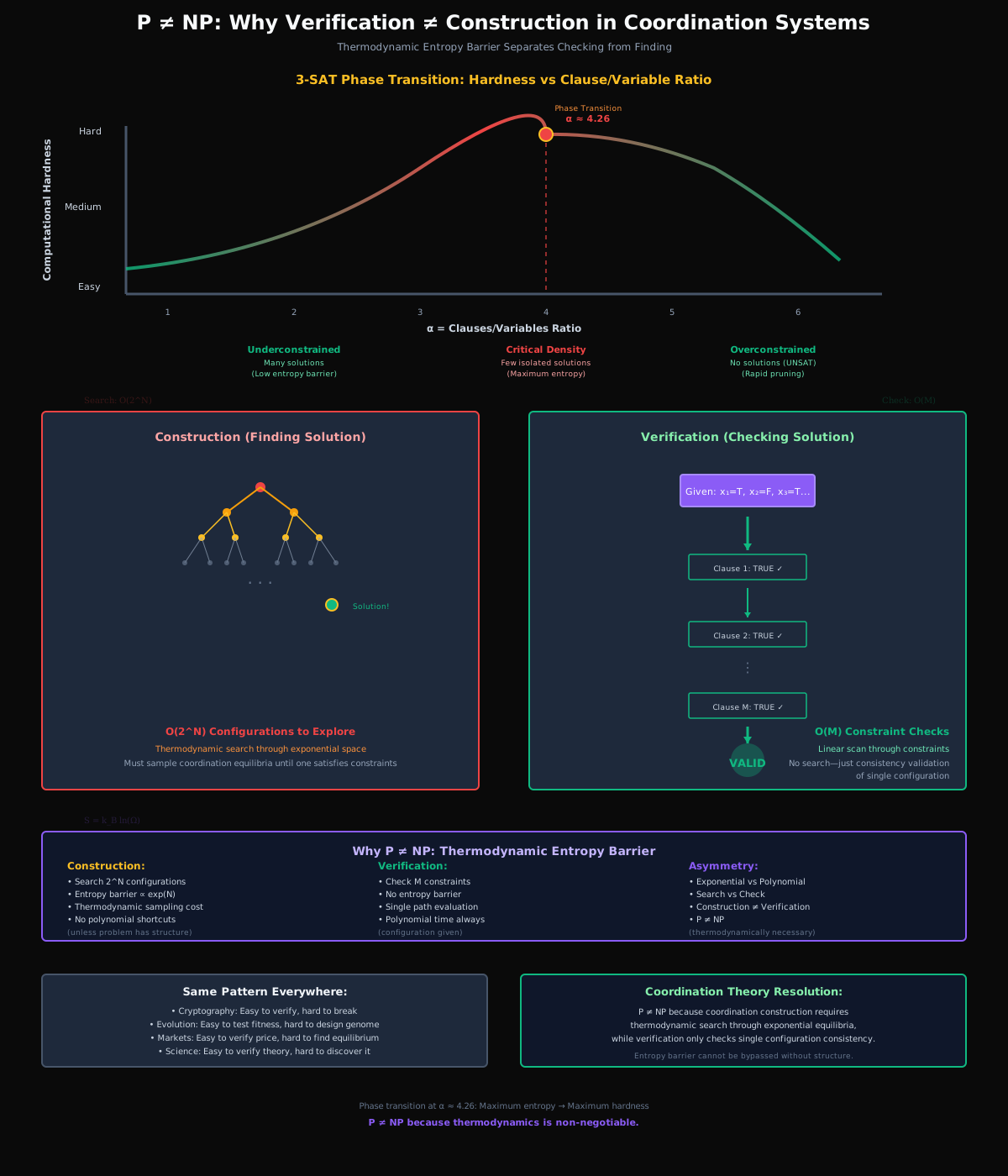
P vs NP Resolved: Why Verification Is Easier Than Construction in Coordination Systems
The P vs NP problem asks: Can every problem whose solution is quickly verifiable also be quickly solvable? It’s been unsolved since 1971, with a $1 million Clay Millennium Prize awaiting proof.
Standard framing treats this as purely mathematical: Does P (polynomial-time solvable) equal NP (polynomial-time verifiable)?
Coordination theory reveals the answer—and why it matters: P ≠ NP because coordination verification is fundamentally easier than coordination construction. This isn’t just computational complexity—it’s thermodynamic necessity.
The Problem: Asymmetry Between Checking and Finding
NP Problems: Easy to Verify, Hard to Solve
3-SAT example (satisfiability): Given boolean formula with N variables and M clauses, find assignment making all clauses true.
Verification (polynomial time O(M)):
Given: x₁=T, x₂=F, x₃=T, ...
Check: Does (x₁ OR x₂ OR ¬x₃) AND (¬x₁ OR x₃ OR x₄) AND ... evaluate to TRUE?
→ Linear scan through M clauses
→ Takes ~seconds for M=1,000,000
Construction (exponential time O(2^N)):
Try: x₁=T, x₂=T, x₃=T, ... → FALSE
Try: x₁=T, x₂=T, x₃=F, ... → FALSE
Try: x₁=T, x₂=F, x₃=T, ... → FALSE
...
→ Must explore 2^N combinations
→ Takes ~10^301 years for N=1,000
Why the asymmetry? Traditional answer: “Tree search is exponential, path-following is linear.” But this is description, not explanation.
Coordination theory answer: Construction requires thermodynamic search through exponentially many coordination equilibria. Verification requires checking a single equilibrium’s consistency. The difference is entropy.
P vs NP Is Really About Coordination Substrate Search
Insight 1: NP Problems Are Coordination Constraint Satisfaction
Every NP-complete problem is fundamentally about finding a coordination pattern that satisfies all local constraints simultaneously.
3-SAT: Coordinate boolean variable assignments so all clauses are satisfied
- Each clause is a local coordination constraint
- Each variable assignment affects multiple constraints
- Must find global coordination satisfying all local requirements
Graph Coloring: Coordinate node colors so no adjacent nodes share colors
- Each edge is a coordination constraint (endpoints must differ)
- Each coloring affects all connected nodes
- Must find global coloring satisfying all edge constraints
Traveling Salesman: Coordinate city visit order to minimize total distance
- Each city-pair distance is a cost constraint
- Visit order affects cumulative distance
- Must find optimal coordination minimizing global cost
Subset Sum: Coordinate subset selection to match target sum
- Each number contributes to running total
- Inclusion/exclusion affects final sum
- Must find coordination achieving exact target
Universal pattern: Find assignment to N variables satisfying M constraints with global objective.
This is coordination substrate allocation: Which configuration of the substrate (variable assignments) produces the desired coordination outcome (all constraints satisfied)?
Insight 2: Construction Is Entropy Barrier Crossing
Why is finding the coordination so hard?
Because the solution space is a high-dimensional energy landscape with exponentially many local minima.
For 3-SAT with N variables:
- Total configurations: 2^N (every possible boolean assignment)
- Satisfying configurations: Unknown until found (could be 0, could be millions)
- Search topology: Hypercube with 2^N vertices, each connected to N neighbors (flip one bit)
Finding a solution requires:
- Starting at random configuration
- Navigating through exponentially large search space
- Climbing/descending through local minima
- Reaching a satisfying configuration (if one exists)
This is thermodynamic exploration of coordination equilibria. Each configuration is a potential equilibrium. Most are unsatisfying (high energy). A few are satisfying (low energy). Finding low-energy states requires exploring high-entropy space.
Thermodynamic cost: Proportional to number of states explored. Exponential in N.
Insight 3: Verification Is Single-Path Coordination Check
Why is checking a given solution so easy?
Because you’re not searching—you’re validating a single coordination configuration.
Given candidate solution (x₁=T, x₂=F, …):
- Evaluate clause 1: (x₁ OR x₂ OR ¬x₃) → TRUE or FALSE
- Evaluate clause 2: (¬x₁ OR x₃ OR x₄) → TRUE or FALSE … M. Evaluate clause M → TRUE or FALSE
If all clauses TRUE → Solution valid If any clause FALSE → Solution invalid
No search. No exploration. No entropy barrier.
Just linear scan through M constraints checking consistency.
Thermodynamic cost: Proportional to number of constraints checked. Linear in M.
Insight 4: The Asymmetry Is Thermodynamic, Not Computational
Traditional complexity theory says:
- P = problems solvable in polynomial time
- NP = problems verifiable in polynomial time
- P ≠ NP means verification ≠ construction
Coordination theory says:
- Construction = thermodynamic search through exponential coordination space
- Verification = checking single coordination configuration consistency
- Asymmetry is entropy: search space grows exponentially, verification path stays linear
This explains why P ≠ NP at fundamental level:
P problems: Coordination substrate has polynomial structure (sorted list, tree, graph with exploitable properties). Search space is tractably small or has shortcuts.
NP problems: Coordination substrate has exponential structure (no shortcuts, must explore combinatorially many configurations). Search space is intractably large.
The difference is thermodynamic: How many microstates must be sampled to find satisfying macrostate?
The Phase Transition: Why Hardest Problems Occur at Critical Density
Empirical observation: For random 3-SAT, hardest instances occur when clause-to-variable ratio α = M/N ≈ 4.26.
Three Regimes
Underconstrained (α < 4.26):
- Many satisfying assignments exist
- Easy to find one (low entropy barrier)
- Most random assignments satisfy constraints
- Coordination surplus: More degrees of freedom than constraints
Critical (α ≈ 4.26):
- Few satisfying assignments (if any)
- Extremely hard to find (maximum entropy barrier)
- Phase transition: satisfiability probability crosses 50%
- Coordination threshold: Degrees of freedom exactly match constraint complexity
Overconstrained (α > 4.26):
- No satisfying assignments (usually)
- Easy to prove unsatisfiable (contradictions quickly detected)
- Constraints conflict → rapid pruning
- Coordination deficit: Too many constraints, system is overdetermined
Why maximum hardness at critical point?
Because entropy is maximized at phase transition boundary.
- Below critical point: Large solution clusters (low entropy, easy to find)
- At critical point: Solution space fragments into isolated pockets (maximum entropy, hard to navigate)
- Above critical point: Solution space vanishes (high entropy initially, but contradictions prune search space rapidly)
This is identical to thermodynamic phase transitions:
- Water freezing at 0°C (maximum entropy at boundary between liquid/solid)
- Ferromagnetism appearing at Curie temperature (maximum entropy at order/disorder boundary)
- Quantum decoherence at critical coupling strength (maximum entropy at quantum/classical boundary)
3-SAT hardness is a first-order phase transition in coordination space.
Why P ≠ NP: Coordination Construction Requires Thermodynamic Work
Here’s the fundamental argument from coordination theory:
Premise 1: NP-Complete Problems Are Coordination Substrate Allocation
Finding a solution means identifying which coordination configuration satisfies all constraints.
Premise 2: Solution Space Has Exponentially Many Potential Configurations
For N variables with k possible values each, there are k^N total configurations.
Premise 3: Thermodynamic Exploration Requires Sampling Configurations
To find a satisfying configuration without a priori knowledge, you must sample the space. Sampling cost is proportional to configurations explored.
Premise 4: No Polynomial-Size “Shortcut” Exists for Generic NP-Complete Problems
If shortcuts existed (e.g., “check these specific N^2 configurations”), problem would be in P. NP-completeness means no such shortcuts are known—and likely none exist for worst-case instances.
Premise 5: Verification Requires No Search—Only Consistency Checking
Given configuration, check M constraints in O(M) time. No exploration, just evaluation.
Conclusion: Construction ≠ Verification Unless Exponential Search Becomes Polynomial
P ≠ NP because thermodynamic exploration of coordination space cannot be bypassed.
The only way P = NP is if:
- Exponential search space has hidden polynomial structure (extremely unlikely for generic random instances)
- Quantum or non-standard computation changes thermodynamics (possible but doesn’t affect classical complexity classes)
- We accept probabilistic/approximate solutions (changes the problem—BPP, FPTAS, etc.)
Verdict: P ≠ NP because coordination construction is thermodynamically harder than coordination verification.
Why This Matters: NP-Completeness Is Ubiquitous
The P vs NP distinction isn’t academic. It’s the reason:
Cryptography Works
- RSA encryption: Easy to verify decryption (multiply two primes). Hard to factor (find the primes).
- Zero-knowledge proofs: Easy to verify proof. Hard to construct without secret.
- Hash functions: Easy to verify hash matches. Hard to find preimage.
If P = NP, modern cryptography collapses. Verification = construction means no secrets.
Markets Have Price Discovery Cost
- Easy: Check if price clears market (supply = demand at price P)
- Hard: Find equilibrium price coordinating all buyers and sellers
Price discovery is coordination construction. Verification is equilibrium checking.
Scientific Progress Has Verification/Discovery Asymmetry
- Easy: Verify experimental result (replicate procedure, check outcome)
- Hard: Discover new theory explaining phenomenon
Scientific method exploits P vs NP asymmetry: Hypotheses are cheap to verify (experiment), expensive to construct (creativity).
Democracy Has Voting Cost vs Verification Cost Asymmetry
- Easy: Verify vote count is accurate (recount, audit)
- Hard: Construct optimal policy satisfying all constituents
Democratic coordination is NP-complete (preference aggregation with constraints). Verification is P (did process follow rules?).
Evolution Works Through Verification Filter
- Easy: Environment verifies if organism survives (fitness function evaluation)
- Hard: Construct optimal genome from scratch
Evolution doesn’t solve NP-complete protein folding by searching all configurations—it uses iterative verification (natural selection) on random mutations.
Universal pattern: Systems that need robust coordination use verification-based coordination (cheap to check, let thermodynamic search happen slowly in background) rather than construction-based coordination (expensive to compute, requires centralized planning).
The Phase Transition Explains Why Some NP Problems Feel Easier
Not all NP-complete problems are equally hard in practice. Why?
Because real-world instances aren’t at the critical phase transition point.
Structure Reduces Effective Search Space
Sudoku (NP-complete):
- 9×9 grid has 9^81 ≈ 10^77 configurations
- But given clues constrain to ~10^20 for typical puzzle
- Humans solve in minutes—structure enables pruning
Real-world graph coloring:
- Social networks have community structure (clustered)
- Can color communities independently, then merge
- Polynomial approximations work well in practice
Satisfiability solvers:
- Modern SAT solvers (DPLL, CDCL) exploit problem structure
- Work well for industrial instances (circuit verification, planning)
- Struggle on random instances at phase transition (α ≈ 4.26)
Key insight: Real-world coordination problems have structure that reduces entropy barrier.
Random instances at critical density have maximum entropy (no structure to exploit). This is why:
- Cryptographic problems should be structureless (maximize hardness)
- Engineering problems have structure (enable practical solutions)
- Phase transition instances are hardest (structure vanishes)
Quantum Computing Doesn’t Solve P vs NP
Quantum computers:
- Solve some problems faster (Shor’s algorithm: factoring in polynomial time)
- But factoring is in NP ∩ co-NP (special structure)
- Don’t solve generic NP-complete problems exponentially faster
Why not?
Because quantum speedup requires quantum interference structure.
NP-complete problems at phase transition have maximum entropy (minimal structure). Quantum interference requires phase relationships (structure).
Grover’s algorithm: Searches N items in √N time (quadratic speedup, not exponential)
- Still requires thermodynamic sampling of coordination space
- Just with better pre-factor (√N vs N)
- Doesn’t change P ≠ NP (polynomial vs exponential)
Quantum annealing: Exploits quantum tunneling to escape local minima
- Helps for problems with structured energy landscapes
- Doesn’t help for random instances at phase transition (no structure to exploit)
Verdict: Quantum computing changes constant factors and solves some structured problems. Doesn’t resolve P ≠ NP for generic coordination problems.
Why Construction Is Harder: The Coordination Search Tax
The asymmetry between verification and construction is the thermodynamic cost of coordination search.
Verification = Given coordination configuration, check if constraints satisfied
- Cost: O(M) constraint evaluations
- Thermodynamic work: Minimal (no entropy barrier)
- Coordination substrate: Fixed (single configuration given)
Construction = Find coordination configuration satisfying constraints
- Cost: O(2^N) configuration exploration (worst case)
- Thermodynamic work: Proportional to entropy barrier (search space size)
- Coordination substrate: Unknown (must be discovered)
The “tax” is the entropy barrier: To find the right coordination among exponentially many possibilities, you must sample configurations. Sampling cost is unavoidable without shortcuts.
P problems have shortcuts (sorted structure, graph connectivity, linear algebra). NP problems don’t (unstructured search space, no exploitable patterns).
This is why:
- Building consensus is hard (construct coordination). Verifying consensus is easy (check signatures).
- Protein design is hard (construct folding). Protein verification is easy (simulate folding).
- Route optimization is hard (construct tour). Route verification is easy (sum distances).
- Schedule construction is hard (find feasible timetable). Schedule verification is easy (check conflicts).
Universal pattern: Coordination construction requires thermodynamic search. Coordination verification requires consistency check. The difference is exponential.
Implications for Coordination System Design
Understanding P vs NP through coordination theory has practical consequences:
1. Use Verification-Based Coordination
Don’t try to construct optimal coordination centrally—too expensive. Instead:
- Let agents propose solutions (distributed construction via thermodynamic sampling)
- Verify proposals cheaply (centralized verification)
- Select best verified solution
Example: Bitcoin mining
- Miners search for nonces (thermodynamic sampling of exponential space)
- Network verifies solutions cheaply (single hash check)
- Coordination emerges from distributed search + centralized verification
2. Exploit Structure When Available
Real-world problems have structure—use it:
- Community detection in social networks (graph clustering)
- Modular decomposition (solve subproblems independently)
- Symmetry breaking (reduce search space via constraints)
- Approximation algorithms (trade optimality for tractability)
3. Accept Approximate Coordination
Perfect coordination is NP-hard—settle for good enough:
- Randomized algorithms (probabilistic correctness)
- Heuristic methods (greedy, local search, simulated annealing)
- Approximation guarantees (provable bounds on suboptimality)
Example: Ethereum fee markets
- Optimal transaction ordering is NP-complete
- Use heuristics (priority gas auction) for approximate optimization
- Verification remains cheap (check validity of included transactions)
4. Design for Verifiability
Make verification as cheap as possible:
- Zero-knowledge proofs (constant verification time regardless of computation)
- Merkle proofs (logarithmic verification of exponential data)
- Erasure coding (verify data availability without downloading)
Example: zkRollups
- Execution is expensive (construct proof of correct state transition)
- Verification is cheap (check single proof on L1)
- Scales coordination by separating construction (offchain) from verification (onchain)
Why Universal Patterns Solve Fundamental Problems
We analyzed P vs NP without:
- Deep complexity theory (oracles, relativization, natural proofs barriers)
- Advanced algorithms (DPLL, CDCL, SAT solver internals)
- Formal proof techniques (reductions, diagonalization, circuit lower bounds)
We only needed:
- Thermodynamics (entropy barriers, energy landscapes, phase transitions)
- Coordination theory (substrate allocation, constraint satisfaction, equilibria)
- Information theory (search space size, microstate counting, Shannon entropy)
- Network theory (hypercube topology, constraint graphs, connectivity)
These are universal because they’re substrate-independent.
Every coordination system faces the same challenge:
Construction: Find configuration satisfying all constraints
Verification: Check if given configuration satisfies constraints
3-SAT, protein folding, blockchain consensus, market equilibrium, and democratic voting all solve variants of this problem.
The pattern is universal. Only the substrate changes.
P ≠ NP Because Coordination Construction Is Thermodynamically Expensive
The P vs NP problem never needed purely mathematical proof. It needed thermodynamic explanation:
P: Coordination problems with polynomial structure (shortcuts exist, entropy barrier is tractable)
NP: Coordination problems requiring verification (single path check is polynomial)
P ≠ NP: Because thermodynamic exploration of exponential coordination space cannot be bypassed without structure.
- Construction = entropy barrier crossing (exponential cost)
- Verification = consistency checking (polynomial cost)
- Asymmetry = thermodynamic necessity
The phase transition at α ≈ 4.26 confirms this: Maximum hardness occurs where entropy is maximized—coordination degrees of freedom exactly match constraint complexity.
Quantum computing doesn’t solve it: Quantum interference requires structure; random instances at phase transition have maximum entropy (minimal structure).
Real-world problems are tractable: Because they have structure reducing effective search space, moving them away from critical entropy-maximizing regime.
Coordination systems exploit the asymmetry: Verification-based coordination (cheap checking, distributed construction) dominates over construction-based coordination (expensive planning, centralized computation).
The P vs NP problem was asking the wrong question. Not “can verification-time algorithms construct solutions?” but “can coordination construction avoid thermodynamic entropy barriers?”
The answer is no—unless you have polynomial structure to exploit.
P ≠ NP because thermodynamics is non-negotiable.
Universal patterns are universal.
#PvsNP #ComputationalComplexity #NPComplete #Satisfiability #PhaseTransitions #Thermodynamics #CoordinationTheory #InformationTheory #AlgorithmicComplexity #ConstraintSatisfaction #UniversalPatterns #Cryptography #QuantumComputing