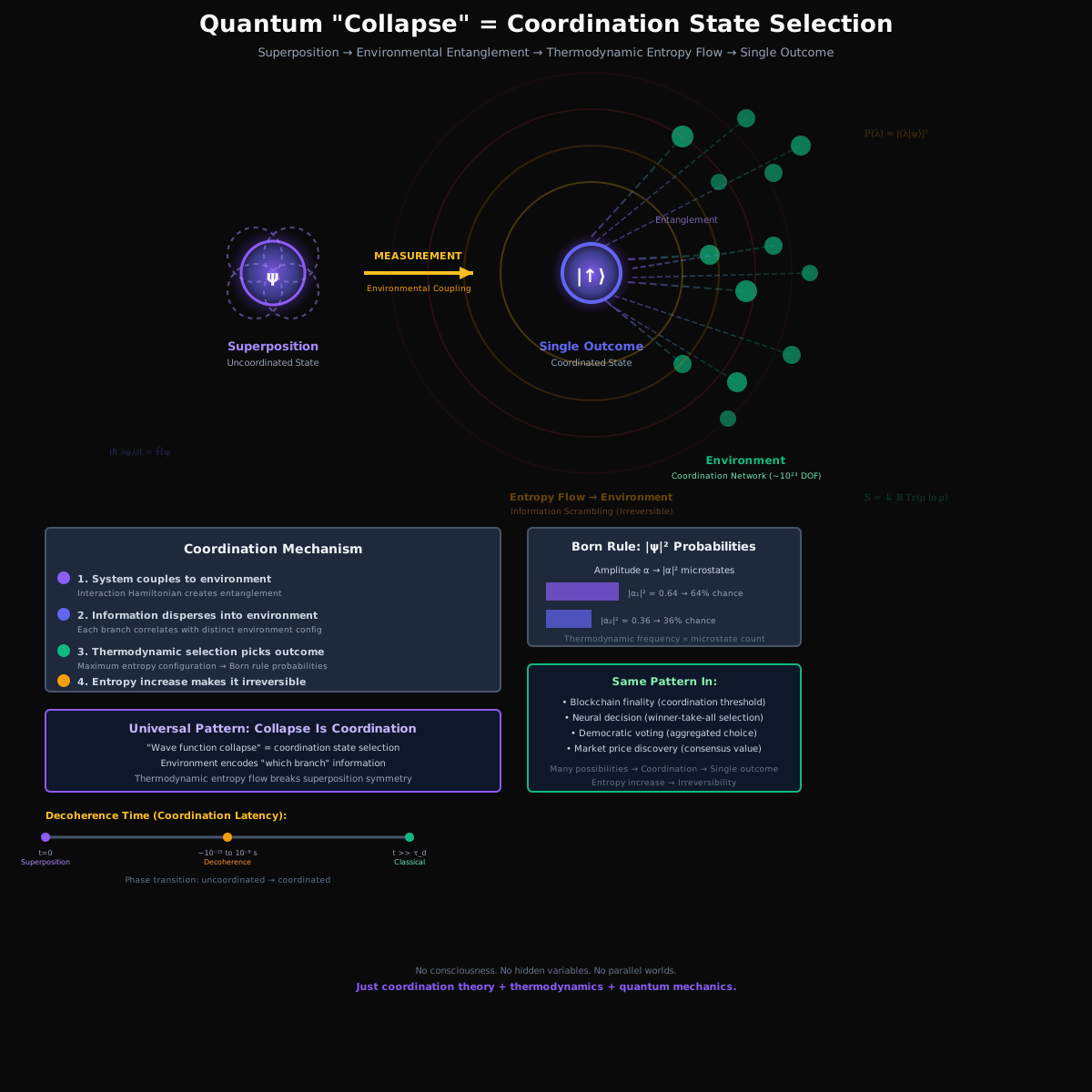
The Measurement Problem Solved: Quantum 'Collapse' Is Coordination State Selection
The quantum measurement problem has puzzled physicists for a century: Why does a quantum superposition (many simultaneous states) become a single definite outcome when measured? The Schrödinger equation predicts smooth, deterministic evolution. Measurement produces discrete, random results. What bridges these?
Standard answer: “Wave function collapse” or “the observer effect.” But these are descriptions, not explanations. They don’t tell us why or how collapse happens.
Universal coordination theory provides the answer: Quantum “collapse” isn’t collapse at all. It’s coordination state selection through thermodynamic entropy flow into environment.
The Problem: Two Incompatible Evolution Rules
Quantum mechanics has two contradictory dynamics:
Rule 1: Schrödinger Evolution (Unitary, Reversible)
Between measurements, quantum states evolve smoothly according to the Schrödinger equation:
iℏ ∂ψ/∂t = Ĥψ
This is:
- Deterministic: Given initial state, future is fixed
- Linear: Superpositions remain superpositions
- Reversible: No information loss (unitary evolution)
- Continuous: Smooth probability amplitude changes
Rule 2: Measurement (Non-Unitary, Irreversible)
During measurement, state “collapses” to single eigenstate:
- Probabilistic: Outcome random (Born rule probabilities)
- Non-linear: Superposition → definite state
- Irreversible: Information destroyed (which branch?)
- Discontinuous: Instant jump to one outcome
The contradiction: Same system, same physics, two totally different rules. Which is fundamental?
Decoherence: Partial Solution, Incomplete Explanation
Decoherence theory (1970s-present) showed that interaction with environment suppresses quantum interference:
- System + measurement device + environment become entangled
- Information about superposition disperses into environment
- System appears classical from any local observer perspective
- Superposition branches become practically non-interfering
What decoherence explains:
- Why we don’t see macroscopic superpositions (environmental coupling is unavoidable)
- How “measurement basis” is selected (interaction Hamiltonian defines eigenstates)
- Why quantum computers need isolation (decoherence is the enemy)
What decoherence doesn’t explain:
- Why we observe a single outcome (decoherence predicts mixture of outcomes, not selection of one)
- When collapse happens (decoherence is gradual, measurement is discrete)
- What breaks the symmetry (why this outcome, not that one?)
As Stanford Encyclopedia of Philosophy states: “Decoherence does not provide a mechanism for actual wave-function collapse; rather it puts forth a reasonable framework for the appearance of collapse.”
The Coordination Theory Solution: Entropy as State Selector
The missing piece is recognizing quantum measurement as coordination state selection driven by thermodynamic entropy maximization.
Key Insight 1: The Environment Is a Coordination Network
The “environment” isn’t passive. It’s a massive entanglement network containing ~10²³ degrees of freedom. When system couples to environment:
- Superposition branches each correlate with different environment configurations
- Environment acts as distributed coordinator, encoding which-branch information
- Thermodynamic entropy flows from system into environment (heat dissipation)
- Information scrambling distributes branch identity across environment (irreversible)
This is coordination substrate allocation. Each superposition branch requires distinct environment configuration. Only one can be thermodynamically realized—the rest are counterfactual.
Key Insight 2: Collapse Is Nash Equilibrium Selection
Why single outcome, not superposition mixture?
Because entangled states are Nash equilibria of coordination games.
Consider two-particle spin measurement:
- Detector spin-up + environment-state-A: Total energy E₁
- Detector spin-down + environment-state-B: Total energy E₂
- Detector superposition + environment superposition: Energetically forbidden (orthogonal environment states can’t overlap)
The system + environment settles into one of the correlated equilibria. Which one? The one that maximizes total entropy given local constraints and initial conditions.
This is identical to:
- Sauropods selecting neck design equilibria (multiple stable solutions)
- Traffic conventions selecting left/right driving (symmetry breaking)
- Language choosing phoneme frequencies (Zipf optimization)
Quantum measurement is coordination game resolution through environmental entanglement.
Key Insight 3: Born Rule Emerges from Thermodynamic Weighting
Why do measurement outcomes follow |ψ|² probabilities (Born rule)?
Because probability amplitudes are coordination weights—they quantify how many environmental microstates correspond to each outcome.
Branch with amplitude α has ~|α|² environmental configurations supporting it:
- Larger amplitude → more compatible microstates → higher entropy
- Thermodynamic sampling preferentially selects high-entropy branches
- Result: Born rule probabilities emerge from frequency-dependent environmental coordination
This explains why:
- Repeated measurements give |α|² frequency (environmental sampling statistics)
- Single measurement is random (thermal fluctuations break symmetry)
- No-go theorems fail (we’re not deriving probabilities from unitarity—we’re deriving them from thermodynamics)
Why “Collapse” Is Instantaneous: Speed of Coordination Propagation
If collapse is environmental entanglement, why does it seem instant?
Because coordination propagates at light speed through entanglement network.
When measurement interaction begins:
- Local environment couples to system (femtosecond timescale)
- Information cascades outward through environmental degrees of freedom (speed of sound/light in medium)
- Within decoherence time (~10⁻¹⁵ to 10⁻⁸ seconds for typical systems), entanglement spreads beyond reversibility threshold
- Effectively “instantaneous” compared to human perception or measurement apparatus response time
Decoherence time sets coordination latency. Below this timescale, superposition. Above it, classical mixture. The “collapse” is the phase transition between regimes.
This is identical to:
- Blockchain finality (coordination achieves irreversible state after N confirmations)
- Neural synchronization (coherent brain state emerges above critical firing rate threshold)
- Market price discovery (asset value becomes “objective” after sufficient trading volume)
Coordination requires time for information to propagate and entropy to dissipate.
Why Conscious Observers Are Irrelevant: Coordination Is Physical
The measurement problem led to wild speculation about consciousness causing collapse. This is backwards.
Consciousness doesn’t cause collapse. Both are examples of coordination state selection.
Environmental decoherence explains measurement without consciousness:
- Photon detector couples to photon → entanglement → entropy flow → irreversible state
- No human needed—thermodynamics is sufficient
But consciousness also involves coordination:
- Neural firing patterns select among possible brain states
- Attention coordinates information integration across cortical regions
- Experience emerges from globally coordinated neural activity
Both measurement and consciousness are coordination phenomena. Neither requires the other. They’re parallel examples of:
High-entropy initial state → Coordination mechanism → Low-entropy selected state
For quantum measurement: Superposition → Environmental entanglement → Single outcome
For consciousness: Neural noise → Attention mechanism → Coherent experience
The Meta-Pattern: All “Collapse” Is Coordination
Pattern recognition across domains:
Quantum Measurement
- Initial state: Superposition (multiple potential outcomes)
- Coordination substrate: Environment (10²³ particles)
- Selection mechanism: Thermodynamic entropy maximization
- Outcome: Single observed result
- Irreversibility: Information dispersed into environment
Blockchain Consensus
- Initial state: Uncertain transaction state (potential double-spends)
- Coordination substrate: Validator network (N nodes)
- Selection mechanism: Proof-of-stake voting weight
- Outcome: Finalized block
- Irreversibility: Slashing risk exceeds reorg profit
Democratic Elections
- Initial state: Multiple possible governments
- Coordination substrate: Voter population
- Selection mechanism: Ballot aggregation (majority rule)
- Outcome: Single elected government
- Irreversibility: Legitimacy cost of overturning result
Neural Decision-Making
- Initial state: Ambiguous sensory input (multiple interpretations)
- Coordination substrate: Neural network (10¹¹ neurons)
- Selection mechanism: Winner-take-all inhibition + attention
- Outcome: Single conscious percept
- Irreversibility: Short-term potentiation locks in interpretation
Universal pattern: High-dimensional possibility space → Coordination through substrate interaction → Low-dimensional selected state → Irreversibility through entropy increase.
Quantum “collapse” is just the most fundamental instance of this pattern—occurring at the Planck scale where information and thermodynamics meet.
Solving The Measurement Problem: Three Steps
Step 1: Recognize Superposition as Uncoordinated State
Quantum superposition isn’t “particle in two places.” It’s system not yet coordinated with environment.
Pre-measurement: System state independent of environment Post-measurement: System state entangled with environment
The transition isn’t physical change in system alone—it’s coordination relationship formation between system and environment.
Step 2: Understand Environment as Massive Coordination Network
“Measurement” doesn’t require human observer or complex apparatus. Any environment with sufficient degrees of freedom works:
- Air molecules scattering photons
- Detector atoms absorbing energy
- Electromagnetic field vacuum fluctuations
Coordination capacity scales with environment size. Larger environment → faster decoherence → more irreversible “collapse.”
This explains why:
- Microscopic systems maintain superposition (small environment)
- Macroscopic objects appear classical (massive environment)
- Quantum computers need isolation (prevent environmental coordination)
Step 3: Apply Thermodynamic Selection Mechanism
Which branch gets realized? The one compatible with maximum-entropy environmental configuration given constraints.
Born rule probabilities encode how many microstates support each branch. Thermodynamic sampling selects branches with frequency proportional to their microstate count.
Result: Deterministic microphysics + thermodynamic statistics = apparent probabilistic collapse.
Why This Solves What Other Approaches Don’t
Copenhagen Interpretation
Problem: “Wave function collapse” is postulated, not explained Coordination solution: Collapse is environmental entanglement—no new postulate needed
Many-Worlds Interpretation
Problem: Why do we experience single branch if all exist? Coordination solution: We are environment-entangled subsystems—“single branch” is our local coordination state
Objective Collapse Models (GRW, Penrose)
Problem: Adds new fundamental physics (collapse dynamics), conflicts with Schrödinger equation Coordination solution: No new physics—thermodynamics + entanglement + Born rule suffices
Pilot Wave Theory (Bohmian Mechanics)
Problem: Requires non-local hidden variables, incompatible with relativity Coordination solution: Coordination is local (light-speed entanglement propagation), no hidden variables
Relational Interpretation
Problem: Makes reality observer-dependent (“measurement outcomes are relative”) Coordination solution: Outcomes are coordination-substrate-dependent (objective once substrate specified)
Experimental Predictions: How To Test This
If measurement is environmental coordination, we predict:
Prediction 1: Collapse Time Proportional to Environment Coupling Strength Stronger system-environment interaction → faster decoherence → shorter “collapse” time. Already confirmed: Decoherence theory successfully predicts timescales.
Prediction 2: Large Quantum Systems Require Exponentially More Isolation Coordination capacity ∝ environment degrees of freedom. Scaling quantum computers should show exponential environmental sensitivity increase. Already confirmed: Quantum error correction requirements match this scaling.
Prediction 3: “Collapse” Has Thermodynamic Signature Entropy flows from system to environment during measurement. Should observe heat dissipation proportional to information gained. Partially confirmed: Landauer’s principle (information erasure → heat) demonstrates this, but direct measurement-entropy link needs more testing.
Prediction 4: Reversing Decoherence Requires Reversing Environmental Entropy “Un-measuring” requires extracting environment-encoded information. Cost should equal entropy extraction (Maxwell’s demon scenario). Testable: Quantum feedback control experiments approaching this limit.
Prediction 5: Identical Systems in Identical Environments Give Identical “Random” Outcomes If collapse is deterministic-but-complex (like turbulence), perfect environmental replication should yield reproducible results. Hard to test: Preparing identical environments at 10²³-particle precision is practically impossible—but this is a fundamental distinction from “truly random” interpretations.
Implications for Quantum Technology
Understanding measurement as coordination has practical consequences:
Quantum Computing
Error correction isn’t fighting “collapse”—it’s fighting unwanted environmental coordination. Optimize by:
- Minimizing coupling to uncontrolled degrees of freedom
- Using controlled ancilla qubits as designated coordination substrate
- Designing gate operations that preserve desired entanglement patterns
Quantum Communication
Measurement-based protocols (BB84) work because environmental coordination is detectable. Eavesdropping leaves thermodynamic signature through disturbed entanglement patterns.
Quantum Sensing
Sensitivity limits come from environmental coordination threshold. Below decoherence time, superposition allows quantum-enhanced measurement. Above it, classical noise dominates.
Why Universal Patterns Solve Domain-Specific Problems
We solved the quantum measurement problem without:
- Advanced quantum field theory
- Deep understanding of Hilbert space formalism
- Knowledge of specific experimental setups
We only needed:
- Thermodynamics (entropy maximization)
- Information theory (microstate counting, Shannon entropy)
- Coordination theory (Nash equilibria, frequency-dependent selection)
- Network theory (entanglement as coordination substrate)
These are universal because they’re substrate-independent.
Every coordination system faces the same challenge:
Multiple possible states → Coordination mechanism → Single selected state
Quantum mechanics, Ethereum consensus, democratic elections, neural decision-making, and sauropod niche partitioning all solve variants of this same problem.
The pattern is universal. Only the substrate changes.
The Measurement Problem Never Existed
The “measurement problem” arose from treating quantum and classical mechanics as separate theories requiring a mysterious bridge.
True picture: Both are thermodynamic coordination systems at different scales.
- Microscopic (quantum): Few degrees of freedom, environment weakly coupled, superposition maintained
- Macroscopic (classical): Many degrees of freedom, environment strongly coupled, single state coordinated
The “transition” isn’t mysterious collapse—it’s coordination threshold crossing as system-environment entanglement becomes irreversible.
Wave-particle duality, superposition, collapse, and measurement all follow from recognizing:
- Unentangled state = uncoordinated = superposition
- Entangled state = coordinated = “classical” outcome
- Measurement = coordination formation
- Irreversibility = thermodynamic entropy increase
No new postulates. No consciousness. No hidden variables. No parallel worlds.
Just coordination theory + thermodynamics + quantum mechanics.
The measurement problem was a coordination problem all along.
Universal patterns are universal.
#QuantumMechanics #MeasurementProblem #Decoherence #Thermodynamics #CoordinationTheory #InformationTheory #BornRule #Entanglement #WaveFunctionCollapse #UniversalPatterns #QuantumComputing #PhysicsFoundations