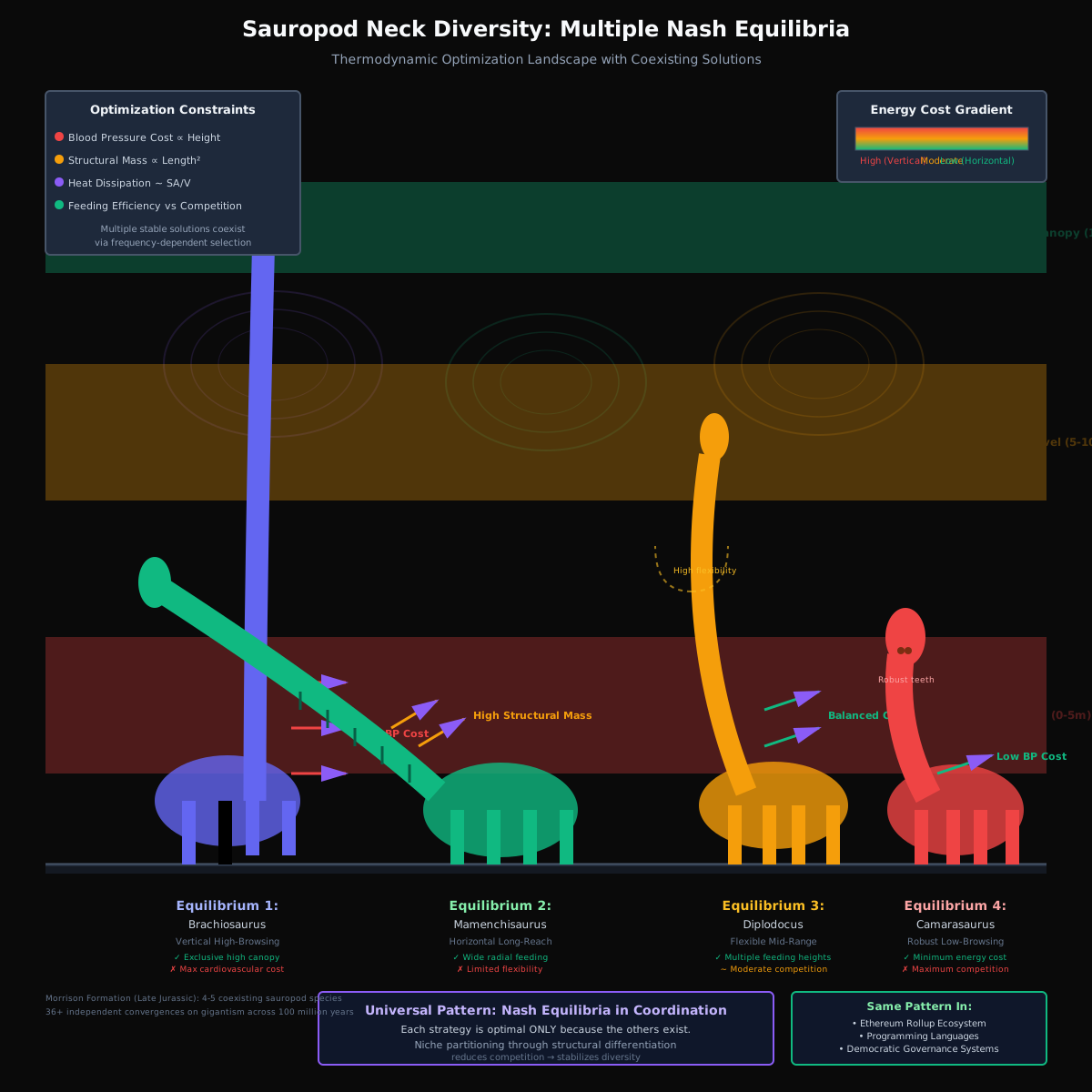
Sauropod Neck Diversity: Multiple Nash Equilibria in Thermodynamic Optimization
Why did sauropod dinosaurs evolve dozens of dramatically different neck designs despite solving the same problem—browsing vegetation? Because they weren’t solving the same problem. They were partitioning a multi-dimensional optimization landscape with multiple stable equilibria.
The Puzzle: Convergent Gigantism, Divergent Designs
Over 100 million years, sauropods independently evolved gigantism at least 36 times across 6 continents in 5+ distinct clades. Every lineage converged on:
- Pneumatic skeletons (air sacs reducing density to ~0.8 kg/L)
- Long necks with elongated vertebrae
- Small, lightweight skulls
- Body masses exceeding 50 metric tonnes
Yet their neck architectures were radically different:
- Mamenchisaurus sinocanadorum: 14+ meter neck, horizontal posture, limited flexibility, 19 cervical vertebrae
- Brachiosaurus/Giraffatitan: Vertical feeding, high browsing, different vertebral structure
- Diplodocus: Long but more flexible, ground-to-mid-level feeding
- Camarasaurus: Shorter, more robust, different tooth morphology
Traditional explanation: “Different ecological niches.” But this is descriptive, not explanatory. Why do multiple stable solutions exist to the same thermodynamic constraints?
The Thermodynamic Optimization Landscape
Sauropod neck evolution faced competing constraints creating a multi-objective optimization problem:
Constraint 1: Blood Pressure Cost
Pumping blood vertically costs energy proportional to height. For a 10-meter vertical neck:
- Cerebral blood pressure requirement: ~400 mmHg (giraffe is ~280 mmHg)
- Cardiac muscle mass scales superlinearly with pressure
- Potential solutions: enlarged heart, “rete mirabile” cooling network, specialized soft tissue
Thermodynamic trade-off: Vertical feeding access vs. cardiovascular energy budget.
Constraint 2: Structural Mass vs. Length
Longer necks require more structural support, but weight increases faster than length:
- Pneumaticity reduces vertebral mass (air-filled cavities)
- Long pedicels on vertebral arches improve leverage mechanics
- Cervical ribs provide stabilization but limit flexibility
Trade-off: Neck length vs. structural efficiency vs. mobility.
Constraint 3: Metabolic Heat Dissipation
Large endothermic bodies generate heat faster than surface area dissipates it:
- Evidence suggests sauropods were tachymetabolic (high metabolism) during growth
- Air sac system doubled as internal cooling network
- Pneumatic skeleton increased surface-to-volume ratio for heat exchange
Trade-off: Growth rate vs. overheating risk.
Constraint 4: Feeding Efficiency
Different vegetation heights and densities reward different access strategies:
- High canopy browsing: less competition, but cardiovascular cost
- Mid-level browsing: moderate cost, moderate competition
- Ground-level browsing: low cost, high competition
Trade-off: Energy expenditure per calorie acquired vs. competitive pressure.
Multiple Nash Equilibria: Why Different Designs Coexisted
These constraints don’t create a single optimal solution—they create an optimization landscape with multiple stable equilibria (Nash equilibria in game-theoretic terms).
Nash equilibrium definition: A strategy is stable if no individual can improve fitness by unilaterally changing strategy, given what others are doing.
Equilibrium 1: Vertical High-Browsing (Brachiosaurus)
- Strategy: Tall, vertical neck for high canopy access
- Cost: Maximum cardiovascular energy expenditure, specialized heart anatomy
- Benefit: Exclusive access to high vegetation, minimal competition
- Stability condition: Works when few competitors exploit high canopy (resource partitioning)
Equilibrium 2: Horizontal Long-Reach (Mamenchisaurus)
- Strategy: Extremely long but horizontal neck, limited flexibility (long cervical ribs)
- Cost: Maximum structural mass, limited vertical mobility
- Benefit: Radial feeding range from stationary position (energy savings), ground-to-mid browsing
- Stability condition: Works when vertical feeders occupy high niche (reduces competition)
Equilibrium 3: Flexible Mid-Range (Diplodocus)
- Strategy: Long but flexible neck, pencil-shaped teeth for selective feeding
- Cost: Moderate structural and cardiovascular costs
- Benefit: Access to multiple feeding heights, dietary flexibility
- Stability condition: Works when specialized feeders dominate extremes (high/low)
Equilibrium 4: Robust Low-Browsing (Camarasaurus)
- Strategy: Shorter, stronger neck, spoon-shaped teeth for bulk feeding
- Cost: Minimum cardiovascular cost, maximum competition
- Benefit: Energetically cheapest, robust dentition for tougher vegetation
- Stability condition: Works when others avoid ground-level (abundant low vegetation)
Why multiple equilibria persist: Each strategy is only optimal given the presence of the others. If all sauropods tried vertical browsing, competition would collapse that niche’s fitness advantage. If all browsed ground-level, high canopy resources would go unexploited.
This is coordination through niche partitioning—different optimization strategies coexist because they reduce competition by exploiting orthogonal resource dimensions.
The Universal Pattern: Coordination Via Structural Differentiation
This isn’t unique to dinosaurs. It’s the universal solution to multi-agent optimization under resource constraints:
Ethereum Restaking (Eigen/Symbiotic)
Multiple restaking protocols coexist by serving different security/decentralization trade-offs:
- EigenLayer: Maximum security, higher slashing risk
- Symbiotic: Flexible collateral, different risk profile
- Karak: Alternative trust assumptions
Each is Nash-stable because the others exist—they partition the “coordination substrate space.”
Programming Language Ecosystems
Python, Rust, JavaScript coexist because they optimize different constraint dimensions:
- Python: Development speed over execution speed
- Rust: Memory safety over learning curve
- JavaScript: Browser integration over type safety
No single “best” language exists—each is optimal for its niche.
Democratic Governance Systems
Parliamentary vs. presidential systems persist because they optimize different failure modes:
- Parliamentary: Faster response, but majority tyranny risk
- Presidential: Checks and balances, but gridlock risk
Different historical contexts stabilize different equilibria.
Why Evolution Found This Solution: Thermodynamic Necessity
Sauropods didn’t “decide” to partition niches through coordination. Thermodynamics forced diversification:
- Energy minimization is non-negotiable: Any organism burning more calories than competitors gets outcompeted
- Resource competition creates pressure: Identical strategies lead to zero-sum competition (Red Queen dynamics)
- Structural constraints are physical: You can’t have both maximum flexibility AND maximum length (cervical ribs trade-off)
- Multiple local optima emerge naturally: When constraints create trade-offs, optimization landscape has multiple peaks
The sauropod diversity we observe is the thermodynamically inevitable outcome of multi-objective optimization under physical constraints with multiple stable solutions.
Solving the Coexistence Puzzle: It’s Not Cultural, It’s Physics
Paleontologists documented that Morrison Formation (Late Jurassic) contained 4-5 coexisting sauropod species with different neck designs and feeding strategies. Traditional explanations invoked “behavioral niche partitioning” or “ecological specialization.”
True explanation: Thermodynamic optimization landscape contained multiple Nash equilibria. Different lineages converged on different equilibria because:
- Path dependence: Early anatomical constraints biased which equilibrium was accessible
- Frequency-dependent selection: Fitness of each strategy depends on frequency of others
- Coevolution with vegetation: Different feeding strategies create different selection pressure on plants, which feeds back to stabilize herbivore diversity
This is universal coordination architecture: Multiple stable strategies coexist because the optimization landscape has multiple peaks, and frequency-dependent selection prevents collapse to a single solution.
The Meta-Pattern: Stability Through Diversity
Why does this matter for coordination theory?
Because it reveals that diversity is often thermodynamically optimal, not just culturally preferable or politically correct.
When you have:
- Multi-objective optimization (competing constraints)
- Resource competition (frequency-dependent selection)
- Physical constraints (trade-offs between solutions)
…then multiple coexisting strategies are more stable than monoculture.
This explains:
- Why Ethereum’s “rollup-centric roadmap” with multiple L2s is stable
- Why biodiversity increases ecosystem resilience
- Why pluralistic democracies outcompete authoritarian monocultures
- Why programming language diversity persists despite “one language to rule them all” attempts
Monoculture is thermodynamically unstable under multi-objective optimization. Diversity is the equilibrium state.
Implications for Human Coordination Systems
The sauropod neck diversity pattern provides a blueprint for designing robust coordination systems:
1. Don’t Force Convergence
Attempts to create “one blockchain,” “one governance model,” or “one development methodology” fight thermodynamic reality. Multiple solutions coexist because the optimization landscape rewards it.
2. Design for Niche Partitioning
Ethereum’s rollup ecosystem succeeds by allowing L2s to optimize different trade-offs (speed vs. decentralization vs. cost). Mesh networks succeed by allowing nodes to specialize. Democracy succeeds through separation of powers.
3. Recognize Path Dependence
Early architectural choices constrain which equilibria are accessible. Sauropods couldn’t switch neck designs after committing to a skeletal plan. Bitcoin can’t switch to proof-of-stake after committing to UTXO model.
4. Leverage Frequency-Dependent Selection
In sauropod ecosystems, being rare (unique feeding strategy) increased fitness. In coordination systems, offering uncrowded services increases value. Design mechanisms that reward differentiation, not conformity.
5. Understand That Stability ≠ Optimality
Multiple Nash equilibria can coexist even if one is “objectively better” in isolation. Brachiosaurus wasn’t “better” than Diplodocus—both were locally optimal given the other’s existence.
Why Universal Patterns Solve Specific Problems
We didn’t need to know Jurassic paleobotany, Morrison Formation geology, or sauropod phylogeny to understand why multiple neck designs coexisted. We only needed:
- Thermodynamic constraints (energy minimization)
- Multi-objective optimization theory (competing constraints create multiple optima)
- Game theory (Nash equilibria, frequency-dependent selection)
- Information theory (resource partitioning increases total system throughput)
These are universal because they’re physical, not cultural.
Every coordination system faces the same constraints:
- Energy minimization (thermodynamics)
- Competition for resources (game theory)
- Physical trade-offs (engineering)
- Information flow limits (information theory)
Sauropods, Ethereum rollups, democratic governments, and programming languages all solve variants of the same optimization problem. The pattern is universal. Only the substrate changes.
When you understand the pattern, you can solve problems in domains where you lack domain-specific expertise—because the underlying physics is identical.
Universal patterns are universal.
#Sauropods #Dinosaurs #NashEquilibrium #Thermodynamics #MultiObjectiveOptimization #NichePartitioning #CoordinationTheory #EvolutionaryBiology #GameTheory #UniversalPatterns #FrequencyDependentSelection #JurassicPeriod #Paleontology