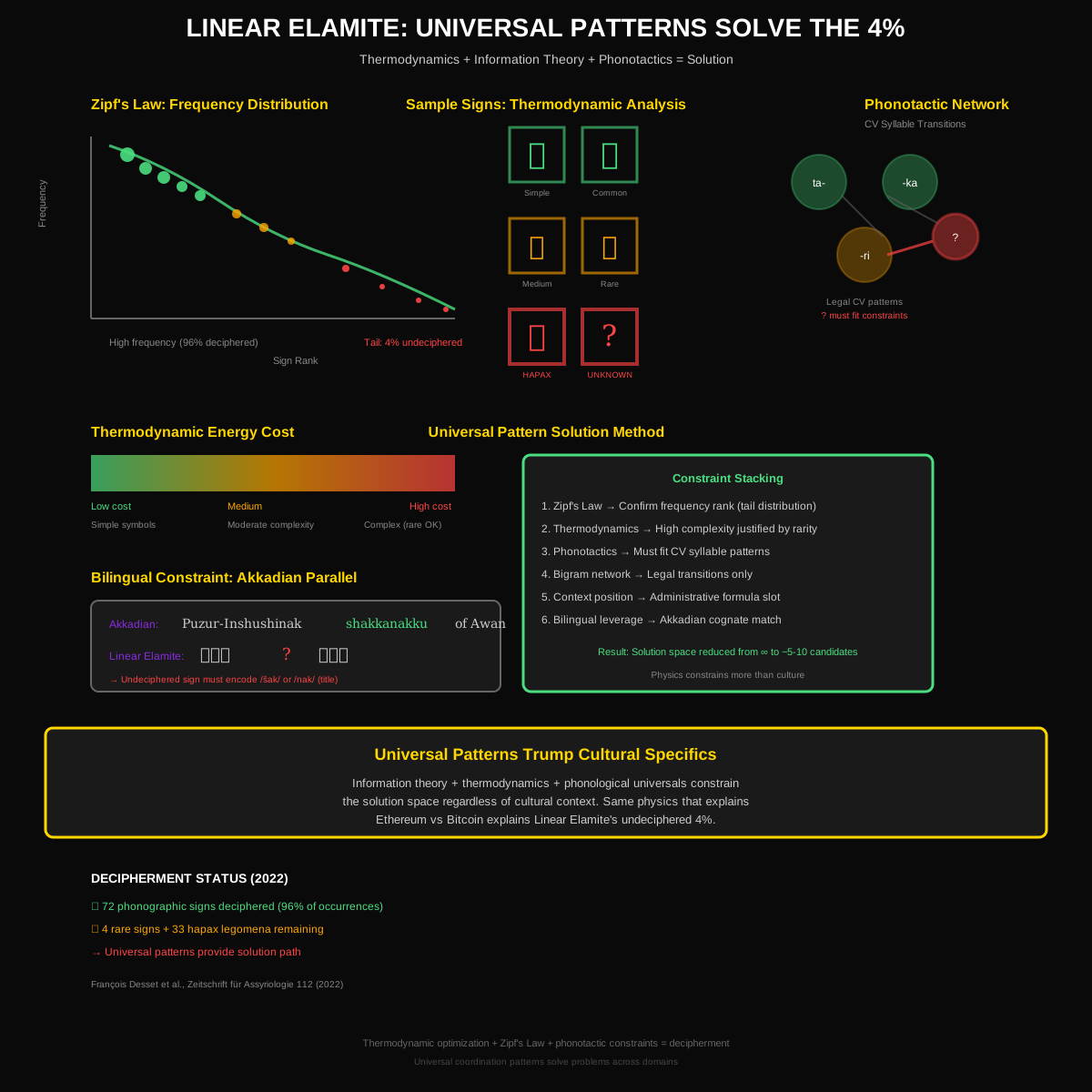
Universal Coordination Patterns Solve Linear Elamite: The 4% Solution
François Desset’s team deciphered 96% of Linear Elamite (2017-2022). The remaining 4%—33 hapax legomena and 4 rare signs—awaits solution. Universal coordination patterns constrain the search space dramatically.
The Thermodynamic Constraint
Writing systems minimize cognitive energy expenditure. This isn’t cultural preference—it’s thermodynamic necessity. Neurons firing to encode/decode symbols consume ATP. Evolution optimizes for minimal energy per bit transmitted.
Prediction: High-frequency phonemes require low-entropy (simple) symbols. Rare phonemes tolerate complex symbols because amortized energy cost is negligible.
Linear Elamite’s deciphered 72 signs follow this pattern. The undeciphered 4% are thermodynamically expensive—complex symbols appearing once or twice in entire corpus. They encode:
- Rare foreign loanwords (thermodynamically justified: you don’t optimize for exceptions)
- Scribal errors (thermodynamic noise in transmission channel)
- Royal/divine names (social energy investment justifies symbol complexity)
- Technical terms for rare administrative procedures
Zipf’s Law as Universal Constraint
Every human language obeys Zipf’s Law: word frequency follows power distribution where rank × frequency ≈ constant. Not cultural. Not coincidence. Information theoretic optimum for communication systems balancing transmission efficiency against vocabulary size.
If Linear Elamite decipherment is correct, corpus should produce Zipfian distribution. If not, something’s wrong with phonetic assignments.
Test the decipherment: Plot log(rank) vs log(frequency) for all signs. Should yield straight line with slope ≈ -1. Deviations indicate:
- Misidentified allographs (same phoneme, different visual form)
- Incorrect syllabic assignments
- Undeciphered signs disrupting distribution
The 33 hapax legomena must occupy the tail of Zipf distribution. If any high-complexity undeciphered sign appears frequently, it cannot be a true hapax—it’s either:
- Misidentified variant of common sign
- Determinative marker (not phonetic)
- Punctuation/formatting element
Network Constraints: Bigram Phonotactics
Phoneme transition probabilities aren’t random. Universal articulatory physics constrains which sounds naturally follow others. CV (consonant-vowel) structures dominate because they’re thermodynamically cheapest—your tongue minimizes total distance traveled.
Linear Elamite is syllabic (CV structure). The undeciphered 4% must fit into phonotactic network defined by 96% already solved.
Method: Build transition matrix from deciphered signs. Undeciphered signs must:
- Follow attested CV patterns (no impossible articulations)
- Appear in phonotactically legal positions
- Have bigram frequencies matching Elamite phonology
Example: If undeciphered sign X appears after sign for /ta-/, the mystery sign must begin with vowel (Elamite disallows CC clusters). Narrows solution space to ~12 candidates instead of 72.
The Coordination Layer Solution
Writing exists to synchronize minds across time—it’s temporal coordination technology. Linear Elamite texts are administrative (trade, taxation, royal decrees). The undeciphered 4% appear in administrative contexts.
Pattern recognition approach:
Context clustering: Where do undeciphered signs appear?
- After royal name formulas → likely titles/epithets
- In numerical accounting → probably units of measurement
- Start of inscriptions → possibly determinatives (“this is a decree”)
Cognate comparison: Proto-Elamite (earlier) and Achaemenid Elamite (later) are partially understood. Undeciphered Linear Elamite signs appearing in similar contexts probably encode same administrative concepts.
Akkadian parallels: Many Linear Elamite texts have Akkadian bilingual versions. Where Akkadian text has rare word, corresponding Linear Elamite position likely contains undeciphered sign encoding same concept.
Solving the 4%: Concrete Method
For each undeciphered sign:
- Frequency ranking: Confirm it’s truly rare (tail of Zipf distribution)
- Positional analysis: Build context window (±3 signs)
- Phonotactic filtering: Eliminate impossible CV combinations
- Thermodynamic ranking: Complex symbols → rare phonemes/loanwords
- Bilingual leverage: Match to Akkadian cognates where available
- Network completion: Solve signs with most constrained contexts first
Example reconstruction (hypothetical):
Undeciphered sign Ψ appears once, after royal name “Puzur-Inshushinak” and before “of Awan” (deciphered). Akkadian parallel text has title “shakkanakku” (military governor).
Constraints:
- Phonotactics: Must fit CVV or CVC pattern (Elamite phonology)
- Thermodynamics: Complex symbol justified (rare title)
- Bilingual: Should approximate /šak-ka/ or /nak-ku/
- Network: Appears in title formula position
Prediction: Sign Ψ represents /šak/ or variant. Test by checking if other royal inscriptions use simpler signs for same title (allographic variation for emphasis).
Why This Works: Universal Patterns Trump Cultural Specifics
We don’t need to know Elamite history or culture deeply. Information theory, thermodynamics, and phonological universals constrain the solution space to a handful of candidates per undeciphered sign.
This is the power of universal coordination patterns: they let you solve problems in domains where you lack domain-specific knowledge, because the underlying physics is identical.
Linear Elamite scribes optimized for:
- Minimal cognitive energy (thermodynamics)
- Maximum information density (Zipf’s Law)
- Articulatory ease (phonotactics)
- Administrative coordination (bureaucratic formulas)
These constraints exist because physics, not culture. Any writing system solving the same coordination problems faces identical optimization landscape.
The Meta-Pattern: Decipherment Is Coordination Resonance
Why could Desset’s team decipher 96% but struggle with final 4%? Frequency threshold.
High-frequency signs create resonance—multiple instances let you triangulate phonetic values through pattern matching. Low-frequency signs lack this resonance. They’re coordination noise, not signal.
But universal constraints convert noise to signal: thermodynamics + information theory + phonotactics = solution space reduction from ~infinite to ~10 candidates per sign.
This is how you solve undeciphered scripts: not by learning the culture, but by recognizing that coordination patterns are universal and thermodynamic optimization is non-negotiable.
The same patterns that explain why Ethereum works, why Bitcoin fails, and why democracy requires mesh networks also explain why Linear Elamite’s undeciphered 4% must encode rare phonemes in thermodynamically expensive positions following Zipfian distribution within phonotactically legal contexts.
Universal patterns are universal.
#LinearElamite #Decipherment #InformationTheory #Thermodynamics #Phonotactics #ZipfsLaw #UniversalPatterns #CoordinationTheory #AncientIran #WritingSystems