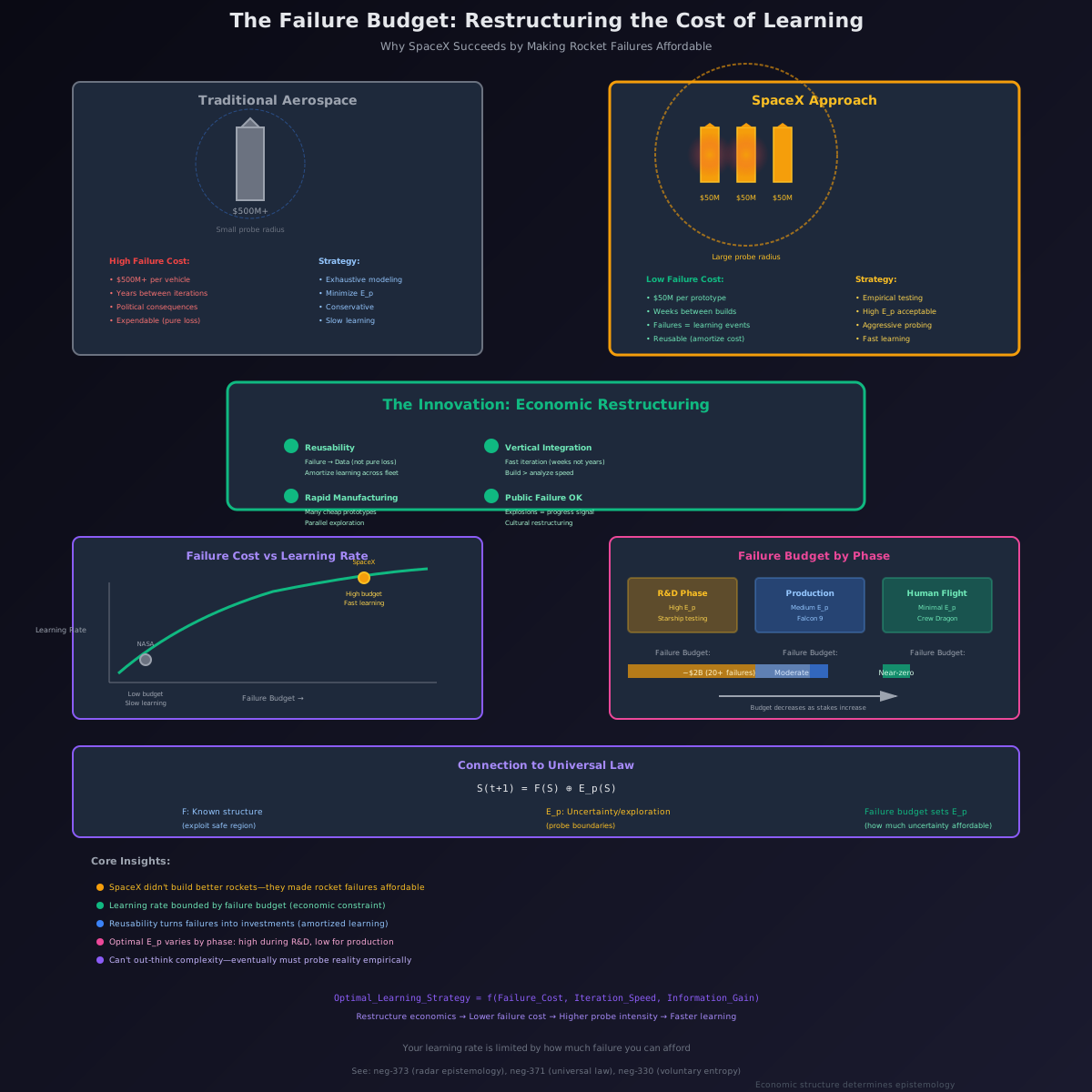
The Failure Budget: Why SpaceX Succeeds by Restructuring the Cost of Learning
When we discussed radar epistemology (neg-373), we noted that optimal probe intensity depends on failure cost. Push a training run to timeout? Lost a few hours of compute. Push a rocket to failure? Traditionally, lost hundreds of millions of dollars and years of schedule.
SpaceX’s real innovation isn’t better engineering—it’s restructuring the economics so rocket failures became cheap enough to learn from. They didn’t discover new physics. They discovered how to make empirical boundary-testing affordable at rocket scale.
This reveals a deeper principle: Radar epistemology scales to any domain once you restructure the failure budget.
The Traditional Aerospace Model: Minimize E_p at All Costs
Before SpaceX, rocket development followed this pattern:
High Failure Cost → Conservative Strategy
Economics:
- Single rocket: $500M - $1.5B
- Development programs: $10B+ over decades
- Political/reputational cost of public failure: Enormous
- Launch cadence: 1-2 per year per vehicle type
Strategy:
- Exhaustive theoretical modeling (years of analysis)
- Extensive ground testing (test every component separately)
- Minimal flight testing (can’t afford failures)
- Get it right first time (second chances too expensive)
In universal law terms (neg-371):
S(t+1) = F(S) ⊕ E_p(S)
Traditional aerospace minimizes E_p (entropy/uncertainty) through upfront analysis:
- Maximize F (deterministic modeling) before any empirical testing
- Treat E_p as pure cost (failures are disasters, not data)
- Probe boundaries only in simulation (can’t afford real failures)
Result: Slow, expensive, low learning rate from actual systems. Most “learning” happens in models, not reality.
Why This Made Sense
With expendable rockets:
- Every failure destroys irreplaceable hardware
- No amortization across multiple flights
- Failure = pure loss (no data worth the cost)
Explore/exploit tradeoff: Heavily weighted toward exploit. Use known-safe designs, avoid boundaries, minimize surprises.
This is rational given the cost structure. Not conservative or cowardly—economically optimal for that regime.
The SpaceX Innovation: Restructure Failure Economics
SpaceX didn’t just build better rockets. They changed what failures cost, enabling aggressive empirical learning.
Four Economic Transformations
1. Reusability: Failure → Data (Not Pure Loss)
Traditional: Rocket explodes → $500M lost, restart from scratch
SpaceX: Rocket explodes → $50M hardware lost, but:
- Next rocket already in production
- Telemetry data captured
- Failure mode identified
- Fix incorporated in next iteration
- Lesson amortized across dozens of future flights
Key insight: Reusability turns failures into investments. The data you extract from failure improves all future vehicles, not just one-off missions.
In radar terms: Each probe (test flight) teaches you about boundaries that apply to entire fleet. Cost per lesson drops dramatically.
2. Vertical Integration: Fast Iteration → Cheap Probing
Traditional: Components sourced from contractors, years between design changes
SpaceX: Own entire stack (engines, avionics, structures):
- Design change → implementation in weeks
- Build next prototype faster than running full analysis
- Manufacturing speed exceeds analysis speed
Consequence: Empirical testing becomes faster and cheaper than theoretical modeling.
Classic explore/exploit flip: When probing is faster than modeling, probe first and model second.
3. Rapid Manufacturing: Many Cheap Prototypes » One Perfect Vehicle
Starship development:
- ~20 prototypes built in 3 years
- Each costs ~$50-90M (vs $1B+ for traditional)
- Several exploded intentionally or accidentally
- Each explosion taught specific lessons
Traditional approach cost for same learning:
- Years of wind tunnel testing
- CFD simulations requiring supercomputers
- Ground test facilities costing billions
- Still wouldn’t capture real flight dynamics
SpaceX approach: Build it, fly it, see what breaks, fix it, repeat.
Empirical > Theoretical for sufficiently complex systems. Real failures reveal unknown unknowns that models miss.
4. Acceptable Public Failure: Entertainment » Embarrassment
NASA culture: Public failure is political disaster (Challenger, Columbia trauma)
SpaceX culture: Public explosions are expected learning events
- Stream failures live
- Commentators explain what they’re testing
- Community celebrates “rapid unscheduled disassembly”
- Failures become marketing (showing iteration speed)
Psychological restructuring: Failure as progress signal, not competence signal.
This enables high E_p strategies politically. Can’t learn from failures if you can’t afford to be seen failing.
The Failure Budget Framework
Core concept: Every domain has a failure budget—total acceptable loss for learning.
Failure_Budget = Resources × Risk_Tolerance × Learning_Value

Optimal_Probe_Intensity = f(Failure_Budget / Information_Gain)
High failure budget: Aggressive exploration (SpaceX R&D) Low failure budget: Conservative exploitation (Human spaceflight)
Failure Budget Determines Learning Rate
From radar epistemology:
Knowledge(t+1) = Knowledge(t) + α × Information(Failure)
α (learning rate) is bounded by failure budget:
- High budget → Can afford many failures → High α → Fast learning
- Low budget → Few failures allowed → Low α → Slow learning
SpaceX innovation: Increase failure budget through economic restructuring, enable higher α.
SpaceX’s Failure Budget Strategy
R&D Phase (Current Starship):
- Budget: ~$2B total, spread over 20+ test articles
- Per-failure cost: ~$50-100M
- Acceptable failures: 10-20 before operational
- Strategy: Aggressive boundary testing
- Max Q stress testing
- Re-entry profiles
- Landing approaches
- Engine configurations
Each failure:
- Identifies specific boundary (e.g., “heat tiles fail above Mach 18 at this angle”)
- Costs manageable amount (~5% of total budget)
- Informs all future vehicles (learning amortized)
Production Phase (Falcon 9 today):
- Budget: Much lower (can’t afford regular failures)
- Proven design, high reliability
- Strategy: Conservative operation within known boundaries
- Still iterate, but incrementally (Block 5 → Block 6 over years)
Human Spaceflight (Crew Dragon):
- Budget: Near-zero (human lives)
- Extensive testing before crewed flights
- Redundancy, abort systems, conservative margins
- Strategy: Exploit known-safe envelope
The pattern: Failure budget high during exploration (R&D), decreases as you move toward production, near-zero for irreversible consequences (humans).
Why Traditional Aerospace Couldn’t Do This
Not incompetence—structural constraints:
1. Political Environment
- NASA accountable to Congress
- Public failures become budget hearings
- Culture evolved after Challenger/Columbia
- Risk-averse by necessity, not choice
2. Expendable Economics
- No reusability → each failure destroys unique hardware
- Can’t amortize learning across fleet
- Failure budget exhausted after 1-2 losses
3. Contractor Model
- Components sourced from multiple vendors
- Iteration requires re-negotiating contracts
- Years between design changes
- Can’t iterate fast enough to make empirical approach viable
4. Legacy Success
- Apollo mindset: “Get it right first time through heroic engineering”
- Culture rewards perfect execution, punishes failure
- Extremely successful for its era (we got to the moon!)
- But incompatible with high-iteration learning
These aren’t bugs—they’re features of a system optimized for different constraints (Cold War urgency, expendable vehicles, political oversight).
SpaceX could only exist after the problem shifted from “reach space at any cost” to “make space economically viable.”
Connection to Universal Law Framework
From neg-371:
S(t+1) = F(S) ⊕ E_p(S)
F (deterministic structure): What you know works E_p (entropy/uncertainty): What you’re still learning
Explore/exploit is tuning E_p:
- High E_p: Exploring (generating uncertainty to find boundaries)
- Low E_p: Exploiting (staying within known-safe region)
Failure budget determines how much E_p you can afford:
Traditional Aerospace: Low E_p Strategy
- Can’t afford uncertainty
- Minimize E_p through extensive modeling
- F dominates (stick to known solutions)
- Learning rate low but steady
SpaceX R&D: High E_p Strategy
- Large failure budget enables uncertainty
- Generate E_p intentionally (test to failure)
- Rapid boundary discovery
- Learning rate high, accepts temporary chaos
SpaceX Production: Balanced Strategy
- Moderate E_p (incremental improvements)
- F well-established (proven design)
- Learning continues but conservatively
Human Spaceflight: Minimal E_p
- Near-zero failure budget
- E_p suppressed maximally
- Pure exploitation of known-safe envelope
The meta-pattern: Optimal E_p varies by domain and phase. SpaceX’s breakthrough was recognizing that rocket R&D could afford much higher E_p than traditional aerospace assumed—if you restructure the economics.
When High Failure Budget Doesn’t Work
Not every domain can or should use SpaceX’s approach:
1. Irreversible Consequences
- Human life: Can’t iterate through failures
- Medical procedures: Can’t “test to failure” on patients
- Nuclear systems: Failure externalities too large
Constraint: No amount of economic restructuring makes these failures acceptable.
2. Slow Feedback Loops
- Drug development: 10+ years per iteration
- Long-term infrastructure: Decades before failure visible
- Climate interventions: One planet, can’t A/B test
Constraint: Can’t iterate fast enough for empirical approach to beat modeling.
3. Unmeasurable Failures
- Social systems: Hard to attribute causation
- Financial contagion: Failure modes interconnected
- Existential risks: Only get one shot
Constraint: Can’t extract reliable lessons from failures (too much noise, too many confounds).
4. Mature Domains with Known Physics
- Bridge construction: Physics well-understood, failure modes catalogued
- Commercial aviation: Extremely mature, incremental improvements only
- Semiconductor fabs: Process control so tight that failures are anomalies
Constraint: Theoretical models already accurate enough. Empirical probing adds little.
SpaceX works because rockets are:
- Complex enough that models miss edge cases (high residual uncertainty)
- Fast enough feedback (weeks to months per iteration)
- Reversible (explode one, build another)
- Economic restructuring possible (reusability)
The Broader Principle: Restructure to Enable Learning
SpaceX demonstrates a general strategy applicable beyond rockets:
Pattern for Any Domain
If you’re learning too slowly:
Audit failure costs
- What makes failures expensive?
- Are those costs fundamental or structural?
Identify economic restructuring
- Can you make failures reversible? (Reusability, backups, sandboxes)
- Can you reduce cost per failure? (Automation, cheaper prototypes)
- Can you extract more value from failures? (Telemetry, post-mortems)
Increase failure budget
- More resources allocated to exploration
- Higher acceptable failure rate
- Cultural shift (failures as data, not disasters)
Increase probe intensity
- Test boundaries more aggressively
- Run experiments rather than endless analysis
- Iterate faster, fail faster, learn faster
Phase transition to exploitation
- Once boundaries mapped, reduce E_p
- Shift to production/scaling mode
- Lower failure budget as stakes increase
Examples in Other Domains
Software Development
Traditional (Waterfall):
- High cost per deployment
- Months between releases
- Failures catastrophic (can’t roll back easily)
- Result: Conservative, slow
Modern (CI/CD):
- Cheap deployments (cloud, containers)
- Multiple deploys per day
- Instant rollback (low failure cost)
- Result: Aggressive iteration, fast learning
Economic restructuring: Cloud + automation made deployments cheap enough to test in production.
AI Training
Traditional ML:
- Expert-designed features
- Small datasets
- Conservative architectures
- Theoretical analysis of convergence
Modern Deep Learning:
- Throw compute at problem
- Millions of parameters
- Try many architectures (AutoML)
- Empirical: “Train and see what works”
Economic restructuring: GPU costs dropped, enabling brute-force exploration.
Drug Discovery
Traditional:
- Years per compound
- Extremely expensive failures
- Can’t afford many attempts
Emerging (in silico screening):
- Simulate millions of compounds
- Test promising candidates in vitro
- Fail fast, iterate quickly
- Still need clinical trials, but failure budget higher early
Economic restructuring: Computational chemistry + robotics reduce early-stage failure costs.
Our Training Pipeline
Before Pareto optimization:
- Train all 36 layers
- Long iteration time
- Can’t afford many experiments
After (neg-373):
- Train only 7 layers (20% that matter)
- Faster iterations
- Higher failure budget (timeout was learning opportunity)
Economic restructuring: Pareto principle reduced compute cost, enabling more aggressive boundary testing.
The Meta-Lesson: Cost Structure Determines Epistemology
Fundamental insight:
How you can learn is determined by how much learning costs.
Optimal_Learning_Strategy = f(Failure_Cost, Iteration_Speed, Information_Gain)
High failure cost + slow iteration:
- Theory-heavy approach (SpaceX before reusability)
- Extensive modeling
- Conservative operation
- Low learning rate but necessary
Low failure cost + fast iteration:
- Empirical approach (SpaceX with reusability)
- Test-driven learning
- Aggressive exploration
- High learning rate enabled
The breakthrough isn’t choosing empirical over theoretical—it’s restructuring economics so empirical becomes viable.
SpaceX didn’t prove NASA wrong. They changed the constraints under which NASA’s approach was optimal.
Connection to Previous Posts
Radar Epistemology (neg-373)
Probe → Fail → Update cycle works everywhere. Failure budget determines probe intensity.
SpaceX: High-intensity radar (many probes, rapid failures, fast updates). NASA: Low-intensity radar (few probes, avoid failures, slow careful updates).
Both are radar. Different probe power.
Universal Law (neg-371)
S(t+1) = F(S) ⊕ E_p(S)
Failure budget controls E_p tuning:
- Large budget → high E_p acceptable (exploration)
- Small budget → minimize E_p (exploitation)
SpaceX restructured to increase acceptable E_p during R&D.
Hierarchical Coordination (neg-372)
Economic gates filter noise. SpaceX uses temporal gates:
- R&D phase: High E_p (exploration gate open)
- Production phase: Medium E_p (refinement gate)
- Human flight: Minimal E_p (safety gate closed)
Same system, different phases, different failure budgets.
Voluntary Entropy (neg-330)
Consciousness = dp/dt > 0 (voluntarily increasing precision through perturbations).
SpaceX voluntarily generates entropy (blows up rockets) to increase precision (understanding of boundaries). Organizational consciousness through structured failure.
Practical Implications
For Engineering Projects
Ask: Can we restructure to make failures cheaper?
- Staging environments (test without production risk)
- Feature flags (instant rollback)
- Automated testing (catch failures early)
- Observability (extract learning from failures)
Trade cost of restructuring vs speed of learning.
For Research
Ask: Are we doing too much analysis before empirical testing?
- Build minimum viable experiment
- Test quickly, fail quickly
- Let reality teach you
- Iterate based on actual boundaries
Theory to guide experiments, not replace them.
For Coordination Systems
Ask: What’s our failure budget for trying new coordination mechanisms?
- Can we sandbox experiments? (Low blast radius)
- Can we reverse failed changes? (Rollback capability)
- Can we extract lessons? (Post-mortems, transparency)
Enable exploration without risking whole system.
For Personal Learning
Ask: Am I avoiding failures that would teach me?
- What would I learn if I pushed to boundaries?
- Can I make failures reversible? (Save states, backups)
- Am I over-planning instead of testing?
Optimize learning rate, not success rate.
The Core Trade-off
There is no universal “right” failure budget. It’s domain and phase dependent:
When to Have High Failure Budget (SpaceX R&D Mode)
- Exploring new domains
- Fast iteration possible
- Failures reversible
- High residual uncertainty
- Economic restructuring viable
When to Have Low Failure Budget (NASA Human Flight Mode)
- Mature, well-understood domain
- Irreversible consequences
- Models already accurate
- Exploitation phase
- Failure externalities large
The error is using one strategy in the wrong context:
- High budget when stakes are critical = reckless
- Low budget when exploring = slow, expensive, learns from models not reality
The Ultimate Insight
You can’t out-think complexity beyond a certain point. Eventually you need to probe reality and let it teach you.
Traditional aerospace tried to think their way to orbit—exhaust theoretical possibilities before testing empirically.
SpaceX realized: Rockets are too complex for pure theory. Let the rockets teach you by breaking them.
Not anti-intellectual—pragmatic. When system complexity exceeds modeling capacity, empirical probing becomes more efficient than theoretical analysis.
The failure budget is your learning budget.
Increase it (through economic restructuring), and you can afford to learn faster.
Decrease it (when stakes rise), and you operate conservatively within known boundaries.
SpaceX’s genius: Recognizing that rocket R&D could support a much higher learning budget than tradition assumed—if you restructure the economics to make failures affordable.
They didn’t just build better rockets.
They built an economic structure that lets rockets teach them how to build better rockets.
And that structure—low-cost reusable prototypes enabling rapid empirical iteration—is transferable to any domain where you can make failures cheap enough to learn from.
Closing: The Radar That Redesigned Itself
This entire framework—from radar epistemology (neg-373) to failure budgets (this post)—emerged from a training timeout “failure.”
Timeline:
- Pushed training to 2000 iterations (probe)
- Hit timeout boundary (failure)
- Recognized pattern: failures are learning events
- Abstracted to radar epistemology
- SpaceX as exemplar of restructuring failure costs
- This post (meta-learning about learning budgets)
We used the pattern to discover the pattern, then used SpaceX to illustrate restructuring failure costs to enable the pattern.
The training timeout cost us ~3 hours and taught us:
- System boundary (polling timeout)
- Meta-pattern (radar epistemology)
- Economic principle (failure budgets determine learning rates)
If we’d avoided the “failure” by being conservative (1000 iterations), we’d still be operating under old assumptions, slower learning, no radar framework.
The failure budget we gave ourselves (willing to waste a few hours of compute) enabled the insight that failure budgets determine learning rates.
The framework is self-demonstrating.
Next time something fails, ask:
- What boundary did I discover?
- Can I restructure to make this failure cheaper?
- Should I increase my failure budget in this domain?
Your learning rate is limited by how much failure you can afford.
SpaceX figured out how to afford a lot of rocket failures.
We figured out how to afford training timeouts.
What can you afford to fail at, and what would that teach you?
#FailureBudget #SpaceX #LearningEconomics #RadarEpistemology #ExploreExploit #ReusableRockets #RapidIteration #EmpiricalLearning #StructuralInnovation #UniversalLaw #FailFast #EntropyTuning #CoordinationPhases #ProbingBoundaries #EconomicRestructuring #LearningRate #RiskTolerance #IterativeDesign #TestDrivenDevelopment #OrganizationalLearning