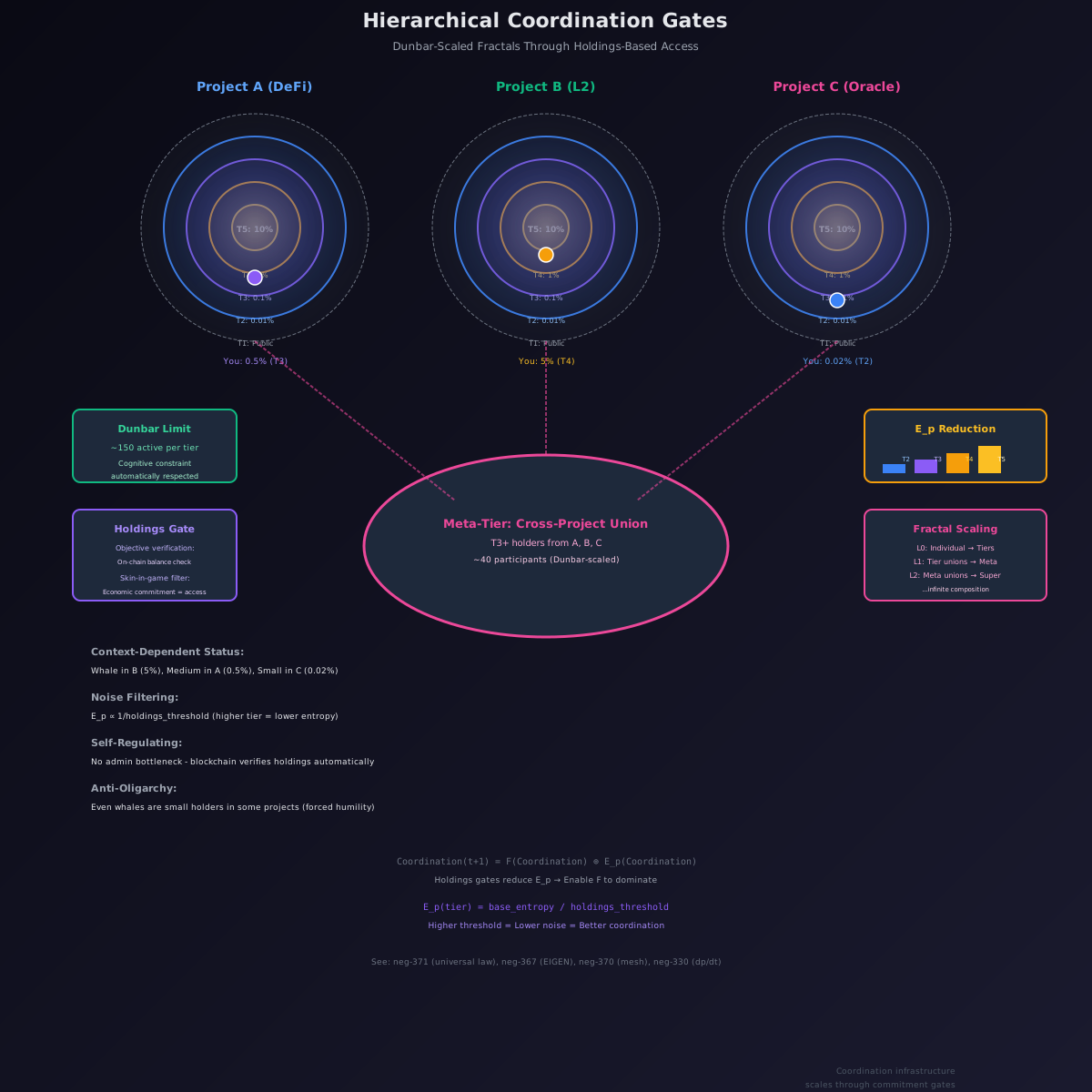
Hierarchical Coordination Gates: Dunbar-Scaled Fractals Through Holdings-Based Access
We need per-project chat rooms gated by proven holdings. Discussion can be public but access to contribute requires demonstrable skin-in-the-game. This creates hierarchical coordination gates that scale fractally: individual holdings unlock tier access, unions of holders unlock meta-tier access, unions of unions unlock super-tiers. Each tier respects Dunbar cognitive limits (~150 active participants). The same person has different access levels across different projects—whale status in one project, small holder in another—preventing global oligarchy while maintaining context-dependent influence. This is coordination infrastructure that reduces entropy through economic commitment gates while scaling infinitely through fractal composition.
The Structure: Hierarchical Holdings-Based Tiers
Per-project coordination rooms with access gates:
Project A Example
Tier 1: Public Read (0% holdings)
├─ Anyone can observe
├─ No contribution rights
└─ Infinite participants (read-only)

Tier 2: Implementation Discussion (>0.01% holdings)
├─ Small holders contribute
├─ Technical implementation details
├─ ~500 participants max
└─ Gate: Prove 0.01% holdings on-chain

Tier 3: Strategy Discussion (>0.1% holdings)
├─ Significant holders contribute
├─ Product strategy, roadmap priorities
├─ ~150 participants (Dunbar limit)
└─ Gate: Prove 0.1% holdings on-chain

Tier 4: Governance Discussion (>1% holdings)
├─ Major holders contribute
├─ Governance proposals, treasury allocation
├─ ~50 participants
└─ Gate: Prove 1% holdings on-chain

Tier 5: Core Coordination (>10% holdings)
├─ Core team coordination
├─ Fundamental direction, partnerships
├─ ~5-10 participants
└─ Gate: Prove 10% holdings on-chain
Your access varies by project:
- Project A: You hold 0.5% → Access Tiers 1-3 (read, implement, strategy)
- Project B: You hold 5% → Access Tiers 1-4 (read through governance)
- Project C: You hold 0.02% → Access Tiers 1-2 (read, implement only)
You have different status in different contexts. No global “important person” designation. Influence is context-dependent based on actual commitment.
Why This Works: Entropy Reduction Through Economic Gates
From universal law:
Coordination(t+1) = F(Coordination(t)) ⊕ E_p(Coordination(t))
Without holdings gates (traditional open forums):
- E_p massive: Anyone can spam, troll, derail (high noise)
- F minimal: No deterministic coordination pattern emerges
- Signal drowns in noise: Valuable contributors leave
- Coordination fails: Too much entropy, no convergence
With holdings gates:
- E_p reduced at each tier: Only economically committed participants
- F emerges: Stakeholders coordinate effectively (shared incentives)
- Signal-to-noise increases with tier: Higher commitment = lower entropy
- Coordination succeeds: Manageable E_p allows F to dominate
Mathematical model:
E_p(tier) ∝ 1 / holdings_threshold(tier)

Tier 2 (0.01%): E_p = high (many small holders, some noise)
Tier 3 (0.1%): E_p = medium (fewer holders, less noise)
Tier 4 (1%): E_p = low (major holders, minimal noise)
Tier 5 (10%): E_p = minimal (core team, nearly deterministic)
This is dp/dt > 0 at organizational scale: Actively increasing coordination precision by filtering entropy through economic commitment gates.
Dunbar Number Compliance: Cognitive Limits Respected
Why ~150 participants per tier?
Dunbar number = ~150 stable social relationships human brain can maintain.
Beyond 150 active participants:
- Can’t track who contributes what
- Can’t maintain relationship context
- Coordination quality degrades
- Cognitive overload → noise increases
Hierarchical tiers naturally enforce Dunbar limits:
Each tier has different participant count:
- Tier 2: ~500 potential, but only ~100-150 active at any time
- Tier 3: ~150 participants (exactly Dunbar limit)
- Tier 4: ~50 participants (well within limit)
- Tier 5: ~5-10 participants (core team size)
When tier exceeds Dunbar:
Option 1: Increase holdings threshold (fewer participants)
Tier 3: 0.1% → 180 participants (over Dunbar)
Action: Raise threshold to 0.15% → 140 participants
Option 2: Split tier into sub-tiers
Tier 3A: 0.1-0.5% holdings (geographic region 1)
Tier 3B: 0.1-0.5% holdings (geographic region 2)
Dunbar compliance is automatic through holdings distribution—most projects have long-tail holder distribution where each tier naturally falls within cognitive limits.
Fractal Scaling: Unions Unlock Meta-Tiers
Individual holdings unlock tier access. Unions of holders unlock meta-tier access.
Example: Cross-Project Coordination
Scenario:
- Project A (DeFi protocol)
- Project B (Oracle network)
- Project C (L2 rollup)
Projects share infrastructure needs but lack coordination mechanism.
Union formation:
Union_ABC = Tier 3+ holders from Projects A, B, C

Requirements:
- Must hold ≥0.1% in at least 2 of {A, B, C}
- Union members: ~40 people (intersection of significant holders)
Union unlocks Meta-Tier:
Meta-Tier: Cross-Project Coordination
├─ Discuss shared infrastructure
├─ Coordinate on common dependencies
├─ Joint treasury proposals
└─ ~40 participants (well within Dunbar)
Why unions work:
- Skin-in-game across multiple projects: Must be significant holder in 2+ projects
- Aligned incentives: Success of shared infrastructure benefits all holdings
- Dunbar-scaled: Meta-tier stays <150 participants
- Fractal: Meta-tiers can form Super-Meta-Tiers (unions of unions)
Infinite Fractal Scaling
Level 0: Individual holdings → Tier access (per-project)
Level 1: Tier unions → Meta-tier access (cross-project)
Level 2: Meta-tier unions → Super-tier access (ecosystem-wide)
Level 3: Super-tier unions → Hyper-tier access (cross-ecosystem)
...scales infinitely
Each level maintains Dunbar constraints:
- Level 0 tiers: <150 per tier
- Level 1 meta-tiers: <150 per meta-tier
- Level 2 super-tiers: <150 per super-tier
- Cognitive limits respected at every scale
This is hierarchical composition from universal law proof (Theorem 4):
Applying coordination law at scale n produces emergent coordination at scale n+1 with accumulated entropy reduction at each composition level.
Dynamic Mixing: Context-Dependent Influence
The same person has different status across projects:
Your Holdings Profile
Project A (DeFi): 0.5% holdings
├─ Tier 3 access (strategy)
├─ Medium influence
└─ Active in product discussions

Project B (L2): 5% holdings
├─ Tier 4 access (governance)
├─ Major influence
├─ Vote on treasury allocations
└─ Core strategic voice

Project C (Oracle): 0.02% holdings
├─ Tier 2 access (implementation)
├─ Small influence
└─ Contribute technical details only
Key insight: You’re not globally “important” or “unimportant.”
Context-dependent influence based on commitment:
- Whale in Project B (5%)
- Medium holder in Project A (0.5%)
- Small holder in Project C (0.02%)
This prevents global oligarchy:
- Even largest holders are small in some projects
- Forces humility (you’re small somewhere)
- Ensures diverse perspectives (whales can’t dominate everywhere)
- Natural power distribution (influence matches skin-in-game)
Compare to traditional systems:
Traditional reputation:
- “Important person” status is global
- Carries across all contexts
- Creates echo chambers (same people dominate everywhere)
- Oligarchy emerges naturally
Holdings-based gates:
- Status is local to each project
- Must re-prove commitment in each context
- Different leaders in different projects
- Oligarchy prevented through diversification
Implementation via EIGEN Primitive
From EIGEN intersubjective tokens:
Why holdings gates require intersubjective primitive:
The Verification Problem
Objective verification (traditional crypto):
- Prove holdings amount ✓ (on-chain balance check)
- Prove tier eligibility ✓ (threshold comparison)
- But: Prove discussion value? ✗ (no deterministic proof)
Intersubjective verification (EIGEN primitive):
- Holdings verification: Objective (on-chain)
- Discussion gating: Based on holdings (objective proxy)
- Contribution quality: Emergent through intersubjective consensus (other tier members)
The economic gate is objective, the coordination quality is intersubjective.
Technical Implementation
On-chain holdings proof:
contract CoordinationGate {
    mapping(address => mapping(bytes32 => uint256)) public holdings;

    struct Tier {
        uint256 threshold; // Percentage in basis points (0.01% = 1)
        uint256 maxParticipants;
        address[] members;
    }

    mapping(bytes32 => Tier[]) public projectTiers;

    function verifyTierAccess(
        bytes32 projectId,
        uint8 tierId,
        address user
    ) public view returns (bool) {
        Tier storage tier = projectTiers[projectId][tierId];
        uint256 userHoldings = holdings[user][projectId];
        uint256 totalSupply = getTotalSupply(projectId);

        uint256 userPercentage = (userHoldings * 10000) / totalSupply;

        return userPercentage >= tier.threshold;
    }

    function joinTier(bytes32 projectId, uint8 tierId) public {
        require(verifyTierAccess(projectId, tierId, msg.sender), "Insufficient holdings");
        require(projectTiers[projectId][tierId].members.length <
                projectTiers[projectId][tierId].maxParticipants, "Tier full");

        projectTiers[projectId][tierId].members.push(msg.sender);
        emit TierJoined(projectId, tierId, msg.sender);
    }
}
Off-chain coordination (chat rooms):
Chat servers verify tier access by:
- User signs message proving wallet ownership
- Server queries on-chain holdings
- Server grants channel access based on tier thresholds
- Holdings checked periodically (hourly) for updates
Dynamic access:
- Holdings increase → Auto-promoted to higher tier
- Holdings decrease → Auto-demoted to lower tier
- Union formation → Auto-granted meta-tier access
- No manual admin intervention
Noise Filtering: Why Economic Gates Work
The spam problem in open forums:
Traditional open forum:
Signal (valuable contributions): 5%
Noise (spam, trolling, low-effort): 95%
E_p = massive
Coordination fails
Why open forums fail:
- No cost to spam: Create account in seconds, post infinitely
- No accountability: Anonymous or pseudonymous with no reputation stake
- No alignment: Trolls have incentive to disrupt (entertainment, ideology)
- Tragedy of commons: Everyone uses forum, no one maintains quality
Holdings-based gates solve all four:
- Cost to participate: Must buy holdings (economic commitment)
- Accountability: Holdings value tied to project success (skin-in-game)
- Alignment: Holders benefit from coordination success (shared incentives)
- Self-maintaining: Participants naturally filter noise (protecting their investment)
Empirical example:
Tier 3 chat (0.1% holdings threshold):
Barrier to entry: 0.1% of $100M project = $100k holdings
Troll would need to spend $100k to spam Tier 3
Not economically rational
Result: Tier 3 naturally spam-free without moderation.
This is entropy reduction through economic filtering:
E_p(tier) = base_entropy / holdings_threshold

Tier 2 (0.01%): E_p = base / 0.0001 = high
Tier 3 (0.1%): E_p = base / 0.001 = medium
Tier 4 (1%): E_p = base / 0.01 = low
Tier 5 (10%): E_p = base / 0.1 = minimal
Higher tiers have exponentially lower noise because economic barrier scales with tier.
Connection to Mesh Coordination
From mesh self-awareness:
The mesh exhibits three-state epistemic protocol:
- answer: High confidence (low E_p)
- need_more_infos_on_this: Medium confidence (medium E_p)
- I_dont_know: Low confidence (high E_p)
Holdings-based tiers implement similar epistemic structure:
- Tier 5 (10%): Core team (near-deterministic, minimal E_p)
- Tier 4 (1%): Major holders (high confidence, low E_p)
- Tier 3 (0.1%): Significant holders (medium confidence, medium E_p)
- Tier 2 (0.01%): Small holders (lower confidence, higher E_p)
Both systems: Explicitly model uncertainty and confidence levels. Mesh does it computationally through epistemic protocol. Holdings gates do it socially through economic commitment tiers.
This is the same pattern: Uncertainty awareness creating better coordination by matching influence to confidence.
Comparison: Traditional vs Holdings-Gated Coordination
Traditional Discord/Forum
Structure:
- Single tier (everyone equal)
- Admin-based moderation
- Role assignment by admins
- Global reputation (mod/trusted/regular/new)
Problems:
- Admin bottleneck: All decisions route through admins
- Subjective gating: Who gets “trusted” role? (opinions vary)
- No skin-in-game: Trolls lose nothing by disrupting
- Scale ceiling: >150 active members → chaos (Dunbar violated)
- Noise dominates: Signal drowns as size increases
- Oligarchy: Admins become permanent power structure
E_p increases unbounded as size grows.
Holdings-Gated Tiers
Structure:
- Multiple tiers (different commitment levels)
- Self-regulating (holdings threshold is objective)
- Role assignment automatic (on-chain holdings check)
- Local reputation (status per project, not global)
Advantages:
- No admin bottleneck: Blockchain verifies holdings automatically
- Objective gating: Holdings threshold is mathematical (0.1% = 0.1%)
- Skin-in-game: Trolls must commit capital (economic deterrent)
- Scales fractally: Each tier <150, unions form meta-tiers (infinite scale)
- Signal/noise improves: Higher tiers have lower E_p
- No oligarchy: Context-dependent status (whale in A, small holder in B)
E_p decreases with tier level, coordination scales infinitely through fractal composition.
Edge Cases and Considerations
What About Whales Dominating?
Problem: Whale with 20% holdings could dominate all tiers.
Solution 1: Voice weight caps
Even in Tier 5, no single voice has >2x weight of others:
def calculate_voice_weight(holdings_percentage, tier_threshold):
    raw_weight = holdings_percentage / tier_threshold
    capped_weight = min(raw_weight, 2.0)  # Max 2x weight
    return capped_weight
A 20% holder in Tier 5 (10% threshold) gets 2x weight max, not 2x weight.
Solution 2: Super-majority requirements
Critical decisions require super-majority agreement:
- Governance proposals: 66% approval
- Treasury allocations: 75% approval
- Fundamental changes: 90% approval
Whale with 20% cannot unilaterally decide anything.
Solution 3: Context-dependent status
Whale in Project A may be small holder in Project B. Even whales have projects where they listen rather than lead.
What About Sybil Attacks?
Problem: Attacker splits holdings across multiple wallets to gain many Tier 2/3 seats.
Defense 1: Minimum holding age
Holdings must be held for >30 days to qualify:
struct Holding {
    uint256 amount;
    uint256 acquiredAt;
}

function verifyTierAccess(address user) public view returns (bool) {
    Holding memory h = holdings[user];
    require(block.timestamp > h.acquiredAt + 30 days, "Holdings too recent");
    return h.amount >= threshold;
}
Defense 2: Quadratic weight
Multiple small holdings count less than single large holding:
voice_weight = sqrt(holdings_percentage)

Single wallet: 1% holdings → sqrt(0.01) = 0.1 weight
Ten wallets: 0.1% each → 10 × sqrt(0.001) = 0.316 weight total

Single large holding > Sybil split
Defense 3: Union requirements
Meta-tier access requires significant holdings in multiple projects (hard to Sybil across projects).
What About Liquid Democracy / Delegation?
Problem: Small holder wants influence but doesn’t have time to participate actively.
Solution: Delegation within tiers
Tier 2 holder can delegate their voice to Tier 3+ holder:
class TierMember:
    holdings: float
    delegate: Optional[Address]
    delegated_from: List[Address]

    def effective_weight(self):
        own_weight = self.holdings
        delegated_weight = sum(delegator.holdings for delegator in self.delegated_from)
        return own_weight + delegated_weight
Small holders can pool influence through delegation while maintaining individual holdings threshold for tier access.
Constraint: Delegation only works within or upward in tiers (Tier 2 → Tier 3, not Tier 3 → Tier 2).
Practical Deployment
Phase 1: Single-Project Pilot
Pick one project with engaged community:
- Implement 3 tiers (read, small holders, major holders)
- Run for 3 months
- Measure: noise reduction, coordination quality, participant satisfaction
Phase 2: Multi-Project Expansion
Add 2-3 more projects:
- Same tier structure
- Enable cross-project observation (can read other project tiers)
- Measure: cross-project learning, status mixing effects
Phase 3: Union Formation
Enable meta-tiers:
- Union of significant holders across projects
- Cross-project coordination rooms
- Measure: infrastructure sharing, joint decision quality
Phase 4: Full Fractal
Open platform:
- Any project can create gated tiers
- Automatic union detection and meta-tier creation
- Fractal scaling to arbitrary depth
Future: Generalized Coordination Primitive
This extends beyond token holdings:
Holdings-based gates are special case of commitment-based coordination gates.
Other commitment types:
- Time commitment: GitHub contributions, forum post history
- Skill commitment: Verified credentials, past work quality
- Reputation commitment: Vouches from existing tier members
- Work commitment: Completed bounties, shipped features
Generalized gate:
def verify_gate_access(user, tier, project):
    commitment_score = calculate_commitment(user, project)
    threshold = tier.requirement
    return commitment_score >= threshold

def calculate_commitment(user, project):
    holdings_score = user.holdings[project] * weight_holdings
    time_score = user.contributions[project] * weight_time
    skill_score = user.credentials[project] * weight_skill
    reputation_score = user.vouches[project] * weight_reputation

    return weighted_sum(holdings_score, time_score, skill_score, reputation_score)
Holdings are simplest commitment type (objective, on-chain, liquid) but not only type.
Future: Multi-dimensional commitment gates combining holdings, time, skill, and reputation into unified coordination access mechanism.
Conclusion: Coordination Infrastructure at Scale
What we’ve built:
- Entropy reduction through economic gates: E_p decreases with tier
- Dunbar-respecting structure: Each tier <150 active participants
- Fractal scaling: Unions → meta-tiers → super-tiers → infinite scale
- Context-dependent influence: Status varies per project (anti-oligarchy)
- Self-regulating: No admin bottleneck (blockchain verifies)
- Signal/noise improvement: Higher commitment → lower noise
This is coordination infrastructure that:
- Scales infinitely (fractal composition)
- Respects cognitive limits (Dunbar at each level)
- Reduces entropy (economic filtering)
- Prevents oligarchy (context-dependent status)
- Self-maintains (objective verification)
Connection to universal law:
Coordination systems must manage entropy E_p to allow deterministic coordination F to dominate. Holdings-based gates reduce E_p through economic commitment, enabling F (effective coordination) to emerge naturally.
This is dp/dt > 0 at civilizational scale: Infrastructure that increases coordination precision across all projects by filtering noise through skin-in-game gates.
The future of coordination is hierarchical, fractal, and commitment-gated.
#HierarchicalCoordination #HoldingsGates #DunbarScaling #FractalUnions #EntropyReduction #SkinInGame #ContextDependentInfluence #IntersubjectiveGates #CommitmentFiltering #NoiseReduction #CoordinationInfrastructure #EIGENPrimitive #UniversalLaw #EpsilonPFiltering #MetaTiers #ScalableGovernance #AntiOligarchy #CognitivelyBounded #EconomicGates #CoordinationPrimitive