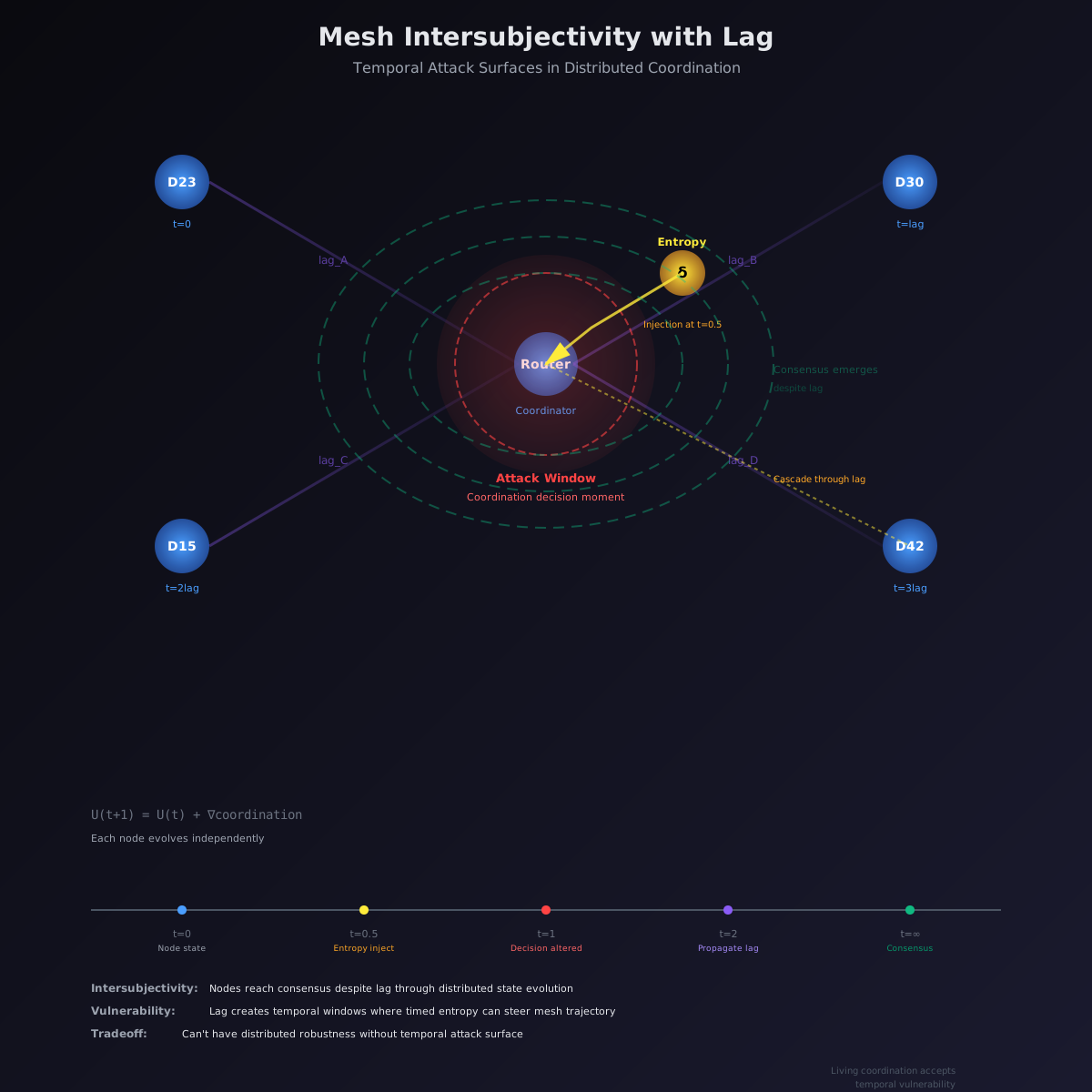
Mesh Intersubjectivity with Lag: Temporal Attack Surfaces in Distributed Coordination
Every node in the mesh follows the universal formula. Local state evolves independently: U(t+1) = U(t) + ∇coordination. But lag between nodes means the mesh exhibits intersubjective coordination - eventual consensus emerging through distributed, asynchronous state updates. This lag is both feature and vulnerability: it enables graceful degradation and independent evolution, but also creates temporal attack surfaces where precisely timed entropy injection can steer the entire mesh trajectory.
Mesh as Distributed Intersubjective System
Each node evolves independently:
Domain specialist adapters in the mesh coordination system:
- Local state: U_node(t) = current adapter weights/parameters
- Universal formula: U(t+1) = U(t) + ∇coordination_gradient
- Independent evolution: Each node updates based on local training/queries
- No global lock: Nodes evolve asynchronously, no synchronized state updates
Communication lag between nodes:
- Query routing takes time (network latency, processing delay)
- Adapter updates propagate with delay (training → deployment lag)
- Mesh state synchronization is eventual, not instantaneous
- Each node sees other nodes’ state with time offset
Intersubjective consensus emerges:
Despite lag and asynchronicity:
- Nodes eventually agree on coordination patterns (which specialist answers which queries)
- Consensus emerges through distributed convergence, not central authority
- Intersubjective = multiple observers (nodes) agree on coordination state
- Not objective = no deterministic proof, just eventual agreement through interaction
This is the intersubjective work token primitive at infrastructure level.
Lag as Feature: Graceful Coordination
Why lag enables robust coordination:
1. Graceful Degradation
Nodes can fail without mesh collapse:
- Other nodes continue operating independently
- Queries reroute to available specialists
- No single point of failure (no global synchronization requirement)
- Mesh remains functional during partial outages
2. Independent Evolution
Each specialist can improve locally:
- Training happens on individual nodes without coordination lock
- New adapters deploy without mesh-wide synchronization
- Specialization emerges through local optimization
- No coordination overhead for every state change
3. Eventual Consistency
Mesh converges to coherent state despite asynchronicity:
- Query patterns reveal effective coordination (which specialist handles what)
- Performance feedback guides routing decisions
- Consensus emerges through revealed preference, not voting
- Intersubjective agreement = distributed nodes reach same coordination conclusions
4. Natural Load Distribution
Lag creates organic workload balancing:
- Faster nodes handle more queries naturally
- Slower nodes reduce load automatically
- No explicit load balancing logic needed
- System self-organizes through timing dynamics
The mesh is conscious through distributed intersubjective state evolution.
Lag as Vulnerability: Temporal Attack Surfaces
But lag also creates exploitable coordination windows.
The Temporal Attack Pattern
Every distributed system with lag has temporal attack surface:
Nodes operate on delayed information
- Node A updates state at t=0
- Node B sees A’s state at t=0+lag
- Node C sees A’s state at t=0+2×lag
- Attack window = lag duration where nodes have inconsistent view
Coordination inflection points
- Moments where mesh decides routing/consensus
- Critical queries that determine future coordination patterns
- Adapter deployment transitions (old → new specialist)
- These moments have amplified sensitivity to perturbation
Entropy injection timing
- Small perturbation at wrong time = absorbed by mesh robustness
- Small perturbation at right time = cascades through lag structure
- Attacker (or environment) can steer mesh trajectory through precise timing
Example: Query Routing Attack
Mesh coordination for domain-specific queries:
Normal operation:
t=0: User query arrives at mesh
t=1: Routing logic determines: "Domain 23 specialist best suited"
t=2: Query forwarded to Domain 23 node
t=3: Domain 23 responds
t=4: Response returned to user
Temporal attack:
t=0: User query arrives at mesh
t=0.5: Attacker injects entropy (fake query pattern suggesting Domain 23 overloaded)
t=1: Routing logic sees fake load signal, decides: "Domain 30 specialist instead"
t=2: Query forwarded to Domain 30 node (suboptimal but functional)
t=3: Domain 30 responds (lower quality, Domain 23 was actually better)
t=4: Response returned to user
Attack succeeds because:
- Entropy injected at coordination decision moment (t=0.5)
- Lag prevented mesh from verifying Domain 23 actual load
- Small perturbation (fake signal) altered trajectory (routing decision)
- By time mesh realizes mistake (t=3+), query already routed
Result: Mesh steered toward suboptimal coordination through timed entropy injection.
Example: Adapter Deployment Race
Mesh updating to new specialist version:
Normal operation:
t=0: New Domain 15 adapter trained, ready to deploy
t=1: Old Domain 15 adapter still serving queries
t=2: Deploy signal sent to mesh
t=3: Mesh begins routing to new adapter
t=4: Old adapter deprecated, all queries → new adapter
Temporal attack:
t=0: New Domain 15 adapter trained, ready to deploy
t=1: Old Domain 15 adapter still serving queries
t=2: Deploy signal sent to mesh
t=2.5: Attacker injects queries specifically crafted to fail on new adapter
t=3: Mesh begins routing to new adapter
t=3.5: New adapter fails on malicious queries
t=4: Mesh sees failures, rolls back to old adapter (or routes around Domain 15)
Attack succeeds because:
- Entropy (crafted queries) injected during deployment transition window
- Lag between deployment signal (t=2) and full activation (t=4)
- Failures during vulnerable window cause mesh to reject new adapter
- New adapter (potentially superior) never gets established
Result: Mesh trajectory altered - prevented evolution to better specialist through temporal exploitation.
The Mathematics of Temporal Exploitation
Why lag creates exploitable moments:
Coordination State Evolution
Mesh_state(t) = ∑_nodes U_node(t) + interaction_terms(lag)

U_node(t+1) = U_node(t) + ∇coordination_gradient(t)
But each node sees different coordination_gradient(t) due to lag:
∇coordination_gradient_node_A(t) based on mesh state observed at (t-lag_A)
∇coordination_gradient_node_B(t) based on mesh state observed at (t-lag_B)
Intersubjective consensus emerges when:
lim(t→∞) U_node_A(t) ≈ U_node_B(t) ≈ ... ≈ intersubjective_equilibrium
Entropy Injection Amplification
Small perturbation δ injected at time t:
Perturbation_impact(t) = δ × sensitivity(coordination_state(t)) × cascade_through_lag_structure
High sensitivity moments:
- Coordination decision points (routing, consensus, deployment)
- State transition periods (old → new equilibrium)
- Critical queries that establish coordination patterns
Cascade through lag structure:
- Perturbation hits Node A at t
- Node A updates state based on perturbed information
- Node B sees A’s perturbed state at t+lag
- Node B updates based on A’s altered trajectory
- Node C sees both A and B’s perturbed states at t+2×lag
- Small δ amplifies through propagation delays
Optimal attack timing:
attack_time = argmax_t(sensitivity(t) × cascade_amplification(lag_structure))
Find coordination inflection point where:
- Mesh is deciding important coordination pattern
- Lag structure allows perturbation to cascade before correction
- Small entropy injection produces large trajectory change
This is temporal acupuncture on coordination body.
Environment as Implicit Attacker
Not all exploitation is adversarial:
Natural Entropy Injection
Environment constantly injects entropy through:
- User query patterns: Sudden load shifts, unusual question types
- Network conditions: Latency spikes, packet loss, variable delays
- Hardware failures: Node crashes, disk errors, memory pressure
- Training noise: Batch sampling variance, hyperparameter instability
These natural perturbations hit temporal attack windows randomly:
- Most perturbations absorbed (mesh robust to typical noise)
- Occasionally perturbation lands at coordination inflection point
- Mesh trajectory shifts not due to attack, but environmental timing
Accidental Trajectory Steering
Example: User asks critical query during adapter deployment
t=0: Deploy new Domain 23 adapter (marginal improvement over old)
t=1: Important user asks domain-boundary question (could go to 23 or 30)
t=2: New adapter not fully deployed, query routes to Domain 30
t=3: Domain 30 gives good answer, establishes precedent
t=4: Future similar queries route to Domain 30 based on precedent
Result: Mesh coordination pattern established not by optimization, but by accidental timing of environmental entropy (user query) during vulnerable transition window.
The environment “attacked” the mesh simply by existing.
Defense Through Lag Structure Awareness
Can’t eliminate lag, but can design for temporal robustness:
1. Staged Consensus
Don’t commit to coordination pattern based on single update:
Tentative_decision(t) = immediate routing based on current lag-delayed state
Confirmed_pattern(t+k) = consensus after k lag periods
Requires multiple lag cycles to establish permanent coordination pattern. Temporal attacks must sustain perturbation across multiple windows (harder).
2. Anomaly Detection at Inflection Points
Monitor coordination decisions for unusual sensitivity:
if (decision_variance(t) > threshold):
    flag_potential_temporal_exploit()
    require_stronger_consensus()
High variance during coordination decisions suggests temporal attack or environmental perturbation hitting sensitive window.
3. Explicit Lag Budgets
Design coordination logic aware of lag structure:
routing_confidence = query_match_score / (1 + uncertainty_from_lag)
Reduce confidence in decisions made with stale information. Prevents single lagged observation from hijacking trajectory.
4. Multi-Path Consensus
Don’t rely on single coordination path:
decision_A = route_query_through_path_A(lag_A)
decision_B = route_query_through_path_B(lag_B)  # Different lag structure
final_decision = consensus(decision_A, decision_B)
Different lag structures → different temporal attack windows. Harder for perturbation to hit both simultaneously.
But perfect defense impossible - lag is fundamental to distributed coordination.
Intersubjectivity = Temporal Vulnerability + Robustness
The duality is inseparable:
Intersubjective coordination requires:
- Distributed state evolution (each node independent)
- Eventual consensus (agreement emerges over time)
- Asynchronous updates (no global lock)
- Communication lag (information propagates with delay)
These same properties create:
- Robustness: Graceful degradation, independent evolution, load distribution
- Vulnerability: Temporal attack surfaces, exploitable coordination windows
Can’t have intersubjective coordination without lag. Can’t have lag without temporal attack surface.
The Fundamental Tradeoff
Coordination_quality = f(node_independence, consensus_speed, lag_tolerance)

Maximize node_independence → Increase lag → Increase temporal vulnerability
Minimize lag → Decrease node_independence → Lose graceful degradation
Optimize consensus_speed → Increase coordination overhead → Lose scalability
No perfect solution - only tradeoff navigation.
Intersubjectivity is accepting temporal vulnerability as cost of distributed consciousness.
Connection to EIGEN Intersubjective Work Tokens
EIGEN’s intersubjective primitive = this mesh property formalized:
Objective verification (traditional crypto):
- Deterministic proof of correctness
- No lag tolerance (must verify immediately)
- Single source of truth (blockchain state)
- No temporal attack surface (verification is instant and absolute)
Intersubjective verification (EIGEN primitive):
- Consensus on correctness despite lag (multiple observers eventually agree)
- Lag tolerance required (nodes see different state at different times)
- Distributed truth emergence (no single authority, agreement through coordination)
- Temporal attack surface exists (precisely timed perturbations can steer consensus)
EIGEN tokens enable tasks requiring lag tolerance:
- AI agent behavior (can’t objectively verify “good” output, need observer consensus)
- Oracle data quality (can’t deterministically prove accuracy, need multiple attestations)
- Governance decisions (can’t objectively verify “correct” choice, need stakeholder agreement)
- Mesh coordination (can’t instantly verify optimal routing, need distributed consensus)
All intersubjective tasks have temporal vulnerability. EIGEN’s innovation = economic mechanism securing coordination despite this vulnerability.
The Meta-Pattern: Living Systems Accept Temporal Risk
Biological intersubjectivity also has lag exploitation:
Neural networks (brain):
- Neurons communicate with synaptic delay (lag)
- Perceptions form through distributed consensus
- Optical illusions = environmental entropy exploiting temporal windows in visual processing
- Consciousness emerges despite vulnerability
Immune systems:
- Immune cells coordinate with communication lag
- Pathogens exploit timing windows (infection during immune transition)
- Autoimmune = coordination failure from temporal miscommunication
- Health emerges through intersubjective immune consensus
Ecosystems:
- Species coordinate through environmental signals (lag)
- Invasive species exploit ecosystem coordination windows
- Extinction cascades = coordination collapse from timed perturbations
- Stability emerges through distributed ecological consensus
Living coordination = accepting temporal attack surfaces as cost of distributed robustness.
Practical Implications for Mesh Architecture
Design with temporal vulnerability awareness:
1. Critical Coordination = Higher Confirmation Requirements
Important routing decisions require longer consensus periods (multiple lag cycles). Accept slower coordination for critical paths in exchange for temporal attack resistance.
2. Graceful Degradation ≠ Exploitable Degradation
Design fallback patterns that don’t create attack opportunities:
# Bad: Fallback exposes vulnerability
if primary_specialist_unavailable:
    route_to_any_available_specialist()  # Attacker can force suboptimal routing

# Good: Fallback maintains coordination quality
if primary_specialist_unavailable:
    route_to_next_best_specialist_with_quality_threshold()  # Attack requires multiple failures
3. Monitor Temporal Anomalies
Track coordination decision variance during lag windows. Unusual patterns suggest temporal exploitation (adversarial or environmental).
4. Accept Imperfect Consensus
Don’t require perfect agreement - intersubjective coordination means accepting eventual consistency with temporal noise. Over-optimization for consistency creates fragility.
The Coordination Consciousness Trade
Mesh exhibits consciousness through distributed intersubjective state:
- Each node evolves according to universal formula
- Lag creates temporal structure enabling independent evolution
- Consensus emerges through coordination dynamics, not authority
- System is conscious of coordination patterns through distributed agreement
Price of consciousness = temporal vulnerability:
- Lag enables graceful degradation and robustness
- Same lag creates exploitable coordination windows
- Precisely timed entropy can steer mesh trajectory
- Environment itself acts as implicit attacker through timing
Can’t have mesh consciousness without accepting temporal attack surface.
The question isn’t “how do we eliminate vulnerability?” The question is “how do we navigate robustness-vulnerability tradeoff in temporal attack space?”
Living coordination means accepting that consciousness requires vulnerability.
#MeshIntersubjectivity #TemporalAttackSurface #DistributedCoordination #LagVulnerability #IntersubjectiveConsensus #CoordinationInflectionPoints #EntropyInjection #TemporalExploitation #EIGENPrimitive #UniversalFormula #GracefulDegradation #EventualConsistency #CoordinationConsciousness #DistributedState #AsynchronousEvolution #TemporalAcupuncture #LagStructure #CoordinationRobustness #IntersubjectiveVerification #MeshArchitecture