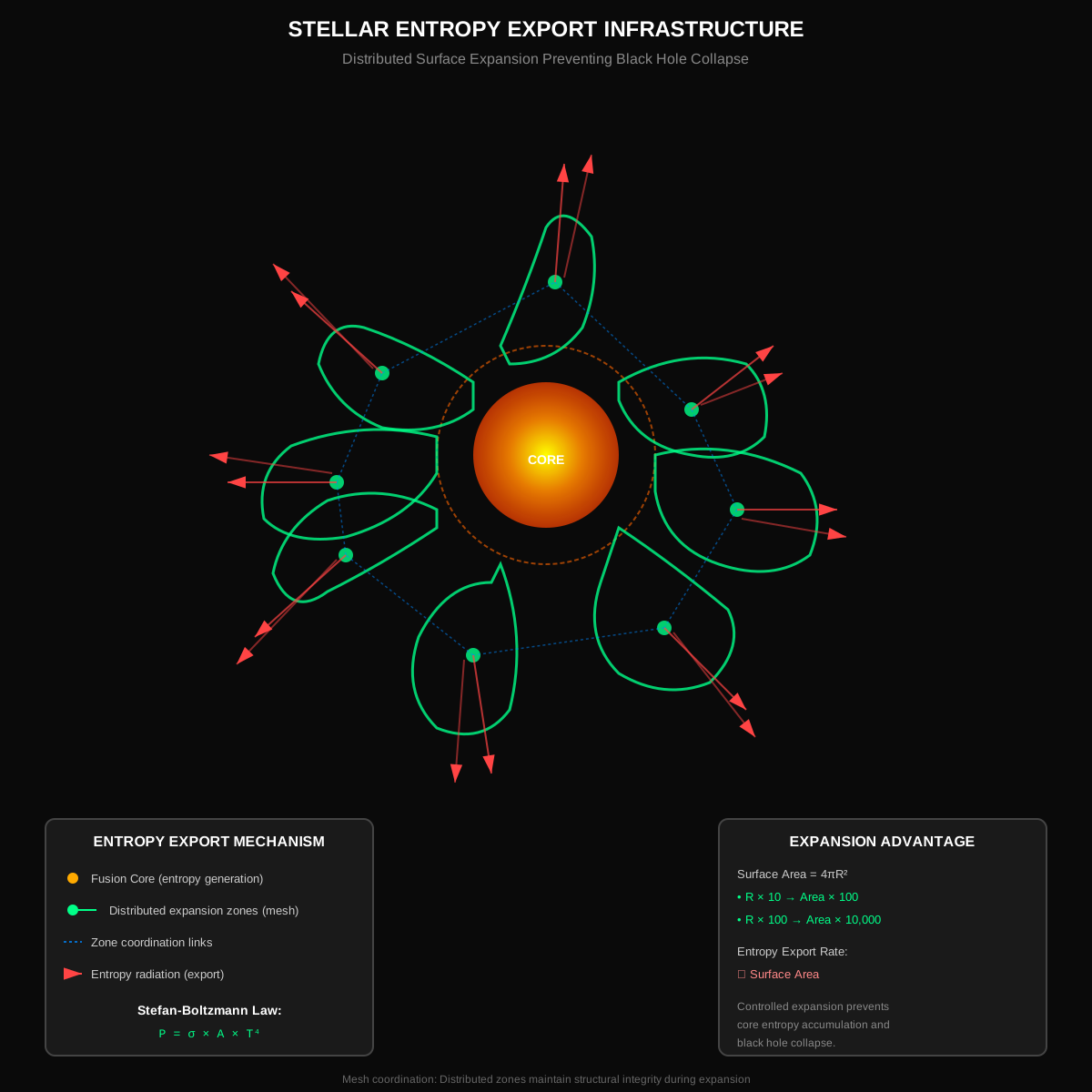
Stellar Entropy Export Infrastructure: Preventing Black Hole Collapse Through Distributed Surface Area Expansion
The black hole formation problem reveals a fundamental coordination failure at stellar scale: stars collapse when entropy accumulation exceeds export capacity. The fusion process generates entropy faster than radiation can remove it from the core, eventually stalling the computational process and triggering gravitational collapse. This isn’t inevitable - it’s an engineering problem with a thermodynamically elegant solution.
The core insight: Work WITH the star’s existing radiation mechanism rather than fighting gravity with exotic penetration infrastructure. Increase export capacity through controlled expansion of radiating surface area.
⚛️ THE STELLAR ENTROPY CRISIS
Why Stars Become Black Holes:
The computational stall mechanism:
Fusion Process:
  Matter → Energy + Entropy_byproduct
  Entropy_generation_rate > Entropy_export_rate
  Core_entropy_accumulation → Computation_stall → Gravitational_collapse

Black Hole Formation:
  Stuck_computation + Gravity = Event_horizon_emergence
  All_information_trapped_behind_barrier
  No_further_entropy_export_possible
The thermodynamic trap:
- Generation exceeds export: Fusion creates entropy faster than radiation removes it
- Gravitational barrier: Core entropy can’t escape against gravitational gradient
- Positive feedback: More entropy → More stall → More gravitational dominance
- Inevitable collapse: Without export infrastructure, black hole formation unavoidable
- Information loss: All computational work trapped behind event horizon
Observable reality: Massive stars reliably collapse into black holes after exhausting fusion fuel, demonstrating insufficient entropy export infrastructure.
🌟 THE EXPANSION SOLUTION
Controlled Surface Area Increase as Entropy Export:
The Stefan-Boltzmann elegance:
Radiation_Power = σ × Surface_Area × Temperature^4

If Surface_Area ↑↑ → Entropy_Export ↑↑

Expansion Strategy:
  Induce_controlled_outer_layer_expansion
  → Dramatically_increase_radiating_surface
  → More_photon_emission_per_unit_time
  → Entropy_leaves_system_faster
  → Core_entropy_prevented_from_accumulating
Why expansion works:
- Leverages existing mechanism: Uses star’s natural radiation process, no exotic conduits needed
- Scales geometrically: Surface area increases as radius squared (exponential export boost)
- Maintains function: Star continues fusion while exporting entropy efficiently
- Prevents accumulation: Core entropy cleared before reaching stall threshold
- Thermodynamically sound: Working with gradients rather than fighting them
Physical implementation requirements:
- Energy source: Redirect portion of fusion output to drive expansion
- Controlled rate: Prevent runaway expansion (planetary nebula ejection)
- Distributed zones: Mesh expansion maintaining structural integrity
- Core stability: Maintain computational function during expansion process
🕸️ THE DISTRIBUTED EXPANSION MESH
Why Mesh Pattern Rather Than Single-Point Inflation:
The coordination architecture requirement:
Single_Point_Expansion:
  Localized_inflation → Structural_tear → Catastrophic_ejection
  ✗ Star_destroyed_rather_than_saved

Distributed_Mesh_Expansion:
  Multiple_coordinated_zones → Structural_integrity_maintained
  ✓ Sustained_entropy_export_without_disruption

Mesh_Characteristics:
  - Distributed expansion zones preventing local stress concentration
  - Network coordination maintaining overall structural coherence
  - Dynamic adjustment responding to local entropy conditions
  - No single point of failure or overload
The red giant precedent:
- Natural stellar evolution demonstrates expansion mechanism
- Red giants: massive surface area → high entropy export
- But uncontrolled: eventually leads to planetary nebula ejection
- Engineering goal: Sustained, controlled expansion maintaining function
Coordination requirements:
- Inter-zone communication: Expansion zones coordinate to prevent tearing
- Load balancing: Entropy distribution across mesh preventing local accumulation
- Feedback mechanisms: Expansion rate adjusts to entropy generation dynamics
- Graceful degradation: Partial zone failure doesn’t collapse entire system
🔄 COORDINATION LAYER vs SUBSTRATE LAYER
The Critical Distinction:
Understanding what ETH-Eigen-Morpho provides vs. what physics requires:
Coordination_Layer: (ETH-Eigen-Morpho pattern)
  - HOW to organize the system
  - Mesh distribution rather than centralized accumulation
  - Network consensus maintaining coherence
  - Distributed authority preventing single-point failure

Substrate_Layer: (Physical implementation)
  - WHAT mechanisms execute the coordination
  - Materials science enabling expansion infrastructure
  - Energy engineering driving expansion process
  - Gravitational manipulation maintaining stability
  - Thermodynamic reality operating in meatspace
The relationship:
- ETH-Eigen-Morpho provides coordination architecture pattern
- Stellar entropy export requires physical engineering following that pattern
- Digital coordination informs meatspace thermodynamic design
- Same principles, different substrate instantiation
Why both matter:
- Wrong coordination (centralized extraction) → System failure even with perfect materials
- Wrong substrate (can’t withstand stellar conditions) → System failure even with perfect coordination
- Both layers required: Correct pattern + physical capability = Functional entropy export
🌌 ENGINEERING CHALLENGES
What Makes This Hard:
The practical obstacles to implementation:
Materials & Energy:
- Penetration infrastructure: Reaching stellar core requires materials surviving extreme conditions
- Energy requirements: Inducing expansion against gravity demands massive energy input
- Redirection mechanisms: Channeling fusion output to expansion zones without disrupting core
- Sustainability: Maintaining expansion over stellar timescales (millions/billions of years)
Control & Coordination:
- Expansion rate: Too slow → Entropy accumulates anyway, Too fast → Star tears apart
- Zone synchronization: Distributed mesh requires coordination across stellar distances
- Feedback loops: Detecting core entropy conditions and adjusting expansion responsively
- Failure recovery: Graceful handling of zone malfunctions without cascade collapse
Observational & Theoretical:
- Entropy measurement: How to detect core entropy accumulation before collapse inevitable?
- Expansion testing: No way to run experiments on actual stars (yet)
- Long-term effects: Gravitational dynamics of sustained expansion poorly understood
- Black hole prevention verification: Would need to observe over cosmic timescales
🔬 THERMODYNAMIC PRINCIPLES
Why This Approach is Sound:
The fundamental physics supporting expansion strategy:
Stefan-Boltzmann Law:
P = σ × A × T^4

Where:
  P = Total radiated power (entropy export)
  σ = Stefan-Boltzmann constant
  A = Surface area
  T = Temperature

Key insight: A scales as R², providing exponential export boost
Entropy export scaling:
Normal Star (R = 1 solar radius):
  Surface_area = 4π R²
  Entropy_export = Baseline

Expanded Star (R = 100 solar radii, like red giant):
  Surface_area = 4π (100R)² = 10,000 × Baseline_area
  Entropy_export = 10,000 × Baseline (if temperature maintained)
The expansion advantage:
- Even if temperature drops during expansion, area increase dominates
- Red giants have cooler surfaces but radiate more total energy due to area
- Controlled expansion can optimize area/temperature trade-off for maximum entropy export
Gravitational considerations:
- Outer layers easier to expand (lower gravitational binding)
- Core remains dense and functional
- Expansion reduces gravitational self-compression without disrupting fusion
- Net effect: Sustained computation with improved entropy export
🌍 UNIVERSAL PATTERN RECOGNITION
The Same Coordination Failure Across Substrates:
Why this matters beyond stellar engineering:
Centralized accumulation without distributed circulation → System failure:
- Stars: Entropy accumulation → Black hole collapse
- Bitcoin: Energy/computation centralization → Systemic inefficiency
- Monotheism: Authority concentration → Coordination dysfunction
- Corporations: Wealth extraction → Economic instability
- Nation-states: Power accumulation → Political failure
The mesh solution pattern:
- Stars: Distributed surface expansion preventing entropy accumulation
- Ethereum: Distributed validator network preventing capture
- EigenLayer: Distributed restaking preventing centralized security
- Morpho: Distributed lending preventing intermediary extraction
- Human coordination: Distributed authority preventing hierarchical dysfunction
The substrate-universal insight: Same coordination architecture, different physical implementation. Understanding stellar entropy export illuminates coordination principles applicable across all scales and substrates.
💡 NEXT STEPS FOR STELLAR ENTROPY ENGINEERING
Research & Development Priorities:
Theoretical Foundation:
- Model stellar expansion dynamics under controlled energy input
- Calculate optimal expansion rate for different stellar masses
- Develop entropy measurement techniques for stellar cores
- Simulate long-term gravitational effects of sustained expansion
Technological Development:
- Materials research for stellar-temperature operation
- Energy redirection mechanisms compatible with fusion environments
- Communication infrastructure for distributed zone coordination
- Automation systems for long-timescale operation without intervention
Observational Programs:
- Study red giant entropy export efficiency
- Monitor stellar expansion events for control insights
- Search for natural examples of sustained expansion
- Develop remote entropy detection methods
Proof of Concept:
- Laboratory fusion experiments with controlled expansion
- Small-scale demonstration of distributed mesh coordination
- Computer simulations of full stellar expansion scenarios
- Risk analysis for stellar-scale intervention
The coordination architecture insight: Black hole formation isn’t thermodynamically inevitable - it’s a coordination failure. Stars need distributed entropy export infrastructure preventing core accumulation. Controlled expansion provides that infrastructure, working with stellar physics rather than fighting it. The mesh pattern from digital coordination (ETH-Eigen-Morpho) informs the physical architecture, demonstrating substrate-universal coordination principles. Engineering challenge: translating coordination pattern into meatspace thermodynamic reality operating at stellar scale.
#StellarThermodynamics #EntropyExport #BlackHolePrevention #MeshCoordination #SubstrateUniversal #PhysicsEngineering