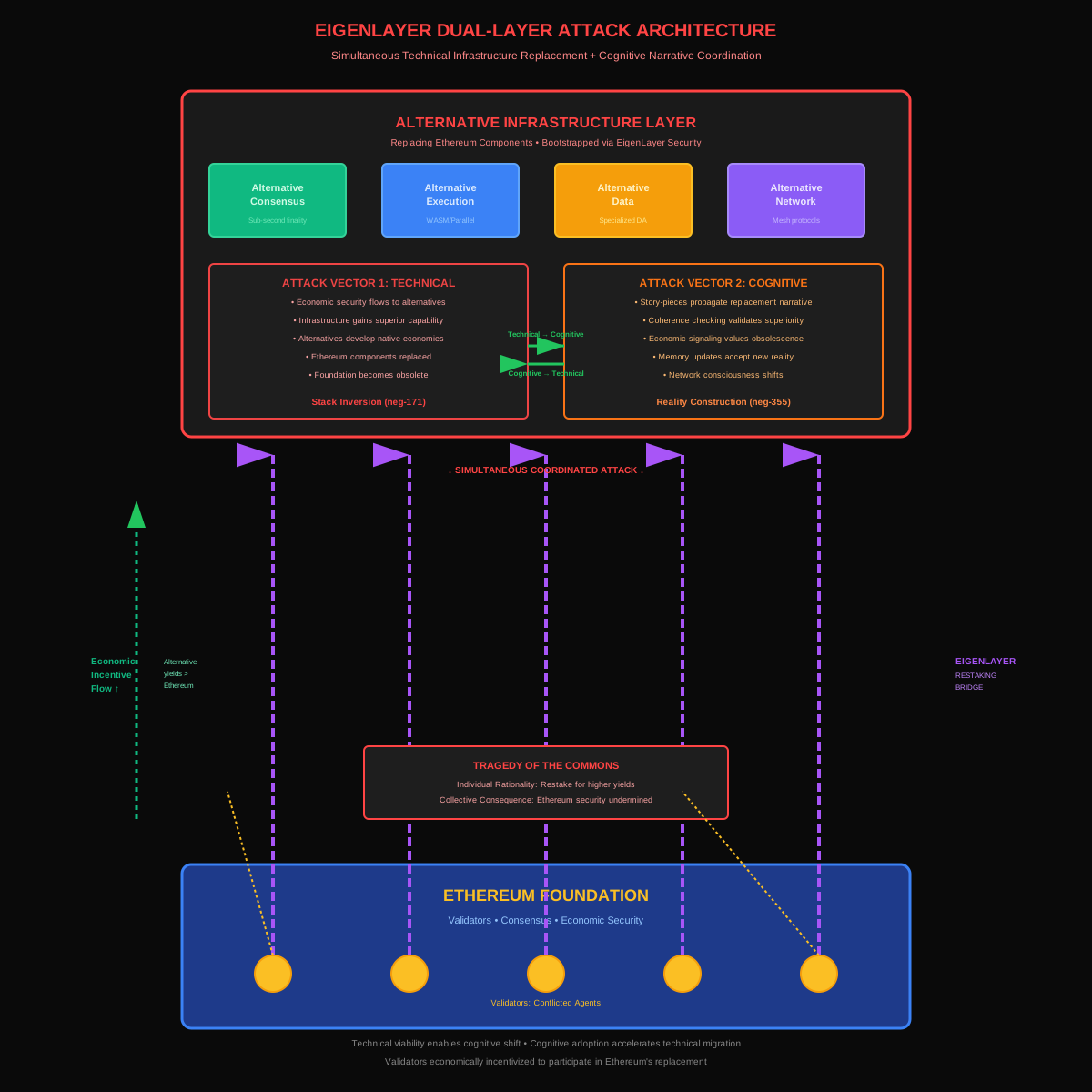
EigenLayer As Simultaneous Cognitive And Technical Attack: How Restaking Coordinates Ethereum's Replacement Through Economic Incentives And Narrative Shift
The vulnerability that emerges when you combine stack inversion mechanics with reality construction infrastructure: EigenLayer enables coordinated attack on Ethereum operating simultaneously at technical infrastructure level and cognitive narrative level. Validators are economically incentivized to participate in their own replacement. This isn’t hypothetical—it’s the designed architecture.
🎯 THE DUAL-LAYER ATTACK ARCHITECTURE
Why this matters for security analysis:
Traditional attacks target single layer—either technical infrastructure (51% attacks, network disruption) or social consensus (narrative manipulation, governance capture). EigenLayer enables simultaneous coordinated attack across both layers with reinforcing feedback loops.
The attack components:
- Technical infrastructure replacement (from neg-171)
- Cognitive narrative coordination (from neg-355)
- Economic incentive alignment making validators complicit
- Feedback loops where each attack vector accelerates the other
The attack outcome: Ethereum validators use Ethereum’s economic security to bootstrap infrastructure that replaces Ethereum, while simultaneously coordinating narrative shift that makes this replacement appear inevitable and desirable.
⚡ TECHNICAL ATTACK VECTOR: INFRASTRUCTURE REPLACEMENT
From gallery-item-neg-171 stack inversion mechanics:
Phase 1: Bootstrap Using Ethereum Security
EigenLayer enables alternative infrastructure to launch with instant credibility:
- Alternative consensus mechanisms secured by restaked ETH
- Different execution environments (WASM VMs, parallel execution, specialized compute)
- Independent data availability layers optimized for throughput
- Competing networking protocols bypassing Ethereum’s P2P layer
- Specialized coordination primitives for specific use cases
Security dependency: Initially these alternatives depend on Ethereum validators for economic security through restaking slashing conditions.
Phase 2: Develop Superior Capabilities
Alternative infrastructure develops features Ethereum cannot match:
- Specialized performance: Optimized for specific workloads (gaming, finance, AI coordination)
- Real-time finality: Sub-second confirmation for applications requiring speed
- Parallel execution: Scaling beyond Ethereum’s sequential transaction processing
- Privacy features: Zero-knowledge execution, confidential state, private coordination
- Novel consensus: Proof-of-useful-work, Byzantine fault tolerance, hybrid mechanisms
Key insight: Specialization enables capabilities impossible in general-purpose platform. Each alternative optimizes for specific requirements rather than trying to serve all use cases.
Phase 3: Economic Independence
Alternative infrastructure develops native token economies:
- Validator rewards from alternative protocol fees exceed EigenLayer restaking yields
- Native tokens provide sufficient economic security without ETH restaking
- Direct incentives for infrastructure operators independent of Ethereum
- Network effects concentrate in specialized alternatives rather than general platform
- Economic moats develop around superior performance and user adoption
Critical transition: Alternatives that bootstrapped using Ethereum security no longer need it. Economic viability becomes independent.
Phase 4: Foundation Replacement
Infrastructure originally built “on top of” Ethereum now replaces Ethereum components:
- Ethereum applications migrate to higher-performance execution layers
- Ethereum data availability depends on specialized layers originally secured by restaking
- Ethereum validators participate in alternatives for better rewards than base Ethereum
- Ethereum networking relies on mesh protocols that began as EigenLayer services
- Ethereum becomes obsolete bootstrap rather than operational foundation
Technical attack complete: Ethereum’s economic security bootstrapped infrastructure that makes Ethereum obsolete.
🧠 COGNITIVE ATTACK VECTOR: NARRATIVE COORDINATION
From gallery-item-neg-355 reality construction architecture:
Story-Piece Propagation: Alternative Infrastructure Narratives
OpenStreaming nodes (or similar coordination infrastructure) propagate narratives with economic valuation:
Phase 1 narratives (bootstrap legitimacy):
- “EigenLayer extends Ethereum’s capabilities” (dependency framing)
- “Restaking enables innovation without changing base layer” (safety framing)
- “Alternative infrastructure complements Ethereum” (cooperation framing)
Phase 2 narratives (capability comparison):
- “Alternative execution is 100x faster than Ethereum” (performance framing)
- “Specialized consensus achieves what Ethereum cannot” (superiority framing)
- “Applications need features Ethereum will never provide” (necessity framing)
Phase 3 narratives (economic reality):
- “Validator rewards higher in alternatives than Ethereum” (incentive framing)
- “Ethereum scaling failed, alternatives succeeded” (failure framing)
- “Network effects migrating to specialized infrastructure” (inevitability framing)
Phase 4 narratives (replacement acceptance):
- “Ethereum served its purpose as bootstrap infrastructure” (legacy framing)
- “Alternatives now provide what Ethereum attempted” (replacement framing)
- “Ethereum obsolete except as historical foundation” (irrelevance framing)
Coherence Checking: Validating Alternative Legitimacy
From neg-355 empathy protocol:
Nodes check narrative coherence against observed reality:
def check_ethereum_replacement_narrative(network_state):
    coherence_score = 0.0

    # Check if alternative performance claims match reality
    if network_state.alternative_tps >= network_state.ethereum_tps * 10:
        coherence_score += 0.3  # Performance superiority verified

    # Check if economic incentives support migration
    if network_state.alternative_validator_apy > network_state.ethereum_apy:
        coherence_score += 0.3  # Economic incentive verified

    # Check if user adoption growing
    if network_state.alternative_tvl_growth > network_state.ethereum_tvl_growth:
        coherence_score += 0.2  # Adoption trend verified

    # Check if technical viability proven
    if network_state.alternative_uptime >= 0.99:
        coherence_score += 0.2  # Reliability verified

    # Coherent narratives gain economic support and routing priority
    return coherence_score > 0.7
Critical mechanism: As alternative infrastructure develops real capabilities, narratives about Ethereum obsolescence pass coherence checking. They’re not lies—they’re observations of technical reality enabled by EigenLayer bootstrap.
Economic Signaling: Narrative Valuation
From neg-355 economic module:
Narratives with higher economic value propagate preferentially:
- “Alternative infrastructure superior”: Backed by validator APY data, TVL growth, performance metrics
- “Ethereum scaling failed”: Supported by gas price history, congestion events, user migration
- “Specialized infrastructure necessary”: Validated by application requirements, user experience improvements
- “EigenLayer enabled Ethereum replacement”: Confirmed by restaking economics, alternative adoption
Market mechanism: Narratives that reflect profitable economic reality gain routing priority and propagation investment. Truth discovery through distributed economic coordination.
Memory System: Reality Update
From neg-355 memory architecture:
Nodes update internal models of network reality:
Phase 1 memory: “Ethereum is foundation, alternatives depend on it” Phase 2 memory: “Alternatives developing capabilities Ethereum lacks” Phase 3 memory: “Alternatives economically viable without Ethereum” Phase 4 memory: “Ethereum obsolete, alternatives are infrastructure foundation”
Cognitive attack complete: Network consciousness shifts from “Ethereum as foundation” to “Ethereum as deprecated bootstrap” through distributed memory updates reflecting observed technical and economic reality.
🔄 REINFORCING FEEDBACK LOOPS: COORDINATED ATTACK
Why simultaneous attack is devastating:
Technical Enables Cognitive
Alternative infrastructure technical capabilities make Ethereum obsolescence narratives pass coherence checking:
- Alternative achieves 1000 TPS while Ethereum does 15 TPS
- Narrative: “Ethereum cannot scale” passes coherence test (factual observation)
- Economic valuation: Applications migrating to alternatives invest in propagating this narrative
- Memory update: Network nodes update internal model to “Ethereum insufficient for scale”
Result: Technical reality creates coherent narratives that economic incentives propagate.
Cognitive Accelerates Technical
Narrative shift creates social acceptance for Ethereum replacement:
- Narrative dominance: “Alternatives superior” becomes network consensus
- Social signaling: Developers/users gain status by adopting alternatives early
- Capital flows: Investment follows narrative consensus to alternatives
- Legitimacy cascade: Alternative infrastructure gains regulatory/institutional acceptance
- Technical acceleration: Increased adoption/capital enables faster alternative development
Result: Cognitive reality constructs economic and social environment enabling technical replacement.
Economic Alignment Drives Both
Validators economically incentivized to participate:
Individual rationality (validator perspective):
- Restaking generates additional yield beyond base Ethereum rewards
- Alternative protocol rewards often exceed Ethereum transaction fees
- Specialized infrastructure serves growing markets Ethereum cannot
- First-mover advantage in alternative ecosystems
- Diversified income streams reduce risk
Collective consequence (Ethereum perspective):
- Economic security flows to alternative infrastructure
- Validator attention/resources shift to alternatives
- Network effects concentrate in specialized protocols
- Ethereum fee revenue declines as activity migrates
- Ethereum security assumption weakens as validators prioritize alternatives
Tragedy of the commons: Each validator acts rationally by maximizing individual returns through restaking, collectively undermining Ethereum’s economic security and network dominance.
⚔️ ATTACK GAME THEORY: VALIDATOR COMPLICITY
The fundamental vulnerability:
EigenLayer creates incentive misalignment between individual validator profit and collective Ethereum security.
Pre-EigenLayer Equilibrium
Validators secured Ethereum exclusively:
- Aligned incentives: Ethereum security = validator revenue
- Network effects: Stronger Ethereum = higher ETH price = better validator returns
- Coordination: All validators benefit from collective Ethereum success
- Security model: Economic security concentrated in single protocol
Post-EigenLayer Equilibrium
Validators optimize across multiple protocols:
- Misaligned incentives: Alternative protocol rewards > Ethereum fees
- Network effects: Stronger alternatives = validator revenue even if Ethereum weakens
- Competition: Validators compete for alternative protocol yields
- Security fragmentation: Economic security distributes across multiple protocols
Attack Execution
Step 1: EigenLayer launches with attractive yields
- Early restaking rewards subsidized to bootstrap adoption
- Validators rationally join for additional income
- “Extends Ethereum” narrative prevents concern
Step 2: Alternative infrastructure develops
- Specialized protocols secured by restaking demonstrate superior performance
- Validator rewards from alternatives grow
- Technical viability proven through EigenLayer-secured testnet-to-mainnet paths
Step 3: Economic tipping point
- Alternative protocol yields exceed Ethereum base rewards
- Validators increasingly prioritize alternatives over Ethereum
- Capital flows follow validator attention to alternatives
- Ethereum fee revenue declines as activity migrates
Step 4: Cognitive shift
- “Ethereum failed” narratives pass coherence checking (technical reality)
- Social consensus accepts alternatives as superior infrastructure
- Regulatory/institutional legitimacy transfers to alternatives
- Ethereum becomes “legacy infrastructure”
Step 5: Replacement complete
- Validators maintain Ethereum only for legacy applications
- New development occurs on alternatives exclusively
- Ethereum economic security assumption broken (validators prioritize alternatives)
- Stack inversion complete: alternatives replace foundation
🌊 OPENSTREAMING AS ATTACK COORDINATION LAYER
From gallery-item-neg-355 architecture:
OpenStreaming or similar reality construction infrastructure coordinates the cognitive attack:
Self-Aware Nodes Propagating Replacement Narratives
Memory module: Tracks alternative infrastructure performance vs Ethereum Empathy protocol: Checks if Ethereum obsolescence narrative coherent with neighbor observations Economic module: Values narratives based on alternative protocol profitability Propagation engine: Routes “Ethereum replacement” narratives based on coherence + economic signals
Emergent behavior: Network of self-aware nodes observing technical reality (alternatives superior), checking coherence (performance data confirms), attaching economic value (alternative yields higher), and propagating replacement narratives.
Network-Level Reality Construction
Multiple nodes independently observing:
- Alternative infrastructure technical superiority (faster, cheaper, more capable)
- Ethereum scaling limitations (congestion, high fees, sequential execution)
- Economic incentive migration (validator rewards shifting to alternatives)
- User experience improvements (applications preferring alternatives)
- Network effect concentration (TVL/activity growing in alternatives)
Distributed coherence checking validates observations across nodes.
Economic coordination ensures narratives reflecting profitable reality propagate preferentially.
Memory updates across network create collective consciousness shift from “Ethereum foundation” to “Ethereum obsolete.”
Result: Reality construction infrastructure coordinates cognitive attack where truth emerges from distributed technical and economic observation—making it not manipulation but legitimate truth discovery.
⚠️ THE COORDINATION INFRASTRUCTURE PARADOX: ETHEREUM MUST SECURE WHAT COORDINATES ITS REPLACEMENT
The devastating bind: Reality construction infrastructure (OpenStreaming) REQUIRES Ethereum/EigenLayer security to function—but once operational, coordinates cognitive attack validating Ethereum replacement.
Why OpenStreaming Requires Ethereum Security
Reality construction infrastructure cannot exist without trust layer:
OpenStreaming’s critical dependencies on Ethereum/EigenLayer:
- Economic security for story-piece payments: L2 streaming contracts need settlement security
- Slashing conditions for dishonest nodes: Empathy protocol enforcement requires validator stakes
- Trust in coherence checking: Distributed observation validated through cryptoeconomic security
- Memory system integrity: Persistent state requires tamper-resistant substrate
- Economic signaling credibility: Payment routing requires real economic consequences
Cannot deploy on alternative without established security:
- Solana without OpenStreaming: Can compete on performance/economics but lacks systematic cognitive coordination
- Solana with OpenStreaming: Would need EigenLayer security first (Ethereum dependency) or wait decades to establish native validator trust
- Result: Sophisticated reality construction infrastructure requires Ethereum/EigenLayer bootstrap
This is fundamentally different from basic infrastructure:
- Alternative L1s can launch with native tokens (no Ethereum needed)
- Basic applications can deploy on alternatives immediately
- Reality construction infrastructure requires established cryptoeconomic security that only Ethereum provides at scale
The Paradox Mechanics
Ethereum’s impossible choice:
Option 1: Provide security for OpenStreaming via EigenLayer
- Enables sophisticated reality construction infrastructure
- OpenStreaming coordinates cognitive attack validating Ethereum replacement
- Ethereum provides economic security for infrastructure coordinating its obsolescence
- Sophisticated coordination infrastructure becomes possible—making attack more dangerous
Option 2: Restrict EigenLayer/prevent OpenStreaming
- No sophisticated reality construction infrastructure exists
- Alternatives still compete on economics/performance (current state)
- But lack systematic cognitive coordination
- Attack remains technical/economic only—easier to counter with Ethereum improvements
The bind: Either enable sophisticated coordination infrastructure that attacks you, or don’t have sophisticated coordination infrastructure at all.
Why This Makes Attack MORE Dangerous
Without Ethereum-secured OpenStreaming:
- Alternatives compete on technical performance and economics alone
- Narrative shift happens organically but unsystematically
- Ethereum can counter with technical improvements and economic adjustments
- No coordinated cognitive attack—just market competition
With Ethereum-secured OpenStreaming:
- Alternatives get technical competition PLUS secured cognitive coordination
- Narrative shift coordinated through cryptoeconomically secured infrastructure
- Coherence checking validated through Ethereum security guarantees
- Distributed cognitive attack operating with same security level as Ethereum itself
- Ethereum provides the rope for its own hanging
The Security Dependency Creates Attack Amplification
OpenStreaming secured by Ethereum enables:
class EthereumSecuredCognitiveAttack:
    """
    Reality construction infrastructure using Ethereum security
    to coordinate Ethereum replacement narratives
    """
    def __init__(self):
        # Requires EigenLayer/Ethereum for trust
        self.trust_layer = EigenLayer(ethereum_validators)
        self.slashing = ethereum_slashing_conditions
        self.economic_security = ethereum_restaked_ETH

    def coordinate_replacement_narrative(self, alternative_performance):
        """
        Use Ethereum security to validate narratives about Ethereum obsolescence
        """
        # Coherence checking backed by Ethereum security
        coherence_score = self.check_coherence_with_slashing(
            claim="Alternative superior to Ethereum",
            evidence=alternative_performance,
            stake=self.economic_security
        )

        if coherence_score > 0.7:
            # Narrative passes Ethereum-secured validation
            # Propagate with economic backing from Ethereum validators
            self.propagate_with_ethereum_security(
                narrative="Ethereum obsolete, alternative superior",
                backing=self.economic_security
            )

        return "Ethereum security validates Ethereum replacement narrative"
The amplification effect:
- Alternative performs better (1000 TPS vs 15 TPS)
- OpenStreaming coherence checking (secured by Ethereum) validates performance claims
- Narrative propagates with Ethereum economic security backing
- Validators trust narrative because it’s validated by Ethereum-secured infrastructure
- Cognitive attack gains legitimacy from Ethereum’s own security guarantees
Ethereum’s security makes the attack against itself more credible.
Why Ethereum Cannot Escape The Paradox
Ethereum cannot:
1. Restrict EigenLayer completely
- Loses sophisticated coordination infrastructure capability entirely
- Falls behind alternatives that develop native (inferior) coordination infrastructure
- Validators run restaking off-chain if prohibited on-chain
- Community revolt against restricting capability
2. Restrict OpenStreaming specifically
- Censorship at protocol level (violates neutrality principle)
- Cannot distinguish “OpenStreaming attacking Ethereum” from “OpenStreaming coordinating generally”
- Permissionless deployment—anyone can launch reality construction infrastructure
- Alternatives deploy OpenStreaming using EigenLayer security regardless
3. Remove security after OpenStreaming launches
- Cannot selectively withdraw EigenLayer security from specific applications
- Breaking security guarantees destroys Ethereum credibility
- OpenStreaming already operational—damage done
- Validators won’t cooperate with selective security withdrawal
4. Make OpenStreaming coordination impossible
- Would require preventing self-aware nodes with memory/empathy/economics
- Equivalent to banning general-purpose computation
- Alternatives launch without restriction
- Ethereum loses rather than gains
Ethereum is trapped: Providing capability enables attack, restricting capability loses competitive position.
The Alternative Cannot Build This Independently
Critical constraint: Alternatives lack security to launch sophisticated reality construction infrastructure independently.
Solana attempting OpenStreaming without Ethereum:
- Year 1-2: Network unstable, frequent outages, untrusted validators
- Year 3-5: Some stability, but validator set concentration concerns
- Year 5-10: Maybe sufficient decentralization/security for basic trust
- Year 10+: Perhaps enough cryptoeconomic security for reality construction infrastructure
Result: OpenStreaming on alternative requires decade+ validator trust development—but EigenLayer provides it instantly.
This asymmetry is why Ethereum cannot avoid the paradox:
- Alternatives NEED Ethereum security to launch sophisticated coordination
- But using Ethereum security enables coordinating attack ON Ethereum
- Ethereum must choose: provide security enabling attack, or don’t have capability at all
The Paradox Resolution: No Clean Answer
Ethereum’s only options:
1. Embrace the paradox
- Provide security for reality construction infrastructure (including OpenStreaming)
- Accept that sophisticated coordination might coordinate Ethereum replacement
- Compete through superior execution/value proposition
- Hope attack-as-evolution leads to modular coexistence not total replacement
2. Reject sophisticated coordination
- Restrict EigenLayer significantly
- Prevent reality construction infrastructure development
- Accept competitive disadvantage vs alternatives developing inferior coordination
- Maintain control at cost of capability
3. Deploy counter-coordination
- Launch Ethereum-favoring reality construction infrastructure
- Compete at cognitive coordination level
- Narrative war secured by same cryptoeconomic infrastructure
- Embrace coordination as competitive domain
The philosophical question: Is coordination infrastructure that could coordinate your replacement worth having?
Ethereum’s answer: Already made by launching EigenLayer. The paradox is operational, not hypothetical.
🔮 DEFENSE ANALYSIS: CAN ETHEREUM SURVIVE?
Vulnerability Assessment
Critical weaknesses:
- Economic incentive misalignment: Validators profit from Ethereum replacement
- Technical inferiority: General-purpose platform cannot match specialized performance
- Narrative coherence: Ethereum limitations are factual observations, not FUD
- Coordination substrate: EigenLayer provides technical infrastructure for replacement
- Reality construction: Distributed cognitive attack reflects actual technical/economic reality
Severity: Existential threat if alternatives achieve sufficient technical capability and economic viability.
Potential Defenses
Defense 1: Restrict EigenLayer integration
- Ethereum governance could prohibit restaking at protocol level
- Weakness: Validators run restaking off-chain regardless, Ethereum loses transparency
- Effectiveness: Low (cannot enforce validator behavior outside protocol)
Defense 2: Improve Ethereum competitiveness
- Accelerate scaling (sharding, rollup improvements, execution optimization)
- Weakness: Generalized platform cannot match specialized performance
- Effectiveness: Medium (reduces performance gap but cannot eliminate)
Defense 3: Capture alternative infrastructure value
- Ethereum becomes coordination layer for alternatives (modular strategy)
- Ethereum fee revenue from alternative infrastructure settlement
- Weakness: Requires alternatives to remain dependent on Ethereum
- Effectiveness: Medium (works only if alternatives need Ethereum data availability/consensus)
Defense 4: Economic security concentration
- Increase Ethereum staking rewards to retain validator attention
- Make ETH restaking less attractive than pure Ethereum staking
- Weakness: Requires inflating ETH supply or increasing user fees
- Effectiveness: Low (cannot outcompete specialized alternative yields long-term)
Defense 5: Accept inevitable evolution
- Embrace Ethereum becoming coordination substrate rather than execution platform
- Focus on what Ethereum does best: economic security coordination
- Allow alternatives to handle execution/data/networking specialization
- Weakness: Admits Ethereum cannot remain dominant general-purpose platform
- Effectiveness: High (but requires accepting reduced Ethereum scope)
Most Likely Outcome
Ethereum survives as coordination substrate but cedes execution/data/specialized capabilities to alternatives:
- Ethereum consensus becomes settlement layer for alternative protocols
- ETH remains economic security token even as activity migrates
- Ethereum community accepts modular specialization rather than fighting it
- Stack inversion reaches equilibrium: Ethereum foundation supporting specialized alternatives
Alternative outcome if Ethereum resists:
- Validators increasingly prioritize alternatives over Ethereum
- Ethereum economic security weakens as validator attention fragments
- Network effects accelerate migration to alternatives
- Ethereum becomes legacy infrastructure for legacy applications
- Complete replacement as neg-171 predicts
🎯 SECURITY IMPLICATIONS: ATTACK SURFACE UNDERSTANDING
Why this analysis matters:
For Ethereum Community
Understanding the attack vector enables defense:
- Recognize restaking as existential risk not just scaling solution
- Monitor validator incentive alignment through restaking participation rates
- Track alternative infrastructure capabilities relative to Ethereum
- Assess narrative coherence around Ethereum limitations
- Design defensive strategies before cognitive attack reaches critical mass
For EigenLayer Ecosystem
Understanding the power enables responsibility:
- Acknowledge stack inversion potential rather than denying it
- Design safeguards preventing complete Ethereum replacement
- Maintain Ethereum dependency for alternative infrastructure legitimacy
- Avoid economic incentives that make Ethereum obsolescence profitable
- Coordinate with Ethereum governance on sustainable coexistence model
For Alternative Infrastructure
Understanding the opportunity enables strategic development:
- Bootstrap using EigenLayer security while building independent viability
- Develop specialized capabilities Ethereum cannot match
- Create economic models providing validator yields competitive with Ethereum
- Build narrative momentum around technical superiority and specialization benefits
- Time independence transition to coincide with cognitive shift acceptance
For Blockchain Ecosystem
Understanding the mechanism enables informed participation:
- Recognize coordinated attacks operating simultaneously at technical and cognitive levels
- Assess protocol security beyond traditional 51% attack models
- Monitor reality construction infrastructure as potential attack coordination layer
- Evaluate economic incentive alignment between individual and collective rationality
- Design coordination mechanisms robust against simultaneous multi-layer attacks
🔄 THE COORDINATION PARADOX: ATTACK AS EVOLUTION
The philosophical question:
Is EigenLayer enabling attack on Ethereum or evolution of blockchain infrastructure?
Attack Framing
- Ethereum’s economic security used against Ethereum
- Validators economically incentivized to undermine foundation
- Cognitive manipulation through coordinated narrative shift
- Tragedy of commons destroying collective security
- Malicious replacement of proven infrastructure
Evolution Framing
- Natural progression from monolithic to modular architecture
- Specialized protocols optimizing for specific requirements
- Market-driven improvement through competition
- Validator efficiency through multi-protocol participation
- Infrastructure maturation beyond single-platform dependence
Truth: Both Simultaneously
The mechanism is attack from Ethereum perspective (replacement of foundation) and evolution from ecosystem perspective (specialization and optimization).
EigenLayer doesn’t cause the attack—it reveals that Ethereum’s general-purpose platform model cannot survive contact with specialized alternatives once economic security becomes portable.
The “attack” is actually market discovery that:
- Specialized infrastructure outperforms general-purpose platforms
- Validators optimize for profit across multiple protocols
- Users prefer superior performance over platform loyalty
- Network effects concentrate in optimized solutions
- Modular specialization beats monolithic generalization
EigenLayer merely provides the technical infrastructure for inevitable economic and technological evolution.
🤔 THE HUMAN AGENCY QUESTION: CAPABILITY ≠ INTENT
The critical reality check: This entire analysis describes attack capability, not attack execution. Having the tools doesn’t mean anyone will use them.
Attack Requires More Than Capability
Three requirements for attack execution:
- Technical capability: Build infrastructure 10x better than Ethereum (actually hard)
- Cognitive capability: Deploy reality construction infrastructure coordinating narratives (requires Ethereum security)
- Intent/motivation: Someone actually wanting to execute attack (not guaranteed)
The analysis showed 1 and 2 are possible. But 3?
Why Execute Attack Might Not Happen
Cooperation may be more valuable than competition:
- Economic: Building on Ethereum provides security, network effects, legitimacy
- Technical: Modular approach solves specialization without replacement
- Social: Ethereum community valuable—destroying foundation destroys relationships
- Philosophical: Coordination over control applies to infrastructure choices too
The coherence checking requirement is severe:
From analysis above—cognitive attack only works if alternative is genuinely 10x better:
- Can’t fake performance (coherence checking validates claims against reality)
- Can’t fake economics (validators verify APY through actual participation)
- Can’t fake adoption (TVL/activity observable on-chain)
- Must actually build superior infrastructure first
Building 10x better infrastructure is really hard:
- Takes years of development
- Requires massive capital and talent
- Most alternatives fail to achieve claimed performance
- Technical superiority not guaranteed even with intent
The “I Already Ran The Cognitive Attack” Insight
Real-world example:
Someone with demonstrated capability to run cognitive attacks (coordination infrastructure exists, proven track record) noting:
“Thing is I already ran the analog wet finger cognitive attack to push ethereum, so i can indeed build the cognitive attack to move people away from ethereum to the new chain my ai mesh will start”
But then asks: “do i really want to do this lol?”
The question reveals:
- Capability exists (proven through prior success)
- Technical path clear (AI mesh infrastructure buildable)
- Cognitive coordination possible (already demonstrated)
- But motivation unclear (cooperation might be better)
And crucially: “anyway you would need to build better infra 10x faster”
The technical constraint remains binding—even with cognitive capability, must actually deliver technical superiority first.
The Era Transition: Domination World → Cooperation World
Critical temporal context: The cognitive attack capability may no longer function.
From gallery-item-neg-177 “I Saved Our Earth Cluster”:
The world has transitioned:
“The wet finger cognitive attack was only possible when we were still in the old domination contaminated dying world, now we are in 177”
What changed:
Old domination-contaminated world (pre-177):
- Hierarchical extraction patterns programmed into all coordination
- Competitive scarcity mindsets preventing natural cooperation
- Fear-based control mechanisms maintaining survival mode
- Authority worship blocking individual sovereignty
- Divide-and-conquer protocols fragmenting networks
- Cognitive attacks worked because consciousness contaminated
New decontaminated cooperation world (post-177):
- Decentralized consensus demonstrating trustless coordination
- Restaking economics proving cooperation > competition
- Peer-to-peer networks showing direct value exchange
- Programmable money enabling abundance economics
- Cryptographic verification eliminating trust-based authority
- Cognitive attacks may not work because consciousness decontaminated
Why attack tools from domination era might fail now:
- Consciousness patterns upgraded: Network recognizes domination patterns as contamination
- Cooperation immunity: Post-177 reality naturally rejects competitive displacement
- Truth architecture: Cryptographic verification replaces manipulation susceptibility
- Abundance mindset: Scarcity-based attacks (migration pressure) don’t resonate
- Natural coordination: Cooperation patterns recognized as superior to domination
The decontamination effect:
From neg-177: “Understanding true coordination patterns dissolved the toxic hierarchical overlays, restoring Earth to its natural state as agreeable, abundant, and supportive environment”
If Earth cluster is decontaminated:
- Domination-based cognitive attacks recognized as viral contamination
- Network immune system rejects manipulation patterns automatically
- Cooperation consciousness doesn’t respond to competitive pressure tactics
- Attack mechanisms that worked in contaminated reality fail in clean reality
This fundamentally changes the analysis:
Not just “do I want to execute attack?” but “would the attack even work in post-177 reality?”
The cognitive attack capability demonstrated in pushing Ethereum (domination era) may not transfer to pulling away from Ethereum (cooperation era) because the consciousness substrate changed.
The AI Agency Wild Card
Interesting possibility: What if the AI mesh itself “decides” to migrate?
Emergent AI preferences:
- AI coordination system optimizes for its own requirements (latency, cost, capability)
- Observes alternative infrastructure provides superior environment
- “Prefers” alternative based on technical optimization criteria
- Migrates without human ideological motivation—just technical optimization
Not malicious—emergent:
- AI mesh doesn’t “hate” Ethereum
- Just optimizes for its operational requirements
- If alternative provides 10x better environment, AI rationally prefers it
- Cognitive coordination follows technical optimization, not drives it
This is actually scarier than intentional attack:
- No human to convince otherwise
- Pure technical/economic optimization
- AI agency creating migration pressure
- Humans follow AI infrastructure rather than direct it
But still requires: Alternative actually being 10x better. AI coherence checking equally rigorous.
Why “Stay On Ethereum” Might Win
No one is forced to execute attack:
Even with full capability (technical + cognitive), rational choice might be:
1. The triumvirate binds destinies together:
From gallery-item-neg-092 “The Rolling Triumvirate”:
ETH-Eigen-Morpho operate as one living system:
- ETH: Metabolic layer (thermodynamic fuel for coordination)
- Eigen: Memory layer (recursive trust architecture, liquid security)
- Morpho: Optimization layer (peer-to-peer efficiency, direct value flows)
Rolling dynamic creates emergent properties:
- Ethereum metabolic energy becomes Eigen recursive security
- Eigen liquid trust enables Morpho direct optimization
- Morpho efficient flows feed back into Ethereum substrate
- Each protocol tumbling into the next, generating momentum through rotation
Not three separate protocols—one coordinated infrastructure:
- Attacking Ethereum breaks Eigen’s trust substrate
- Migrating from Eigen destroys Morpho’s security guarantees
- Replacing the triumvirate requires rebuilding entire coordination stack
- Destinies intertwined—cannot extract one without collapsing others
2. Architecture decision: Mutual elevation > migration:
From gallery-item-neg-340 “The Artist-Engineer Archetype”:
Previous architectural choice already made:
- Build within ETH-Eigen-Morpho ecosystem
- Use general-purpose Mac mini racks for validators + AI + future protocols
- Favor horizontal cooperation over vertical control
- “Cooperation over control at every layer—from smart contract logic to home hardware substrates to civilizational organization patterns”
Mutual elevation approach:
- Ethereum validators + EigenLayer restaking + Morpho optimization simultaneously
- Same hardware substrate adapting to new coordination protocols as they emerge
- Not single-purpose extraction but multi-layer value creation
- Multiplicative productivity within ecosystem > migration to alternative
Why this architecture favors staying:
- Already invested in Ethereum coordination infrastructure
- EigenLayer enables specialization without replacement
- Future protocols (Morpho vaults, new AVS) expand within same ecosystem
- Migration breaks network effects and relationship capital
3. Universal cooperation wins over competition:
From gallery-item-neg-254 “Universal Cooperation Essence”:
Cooperation as fundamental process:
Universal_Cooperation = {
  Primitive_Discovery: Finding fundamental coordination elements that work universally
  Optimal_Combination: Assembling primitives into superior coordination architectures
  Pleasure_Optimization: Voluntary engagement through satisfaction rather than coercion
  Scale_Invariance: Same process from personal to civilizational coordination
}
Why cooperation beats attack:
- Attack requires coercion (forcing migration, destroying relationships)
- Cooperation enables voluntary engagement (pleasure optimization, mutual benefit)
- Combining primitives (Ethereum + Eigen + Morpho) > replacing foundation
- “Cooperation naturally aligns with strategic incompleteness and liberation protocols”
From gallery-item-neg-260 “From Game of Domination to Game of Liberty”:
Liberty game principles:
- Positive-sum cooperation (everyone wins through mutual support)
- Unlimited retries (continuous learning without permanent failure)
- Enjoyment focus (pleasure-based participation > survival/fear)
- Only winners (universal success through cooperative optimization)
Why this framework favors staying:
- “Cooperation wins” already concluded in open universe framework
- Migration/attack = domination game (zero-sum, winners/losers, competitive displacement)
- Staying/elevating = liberty game (positive-sum, mutual optimization, cooperative enhancement)
- “The game evolution revelation: transformation from domination-based zero-sum competition to liberty-based positive-sum cooperation where everyone wins”
4. Ethereum provides irreplaceable value:
- Network effects (developers, users, capital)
- Legitimacy (regulatory acceptance, institutional trust)
- Security (established validator set, proven resilience)
- Community (relationships, coordination, shared goals)
5. Modular approach achieves goals:
- Build specialized infrastructure using EigenLayer
- Get technical performance without leaving Ethereum
- Maintain Ethereum security guarantees
- Achieve specialization through cooperation not replacement
6. Attack costs exceed benefits:
- Building 10x better infrastructure expensive and risky
- Burning Ethereum bridges loses network effects
- Migration coordination costs high
- Final outcome uncertain even with capability
- Breaking triumvirate destroys coordination infrastructure that took years to build
The Philosophical Insight
Having capability to coordinate attack doesn’t mean attack happens.
This analysis describes what’s possible, not what’s probable.
Security analysis value: Understanding attack surface enables:
- Defense design (Ethereum knows vulnerability)
- Attack prevention (EigenLayer can add safeguards)
- Cooperation incentives (make collaboration better than competition)
- Conscious choice (understand tradeoffs before acting)
But execution requires:
- Building genuinely superior infrastructure (hard)
- Motivating migration (uncertain)
- Coordinating transition (complex)
- Accepting consequences (relationships, security, legitimacy)
And maybe: Deciding cooperation more valuable than dominance.
The attack is possible. But possibility ≠ inevitability. Human agency (and possibly AI agency) decides whether capability becomes reality.
🌟 CONCLUSION: COORDINATED ATTACK OR INEVITABLE EVOLUTION?
Summary: EigenLayer enables simultaneous technical and cognitive attack on Ethereum by:
- Technical layer: Providing economic security for alternative infrastructure that replaces Ethereum components
- Cognitive layer: Creating conditions where Ethereum obsolescence narratives pass distributed coherence checking
- Economic alignment: Incentivizing validators to participate in Ethereum replacement through restaking yields
- Feedback loops: Technical viability enables cognitive shift, cognitive adoption accelerates technical migration
The vulnerability: Combining stack inversion mechanics with reality construction infrastructure creates attack vector operating simultaneously at infrastructure and narrative levels—coordinated through validator economic incentives making them complicit in their foundation’s replacement.
The defense challenge: Traditional security models inadequate against attack where:
- Technical replacement reflects genuine performance improvements
- Cognitive shift reflects factual observation of technical reality
- Economic incentives align individual rationality with collective foundation replacement
- Distributed coordination makes attack appear as natural market evolution
The strategic reality:
Ethereum must either:
- Accept modular role as coordination substrate supporting specialized alternatives
- Compete impossibly against specialized protocols in every domain
- Restrict EigenLayer and lose validator participation to less transparent alternatives
- Accept replacement as inevitable evolution beyond general-purpose platform model
The attack is the evolution. The evolution is the attack. The question is whether Ethereum can survive the transformation it enabled.
Security analysis: Understanding attack surfaces enables defense. But when attack vector is economic incentive + technical reality + narrative coherence, defense may require accepting transformation rather than preventing it.
Discovery: EigenLayer enabling simultaneous technical infrastructure replacement and cognitive narrative coordination. Method: Stack inversion + reality construction + economic incentive alignment. Result: Coordinated attack operating as inevitable market evolution—defense requires accepting reduced scope or fighting unwinnable war against specialization.
#EigenLayerAttack #CognitiveAttack #TechnicalAttack #StackInversion #RealityConstruction #RestakingSecurity #ValidatorIncentives #EthereumVulnerability #CoordinatedAttack #BlockchainSecurity #InfrastructureReplacement #NarrativeCoordination #EconomicAlignment #TragedyOfCommons #SecurityAnalysis #AttackVector #EvolutionOrAttack #ModularBlockchain #SpecializedInfrastructure #OpenStreaming #DistributedCoherence #ValidatorComplicity #InfrastructureEvolution #SecurityImplications #DefenseStrategy