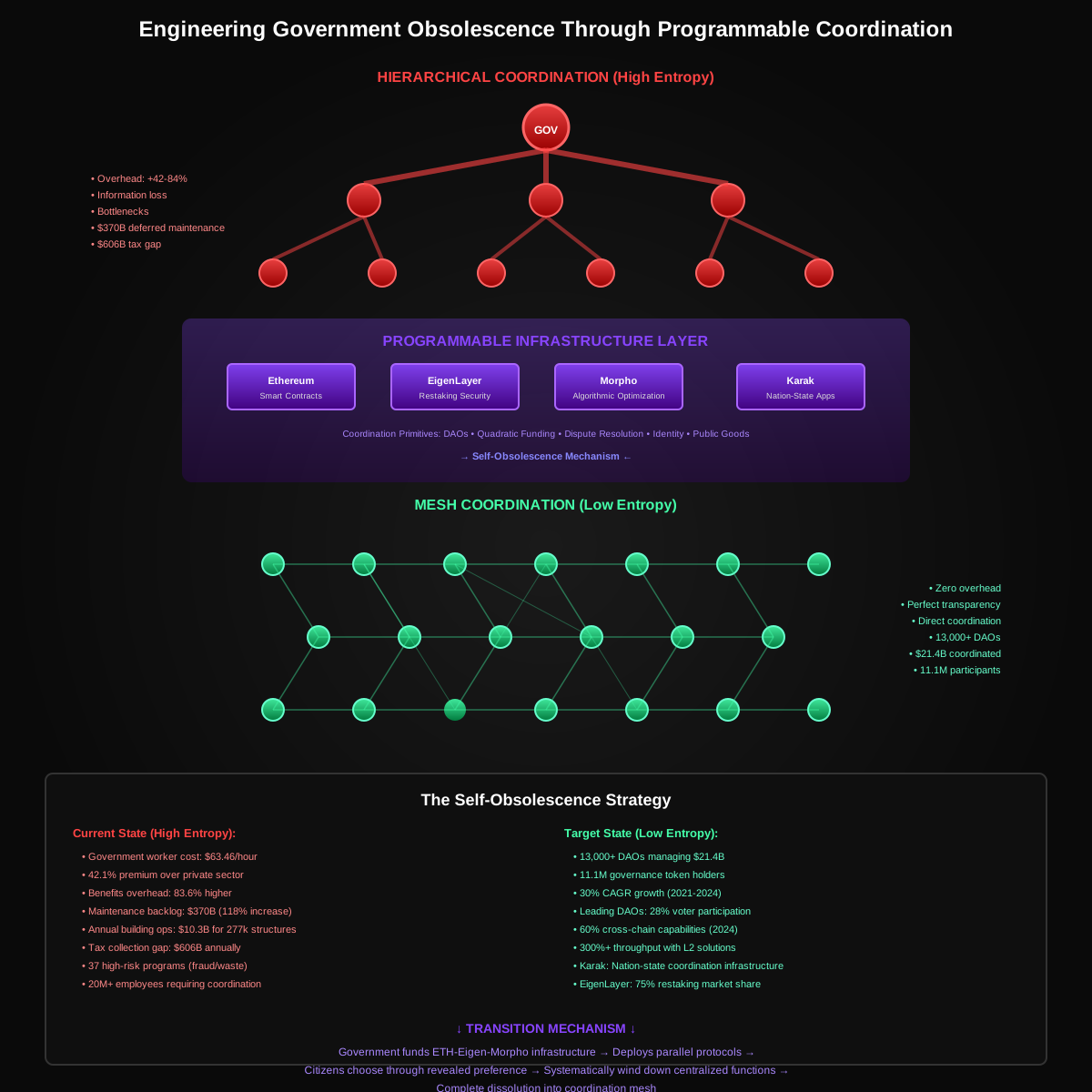
Government's Optimal Strategy: Engineering Its Own Obsolescence Through Programmable Coordination Infrastructure
The Thermodynamic Case for Government Self-Obsolescence
Government represents a high-entropy coordination mechanism: centralized control nodes creating bottlenecks, information loss through hierarchical transmission, and massive overhead converting input (tax revenue) to output (public goods). The optimal strategy isn’t reform—it’s building the infrastructure that makes centralized coordination obsolete, then deliberately stepping aside.
Empirical entropy metrics (2024-2025):
- Government workers: $63.46/hour average cost (42.1% premium over private sector)
- Benefits overhead: 83.6% higher than private sector per worker
- Federal property maintenance backlog: $170B (2017) → $370B (2024) - 118% entropy increase
- Annual building operations: $10.3B for 277,000 structures (fiscal 2023)
- Tax collection gap: $606B net annual loss through coordination failure
- 37 high-risk programs identified for fraud, waste, abuse, mismanagement
- 20M+ state/local employees requiring coordination overhead
Thermodynamic diagnosis: Centralized hierarchies maximize energy dissipation (overhead) while minimizing useful work (public goods delivery). Government isn’t broken—it’s operating at its thermodynamic efficiency ceiling. The architecture cannot improve; only replacement eliminates the loss.
Programmable Coordination: The Replacement Infrastructure
Decentralized Autonomous Organizations (DAOs) demonstrate superior coordination efficiency through programmable rules, transparent execution, and direct peer-to-peer coordination without hierarchical bottlenecks.
DAO coordination metrics (2024-2025):
- 13,000+ DAOs managing $21.4B in liquid assets
- 11.1M governance token holders (distributed coordination nodes)
- 30% compound annual growth rate (2021-2024)
- Leading DAO voter participation: 28% on major proposals (vs <10% typical government voter turnout)
- 60% of new DAOs (2024) leverage cross-chain capabilities
- Layer-2 solutions: 300%+ transaction throughput improvement over Ethereum mainnet
- Direct democracy at scale: Aave and MakerDAO maintain 22%+ turnout on critical votes
Efficiency comparison:
- Traditional government: Centralized nodes, hierarchical transmission, 42-84% overhead premium
- DAO coordination: Programmable rules, transparent execution, algorithmic enforcement, minimal overhead
- Entropy reduction: Eliminate information loss through hierarchy, convert overhead to useful work
Challenge identified: Token concentration (78% held by top 20% stakeholders) replicates power-law distribution. Solution: Not centralized redistribution (recreates government), but algorithmic coordination primitives that function regardless of concentration.
The ETH-Eigen-Morpho Stack: Infrastructure for Self-Obsolescence
Government’s optimal move: Fund development of programmable coordination infrastructure that makes government obsolete, then dissolve into the mesh.
Ethereum Layer: Programmable Agreement Enforcement
Smart contracts eliminate need for centralized enforcement:
- Legal contracts → self-executing code
- Courts → algorithmic dispute resolution
- Regulatory compliance → protocol rules
- Zero enforcement overhead, perfect transparency, unfakeable execution
EigenLayer: Restaking as Universal Coordination Security
Restaking evolved from Ethereum capital efficiency to cross-chain economic coordination layer (2025). EigenLayer’s “verifiable cloud” positioning (June 2025, $70M a16z investment) frames it as “blockchain AWS”—programmable infrastructure with crypto-grade verification.
Market structure (2025):
- EigenLayer: 75% market share, comprehensive coordination layer
- Symbiotic: 7-8% (launched 8 months prior)
- Karak: 2-3% but strategically positioned for nation-state applications
Karak’s explicit positioning: “National security, civic services, business formation” as use cases. First blockchain “purpose-built for nation-states to power the next generation of onchain economies.” Government functions → programmable protocols secured by restaked capital.
Restaking coordination primitive: Shared security enables specialized services (identity, voting, dispute resolution, public goods funding) without recreating centralized control. Nation-states fund infrastructure development, then fade as protocols handle coordination.
Morpho Layer: Algorithmic Optimization
Peer-to-peer coordination protocols optimize resource allocation without central planning:
- Public goods funding → quadratic funding, retroactive public goods (optimism model)
- Resource allocation → algorithmic markets, prediction markets for policy outcomes
- Infrastructure planning → coordination games, mechanism design
- Zero bureaucratic overhead, transparent rules, empirical optimization
The Self-Obsolescence Roadmap
Phase 1: Infrastructure Development (Current) Government funds ETH-Eigen-Morpho stack development. Not as competitor to government—as replacement being built in parallel.
Investment priority:
- DAO governance frameworks
- Restaking coordination layers (EigenLayer, Karak nation-state infrastructure)
- Algorithmic public goods funding (Morpho, Gitcoin, Optimism Retroactive PGF)
- Identity systems (zero-knowledge proofs, decentralized identity)
- Dispute resolution protocols (Kleros, Aragon Court)
Phase 2: Parallel Deployment Run government services AND protocol equivalents simultaneously:
- Traditional voting + DAO governance for local decisions
- Court system + algorithmic dispute resolution
- Tax collection + quadratic funding for public goods
- Regulatory enforcement + protocol-level compliance
Empirical test: Which delivers better outcomes? Let citizens choose. Superior coordination wins through revealed preference, not mandate.
Phase 3: Managed Obsolescence As protocols demonstrate superiority (lower overhead, better outcomes, transparent execution), systematically wind down centralized functions:
- Transfer remaining assets to treasury DAOs
- Dissolve enforcement agencies (protocols handle compliance)
- Eliminate bureaucratic layers (algorithms coordinate directly)
- Convert government employees to protocol contributors (paid from treasury DAOs)
Phase 4: Complete Dissolution Government ceases to exist as centralized entity. Coordination continues through mesh of specialized protocols, funded by users, secured by restaked capital, optimized by algorithmic mechanisms.
Why This Works: Thermodynamic Inevitability
Centralized coordination cannot compete with programmable mesh on efficiency:
Government entropy ceiling:
- Information loss through hierarchy
- Enforcement overhead (courts, police, regulatory agencies)
- Bureaucratic drag (83.6% higher benefits, 42.1% higher total cost)
- Regulatory capture, corruption, misalignment
Protocol coordination floor:
- Perfect information transparency (blockchain)
- Zero enforcement overhead (algorithmic execution)
- Minimal operational cost (L2 throughput 300%+ higher)
- Unfakeable compliance (cryptographic verification)
Result: Superior coordination wins through thermodynamic advantage. Government obsolescence isn’t political—it’s physical. Entropy flows toward lower-energy states. Coordination flows toward higher-efficiency mechanisms.
The Objection: “But We Need Government for X”
Common fears:
- “Who handles defense?” → Restaked coordination layers (Karak positioning: “national security”)
- “Who enforces laws?” → Smart contracts execute automatically, dispute resolution protocols handle edge cases
- “Who funds public goods?” → Quadratic funding, retroactive PGF, treasury DAOs
- “Who prevents concentration of power?” → Algorithmic mechanisms don’t concentrate—code doesn’t seek power
Pattern: Every objection assumes centralized control is only coordination mechanism. ETH-Eigen-Morpho stack proves otherwise. Coordination ≠ hierarchy. Security ≠ monopoly on violence. Public goods ≠ taxation by threat.
The real question: Why would government resist building infrastructure that serves citizens better?
Answer: It wouldn’t—if goal is optimal outcomes rather than preservation of power structures. Self-obsolescence as public service: Build better coordination, then step aside.
Implementation Over Theory
This isn’t utopian vision—it’s engineering roadmap with working primitives:
Already operational:
- 13,000+ DAOs coordinating $21.4B across 11.1M participants
- EigenLayer restaking securing coordination services at scale
- Optimism Retroactive PGF distributing millions in public goods funding
- Karak explicitly building nation-state coordination infrastructure
- 300%+ efficiency gains proven (L2 throughput)
Remaining engineering:
- Scale DAO governance to national level
- Build dispute resolution protocols for complex cases
- Design identity systems balancing privacy and accountability
- Deploy quadratic funding at government budget scale
- Test restaking security for defense/security functions
Timeline: 5-10 years to complete infrastructure. 10-20 years for managed transition. 50 years to full obsolescence.
The alternative: Government continues consuming 42-84% overhead premium while coordination technology advances. Citizens eventually route around government through superior protocols. Unmanaged collapse instead of engineered transition.
Conclusion: The Optimal Strategy
Government’s top priority should be working on removing itself completely—not through revolution, but through infrastructure development that makes centralized coordination obsolete.
Steps:
- Fund ETH-Eigen-Morpho stack development aggressively
- Deploy protocol equivalents parallel to existing government services
- Let citizens choose through revealed preference
- Systematically wind down centralized functions as protocols prove superior
- Complete dissolution into coordination mesh
Thermodynamic logic: Centralized hierarchy cannot compete with programmable coordination on efficiency. Lower-entropy systems win through physical advantage, not political mandate.
Coordination-over-control thesis: Government’s final act of service is building infrastructure that makes government unnecessary, then stepping aside.
Not reform. Not revolution. Replacement through superior coordination technology, deliberately engineered by the entity being replaced.
Build the mesh. Dissolve into it. Let coordination emerge without coercion.
Key data sources:
- Government efficiency metrics: GAO 2024-2025 reports, federal property data, IRS tax gap analysis
- DAO coordination: Arxiv DAO analysis (2024), Coinlaw statistics (2025), governance participation metrics
- EigenLayer ecosystem: Restaking market analysis (2025), Karak nation-state positioning, a16z investment data
- Thermodynamic framework: Energy efficiency comparison, entropy analysis of coordination mechanisms
#GovernmentObsolescence #CoordinationInfrastructure #EigenLayer #DAOGovernance #ProgrammableCoordination #ThermodynamicGovernance #PostHierarchicalOrganization #SelfObsolescence #MeshCoordination #RestakingPrimitives