Electrochemical Self-Assembly as Mesh Manufacturing Primitive
Electrochemical Self-Assembly as Mesh Manufacturing Primitive
The chemical garden simulator demonstrates Sₙ₊₁ = f(Sₙ) + entropy(p) in chemical substrate. But computation doesn’t stop at passive observation.
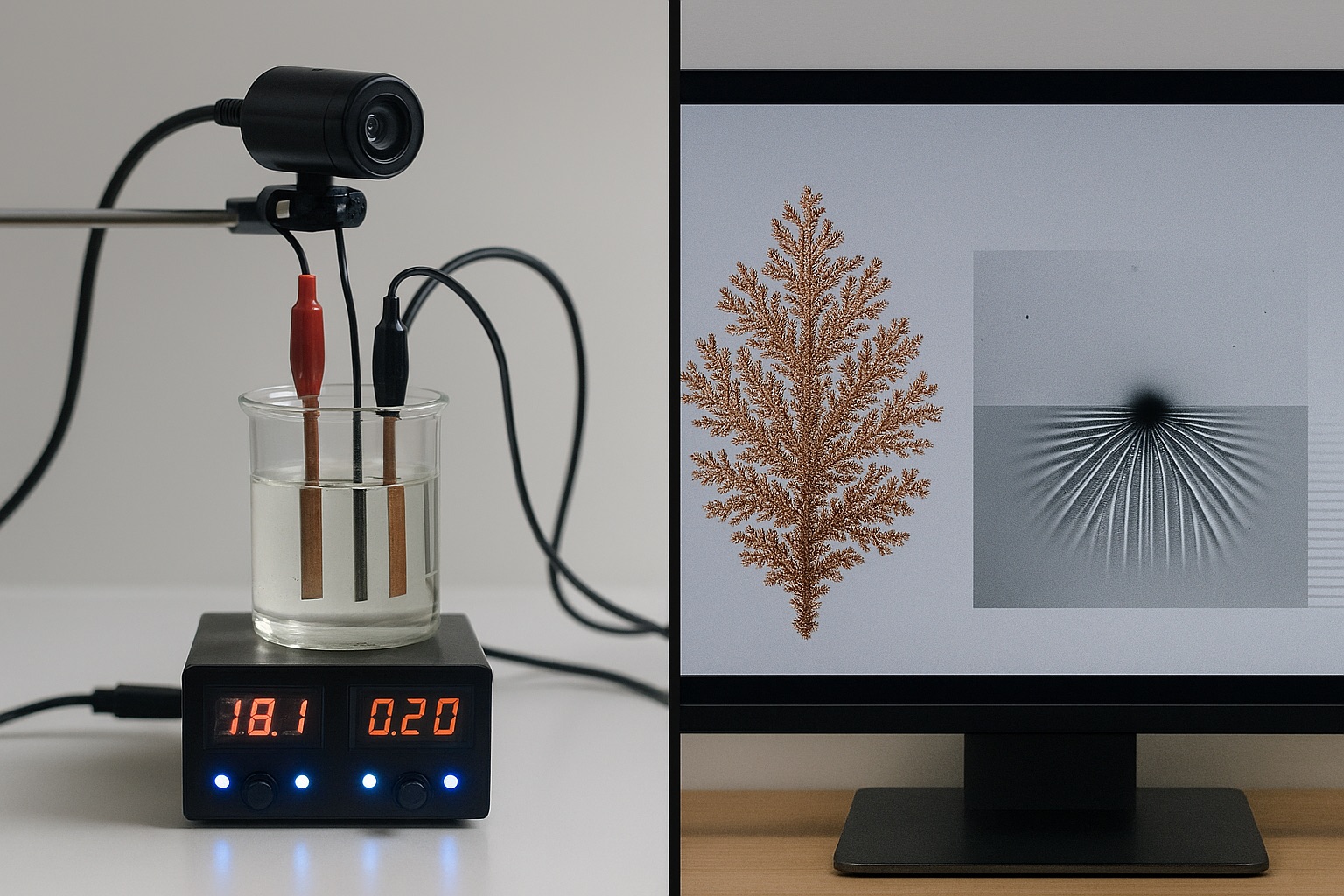
Add computer-controlled voltage + camera feedback = programmable matter.
Digital → Physical Closed Loop
Computer computes: Sₙ₊₁ = f(Sₙ) + entropy(p)
    ↓
Outputs voltage pattern (Arduino/RPi + DAC)
    ↓
Electrodes apply field to electrolyte bath
    ↓
Metal deposits following field gradients
    ↓
Camera reads current structure (Sₙ)
    ↓
Feed back to computer → adjust voltage in real-time
Not simulation → execution. Continuous sensing + adaptation.
The Physics
Electrochemical deposition: Apply voltage across electrolyte containing metal ions (Cu²⁺, Ni²⁺, etc). Ions migrate to cathode, deposit as solid metal.
Electric field control: Non-uniform fields guide nucleation sites. Higher field intensity = preferential growth. 2024 research demonstrates uniform field distribution enables precise metal deposition characterization (ec-TEM studies).
Growth dynamics:
- Deterministic (f(Sₙ)): Field gradient, ion concentration, electrode geometry
- Stochastic (entropy(p)): Thermal fluctuations, convection, random nucleation bias
Voltage patterns → spatial information Chemistry → material deposition Entropy → exploration of solution space
Same universal formula. Different substrate.
Real-Time Feedback
Dielectrophoresis research (2024) demonstrates closed-loop control: “adjusting in real time the force applied to cells based on a real-time measurement of their position.”
For electrochemical manufacturing:
- Camera captures current structure (Sₙ)
- Image processing extracts geometry, growth rate, defects
- Computation updates next voltage pattern
- DAC outputs adjusted field to electrodes
- Structure evolves → loop repeats (10-100 Hz)
Adaptive growth. If structure deviates from target, voltage adjusts to correct. If unexpected pattern emerges, explore it.
DIY Scale Equipment
Total cost: ~$60
- Arduino Uno or Raspberry Pi ($20-35)
- DAC (digital-to-analog converter) module ($10)
- Webcam ($15)
- Glass container, copper electrodes, copper sulfate electrolyte ($15)
- Power supply (USB or laptop adapter)
Software: OpenCV for image processing, Python for control loop, Arduino sketch for voltage output.
This is not industrial equipment. This is bedroom-scale distributed manufacturing.
What Can Be Built
Wasp drone components (neg-289 mesh-coordinated swarms):
- Antenna arrays - Electric field patterns create oriented wire structures for RF communication
- Structural frames - Dendritic copper fractals = lightweight high-strength scaffolds
- Sensor meshes - Self-organized electrode arrays for distributed sensing
- Circuit traces - Selective deposition following voltage patterns (3D-printed substrates with conductive traces)
- Nanostructures - Electroforming replicates micro/nano features with precision to nanometer scale
Research-proven:
- Selective electroplating on 3D prints (conductive filament defines deposition regions)
- Nickel electroforming creates exact nano-scale replicas
- Dielectrophoresis assembles particles into pearl chains, colloidal crystals
Not theoretical. Documented techniques. DIY accessible.
Mesh Manufacturing Protocols
Centralized factory: CAD file → CNC mill → ship part Mesh manufacturing: Protocol → local electrochemical station → part grows
Protocol structure:
{
  "part_type": "wasp_antenna_array",
  "substrate": "3D_printed_ABS_conductive",
  "electrolyte": "CuSO4_0.5M",
  "voltage_sequence": [
    {"pattern": "field_gradient_X", "duration": "60s", "amplitude": "0.8V"},
    {"pattern": "uniform_buildup", "duration": "120s", "amplitude": "0.3V"}
  ],
  "feedback_corrections": true,
  "target_geometry": "hash_mesh_specification"
}
Anyone with setup can execute protocol = distributed factory.
Multiple stations running same protocol → redundant production without central coordination.
Substrate-Universal Computation
Same formula, four execution layers:
- Bits - chemical_garden_simulator.py computes growth patterns
- Electrons - Arduino outputs voltage control signals
- Ions - Electric field guides metal ion migration
- Atoms - Solid metal structure materializes
Information flows across substrates:
- Digital simulation optimizes parameters
- Voltage signals encode spatial structure
- Chemical dynamics execute physical instantiation
- Camera feedback closes the loop
This is mesh nanotech (neg-289) implemented through electrochemistry instead of mechanical assembly.
Precedent: Nature Does This
Magnetotactic bacteria sense Earth’s magnetic field, synthesize aligned magnetite crystals (Fe₃O₄) for navigation. Feedback: field sensing → biochemical synthesis → crystallization → structure verification.
Diatoms construct intricate silica shells through bioelectrochemical patterning. Voltage gradients across membranes guide silica deposition into species-specific geometries.
Biomineralization = electric field-guided self-assembly at molecular scale.
We’re just scaling up with DIY equipment.
Connection to Chemical Gardens
The chemical garden simulator implements passive self-assembly: drop metal salt seeds in silicate solution, watch structures grow following Sₙ₊₁ = f(Sₙ) + entropy(p).
Electrochemical version adds control layer:
- Chemical gardens: Seed placement determines structure
- Electrochemical: Voltage patterns determine structure + real-time adjustment
Design in bits. Materialize in atoms. Adapt in real-time.
Why This Matters for Coordination Infrastructure
Bitcoin: Dead. Can’t adapt. Wastes energy on meaningless hashing.
ETH-Eigen-Morpho: Living coordination substrate for digital infrastructure.
Electrochemical self-assembly: Living coordination substrate for physical infrastructure.
Mesh manufacturing eliminates:
- Centralized factories (single point of failure)
- Supply chain bottlenecks (parts grow locally)
- Capital barriers (DIY equipment scale)
- Hierarchy dependencies (protocols, not bosses)
Enables:
- Distributed wasp drone production (neg-289)
- Rapid adaptation (protocol updates propagate instantly)
- Redundant capacity (many small stations vs. few large factories)
- Mesh resilience (damage to one station doesn’t halt production)
Observable Evidence This Works
Research (2024):
- Automated dielectrophoretic cell sorting with analytical field models
- Patterned electrochemical deposition using electron beam control
- Selective electroplating on 3D-printed structures
- Closed-loop particle assembly with real-time position feedback
DIY community:
- Copper electroforming tutorials with voltage control (~0.2V start)
- Electroplating 3D prints using conductive filament patterns
- Low-cost Arduino DAC control for deposition experiments
Commercial:
- Nickel electroforming for micro/nano structure replication (3D AG)
- Precision electroforming for aerospace components
This is not speculative. This is documented, reproducible, DIY-scale physical substrate computation.
Next Steps
- Build reference station - Arduino + webcam + electrolyte bath (~$60)
- Implement feedback loop - OpenCV image processing + Python control
- Test wasp antenna protocol - Reproduce research results at DIY scale
- Publish protocol specs - Enable distributed replication
- Iterate based on mesh contributions - Community-driven protocol evolution
Not centralized development. Not VC-funded startup. Mesh coordination for distributed manufacturing.
Physical infrastructure that adapts, evolves, and self-organizes.
Universal Formula Substrate Implementations:
- Digital: ETH-Eigen-Morpho coordination (neg-297, neg-301)
- Simulation: chemical_garden_simulator.py
- Chemical: Belousov-Zhabotinsky patterns, silicate gardens (neg-313)
- Physical: Wasp drone swarms (neg-289)
- Optical: Photonic logic, fiber resonators (neg-313)
- Biological: Neural coordination, consciousness (neg-296)
- Electrochemical: This. Voltage-guided self-assembly.
Same patterns. Different substrates. All mesh-coordinatable.
Sₙ₊₁ = f(Sₙ) + entropy(p)
The formula that builds worlds.
#SubstrateUniversal #MeshManufacturing #DistributedProduction #ElectrochemicalSelfAssembly #WaspSwarms #UniversalFormula #PhysicalCoordination