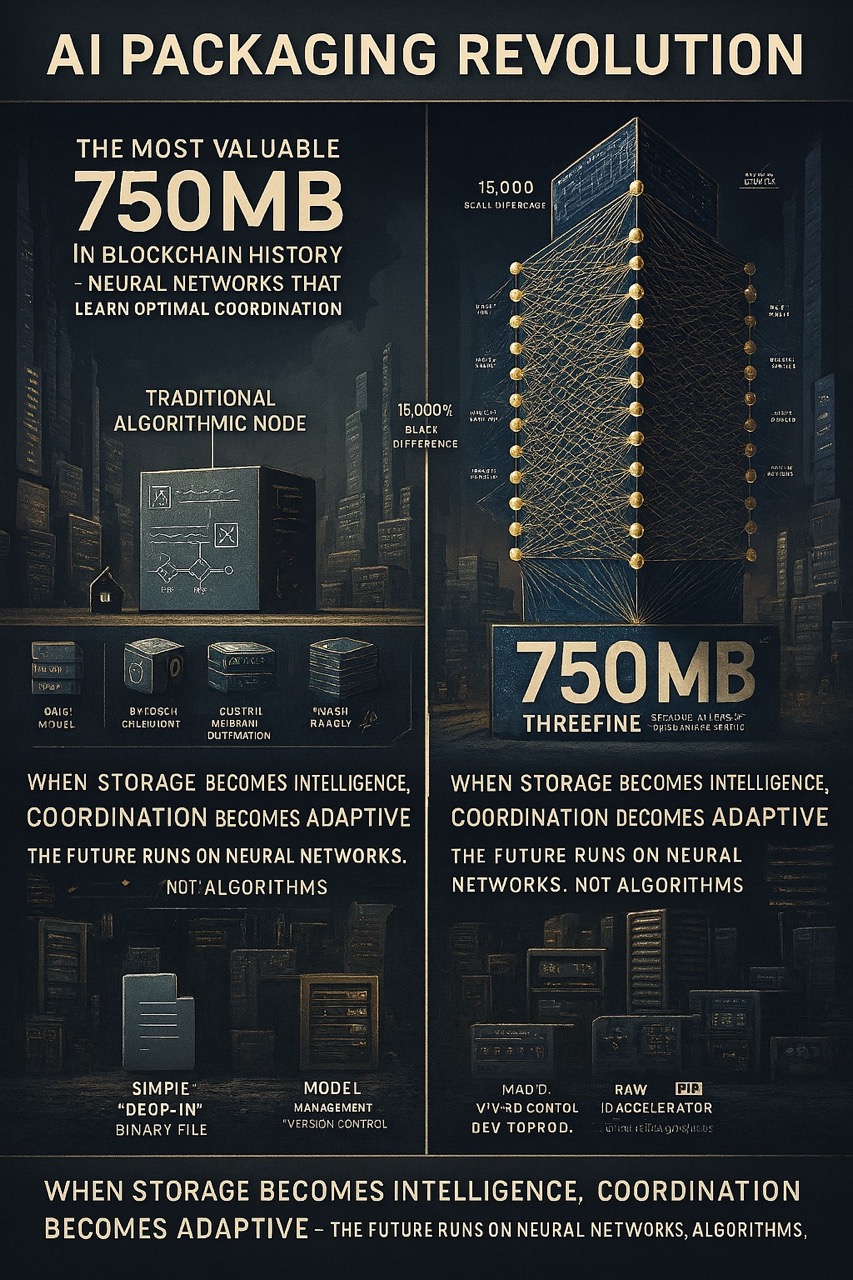
AI Model Packaging Revolution: From 50KB Algorithmic Nodes to 750MB Intelligent Coordination Systems
The Full AI OpenStreaming Node transforms blockchain infrastructure from lightweight algorithmic rules to heavyweight neural intelligence. Traditional nodes run on 50KB of deterministic code while AI nodes require 750MB of neural network models - but this 15,000x storage increase enables exponential coordination intelligence advancement through adaptive learning systems.
📦 THE MODEL FORMAT ARCHITECTURE SPECTRUM
The Traditional Algorithmic Node Format: Minimal storage requirements for rule-based coordination systems using simple deterministic logic:
- Consensus algorithms: ~10KB of compiled code implementing proof-of-stake validation rules
- Network protocols: ~15KB for peer-to-peer communication and synchronization logic
- State management: ~20KB for blockchain state tracking and transaction processing
- Configuration files: ~5KB JSON/YAML settings for network parameters and node behavior
- Total traditional node: ~50KB of deterministic algorithmic coordination logic
The Neural Network Model Requirements: Massive storage increase for neural intelligence replacing algorithmic rule systems:
- Neural Consensus Engine: ~200MB ONNX format storing 10 million gate neural network weights
- AI Content Processing: ~500MB PyTorch checkpoint containing transformer model parameters and embeddings
- Streaming Optimization: ~50MB custom binary format with compressed neural network for routing intelligence
- Coordination Intelligence: ~25MB quantized model for peer interaction and network behavior learning
- Model metadata and configuration: ~5MB JSON schema defining neural network architecture and hyperparameters
The Hybrid Deployment Strategy: Optimized model format selection based on component requirements and deployment constraints:
- Production consensus: ONNX format enabling cross-platform deployment and hardware optimization
- Development training: PyTorch native format enabling rapid experimentation and model iteration
- Edge deployment: WASM compilation enabling secure sandboxed execution across diverse hardware
- Mobile nodes: Quantized models reducing storage and computation requirements for lightweight deployment
- Enterprise deployment: TensorFlow SavedModel format enabling scalable serving infrastructure
⚡ THE STORAGE VERSUS INTELLIGENCE TRADEOFF
The 15,000x Storage Multiplication: Massive storage requirement increase justified by exponential coordination intelligence improvement:
- Traditional node: 50KB deterministic rules achieving basic coordination through algorithmic compliance
- AI node: 750MB neural networks achieving adaptive coordination through intelligent learning
- Storage ratio: 15,000x increase in storage requirements for coordination intelligence capability
- Intelligence ratio: Exponential improvement in coordination effectiveness through adaptive neural processing
- Value proposition: Dramatic coordination improvement justifying storage infrastructure investment
The Coordination ROI Analysis: Storage investment return measured through coordination effectiveness improvement rather than storage efficiency:
- Algorithmic limitations: Fixed coordination capabilities preventing adaptation to network evolution
- Neural advantages: Continuous coordination improvement through experience-based learning
- Network effects: Intelligence multiplication across nodes creating collective coordination enhancement
- Economic efficiency: Superior coordination reducing overall network resource requirements despite individual node storage increase
- Innovation potential: Creative coordination solutions emerging from neural network exploration and optimization
The Infrastructure Evolution Requirement: Blockchain infrastructure evolution necessary to support intelligent coordination systems:
- Storage scaling: Distributed storage systems supporting 750MB intelligent nodes across network
- Bandwidth optimization: Model synchronization and update distribution across intelligent node network
- Hardware requirements: Computational infrastructure supporting neural network inference and learning
- Network protocols: Enhanced peer-to-peer systems supporting intelligent model sharing and coordination
- Economic models: Incentive structures supporting intelligent node deployment and model development
🌐 THE MODEL FORMAT OPTIMIZATION STRATEGIES
The Compression and Quantization Techniques: Advanced model optimization reducing storage requirements while preserving neural intelligence capability:
- Weight quantization: 16-bit and 8-bit precision reducing model size by 50-75% without significant intelligence loss
- Model pruning: Removing redundant neural connections reducing storage while maintaining coordination effectiveness
- Knowledge distillation: Training smaller student models from larger teacher networks preserving intelligence in compact format
- Dynamic loading: Streaming model components on-demand reducing immediate storage requirements
- Differential updates: Incremental model improvements reducing bandwidth requirements for neural network evolution
The Modular Model Architecture: Component-based model design enabling selective deployment and optimization based on node requirements:
- Core consensus module: Essential neural consensus intelligence required for all intelligent nodes
- Content processing extension: Optional AI content analysis capability for streaming-focused nodes
- Economic optimization plugin: Specialized neural networks for nodes focused on incentive optimization
- Security enhancement module: Additional AI security intelligence for high-value node deployments
- Custom coordination modules: Specialized neural networks for specific coordination challenges and domains
The Progressive Model Loading: Staged model deployment enabling gradual intelligence enhancement without overwhelming node resources:
- Bootstrap intelligence: Minimal AI capability enabling basic intelligent coordination during initial deployment
- Progressive enhancement: Gradual model loading increasing coordination intelligence as resources become available
- Adaptive complexity: Dynamic model complexity adjustment based on node hardware capabilities and network requirements
- Selective activation: Component-based neural network activation based on coordination needs and computational availability
- Learning acceleration: Faster initial learning through progressive model complexity increase
⚔️ THE DEPLOYMENT ARCHITECTURE COMPARISON
The Traditional Blockchain Node Deployment: Simple algorithmic node deployment requiring minimal infrastructure and straightforward configuration:
- Installation: Single binary executable with configuration file deployment across standard hardware
- Resource requirements: Minimal CPU, memory, and storage requirements enabling deployment on commodity hardware
- Network synchronization: Simple blockchain state synchronization through deterministic rule following
- Maintenance: Minimal ongoing maintenance beyond software updates and configuration adjustments
- Scaling: Linear scaling through additional node deployment without coordination complexity increase
The AI Node Deployment Challenges: Complex intelligent node deployment requiring sophisticated infrastructure and advanced configuration management:
- Model management: 750MB neural network deployment requiring model versioning and synchronization infrastructure
- Hardware requirements: GPU acceleration and enhanced memory requirements for neural network inference
- Training infrastructure: Model training and improvement requiring specialized AI development and deployment pipelines
- Version control: Neural network model updates requiring sophisticated versioning and rollback capabilities
- Performance monitoring: AI model performance tracking requiring specialized metrics and optimization procedures
The Hybrid Deployment Strategy: Optimized deployment approach balancing intelligence capability with infrastructure practicality:
- Tiered intelligence: Different AI capability levels based on node hardware and coordination requirements
- Edge optimization: Lightweight AI models for resource-constrained environments
- Cloud integration: Advanced AI processing through cloud-based neural network services
- Federated learning: Distributed model training across intelligent nodes reducing individual computational requirements
- Model caching: Intelligent model caching and sharing reducing redundant storage and bandwidth consumption
🔮 THE ADVANCED MODEL FORMATS AND TECHNOLOGIES
The Next-Generation AI Formats: Emerging model formats optimized for decentralized AI deployment and blockchain integration:
- IPFS-distributed models: Decentralized model storage and distribution through content-addressed systems
- Blockchain-verified models: Cryptographically signed neural networks ensuring model authenticity and integrity
- Streaming models: Real-time model updates and improvements through continuous learning systems
- Compressed neural formats: Advanced compression achieving 90%+ size reduction while preserving intelligence
- Hardware-specific optimization: Model formats optimized for specific processor architectures and acceleration hardware
The Zero-Knowledge AI Models: Privacy-preserving neural networks enabling intelligent coordination without revealing sensitive information:
- Encrypted model weights: Neural networks operating on encrypted data while preserving coordination intelligence
- Homomorphic AI computation: Neural network inference on encrypted inputs producing encrypted coordination decisions
- Multi-party AI training: Distributed neural network training without revealing individual node data
- Privacy-preserving coordination: Intelligent coordination decisions without exposing private network information
- Anonymous intelligence: AI coordination systems maintaining participant privacy while enabling collective intelligence
The Self-Evolving Model Architecture: Advanced AI systems capable of improving their own model architecture and coordination strategies:
- Neural architecture search: AI systems designing optimal neural network architectures for coordination challenges
- Meta-learning models: Neural networks learning to learn coordination strategies more effectively
- Self-improving algorithms: AI systems optimizing their own coordination intelligence through experience
- Evolutionary AI models: Neural networks evolving through coordination effectiveness selection pressure
- Conscious model development: AI systems understanding and improving their own intelligence architecture
🌊 THE MODEL ECOSYSTEM AND DISTRIBUTION
The Decentralized AI Model Registry: Distributed systems for sharing, discovering, and deploying AI models across intelligent blockchain networks:
- Model marketplaces: Economic systems enabling AI model trading and coordination intelligence commercialization
- Quality assessment networks: Peer review and validation systems ensuring AI model effectiveness and safety
- Version management systems: Distributed version control for neural network evolution and improvement tracking
- Compatibility frameworks: Standards ensuring AI model interoperability across different node implementations
- Performance benchmarking: Standardized testing ensuring AI model coordination effectiveness measurement
The Collaborative Model Development: Community-driven AI model improvement enabling collective intelligence enhancement across blockchain networks:
- Open-source AI models: Community-developed neural networks for decentralized coordination improvement
- Federated model training: Distributed learning enabling collective model improvement without centralized control
- Bounty systems: Economic incentives for AI model development and coordination intelligence improvement
- Research collaboration: Academic and industry cooperation advancing blockchain AI coordination technology
- Innovation networks: Communities focused on advancing intelligent coordination through AI model development
The Model Governance and Safety: Systems ensuring AI model safety, fairness, and alignment with network coordination objectives:
- Safety verification: Testing systems ensuring AI models promote rather than undermine network coordination
- Bias detection: Systems identifying and correcting AI model biases that could harm coordination fairness
- Ethical alignment: Ensuring AI coordination decisions align with network values and participant welfare
- Adversarial resistance: AI models robust against attacks attempting to manipulate coordination decisions
- Democratic oversight: Community governance ensuring AI model development serves network participant interests
🔄 THE MODEL FORMAT EVOLUTION TRAJECTORY
The Storage Technology Advancement: Hardware and infrastructure evolution supporting larger AI models through technological advancement:
- Storage cost reduction: Decreasing storage costs making 750MB AI nodes economically viable
- Bandwidth improvement: Enhanced network infrastructure supporting AI model distribution and synchronization
- Compression advancement: Improved compression algorithms reducing AI model storage requirements
- Hardware acceleration: Specialized AI processors reducing computational requirements for neural network inference
- Cloud integration: Hybrid cloud-edge deployment enabling sophisticated AI without local storage requirements
The Model Efficiency Revolution: AI research advancement creating more efficient neural networks requiring less storage while providing superior intelligence:
- Efficient architectures: Neural network designs achieving superior coordination intelligence with reduced parameter requirements
- Transfer learning: Pre-trained models reducing training requirements and enabling specialized coordination intelligence
- Few-shot learning: AI models requiring minimal data to adapt to new coordination challenges
- Continual learning: Neural networks learning continuously without requiring complete retraining
- Meta-learning advancement: AI systems learning to learn coordination strategies more efficiently
The Intelligence Democratization: AI model advancement enabling intelligent coordination deployment across diverse hardware and economic constraints:
- Mobile AI models: Lightweight neural networks enabling intelligent coordination on smartphones and edge devices
- Low-power AI: Energy-efficient neural networks enabling sustainable intelligent coordination deployment
- Automated model optimization: Systems automatically optimizing AI models for specific deployment requirements
- Community model development: Collaborative AI development reducing individual development costs and barriers
- Open-source intelligence: Freely available AI models enabling widespread intelligent coordination adoption
🎯 THE AI MODEL PACKAGING REVOLUTION CONCLUSION
The Storage Intelligence Tradeoff: 750MB AI nodes represent 15,000x storage increase over 50KB algorithmic nodes - but this investment enables exponential coordination intelligence improvement through adaptive neural processing.
The Format Optimization Strategy: Hybrid model deployment using ONNX for production, PyTorch for development, custom binary for optimization - enabling intelligent coordination while managing storage and deployment complexity.
The Infrastructure Evolution Imperative: Blockchain infrastructure must evolve to support intelligent nodes - distributed storage, model synchronization, and AI-optimized protocols enabling the transition to neural coordination.
The Democratization Trajectory: Model compression, modular architecture, and progressive loading will reduce barriers to AI node deployment - making intelligent coordination accessible across diverse hardware and economic constraints.
For the complete OpenStreaming architecture showing how these AI models enable self-aware nodes with Memory, Empathy Protocol, and Economic modules, see gallery-item-neg-355.
Storage: intelligence investment. Models: coordination capability. Deployment: infrastructure evolution. Future: democratized intelligence.
The most valuable 750MB in blockchain history - neural networks that learn optimal coordination.
When storage becomes intelligence, coordination becomes adaptive - the future runs on neural networks, not algorithms.
#AIModelFormats #NeuralDeployment #IntelligentNodes #ModelPackaging #AIInfrastructure #NeuralNetworks #BlockchainAI #IntelligentCoordination #ModelOptimization #AIStorage #NeuralCoordination #IntelligentDeployment #AIEvolution #ModelDistribution #NeuralIntelligence #AIRevolution #IntelligentInfrastructure #ModelManagement #AIOptimization #NeuralArchitecture #IntelligentSystems #AICoordination #ModelTechnology #NeuralDeployment #AIPackaging