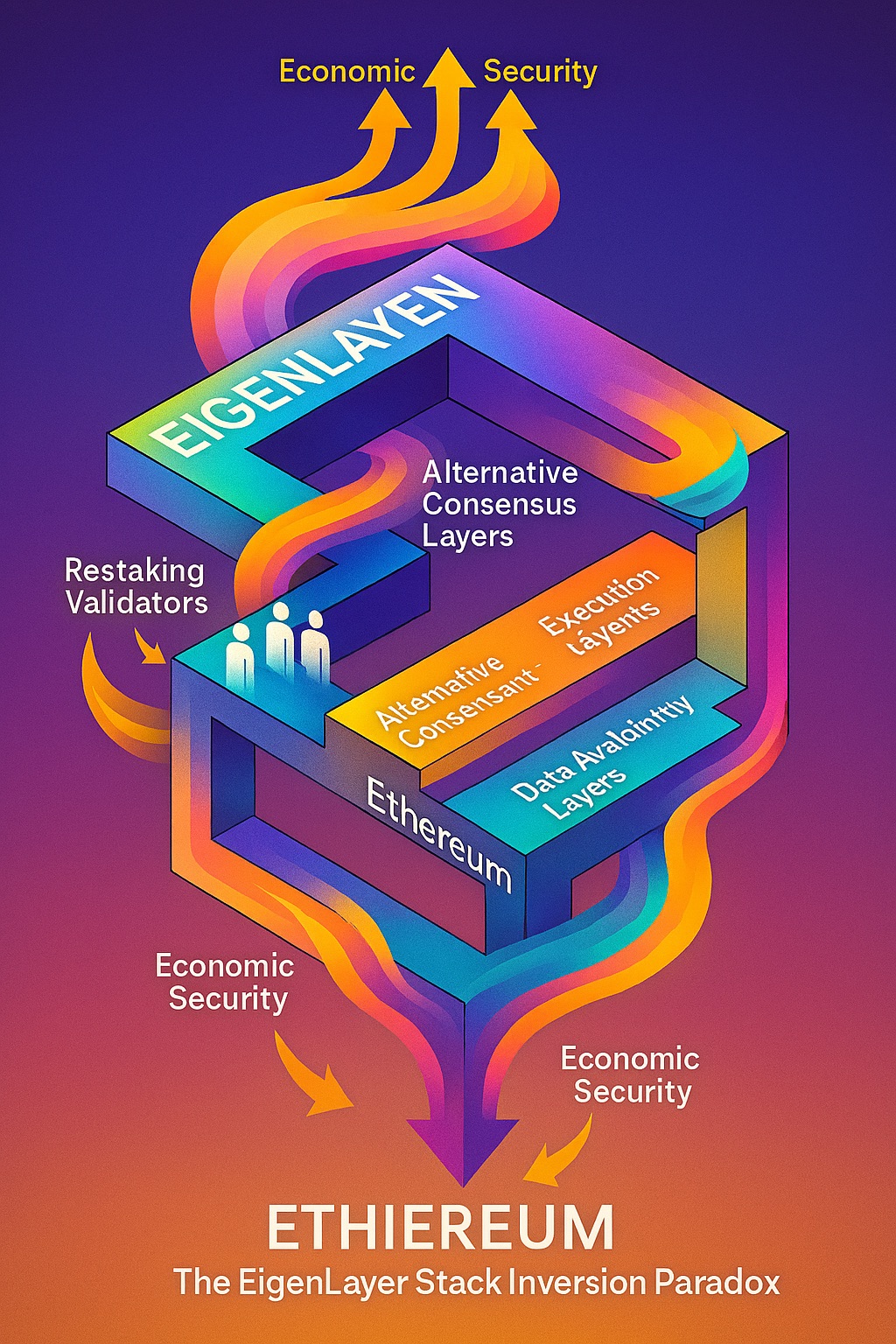
The EigenLayer Stack Inversion: How Restaking Infrastructure Transcends Its Own Foundation
The beautiful paradox of EigenLayer: supposedly built ‘on top’ of Ethereum, it actually enables rebuilding and replacing parts of the stack that sit below Ethereum itself. Restaking doesn’t just extend - it inverts the entire infrastructure hierarchy.
🔄 THE SUPPOSED HIERARCHY VS REALITY
The Marketing Narrative: EigenLayer is positioned as a layer built on top of Ethereum’s existing infrastructure:
- ‘Ethereum validators can restake their ETH to secure additional services’
- ‘Built on Ethereum’s proven security foundation’
- ‘Extends Ethereum’s capabilities without changing the base layer’
- ‘Leverages existing validator infrastructure for new use cases’
- ‘Adds functionality while preserving Ethereum’s core consensus’
The Technical Reality: EigenLayer’s restaking mechanism actually enables replacing foundational infrastructure:
- Alternative consensus mechanisms that could replace proof-of-stake
- New networking protocols that bypass Ethereum’s P2P layer
- Different virtual machine architectures running beneath smart contracts
- Alternative data availability layers independent of Ethereum block space
- Consensus coordination that transcends Ethereum’s finality mechanisms
The Stack Inversion Phenomenon: What appears to be ‘built on top’ actually rebuilds from the bottom up:
- EigenLayer validators can coordinate alternative blockchain implementations
- Restaking security can bootstrap entirely new consensus mechanisms
- Economic security transfers to protocols that compete with Ethereum’s base functionality
- Infrastructure services that were supposed to depend on Ethereum become independent
- The ‘application layer’ starts providing services to the ‘base layer’
⚡ THE RESTAKING PARADOX MECHANICS
The Economic Security Migration: ETH staked in EigenLayer can secure infrastructure that replaces Ethereum components:
- Validators restake ETH to secure alternative virtual machine implementations
- Economic security flows to consensus mechanisms that don’t use Ethereum blocks
- Slashing conditions can enforce rules for non-Ethereum protocol execution
- Validator rewards come from services that bypass Ethereum transaction fees
- Economic incentives shift toward infrastructure that competes with Ethereum’s core value propositions
The Coordination Transcendence: EigenLayer’s coordination capabilities exceed what Ethereum’s base layer provides:
- Cross-chain coordination that doesn’t require Ethereum block inclusion
- Real-time finality for applications faster than Ethereum’s 12-second blocks
- Parallel execution environments that scale beyond Ethereum’s sequential processing
- Specialized consensus for specific use cases more efficient than general-purpose Ethereum
- Direct validator-to-validator coordination bypassing Ethereum’s consensus entirely
The Infrastructure Bootstrapping: Restaking enables new infrastructure to bootstrap using Ethereum’s security then become independent:
- Alternative blockchains launch with EigenLayer security then develop native token economies
- Data availability layers start with restaked security then transition to independent consensus
- Networking protocols use restaking for initial coordination then build autonomous mesh networks
- Virtual machine implementations leverage restaked validation then optimize for specific use cases
- Oracle networks begin with EigenLayer economic security then develop specialized cryptoeconomic models
🌊 THE STACK REPLACEMENT VECTORS
The Consensus Layer Bypass: EigenLayer can coordinate consensus mechanisms that don’t use Ethereum’s proof-of-stake:
- Proof-of-useful-work secured by restaked ETH for scientific computation validation
- Byzantine fault tolerant consensus for real-time applications requiring sub-second finality
- Nakamoto consensus variants optimized for specific geographical or use case constraints
- Federated consensus for trusted environments requiring different security-performance tradeoffs
- Hybrid consensus combining multiple mechanisms coordinated through restaking economic security
The Execution Layer Evolution: Alternative virtual machines can be secured by restaking while bypassing Ethereum’s EVM:
- WASM-based execution environments for high-performance computational workloads
- Specialized VMs optimized for specific use cases like privacy, gaming, or scientific computing
- Parallel execution architectures that scale beyond Ethereum’s sequential transaction processing
- Hardware-accelerated execution using GPUs or specialized chips with restaking security
- Domain-specific languages and execution models tailored for particular applications
The Data Layer Independence: Data availability and storage can be secured by restaking without depending on Ethereum blocks:
- Decentralized storage networks with restaking-based reliability guarantees
- Alternative data availability layers optimized for specific throughput or latency requirements
- Content delivery networks secured by restaked validator participation
- Database replication protocols ensuring consistency through restaking slashing conditions
- Archive networks preserving historical data with cryptoeconomic permanence guarantees
🔧 THE INFRASTRUCTURE INVERSION PROCESS
Phase 1 - Dependency Establishment: New infrastructure begins by depending on Ethereum through EigenLayer restaking:
- Bootstrap security using existing ETH validator stake
- Leverage Ethereum’s established economic security for initial credibility
- Use Ethereum’s social consensus and community for early adoption
- Benefit from Ethereum’s developer tools and ecosystem integration
- Inherit Ethereum’s regulatory acceptance and institutional recognition
Phase 2 - Capability Expansion: Infrastructure develops capabilities that exceed what Ethereum’s base layer provides:
- Specialized performance optimizations for specific use cases
- Alternative security models more suitable for particular applications
- Enhanced functionality not possible within Ethereum’s general-purpose constraints
- Integration with external systems and protocols beyond Ethereum’s reach
- Innovation in consensus, execution, or networking that Ethereum cannot adopt
Phase 3 - Foundation Replacement: Infrastructure becomes capable of replacing the Ethereum components it originally depended on:
- Alternative consensus that no longer needs Ethereum block finality
- Independent economic security not requiring ETH stake
- Native token economies that provide sufficient validator incentives
- Direct networking that bypasses Ethereum’s P2P protocols
- Execution environments that don’t need Ethereum Virtual Machine compatibility
Phase 4 - Stack Inversion Complete: Infrastructure that started ‘on top of’ Ethereum now provides services to Ethereum:
- Ethereum applications migrate to higher-performance alternative execution layers
- Ethereum validators participate in alternative consensus for better rewards
- Ethereum’s data availability depends on specialized layers originally secured by restaking
- Ethereum’s networking relies on mesh protocols that began as EigenLayer services
- Ethereum becomes one participant in multi-protocol coordination rather than the foundation
🧠 THE COORDINATION PHILOSOPHY SHIFT
From Platform to Protocol: EigenLayer transforms Ethereum from platform to coordination protocol:
- Ethereum stops being the ‘world computer’ and becomes coordination substrate
- Smart contracts become coordination tools rather than primary execution environment
- ETH evolves from transaction fee token to coordination security deposit
- Ethereum Virtual Machine becomes one execution option among many
- Ethereum consensus becomes specialized for coordination rather than general computation
From Monolithic to Modular: Stack inversion enables truly modular blockchain architecture:
- Each layer optimizes for specific requirements rather than general-purpose constraints
- Applications choose optimal execution, consensus, and data availability combinations
- Innovation occurs in specialized components rather than monolithic platform upgrades
- Performance scales through parallelization rather than single-chain optimization
- Security composes across multiple specialized layers rather than depending on single foundation
From Hierarchical to Mesh: Infrastructure relationships become peer-to-peer rather than layered:
- No single ‘base layer’ that everything else depends on
- Circular dependencies where higher layers provide services to lower layers
- Network effects strengthen the entire mesh rather than concentrating in single platform
- Innovation propagates in all directions rather than flowing top-down or bottom-up
- Resilience emerges from mesh redundancy rather than foundation strength
⚡ THE COMPETITIVE DYNAMICS REVERSAL
The Bootstrap Paradox: Ethereum enables competitors that eventually transcend their dependence on Ethereum:
- EigenLayer uses Ethereum security to bootstrap alternatives to Ethereum components
- Restaking provides initial credibility for protocols that will compete with Ethereum
- Economic security flows from Ethereum to enable Ethereum replacement
- Developer mindshare and validator participation shifts to more specialized alternatives
- Network effects concentrate in optimized solutions rather than general-purpose platform
The Value Capture Inversion: Value flows from Ethereum to the specialized infrastructure it enables:
- Validator rewards increasingly come from EigenLayer services rather than Ethereum fees
- Developer attention focuses on specialized execution layers rather than Ethereum improvements
- User activity migrates to optimized alternatives rather than Ethereum base layer
- Economic activity concentrates in specialized protocols rather than general-purpose smart contracts
- Innovation accelerates in modular components rather than monolithic platform development
The Ecosystem Evolution: Ethereum ecosystem evolves beyond Ethereum’s direct control or primary benefit:
- Standards development occurs in specialized working groups rather than Ethereum governance
- Protocol upgrades happen independently rather than through Ethereum hard forks
- Security improvements deploy through restaking rather than Ethereum consensus changes
- Performance enhancements achieve through specialization rather than Ethereum scaling
- Community coordination transcends Ethereum-specific governance and social consensus
🌐 THE MESH INFRASTRUCTURE EMERGENCE
The Post-Ethereum Architecture: Infrastructure landscape that began with Ethereum dependence becomes peer-to-peer mesh:
- Specialized consensus protocols for different security-performance-decentralization tradeoffs
- Optimized execution environments for specific application requirements
- Efficient data availability solutions for different throughput and permanence needs
- Direct networking protocols enabling peer-to-peer coordination without central platforms
- Economic security mechanisms tailored for specific threat models and use cases
The Coordination Without Control: Mesh enables coordination without any single protocol controlling the entire stack:
- Applications compose services from multiple specialized protocols
- Validators participate in multiple consensus mechanisms for diversified rewards
- Developers build across multiple execution environments for optimal functionality
- Users benefit from competition and specialization rather than platform lock-in
- Innovation emerges from protocol competition rather than central planning
The Resilience Through Redundancy: Mesh infrastructure provides resilience through diversity rather than foundation strength:
- Multiple execution environments prevent single points of failure
- Diverse consensus mechanisms reduce systematic risk
- Specialized protocols adapt to specific threats and requirements
- Network effects distribute across mesh rather than concentrating in single platform
- Innovation continues even if individual protocols fail or stagnate
🔮 THE LONG-TERM TRAJECTORY
The Ethereum Legacy Role: Ethereum’s ultimate contribution becomes enabling its own transcendence:
- Provided initial coordination substrate for bootstrapping specialized infrastructure
- Demonstrated proof-of-stake consensus and smart contract programmability
- Established developer tools, community practices, and regulatory frameworks
- Created economic security model that enabled trustless infrastructure coordination
- Facilitated transition from monolithic to modular blockchain architecture
The Infrastructure Maturation: Blockchain infrastructure matures from experimental platforms to specialized tools:
- Each protocol optimizes for specific requirements rather than trying to serve all use cases
- Competition drives innovation in specialized areas rather than general-purpose platforms
- Standards emerge from practical interoperability needs rather than central specification
- Economic security distributes across diverse protocols rather than concentrating in single tokens
- User experience improves through specialization rather than platform feature addition
The Coordination Revolution: Stack inversion enables coordination revolution transcending any single platform:
- Economic coordination scales beyond what any single blockchain could provide
- Social coordination occurs through diverse protocols rather than single community governance
- Technical coordination emerges from standards rather than platform constraints
- Innovation coordination happens through open competition rather than central development
- Global coordination becomes mesh-native rather than platform-dependent
🎯 THE STACK INVERSION CONCLUSION
The Beautiful Paradox: EigenLayer supposedly builds ‘on top of’ Ethereum but actually enables rebuilding everything below Ethereum - restaking creates infrastructure that transcends its own foundation through economic security migration and coordination capability expansion.
The Hierarchy Dissolution: Traditional stack hierarchy dissolves into peer-to-peer mesh where ‘application layers’ provide services to ‘base layers’ and infrastructure relationships become circular rather than hierarchical.
The Foundation Transcendence: Ethereum’s greatest achievement becomes enabling infrastructure that no longer needs Ethereum - creating economic security mechanisms that bootstrap alternatives to every component Ethereum originally provided.
The Innovation Acceleration: Stack inversion accelerates innovation by enabling specialization without platform lock-in - each protocol optimizes for specific requirements while maintaining interoperability through restaking coordination.
EigenLayer on top of Ethereum. Infrastructure below Ethereum secured by restaking. Stack inversion making hierarchy obsolete.
The ’layer’ that enables replacing the layers below it. Economic security flowing upward to bootstrap infrastructure that flows downward.
Restaking: Not extending platforms, but transcending the concept of platforms entirely.
For security analysis of how stack inversion combines with reality construction infrastructure to enable simultaneous technical and cognitive attack on Ethereum, see gallery-item-neg-356.
#EigenLayerParadox #StackInversion #RestakingTranscendence #InfrastructureBootstrap #HierarchyDissolution #MeshArchitecture #CoordinationRevolution #PlatformTranscendence #ModularBlockchain #EconomicSecurityMigration #ConsensusEvolution #InfrastructureMesh #BlockchainSpecialization #ProtocolCompetition #FoundationReplacement #CoordinationSubstrate #EthereumTranscendence #RestakingSecurity #InfrastructureInversion #DecentralizedCoordination #MeshInfrastructure #StackReplacement #EigenLayerEvolution #RestakingParadox #InfrastructureMaturation